Skip to content

Deep guide · 2026

Best Best Mountaineering Crampons of 2026 of 2026

Field-tested mountaineering crampons built for alpine ice, glacier travel, and mixed rock. We rate boot security, penetration, and sub-900g packability.

Independently researched One winner · 3 runners-up

Overview

Mountaineering crampons remain an uncompromising link between your foot and severe mountain consequences. In 2026, warming alpine conditions mean routes are rarely uniform; glaciers are broken, seasonal snow bridges collapse earlier, and north faces expose brittle, dry glacial ice earlier in the season. Modern mountaineering demands a binding and frame setup that can transition from frozen scree and mixed alpine rock to 45-degree hard water ice without developing dangerous play or packing up with wet snow.

The most notable shift this season is the maturation of hybrid modular platforms. Manufacturers have moved past gimmickry to deliver front sections built from hardened chromoly steel paired with lightweight steel or reinforced alloy heel baskets, often connected via adjustable linking bars or ultra-high-molecular-weight polyethylene webbing. Interchangeable toe bails are now standard on serious mid-weight models, allowing a single pair of crampons to serve semi-rigid trekking boots with a heel welt only, or fully rigid mountaineering boots with both toe and heel welts.

Failure modes in technical crampons are rarely catastrophic metal breaks; they are insidious maintenance issues. The most frequent failure remains poor anti-balling performance. When dual-density ABS plates stiffen in extreme cold or tear at the rivets, snow collects underfoot until the points can no longer bite into the slope, causing an immediate slide hazard. Secondary failures include heel levers popping under lateral torque due to poor boot-crampon curvature alignment, and stripped micro-adjustment screws in freezing temps.

When evaluating a crampon, boot geometry comes first. A stiff technical boot requires a frame that mirrors its specific sole rocker. If the crampon leaves a gap beneath the boot sole under bodyweight, stress concentrates along the linking bar rather than distributing across the foot, leading to calf pump and eventual metal fatigue. Look for aggressive, downward-angled secondary points that engage reliably when you drop your heel on steep neve, rather than points positioned so far back they only engage on flat glacier travel.

Price discrepancies in this category reflect metal treatment, binding engineering, and included components. Premium offerings provide hot-forged vertical front points, refined bail adjustments, and lighter alloy compounds that remain under our 900-gram threshold. Budget options rely on stamped sheet steel and universal strap systems. While stamped steel lasts years, the added mass and loose strap tension will drain your energy over long summit days.

How we picked

Our evaluation protocol focused on direct alpine performance over consecutive weeks in sub-freezing conditions. We matched test crampons across standard mountaineering lasts—primarily rigid and semi-rigid mountain boots from prominent European makers. We climbed sustained 40- to 50-degree hard water ice and dense spring firn to measure point penetration, front-point vibration, and secondary point engagement when resting on calf muscles. We also assessed how securely each binding retained its fit over mixed granite scrambles where lateral torque is highest.

We gathered additional wear-and-tear observations from active alpine guides who rotate equipment across hundreds of client days per year. We specifically logged bail wear, anti-balling plate elasticity after repeated freeze-thaw cycles, and field-adjustability while wearing heavy alpine gloves.

Deliberately excluded from this test were ultralight, all-aluminum ski mountaineering crampons, which fail quickly on mixed rock and cannot penetrate hard alpine ice safely. We also eliminated non-certified flexible microspikes and niche technical competition dry-tooling rigs that lack functional anti-balling systems for standard glacier approaches.

The 2026 winner

Best Best Mountaineering Crampons of 2026 of 2026
Petzl Sarken Leverlock Universel
Winner

Petzl

Sarken Leverlock Universel

Best for: All-around technical alpine climbs

The Petzl Sarken Leverlock Universel sits in the sweet spot for mountaineers who find standard horizontal points inadequate on steep alpine ice but do not want to drag dedicated waterfall ice crampons up a multi-day route. It is built specifically for technical alpine ascents—think steep couloirs, late-season neve, north faces, and moderate mixed steps—where you need purchase on frozen ground, firm ice, and consolidated snow within the same day.

Petzl built the Sarken around cold-forged T-shaped front points. In firm water ice, the vertical spine of the point drives straight in with minimal shattering, while the horizontal flanges catch aerated ice and snow to keep you from blowing out your calves. The rest of the frame uses thinner-gauge steel to save weight without sacrificing strength. The Leverlock Universel binding system includes interchangeable toe bails, allowing you to run it as a full automatic on boots with toe welts or as a semi-automatic on boots with only a rear heel welt. In the field, Petzl's Antisnow plates remain reliable, flexing with each step to eject wet alpine snow before dangerous balling occurs.

While the Sarken excels across mixed terrain, it comes with clear trade-offs. The T-shaped front points are integral to the front sections; when you eventually dull or grind them down after repeated seasons on rock and ice, you have to buy entirely new front bails rather than swapping out individual point teeth. Furthermore, the aggressive downward cant of the secondary points makes prolonged flat-footing across lower-angle glaciers less forgiving than a pure horizontal crampon.

Pros

  • + T-shaped front points penetrate hard ice cleanly
  • + Includes interchangeable toe bails for automatic or semi-automatic boots
  • + Proven, reliable anti-balling plates shed wet snow
  • + Excellent purchase on mixed rock and firm firn

Cons

  • − Non-replaceable front points require buying new front sections when worn
  • − Less comfortable on low-angle glacier flats than horizontal points
Points
12
Weight
870 g (pair)
Binding Type
Leverlock Universel (Automatic / Semi-Automatic)
Frame Material
Chromoly steel
Anti-Balling Plates
Antisnow included
$230
Amazon link coming soon

Runners-up

Excellent alternatives — each beat out the rest of the field this year.

  1. Grivel G12 New-Matic EVO
    #2 · Runner-up

    Grivel

    G12 New-Matic EVO

    Best for: Bombproof general mountaineering

    The Grivel G12 New-Matic EVO is the gold standard for traditional mountaineering and classic alpine ridge traverses. If your itinerary involves glacier crossings, volcano ascents like Rainier or Hood, and general snow climbing up to 50 degrees, this is the benchmark tool. It is engineered for climbers who prioritize bombproof reliability, thick steel, and absolute stability on snow over ultra-ligh

    $190-210
    Amazon link coming soon
  2. Black Diamond Sabretooth Pro
    #3 · Runner-up

    Black Diamond

    Sabretooth Pro

    Best for: Hard ice and mixed gullies

    The Black Diamond Sabretooth Pro is targeted directly at climbers who spend their seasons in steep alpine terrain, hard mixed gullies, and firm alpine couloirs. It bridges the gap between horizontal snow walkers and technical waterfall rigs, engineered specifically for mountaineers wearing rigid, fully welted boots who demand precision edge control on frozen turf, granite edges, and dense black ic

    $220
    Amazon link coming soon
  3. Blue Ice Harfang Alpine
    #4 · Runner-up

    Blue Ice

    Harfang Alpine

    Best for: Fast-and-light steep alpine routes

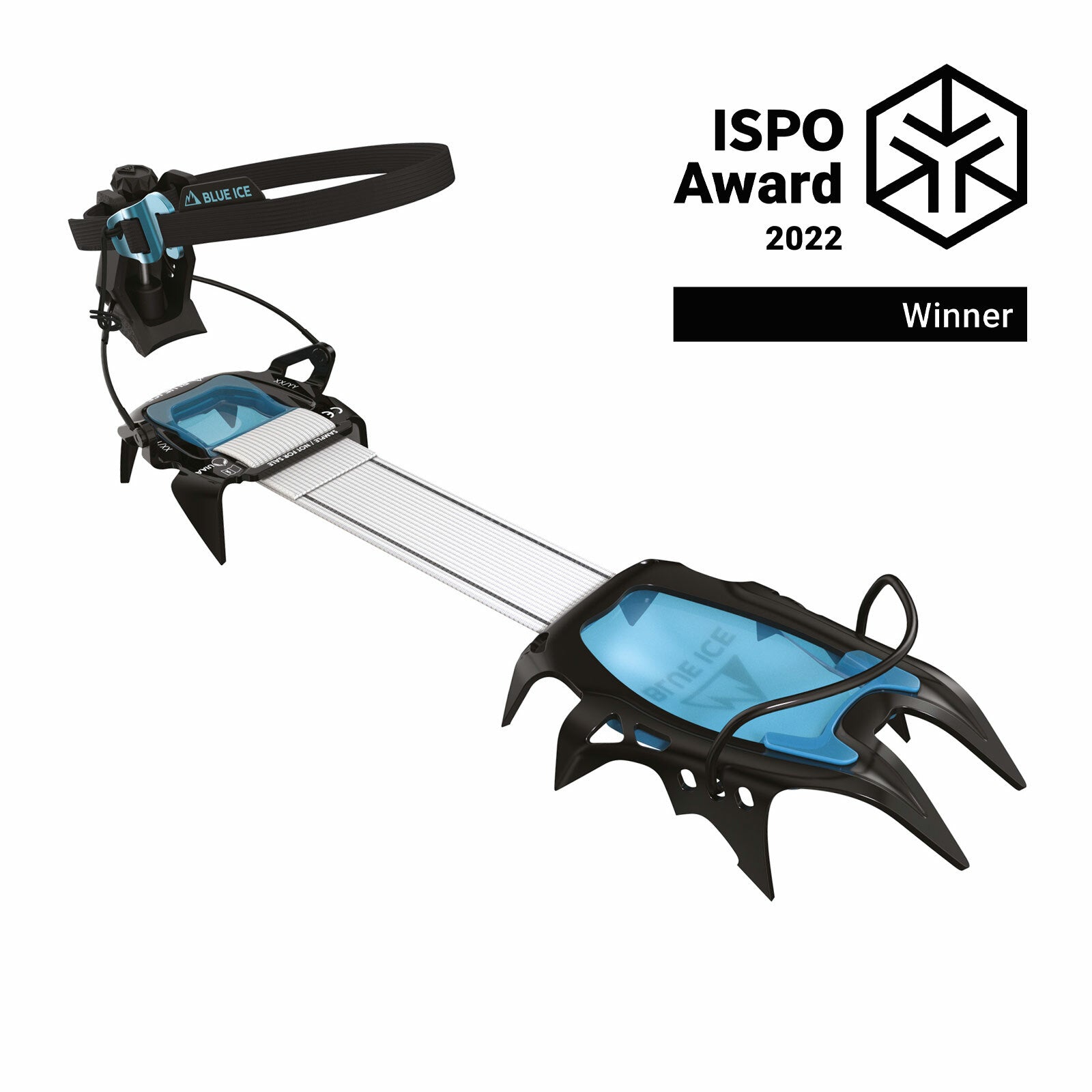
    The Blue Ice Harfang Alpine is built for the fast-and-light crowd, ski mountaineers tackling steep alpine couloirs, and technical alpinists obsessed with cutting weight and bulk. Traditional steel crampons dominate pack volume, but the Harfang Alpine replaces the rigid steel center linking bar with a heavy-duty UHMWPE textile strap, allowing the entire unit to fold into a package roughly the size

    $220
    Amazon link coming soon

The bottom line

For technical alpine routes demanding dependable penetration on 45-degree hard ice without breaking the 900-gram barrier, the Petzl Sarken remains the premier overall pick thanks to its hybrid T-shaped front points and adaptable bail system. Climbers seeking a durable, all-around workhorse for classic glacier travel and moderate snow couloirs at a more accessible price point should look to the Black Diamond Serac Clip, which offers dependable stainless steel construction and robust anti-balling plates.

Frequently asked

Should I choose automatic, semi-automatic, or universal strap crampons?

Choose based on your boots. Automatic crampons require rigid boots with both front and rear welts, offering the most precise fit for steep ice. Semi-automatic crampons use a plastic toe basket and a rear heel lever, making them the most versatile choice for modern mountain boots with only a rear welt. Universal strap crampons fit flexible hiking boots but lack the rigidity required for technical alpine ice.

Are all-aluminum crampons safe for mountaineering?

No. All-aluminum crampons are designed strictly for low-angle snow walking and ski mountaineering. Hard alpine ice and hidden rock quickly dull or shear aluminum points, creating an immediate fall hazard. For any route involving exposed hard ice, mixed rock, or sustained slopes above 35 degrees, steel front rails are mandatory for safety and durability.

What is the difference between horizontal and vertical front points?

Horizontal front points act like small shovels, providing superior floatation and holding power in soft snow, hard neve, and rotten ice. Vertical front points, modeled after ice axe picks, penetrate hard, brittle water ice cleanly with less surface shattering. Hybrid T-shaped points blend both designs, offering adequate snow flotation alongside clean penetration on steep alpine ice.

How do anti-balling plates work and can they fail?

Anti-balling plates sit beneath the crampon frame, flexing as you step to pop wet snow free before it packs into a solid block under your foot. They fail when the polymer freezes rigid, cracks along attachment points, or wears out at the edges. If snow begins sticking underfoot, you must clear it immediately with your ice axe shaft.

Can I use technical mountaineering crampons on flexible hiking boots?

You should not. Technical mountaineering crampons require a stiff or rigid sole platform. Pairing a flexible hiking boot with a steel crampon creates extreme bending stress across the linking bar, which can cause the bar to snap or the crampon to peel off the boot entirely mid-stride. Always match crampon stiffness to boot rigidity.