


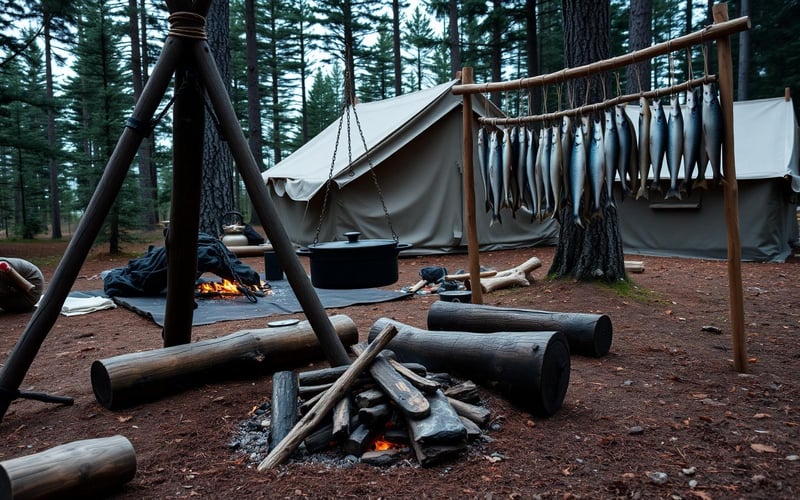
3 skills

Navigation
10 minMeasure distance with a pace count
Knowing your pace count over 100 m tells you how far you've walked without a GPS.
- Measure or step off 100 meters on flat, open ground.
- Walk it at a natural pace, counting every time your left foot lands. That's your pace count.
- Typical adult: 60-70 paces per 100 m.
- In broken ground, up hills, or with a heavy pack, add 20-30% to your count.
- Track distance with pebbles or knots — one per 100 m walked.
SF Actual — Basic Land Navigation
Tools & Cordage
15 minThe four knots that matter
Skip the rest until these are automatic.
- Bowline — a fixed loop that never slips or jams. Rescue, anchoring, tarps.
- Taut-line hitch — an adjustable loop for tent guy lines. Tighten or loosen by hand.
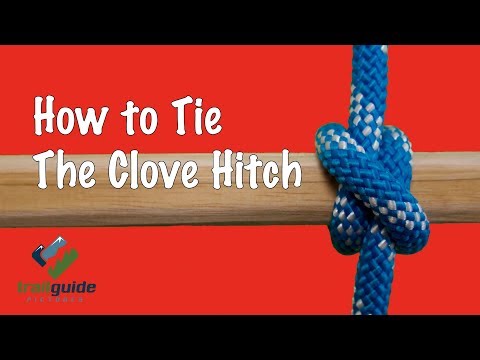
- Clove hitch — quick attachment to a pole or post. Great for starting lashings.
- Trucker's hitch — a pulley for tensioning a line. Ridge lines, cargo, tarps in wind.
Tip: Practice each 20 times with cold, wet hands and eyes closed. That's field-ready.
Trailguide — Clove Hitch (start here)

Tools & Cordage
10 minSplit wood safely with a knife (batoning)
Batoning is a controlled technique for splitting small wood with a fixed-blade knife when no axe is available.
- Use only a full-tang, fixed-blade knife with a spine at least a quarter-inch thick — folding knives will fail.
- Set the round upright on a stable log platform, place the knife edge across the top, and tap the spine with a wooden baton (never metal).
- Once the blade is seated, strike the tip of the spine with progressively firmer taps until the wood splits.
- Keep your off hand well clear of the blade and split path.
- Choose small rounds (wrist-thick or less); larger wood requires an axe, not a knife.
Warning: Batoning stresses knives. Never baton knots, and stop the moment the blade shows lateral flex or the handle scales loosen.
Educational reference only. Wilderness conditions change fast — practice in low-stakes settings, take a certified wilderness first-aid course, and confirm regional regulations (fire, fishing, foraging, snaring) before you rely on any of these skills in the field.