


7 skills

Water
10 minFind water in dry country
Water moves down and collects predictably — read the terrain first, then walk.
- Head to the lowest ground: canyon bottoms, dry washes, the outside bends of dry riverbeds.
- Dig at the base of cliff pour-offs and in shaded gravel bars — seep water rises in minutes.
- Follow converging animal trails downhill; they braid toward water.
- Watch for green vegetation (cottonwood, willow, cattail) standing out from the surroundings.
- At dawn, look for insects, especially bees — most fly within a mile of water.
Warning: Always purify seep and puddle water; livestock and wildlife share the same holes.
Chad Zuber — Water in the Desert

Navigation
10 minNavigate by handrails and catching features
Two habits that keep you found without a GPS: follow a handrail, aim past a catch.
- Pick a linear feature parallel to your route — a river, ridge, road, or valley. That's your handrail.
- Walk keeping the handrail on the same side, checking it visually every few minutes.
- Choose a catching feature past your destination — a river, cliff, or trail perpendicular to your route.
- If you hit the catching feature, you've overshot — turn back along the handrail.
- Aim off deliberately: bias 5-10° left or right of the target so you always know which way to turn at the catch.
Mowser — Essential Hiking Navigation
Food
20 minCook on a hot rock
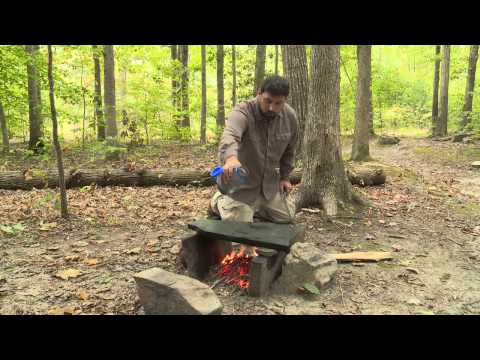
A flat, dry rock in the coals is a griddle for fish, meat, and bannock.
- Pick a flat, dry rock from well above the waterline — never from a stream or lakeshore.
- Bury it in the fire's coals for 20 minutes so it heats evenly.
- Brush off ash. Test with a drop of water — it should sizzle and skip.
- Lay fish or meat directly on the rock; flip once when the underside releases cleanly.
Warning: Wet or river rocks trap steam and can explode in a fire.
Outdoor Life — Cook Food on a Rock
Tools & Cordage
10 minSharpen a knife on a river stone
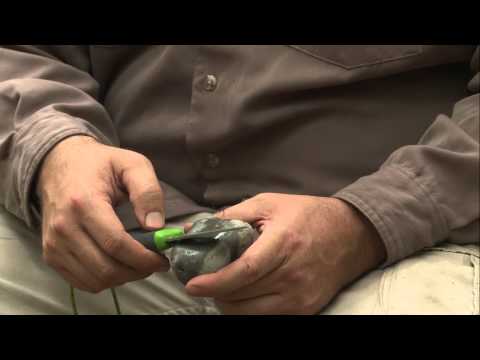
A smooth, flat river stone is a serviceable field whetstone.
- Pick a stone with a flat, fine-grained face. Wet it thoroughly.
- Hold the knife at roughly 20°: the thickness of two stacked coins between spine and stone.
- Sweep the edge across the stone like you're slicing a thin layer off it.
- Do 10-15 strokes per side, alternating until you feel a burr along the whole edge.
- Finish by stropping on your belt, denim, or the inside of a leather boot.
Tip: A knife sharp enough to shave the hair off your forearm is sharp enough.
Outdoor Life — Sharpen a Knife with a Rock

Field Skills
45 minFind and process wild clay
Clay is everywhere along streambanks and cutbanks — you just have to test for it.
- Look at cutbanks, riverbends, and exposed subsoil below the leaf layer.
- Grab a handful, wet it, and roll a snake the thickness of a pencil.
- If it bends around your finger without cracking, it's usable clay.
- Slake: break it up in water, stir, let sit. Sand and gravel sink, clay stays suspended.
- Pour off the milky water into a cloth-lined pit; let it drain until leather-hard, then wedge (knead) to remove air.
Tip: Test-fire a small pinch pot in a hot fire. If it survives without exploding, the clay's clean enough to use.
Andy Ward — Wild Clay for Beginners

Navigation
10 minNavigate to a linear feature with aiming off
Deliberately steering left or right of your target guarantees you know which way to turn when you hit a road, river, or ridge.
- Identify a linear feature (road, river, powerline, coast) that runs across your line of travel and passes through or near your destination.
- Instead of aiming directly at the destination, choose a bearing 5–10° to one side.
- Travel that bearing until you hit the linear feature.
- You now know with certainty whether the destination lies to your left or right along that feature.
- Turn and follow the feature until you reach the destination.
Tip: This trades a small amount of extra walking for total certainty about which way to turn. It's especially valuable in poor visibility.
Navigation
15 minNavigate by dead reckoning
Dead reckoning combines bearing and distance to estimate your position without landmarks or GPS.
- Note your start point exactly — grid coordinate, prominent landmark, or known location.
- Record the bearing you're traveling on with a compass — write it down, don't trust memory.
- Track distance by pace count or estimated time × speed as you move.
- Whenever you change bearing, log the new heading and reset your distance count.
- At any point, you can plot the current estimated position on the map by drawing each leg in sequence from the start.
Tip: Dead reckoning accumulates error. Confirm and reset your position at every known feature (a river crossing, trail junction, distinct peak) you pass.
Educational reference only. Wilderness conditions change fast — practice in low-stakes settings, take a certified wilderness first-aid course, and confirm regional regulations (fire, fishing, foraging, snaring) before you rely on any of these skills in the field.