


Hands-on review · November 12, 2026
From the field
Years on my belt, and a weekend at Devil's Lake
I have had my Bravo 1 for years now, and I still like the look of it. It is a classic shape — nothing flashy about it — and it has earned its spot in my kit the slow way, by being the knife I reach for.
I took it up to Devil's Lake, Wisconsin recently and used it all around camp. It reminded me why it has a reputation as one of the best fixed-blade knives ever made. Almost every job I gave it out there, the size was simply right.
The one thing I got wrong with this knife was sharpening it. A convex grind requires the user to know how to sharpen correctly, and I did not. I went at mine on a stone, got nowhere, and was messing up the blade before I stopped and did some research on what a convex edge actually needs. Next time I want an edge on it, I am paying to have it done professionally.
I also wish it came in MagnaCut. Dealers list a Bravo 1 LT in MagnaCut now, which I checked while writing this up, but that is not the knife I own — and mine is still high quality whatever the steel on it happens to be.
As an Amazon Associate, Wild10 earns from qualifying purchases.
The verdict
The Bravo 1 has stayed in my kit for years because it is the right size for almost every job I give it, and a weekend around camp at Devil's Lake, Wisconsin reminded me why it has the reputation it does. It is not a knife I can look after myself: the convex grind defeated my stone, and I was messing up the blade before I figured out what I was doing wrong. I wish it came in MagnaCut, although dealers list a Bravo 1 LT in that steel now. If you know how to sharpen a convex edge, or you are willing to pay someone who does, this is a fixed blade that earns its reputation. If you expect to touch it up on a stone in the field, that is the part to think about before you buy.
Check Bark River and authorized dealers for current pricing by steel, handle and sheath variant.
What I love
- The right size for almost every job I have given it, over years of use
- Classic look that has not gotten old
- Worked all around camp at Devil's Lake, Wisconsin without complaint
- Convex grind cuts well — it is also the reason maintenance takes know-how
- Steel options include A2 and CPM-3V, with dealers also listing CPM-154, Cru-Wear and a Bravo 1 LT in MagnaCut
- Full-tang build with USMC Force Recon-influenced ergonomics
Watch out for
- The convex grind is hard to sharpen correctly — my stone attempt went nowhere and started messing up the blade
- Professional sharpening is the answer for me, which is an ongoing cost
- I wish it came in MagnaCut; the Bravo 1 LT is the MagnaCut version dealers list
- Steel is spread across variants, so you need to know which one you are buying
Best for
- Campers and bushcraft users who want one full-size belt knife for almost every job
- People who like a classic, non-flashy fixed blade with a long service history
- Buyers who will have a convex edge sharpened professionally rather than guess with a stone
- Anyone weighing the Bravo 1 against lighter fixed blades for camp-based trips
How I actually used it
This is my own Bravo 1 and it has been in my kit for years, so the report below is not a first-week impression. Most recently I took it up to Devil's Lake, Wisconsin and used it all around camp — the ordinary work of a camp trip rather than one heroic task.
What stands out is how often the size is right. Almost every job I reached for a knife for, this was the one I wanted, which is why it has stayed on my belt while other knives have come and gone. That is also what reminded me of its reputation: a knife that keeps getting picked is usually getting picked for a reason.
The convex grind, and the sharpening lesson
The convex grind is a big part of why this knife cuts the way it does, and it is also the thing I got wrong. A convex edge requires the user to know how to sharpen it correctly. I did not. I put mine on a stone, got nowhere, and was messing up the blade before I stopped and went and read up on what the geometry actually needs.
If you buy this knife, decide up front which camp you are in. Either learn the convex technique before the edge needs it, or budget for professional sharpening the way I now do — next time I need an edge, I am paying to have it done. What I would not do is go at it on a stone blind the way I did, because that is how you end up with a worse knife than you started with.
Steel options, and the MagnaCut wish
Bark River has run the Bravo 1 in several steels, and dealers currently list A2 tool steel and CPM-3V, along with CPM-154 and Cru-Wear versions. I wish it came in MagnaCut — that is my honest want. While writing this up I checked, and dealers do list a Bravo 1 LT in MagnaCut, so the steel is available in that family if it matters to you.
None of that changes what I carry. My knife is not the MagnaCut version, and it is still high quality whatever the stamp on it says. I have not gone looking for the stamp, so I am not going to tell you which steel I am holding — check the listing on the one you buy, because the steel is what you are actually shopping between on this model.
Source: DLT Trading — Bark River Bravo 1 LT MagnaCut listing
Why it has the reputation
Bark River developed the Bravo 1 with input from USMC Force Recon operators, and it is a full-tang, convex-ground fixed blade built around a work-first shape. That pedigree gets repeated often enough that it is easy to stop noticing it, but years of my own use is what keeps me saying it: this is a knife that has held up, and it still has the classic look I liked when I bought it.
The reputation as one of the best fixed-blade knives ever made is a strong claim to make about any knife. After a weekend of camp work at Devil's Lake with a knife I have carried for years, it is a claim I understand even if I cannot verify it against every other knife on the market.
Care and review method
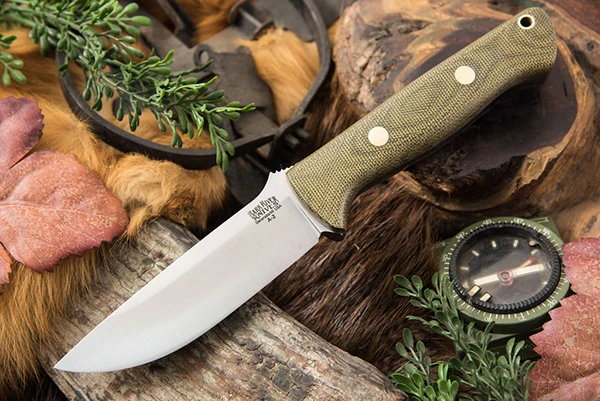
This is my own knife, bought years ago. Bark River did not send it to me, did not see this review before it ran, and did not pay for it. The photo at the top is a dealer product photo from DLT Trading, not a photo from my trip — the trip account above is my own use.
Steel options and the MagnaCut LT listing come from dealer listings checked on November 12, 2026. I have not measured this knife, so I am not printing blade length, weight or thickness numbers I have not verified. What I can tell you is how it has behaved in my hands for years, and where my own maintenance skills ran out.
Specs at a glance
- Blade grind
- Convex
- Construction
- Full tang
- Blade steel options
- A2 tool steel or CPM-3V; dealers also list CPM-154, Cru-Wear and a Bravo 1 LT in MagnaCut
- Design lineage
- Developed with input from USMC Force Recon operators
- Handle as photographed
- Green Micarta (handle varies by variant)
- As tested
- My own knife, in use for years; most recently around camp at Devil's Lake, Wisconsin
- Sharpening
- Convex edge — I send mine out rather than stone it
As an Amazon Associate, Wild10 earns from qualifying purchases.