


Reader rating
Rate it and you move it. Community ratings re-rank this product inside its Top 10 list.
Expert-picked, reader-ranked. Our editors choose the products and the launch order; member star ratings move picks up or down over time.
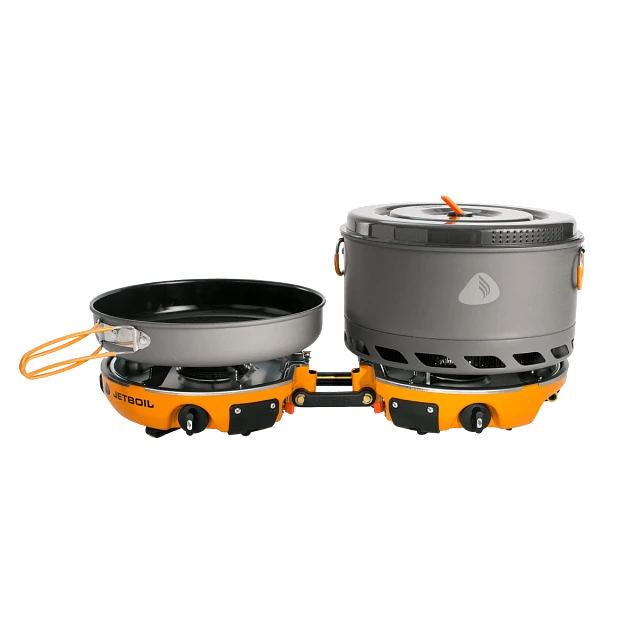
The Jetboil Genesis Basecamp System is a radical departure from traditional nesting cooksets. Instead of designing pots to fit existing stoves, Jetboil built a proprietary folding two-burner stove that nests directly inside a massive five-liter FluxRing pot, topped with a ten-inch ceramic nonstick frypan. It is an integrated, highly efficient cooking platform built for overland travel and feeding hungry groups without wasting fuel. The star of the show is the thermal efficiency. The FluxRing heat exchanger welded to the bottom of the pot captures and transfers heat faster than standard flat-bottom pans, boiling five liters of water in a fraction of the usual time. The stove burners offer exceptional micro-adjust simmer control, allowing you to go from a violent boil down to a whisper-quiet simmer. The frypan's nonstick coating is slick and handles everything from bacon to quesadillas cleanly. This system comes at a premium price and requires commitment to Jetboil's ecosystem. The pot is designed specifically to interface with the Genesis burner grates, and the delicate FluxRing fins on the bottom mean you cannot set the pot directly on campfire coals or rough rock surfaces without damaging it. It is also tied to threaded isobutane/propane backpacking fuel canisters unless you carry the separate bulk propane adapter hose. **Highlights** - Proprietary folding two-burner stove nests completely inside the five-liter pot - FluxRing base delivers unmatched boil times and wind-resistant fuel efficiency - Incremental valve control provides true low-flame simmering capability - Generous ten-inch ceramic nonstick frypan handles full-size meals - Entire stove and cookset system zips into an integrated padded carrying case **Watch-outs** - High investment cost compared to conventional cooksets - Pot base cannot be placed on campfire coals or rough ground without fin damage
Pros
- FluxRing heat exchanger delivers unmatched fuel efficiency and rapid group boil times
- Micro-adjust valves offer true low-heat simmering rather than an all-or-nothing flame
- Stove, 5-liter pot, and 10-inch skillet pack down completely into a single tidy footprint
- Ceramic nonstick pan releases food effortlessly and cleans up with minimal water
Cons
- Substantially more expensive than buying a separate camp stove and cookset
- FluxRing fins make the stockpot unusable over open campfire coals or rough ground
- Running off standard 1-pound or bulk propane tanks requires a separate adapter hose
Best uses
- Overland vehicle expeditions
- Multi-day raft trips
- Compact tailgate camp cooking
- Small group basecamp meals
Specifications
- Total Packed Weight
- 9.1 lbs complete system
- Pot Capacity
- 5.0 liters
- Skillet Diameter
- 10.0 inches
- Burner Output
- 10,000 BTU/h per burner
- Coating
- Eco-friendly ceramic nonstick
- Packed Dimensions
- 10.3 in x 7.2 in
Pricing
We don't publish a price we haven't verified. The retailer links below open the live listing for this exact model.
Full catalog listing & offersBest for
Overland vehicle expeditions, Multi-day raft trips, Compact tailgate camp cooking, Small group basecamp meals
Where to buy the Genesis Basecamp System
We don't have a direct Amazon listing on file yet — this opens an Amazon search for the exact make and model.
Some links are affiliate links. Buying through them supports our testing at no extra cost to you.
The Jetboil Genesis Basecamp System does not fit neatly into conventional camping cookware categories because it refuses to separate the cookware from the heat source. Instead of designing a set of pots intended to rest on an arbitrary two-burner camp stove, Jetboil engineered an integrated system. A folding, clamshell dual-burner stove sits snugly inside a massive five-liter hard-anodized aluminum pot, which is capped by a ten-inch ceramic-coated nonstick skillet. The entire kitchen nests into a heavy-duty padded bucket bag with carry handles. This setup was built for tailgate chefs, overland rigs, and raft expeditions where trunk space is tight but camp meal expectations remain high. By applying Jetboil's FluxRing heat-exchanger technology to a large-format stockpot, the system cuts water boil times significantly and drastically reduces the amount of fuel you have to haul into the backcountry. The accompanying frypan offers legitimate surface area, allowing you to sear multiple chicken breasts or scramble eggs for four people without crowding. It is an undeniably premium piece of hardware that asks for a major financial commitment. It also forces you to accept Jetboil's design parameters: the pot bottoms are engineered specifically to interface with the Genesis burner grates and must be babied around open fires. For campers seeking an all-in-one, hyper-efficient group cooking solution that packs into the footprint of a basketball, nothing else matches its packaging.
Integrated Clamshell Architecture
The core genius of the Genesis system is its nesting geometry. Traditional car-camping setups require a bulky two-burner suitcase stove that slides under a cargo deck and a separate crate for pots and pans. Jetboil eliminated that sprawl by designing a stove that folds along a central hinge like an oversized compact disc case. The folded stove nests directly inside the 5-liter pot, protected by an internal sleeve. The 10-inch skillet sits on top, and the included windscreen wraps neatly around the perimeter. Everything secures inside a rugged, zippered nylon carry bag with reinforced grab handles. For vehicle campers struggling with gear tetris, collapsing a dual-burner stove, a group-sized pot, and a full skillet into a single cylinder roughly 10 inches wide and 7 inches tall transforms packing logistics.
FluxRing Thermal Efficiency
Standard camping pots lose an immense amount of radiant energy around their sidewalls, especially when hit by crosswinds. The Genesis pot counters this with Jetboil's signature FluxRing—a corrugated ribbon of metal welded directly beneath the pot base. This design captures rising heat and channels it directly into the aluminum vessel. The result is rapid boil times even when heating four or five liters of water for pasta or clean-up. More importantly, it requires substantially less fuel to do the job. On extended river trips or overland expeditions where resupplying fuel is difficult, the thermal efficiency translates directly to carrying fewer fuel canisters. Keep in mind, however, that these delicate aluminum fins mean the pot cannot be placed directly on campfire grates, embers, or jagged gravel without risking structural damage.
Precision Valve Simmer Control
Many high-output camp stoves act like on-off switches, forcing outdoor cooks to constantly shuffle pans to avoid scorching rice or burning sauces. Jetboil fitted the Genesis burners with advanced rotary micro-regulators that provide four full turns of valve rotation. This allows you to feather the 10,000 BTU burner down from an intense, roaring boil to a true, whisper-quiet simmer. The ceramic-coated frypan takes full advantage of this control. It provides even heat distribution across its aluminum base, allowing for slow-cooked scrambled eggs, delicate pancakes, or simmering stews without hotspots. You are not forced to compromise culinary technique simply because you are cooking on a tailgate in gusty winds, provided you set up the included wraparound windscreen correctly.
Coating Durability and Care
The ten-inch frypan features a slick ceramic nonstick interior that eliminates the need for heavy cooking oil. Fried eggs slide off easily, and post-dinner cleanup requires little more than a splash of warm water and a wipe from a paper towel. However, ceramic surfaces require discipline in camp. You cannot use metal forks, spatulas, or abrasive scouring pads without scratching the finish. We recommend dedicated silicone or wooden utensils. The pot features a rugged hard-anodized finish that resists corrosion and scrubbing, paired with folding rubberized bail handles that lock securely for draining through the vented lid. You must inspect the FluxRing channels periodically to clear out trapped pine needles or dirt before firing up the stove.
Fuel Logistics and Ecosystem
Out of the box, the Genesis system runs on standard backpacking-style isobutane/propane threaded canisters via an included regulated fuel line. This is convenient if you already own canister fuel, but burning small canisters for high-volume family meals gets expensive quickly. Jetboil sells an optional adapter hose that connects the system to standard one-pound green propane cylinders or bulk five-pound and twenty-pound propane tanks. For true basecamp duty, purchasing that bulk hose is practically mandatory. Another unique design element is the JetLink port, which lets you daisy-chain additional Jetboil stoves or accessories off the same single fuel source, allowing you to expand your cook station without bringing a second regulator.
The Competitive Trade-Off
At roughly four hundred dollars, the Genesis Basecamp represents a steep barrier to entry. Campers can assemble a traditional setup—such as a Camp Chef Everest stove paired with a GSI Pinnacle or Stanley Even-Heat nesting cookset—for half the price. That traditional route also allows you to use standard flat-bottom cast-iron pans or campfire Dutch ovens that would destroy the Genesis burner grates. What you are buying here is not just cookware; it is an unmatched combination of compact storage volume, thermal efficiency, and flame modulation. If your overland storage space is severely restricted or you demand rapid boiling alongside genuine culinary simmering in a single tidy case, the high price tag proves its worth over seasons of use.
How we picked
We started with a long list of camping cookware that people actually buy, cut anything that could not clear our baseline for durability and field performance, then ranked the 10 that were left against the same criteria. Rankings are editorial. No brand pays for placement, and affiliate links never move a pick up or down.
- Throughput and fuel economy
- Boil times, flow rates, and how much fuel or effort a real trip consumes.
- Real-world durability
- How the material, stitching, or steel holds up after a season of hard use — not how it looks new.
- Performance in bad conditions
- Wind, rain, cold, and grit are the test. Anything that only works on a nice day gets marked down.
- Weight and packability
- Every ounce has to earn its place in the pack, but not at the cost of something that fails in the field.
- Ease of use
- Setup, adjustment, and maintenance with cold hands, in the dark, without the manual.
- Value at its price point
- Compared against the closest competitors in the same tier, not against cheaper gear in a different class.
Genesis Basecamp System — frequently asked questions
- Is the Genesis Basecamp System worth it?
- We rank it #6 in Camping Cookware. The Jetboil Genesis Basecamp System is a radical departure from traditional nesting cooksets. Instead of designing pots to fit existing stoves, Jetboil built a proprietary folding two-burner stove that nests directly inside a massive five-liter FluxRing pot, topped with a ten-inch ceramic nonstick frypan.
- What is the Genesis Basecamp System best for?
- Best for overland vehicle expeditions, multi-day raft trips, compact tailgate camp cooking and small group basecamp meals. Standouts: fluxring heat exchanger delivers unmatched fuel efficiency and rapid group boil times and micro-adjust valves offer true low-heat simmering rather than an all-or-nothing flame.
- What are the downsides of the Genesis Basecamp System?
- Substantially more expensive than buying a separate camp stove and cookset, FluxRing fins make the stockpot unusable over open campfire coals or rough ground and Running off standard 1-pound or bulk propane tanks requires a separate adapter hose.
- What are the key specs of the Genesis Basecamp System?
- Total Packed Weight: 9.1 lbs complete system · Pot Capacity: 5.0 liters · Skillet Diameter: 10.0 inches · Burner Output: 10,000 BTU/h per burner · Coating: Eco-friendly ceramic nonstick
- Integrated Clamshell Architecture — what should I know about the Genesis Basecamp System?
- The core genius of the Genesis system is its nesting geometry. Traditional car-camping setups require a bulky two-burner suitcase stove that slides under a cargo deck and a separate crate for pots and pans.
- FluxRing Thermal Efficiency — what should I know about the Genesis Basecamp System?
- Standard camping pots lose an immense amount of radiant energy around their sidewalls, especially when hit by crosswinds. The Genesis pot counters this with Jetboil's signature FluxRing—a corrugated ribbon of metal welded directly beneath the pot base.
Compare side by side
Put the Genesis Basecamp System against any other pick on this list — specs, price, pros, cons and reader ratings.