


Reader rating
Rate it and you move it. Community ratings re-rank this product inside its Top 10 list.
Expert-picked, reader-ranked. Our editors choose the products and the launch order; member star ratings move picks up or down over time.
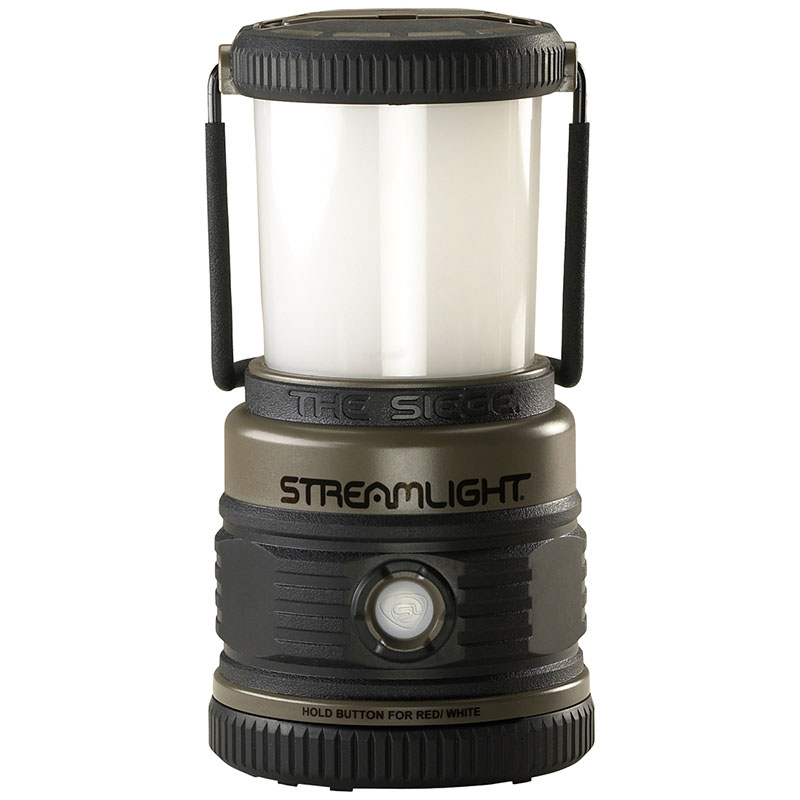
Streamlight built The Siege for environments where gear gets soaked, dropped, and neglected. Encased in high-impact polymer with molded rubber bumpers, this D-cell lantern is IPX7 waterproof, can be submerged in a meter of water, and naturally floats to the surface if knocked out of a canoe or off a wet dock. Powered by three standard D-cell alkaline batteries, The Siege prioritizes brutal durability and extended low-mode runtime over sleek aesthetics. On its lowest white setting, it will run for hundreds of hours, making it the ultimate tool for extended power outages, hunting camps, and remote cabins where wall charging is non-existent. A dedicated red LED mode provides night-vision preservation and emergency signaling without blinding campmates. A brilliant design detail is the removable outer globe: twist it off, and you have an unobstructed, bare-bulb flood light that you can hang upside down via recessed carabiner clips on the base. The trade-off is unmistakable: once loaded with three D-cells, The Siege is heavy and dense. It has no internal USB port to charge your phone, and you have to keep alkaline spares on hand. But if you need an indestructible, waterproof light that will sit in a gear box for eighteen months and turn on without fail, this is the one. **Highlights** - IPX7 waterproof construction survives full submersion and floats handle-up - Removable outer globe allows bare-bulb hanging for downward area coverage - Runs on widely available D-cell alkaline batteries for long-term storage reliability - Recessed carabiner-style D-rings on top and bottom allow inverted suspension - Red light mode preserves natural night vision and offers emergency signaling **Watch-outs** - Substantial weight once loaded with three alkaline D-cell batteries - No integrated power-bank function to charge personal devices - Ongoing battery replacement costs if used heavily throughout the season
Pros
- Certified IPX7 waterproof and floats handle-up if dropped in water
- Removable globe enables unobstructed, shadow-free downward area lighting
- Near-indestructible body with two-meter impact resistance and rubber bumpers
- Massive 295-hour runtime on low white setting using stable D-cell batteries
Cons
- Heft exceeds 31 ounces once loaded with three alkaline D-cells
- Lacks a USB charging port to top off personal electronics in emergencies
- Cool white light output lacks the warmth of modern recreational LEDs
Best uses
- Extended home emergency preparedness
- Overlanding and vehicle basecamps
- Canoe and raft touring
- Remote off-grid hunting cabins
Specifications
- Max Output
- 540 lumens
- Battery Platform
- 3 D-cell alkaline batteries
- Waterproof Rating
- IPX7 (submersible to 1m, buoyant)
- Weight with Batteries
- 31.0 oz (879 g)
- Drop Resistance
- 2 meters
- Max Low Runtime
- 295 hours (white low)
Pricing
We don't publish a price we haven't verified. The retailer links below open the live listing for this exact model.
Full catalog listing & offersBest for
Extended home emergency preparedness, Overlanding and vehicle basecamps, Canoe and raft touring, Remote off-grid hunting cabins
Where to buy the The Siege
We don't have a direct Amazon listing on file yet — this opens an Amazon search for the exact make and model.
Some links are affiliate links. Buying through them supports our testing at no extra cost to you.
The Streamlight Siege sits in direct opposition to the trend of delicate, app-controlled, USB-rechargeable camp lanterns. Built out of heavy-walled polycarbonate with thick molded rubber overmolding, this is a utilitarian lighting brick designed to survive being kicked down a talus slope, forgotten in a flooded bilged canoe, or left in an unheated cabin gear chest for two years between hunting seasons. Running on three standard alkaline D-cell batteries, the Siege delivers a maximum output of 540 lumens on high down to a continuous 55 lumens on low. While lithium-ion lights dominate modern car-camping setups, alkaline cells still offer distinct survival advantages: they hold power indefinitely without parasitic circuit drain, swap out in seconds in the pitch black, and require no generator or wall plug when storms take down the local grid for a week. Its IPX7 waterproof rating means it can handle total submersion in a meter of water, and if dropped overboard while loading boats at dusk, it simply pops to the surface and floats handle-up. At nearly two pounds with fresh batteries, you will not carry it in a backpack, but for basecamps, overlanding trucks, duck blinds, and emergency kits, few lights match its mechanical reliability.
Bombproof Polycarbonate Construction
Streamlight built their reputation on industrial and tactical flashlights, and the Siege borrows heavily from that ethos. The main housing uses high-impact thermoplastic resin reinforced by heavy molded rubber at the top cap and perimeter base. This rubber base keeps the lantern from skidding across aluminum boat benches or wet picnic tables while absorbing blunt impacts from drops up to two meters onto hard ground. The internal battery tray is spring-cushioned at both ends, preventing dropped impacts from shattering terminal connections or crushing battery casing. O-ring seals protect the threaded battery compartment against water ingress down to one meter of depth. Even better, the internal air cavity is sized specifically so the unit floats if knocked off a dock, keeping the switch accessible and the light visible in dark water.
Beam Optics and Globe Removal
The frosted outer globe delivers a soft, glare-free 360-degree white light that will not blind campmates sitting directly across the table. Output spans three white levels: 540 lumens on high, 275 lumens on medium, and 55 lumens on low. When you need area lighting without shadow rings, the outer globe twists off entirely, leaving a bare, domed C4 LED setup. In this bare-bulb configuration, the light throws raw, unobstructed illumination outward and downward. Two secondary red LEDs provide either a 10-lumen steady task light to preserve night-adjusted vision or a flashing SOS emergency beacon rated to run for over four hundred hours. The recessed push-button power switch incorporates a battery indicator that transitions from green to yellow, red, and finally flashing red as D-cell voltage drops.
Hanging and Inverted Rigging
Most lanterns feature a single flimsy bail wire that bends under light pressure, but the Siege includes two distinct, rugged suspension points. The top handle is a thick, rubber-coated wire bail that locks upright or folds flush into the perimeter frame. Recessed directly into the bottom of the rubber base is a sprung, carabiner-style D-ring that folds flat when resting on a table. When you unclip the outer globe and hang the lantern upside down from an overhead tent loop, ridge line, or tarp pole using the base carabiner, it acts as an uninterrupted downlight. This inverted configuration eliminates the heavy shadow footprint beneath the lantern body, bathing an entire four-person tent or camp kitchen workstation in clean, downward-directed floodlight.
Alkaline Simplicity Versus Modern Lithium
The decision to use three D-cell alkaline batteries instead of an internal lithium-ion pack is deliberate. Rechargeable lanterns are convenient until you face a multiday power outage or spend two weeks off-grid without a generator. Lithium batteries slowly self-discharge over months of storage, whereas quality alkaline D-cells maintain usable charge for up to a decade in a trunk kit. There is zero electronic parasitic draw on the Siege when turned off. Swapping in fresh batteries restores full runtime instantly, with the low setting stretching across nearly three hundred operating hours. The trade-off is operating cost and pack weight. Buying replacement D-cells adds up if you run high mode frequently, and you must check stored cells every few years to guard against corrosive alkaline leakage.
Field Limitations and Missing Features
The Siege does not attempt to be a multi-tool camp gadget, which brings clear limitations compared to modern competitors. There is no USB output port to charge a dead smartphone or GPS unit. The color temperature of the white LEDs sits on the cool, stark side of neutral, lacking the warm, firelight ambiance favored by casual weekend campers. It also lacks granular dimming; you are locked into Streamlights predetermined brightness tiers. At nearly two pounds loaded, it is strictly relegated to vehicular transport, stationary emergency boxes, or short portages. For casual backyard barbecues, lighter lanterns with warm light adjustments might feel friendlier, but when conditions deteriorate into torrential downpours and sub-freezing winds, the Siege outlasts them all.
Competitive Basecamp Alternatives
At this price and durability level, the Siege competes directly against options like the Black Diamond Apollo and the Goal Zero Lighthouse series. The Goal Zero offers versatile directional lighting, hand-crank backup, and USB power output, but its articulated legs and exposed switches are far more vulnerable to breakage in rough gear bins. The Black Diamond Apollo provides a warmer, lighter package with dual-fuel rechargeable capabilities, yet it carries only modest water resistance and cannot survive submersion. Coleman makes cheaper alkaline camp lanterns with higher lumen claims, but they use brittle plastics that crack under modest impacts. If your priority is sheer structural toughness, true IPX7 waterproofing, and absolute drop survivability, the Siege remains alone in its class.
How we picked
We started with a long list of camping lanterns that people actually buy, cut anything that could not clear our baseline for durability and field performance, then ranked the 10 that were left against the same criteria. Rankings are editorial. No brand pays for placement, and affiliate links never move a pick up or down.
- Real-world durability
- How the material, stitching, or steel holds up after a season of hard use — not how it looks new.
- Performance in bad conditions
- Wind, rain, cold, and grit are the test. Anything that only works on a nice day gets marked down.
- Weight and packability
- Every ounce has to earn its place in the pack, but not at the cost of something that fails in the field.
- Ease of use
- Setup, adjustment, and maintenance with cold hands, in the dark, without the manual.
- Value at its price point
- Compared against the closest competitors in the same tier, not against cheaper gear in a different class.
- Repairability and support
- Field-fixable design, available parts, and a warranty the maker actually honors.
The Siege — frequently asked questions
- Is the The Siege worth it?
- We rank it #9 in Camping Lanterns. Streamlight built The Siege for environments where gear gets soaked, dropped, and neglected. Encased in high-impact polymer with molded rubber bumpers, this D-cell lantern is IPX7 waterproof, can be submerged in a meter of water, and naturally floats to the surface if knocked out of a canoe or off a wet dock.
- What is the The Siege best for?
- Best for extended home emergency preparedness, overlanding and vehicle basecamps, canoe and raft touring and remote off-grid hunting cabins. Standouts: certified ipx7 waterproof and floats handle-up if dropped in water and removable globe enables unobstructed, shadow-free downward area lighting.
- What are the downsides of the The Siege?
- Heft exceeds 31 ounces once loaded with three alkaline D-cells, Lacks a USB charging port to top off personal electronics in emergencies and Cool white light output lacks the warmth of modern recreational LEDs.
- What are the key specs of the The Siege?
- Max Output: 540 lumens · Battery Platform: 3 D-cell alkaline batteries · Waterproof Rating: IPX7 (submersible to 1m, buoyant) · Weight with Batteries: 31.0 oz (879 g) · Drop Resistance: 2 meters
- Bombproof Polycarbonate Construction — what should I know about the The Siege?
- Streamlight built their reputation on industrial and tactical flashlights, and the Siege borrows heavily from that ethos. The main housing uses high-impact thermoplastic resin reinforced by heavy molded rubber at the top cap and perimeter base.
- Beam Optics and Globe Removal — what should I know about the The Siege?
- The frosted outer globe delivers a soft, glare-free 360-degree white light that will not blind campmates sitting directly across the table. Output spans three white levels: 540 lumens on high, 275 lumens on medium, and 55 lumens on low.
Compare side by side
Put the The Siege against any other pick on this list — specs, price, pros, cons and reader ratings.