


Reader rating
Rate it and you move it. Community ratings re-rank this product inside its Top 10 list.
Expert-picked, reader-ranked. Our editors choose the products and the launch order; member star ratings move picks up or down over time.
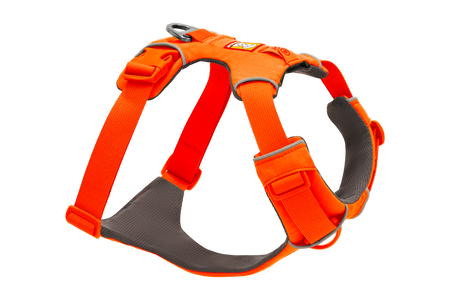
The Ruffwear Front Range Harness serves as an industry standard for day hikers seeking a balanced, comfortable chest harness. Built around a padded chest and belly panel, it spreads load evenly across the dog’s torso, making it an excellent choice for straightforward trail walks and daily exercise. It gives handlers two leash attachment options: an aluminum V-ring centered on the back for traditional lead walking and a reinforced webbing loop on the chest designed to discourage forward pulling. Construction balances comfort and daily durability with foam-padded fabric panels and four adjustment points that accommodate various chest girths. It is straightforward to put on, slipping over the head and securing with two side-release buckles along the ribcage. A small hook-and-loop stash pocket holds dog tags or identification quietly, while reflective trim and an integrated light loop improve visibility in low-light conditions. The primary trade-off is the absence of a top assist handle. Hikers venturing onto steep terrain, boulder fields, or river crossings where physical lifting is necessary will find the Front Range inadequate for assisted maneuvering. Because it must slip over the dog's head, dogs with large skulls or head sensitivity may also find donning it uncomfortable. **Highlights** - Foam-padded chest and belly panel for even load distribution - Dual leash attachment points including back aluminum V-ring and front webbing loop - Four independent adjustment points for a customizable fit - Dedicated stash pocket for dog tags - Reflective trim and integrated safety light attachment loop **Watch-outs** - Lacks a top grab handle for lifting over trail obstacles - Must slip over the dog's head, which some dogs resist
Pros
- Padded chest and belly panels disperse pulling force evenly across the torso.
- Dual leash attachment points support standard walking and directional control.
- Four adjustment points provide a secure fit across varied dog chest girths.
- Integrated hook-and-loop stash pocket silences and secures identification tags.
Cons
- Lacks a dorsal assist handle for lifting dogs over steep ledges or obstacles.
- Over-the-head entry design can cause distress for head-sensitive or broad-skulled dogs.
- Front webbing loop is more prone to abrasion wear than the rear aluminum V-ring.
Best uses
- Day hiking on established trails
- Everyday neighborhood walks
- Mild pull-redirection training
- Low-light morning and evening strolls
Specifications
- Leash Mounts
- Back aluminum V-ring and front webbing loop
- Adjustment Points
- Four independent adjustment sliders
- Closure Type
- Dual side-release ribcage buckles
- Entry Style
- Over-the-head slip-on design
- Visibility Features
- Reflective exterior trim and safety light loop
- ID Storage
- Integrated hook-and-loop tag pocket
Pricing
We don't publish a price we haven't verified. The retailer links below open the live listing for this exact model.
Full catalog listing & offersBest for
Day hiking on established trails, Everyday neighborhood walks, Mild pull-redirection training, Low-light morning and evening strolls
Where to buy the Front Range Harness
We don't have a direct Amazon listing on file yet — this opens an Amazon search for the exact make and model.
Some links are affiliate links. Buying through them supports our testing at no extra cost to you.
The Ruffwear Front Range Harness is widely recognized as a baseline standard for companion-dog day hikes and daily walks. Rather than incorporating specialized gear like load-bearing saddlebags or steep-angle hoisting apparatus, this harness concentrates on balanced load distribution across the chest and sternum. It delivers a secure, non-restrictive fit suitable for moderate trail mileage and neighborhood exercise alike. Built around foam-padded chest and belly panels, the harness mitigates pressure points during sustained forward movement. It offers handlers two distinct leash connection points: an aluminum V-ring centered on the back for standard trail walking, and an engineered front webbing loop intended to help redirect dogs that pull. Sizing relies on four separate adjustment points around the neck and torso, while dual side-release buckles secure the ribcage. While its streamlined silhouette minimizes weight and bulk on hot afternoons, the Front Range is strictly designed for walking rather than technical mountain maneuvering. It lacks a dorsal assistance handle, meaning handlers cannot physically hoist or stabilize a dog over high ledges or fast water crossings. For standard trail conditions, however, it remains one of the most reliable and straightforward options available.
Who It Is For
The Front Range is designed for dog owners who spend most of their outdoor time on established dirt trails, gravel paths, and park networks. It is particularly well suited for active dogs that need reliable chest cushioning without the thermal penalty or bulk of a multi-day expedition harness. Handlers dealing with mild to moderate forward pulling will appreciate the dual-point leash options, which allow training adjustments using the front chest loop without requiring a separate training rig. It serves dogs across a broad spectrum of body shapes, provided their head circumference allows standard slip-on entry. Conversely, it is not built for working dogs carrying their own supplies or owners who frequently tackle technical backcountry routes requiring manual lift assists over boulders.
Materials and Construction
Ruffwear constructs the Front Range using foam-padded panels along the chest and underside, designed to disperse pulling forces evenly along the dog's ribcage. The upper chassis features durable exterior fabric trimmed with reflective piping to aid detection in low-light environments. Hardware is kept minimal yet functional: an anodized aluminum V-ring provides a durable, corrosion-resistant anchor point on the upper back, while the front leash attachment relies on reinforced nylon webbing. Molded plastic side-release buckles sit along the flanks to keep closure quick without adding unnecessary metal weight. A low-profile, hook-and-loop pocket sits atop the back to securely hold identification tags, keeping them from jangling against metal leash snaps or catching on low-hanging underbrush.
Real-World Performance
On standard trails, the dual-clip setup dictates how the harness behaves under leash pressure. Anchoring a lead to the dorsal aluminum V-ring permits natural gait freedom, allowing the dog to track ahead without torso interference or chafing under the armpits. If the dog begins to pull forward eagerly toward wildlife or fellow hikers, switching the lead to the reinforced chest loop provides leverage to steer the torso sideways, redirecting forward momentum back toward the handler. The wide chest plate maintains its position relatively well during straight-line travel, provided the side straps are cinched evenly. However, vigorous side-pulling or leash torque can cause the harness chassis to twist slightly off-center, requiring periodic manual re-centering during extended outings.
Fit and Tuning Notes
Proper adjustment requires balancing four individual webbing sliders—two surrounding the neck opening and two flanking the ribcage. The harness must first slide directly over the dog's head, which means the neck opening needs sufficient slack to clear the ears before being tightened to rest against the base of the neck. When dialed in correctly, the lower chest panel should clear the dog's front legs completely to avoid friction against sensitive armpit tissue during extension. Handlers should aim for a two-finger gap beneath all straps to prevent chafing while ensuring the harness cannot slip over the shoulders if the dog backs up suddenly. Dogs with broader heads relative to their neck girth may require frequent adjustments to slip on and off smoothly.
Durability and Maintenance
The materials used in the Front Range tolerate dirt, abrasive trail dust, and incidental contact with brush without rapid fraying. The closed-cell foam inserts inside the chest and belly panels retain their structure well over time, avoiding the clumping or thinning that softer batting might suffer after wet outings. The aluminum V-ring resists wear from steel leash clips, eliminating the groove-wear typical of softer cast metals. However, the front fabric attachment loop experiences greater friction over time if used continuously with heavy pullers, showing wear faster than the metal back ring. Cleaning the harness requires hand washing with mild detergent and air drying, as machine washing can degrade the internal foam structure and abrade the reflective edge piping.
Comparable Alternatives and Trade-Offs
At this general price and performance tier, the Front Range competes against both basic nylon webbing rigs and fully featured backcountry harnesses like Ruffwear’s own Web Master. Minimalist strap harnesses offer lower weight and cooler performance in high heat, but they lack the Front Range's broad load dispersion and durable chest padding. On the other end, dedicated mountaineering and working harnesses incorporate a third belly strap and an integrated dorsal lift handle. The lack of a top handle is the Front Range's most significant functional trade-off; handlers cannot physically lift, hoist, or steady their dog through treacherous river crossings or steep rock steps. Those needing technical rescue support or packing capacity should step up to heavier chassis designs.
How we picked
We started with a long list of dog hiking harnesses that people actually buy, cut anything that could not clear our baseline for durability and field performance, then ranked the 10 that were left against the same criteria. Rankings are editorial. No brand pays for placement, and affiliate links never move a pick up or down.
- Comfort when hanging
- Waist and leg padding under load, not just standing in the store.
- Gear loops and adjustability
- Loop count and placement, leg-loop adjustment and fit over layers.
- Real-world durability
- How the material, stitching, or steel holds up after a season of hard use — not how it looks new.
- Performance in bad conditions
- Wind, rain, cold, and grit are the test. Anything that only works on a nice day gets marked down.
- Weight and packability
- Every ounce has to earn its place in the pack, but not at the cost of something that fails in the field.
- Ease of use
- Setup, adjustment, and maintenance with cold hands, in the dark, without the manual.
Front Range Harness — frequently asked questions
- Is the Front Range Harness worth it?
- We rank it #1 in Dog Hiking Harnesses. The Ruffwear Front Range Harness serves as an industry standard for day hikers seeking a balanced, comfortable chest harness. Built around a padded chest and belly panel, it spreads load evenly across the dog’s torso, making it an excellent choice for straightforward trail walks and daily exercise.
- What is the Front Range Harness best for?
- Best for day hiking on established trails, everyday neighborhood walks, mild pull-redirection training and low-light morning and evening strolls. Standouts: padded chest and belly panels disperse pulling force evenly across the torso. and dual leash attachment points support standard walking and directional control..
- What are the downsides of the Front Range Harness?
- Lacks a dorsal assist handle for lifting dogs over steep ledges or obstacles., Over-the-head entry design can cause distress for head-sensitive or broad-skulled dogs. and Front webbing loop is more prone to abrasion wear than the rear aluminum V-ring..
- What are the key specs of the Front Range Harness?
- Leash Mounts: Back aluminum V-ring and front webbing loop · Adjustment Points: Four independent adjustment sliders · Closure Type: Dual side-release ribcage buckles · Entry Style: Over-the-head slip-on design · Visibility Features: Reflective exterior trim and safety light loop
- Who It Is For?
- The Front Range is designed for dog owners who spend most of their outdoor time on established dirt trails, gravel paths, and park networks. It is particularly well suited for active dogs that need reliable chest cushioning without the thermal penalty or bulk of a multi-day expedition harness.
- Materials and Construction — what should I know about the Front Range Harness?
- Ruffwear constructs the Front Range using foam-padded panels along the chest and underside, designed to disperse pulling forces evenly along the dog's ribcage. The upper chassis features durable exterior fabric trimmed with reflective piping to aid detection in low-light environments.
Compare side by side
Put the Front Range Harness against any other pick on this list — specs, price, pros, cons and reader ratings.