


Reader rating
Rate it and you move it. Community ratings re-rank this product inside its Top 10 list.
Expert-picked, reader-ranked. Our editors choose the products and the launch order; member star ratings move picks up or down over time.
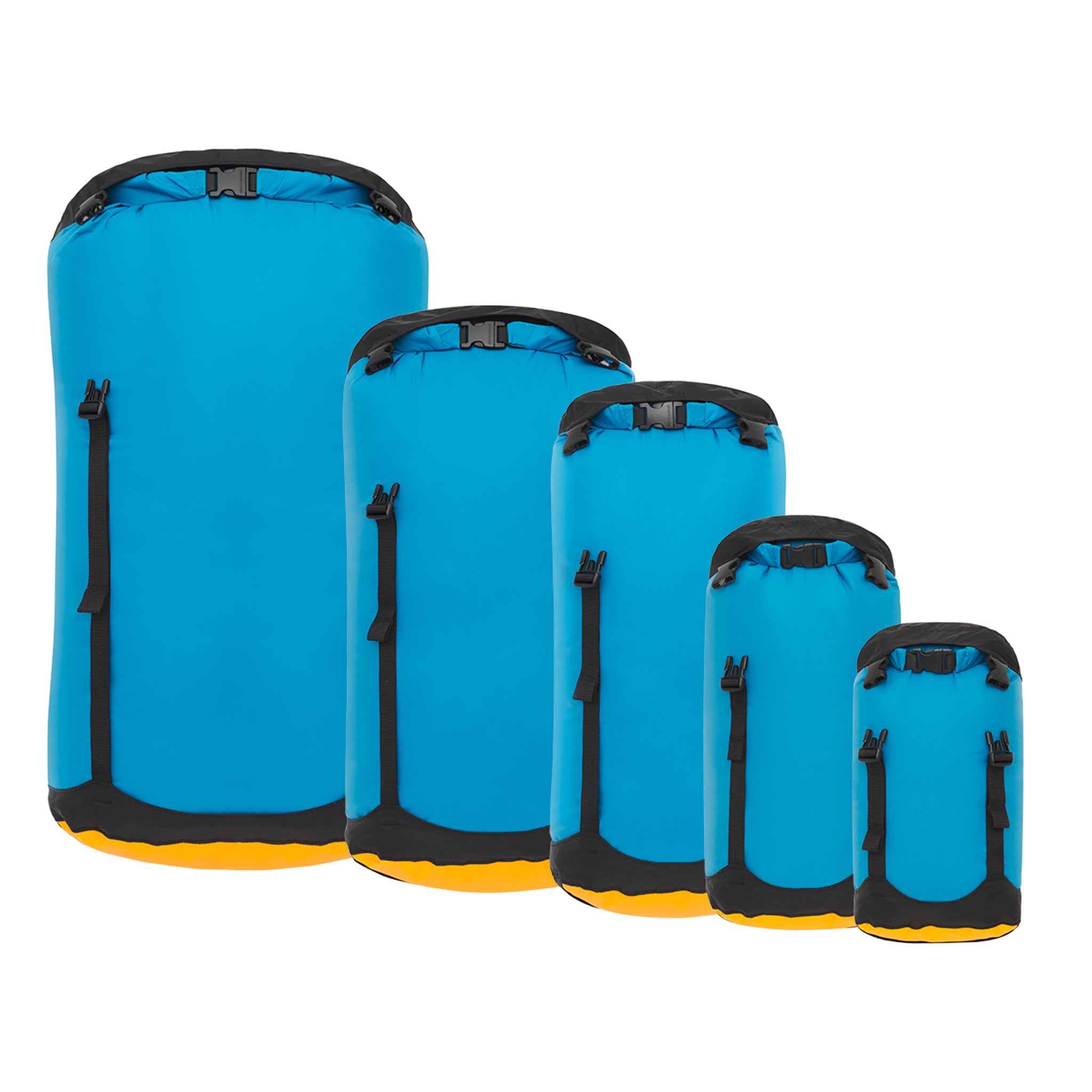
The Sea to Summit Evac Compression Dry Bag is crafted for wet-weather backpackers, bikepackers, and paddlers who need to radically reduce the packed volume of sleeping systems without compromising waterproof integrity. Traditional dry bags often trap air inside when rolled shut, but the Evac avoids this issue using an air-permeable eVent fabric base. During packing, air exhausts effortlessly through the waterproof membrane at the bottom as you roll down the top and cinch the four perimeter compression straps. Reviewers highlight this system as a massive improvement over traditional purge valves, which can snag or fail. Once the air is expelled, the bag locks into an ultra-dense, streamlined block that resists outside moisture from driving rain or bilge water. The main drawback is weight: between the rugged nylon body, eVent laminate, and multiple compression straps and buckles, it carries a noticeable weight penalty compared to minimalist sacks. It is overkill for small dry goods, but for high-value loft items that must stay dry in unrelenting weather, it delivers dependable dual-action compression and weatherproofing. **Highlights** - Air-permeable eVent base allows air to escape without letting water in - Factory-taped waterproof seams across the main body - Four even-pull compression straps reduce packed volume significantly - Hypalon roll-top closure provides reliable water protection - Excellent defense for down sleeping bags in wet climates **Watch-outs** - Substantially heavier than non-compressing dry bags - Bulky strap and buckle hardware can snag on external gear
Pros
- Air purges through the eVent base without needing a fragile mechanical valve
- Rugged 70D nylon fabric withstands rough packing and repeated friction
- Four-strap harness delivers balanced, high-ratio compression on lofty gear
- Hypalon roll-top closure maintains reliable water barrier integrity
Cons
- Significantly heavier than minimalist ultralight stuff sacks
- External compression straps and buckles can snag on interior pack contents
- Substantially more expensive than standard non-compressing dry bags
Best uses
- Wet-weather wilderness backpacking
- Kayak and canoe touring
- Four-season down sleeping storage
- Space-constrained bikepacking setups
Specifications
- Base Material
- Air-permeable eVent waterproof laminate
- Body Material
- 70D polyurethane-coated nylon
- Seam Construction
- Fully factory-taped waterproof seams
- Closure Style
- Non-wicking Hypalon roll-top closure
- Compression System
- Four adjustable straps with ladderlocks
- Available Volumes
- 8L, 13L, 20L, and 35L capacities
Pricing
We don't publish a price we haven't verified. The retailer links below open the live listing for this exact model.
Full catalog listing & offersBest for
Wet-weather wilderness backpacking, Kayak and canoe touring, Four-season down sleeping storage, Space-constrained bikepacking setups
Where to buy the Evac Compression Dry Bag
We don't have a direct Amazon listing on file yet — this opens an Amazon search for the exact make and model.
Some links are affiliate links. Buying through them supports our testing at no extra cost to you.
The Sea to Summit Evac Compression Dry Bag is designed to solve a persistent dilemma in outdoor packing: how to compress bulky, lofty items into the smallest possible space while maintaining absolute waterproof protection. Traditional dry sacks trap internal air when the roll-top is sealed, requiring awkward wrestling to squash out volume. Mechanical purge valves solve that problem but introduce delicate parts that can snag, leak, or fail. The Evac bypasses mechanical valves entirely by using an air-permeable eVent fabric base that lets air exhaust freely under compression while blocking liquid water. This design makes the bag particularly valuable for wet-weather backpackers, paddlers, and bikepackers who carry high-loft down sleeping bags or bulky insulating layers. By cinching down the four perimeter webbing straps, users can compress a sleeping system into an exceptionally dense, brick-like package that slots cleanly into a pack base or dry hatch. The trade-off is weight. With a 70-denier nylon body, heavy-duty webbing straps, and multiple buckles, this is not an ultralight accessory. However, for backcountry travelers facing persistent rain or river crossings where a wet sleeping bag poses genuine danger, the structural security and space efficiency justify the extra grams.
Target User Profile
The Evac Compression Dry Bag targets outdoor enthusiasts who travel in demanding wet environments and need to maximize pack volume. Backpackers navigating sustained rainfall, canoeists, sea kayakers, and packrafters are prime candidates. It is engineered specifically for vulnerable, high-loft gear such as down sleeping bags, insulated jackets, and dry camp clothing. Ultralight thru-hikers who count every fraction of an ounce will likely find the heavy webbing straps and dense 70D shell excessive for dry trail conditions. Conversely, for adventurers operating in maritime climates or on open water, the peace of mind provided by a fully sealed, crushproof dry sack outweighs the weight penalty. If your gear storage requirements are straightforward or your loads consist of dense, non-compressible items like cookware, this bag offers capabilities you simply do not need.
Materials and Architecture
Sea to Summit constructs the upper shell of the Evac from a robust 70-denier polyurethane-coated nylon, paired with factory-taped seams capable of withstanding considerable hydraulic pressure. The critical technical feature sits at the bottom: an eVent fabric membrane base. Because eVent is microporous and air-permeable, internal air escapes smoothly under manual pressure while the membrane's surface tension prevents water molecules from penetrating inward. The roll-top collar uses Hypalon fabric that resists wicking moisture along the closure seams. The compression harness consists of four durable webbing straps anchored through reinforced bar-tacks to a top compression cap and bottom perimeter ring. This architecture distributes tension evenly around the load, avoiding single-point stress failures that commonly plague lighter dry sacks when hauled down tight.
Compression and Packability
Packing loft items into the Evac is a straightforward process. As gear is loaded and the roll-top is folded down at least three times and buckled, air pushes directly out through the bottom membrane without ballooning the main chamber. Once sealed, drawing down the four perimeter straps compresses the contents uniformly into a cylindrical block. Because air vents continuously as the straps tighten, users do not need to pause, vent, or manipulate fragile air valves. The resulting package is dense, rigid, and significantly reduced in volume, making it easy to slide horizontally into the bottom compartment of an internal frame backpack. The smooth exterior nylon glides reasonably well against other pack liners, though the external webbing harness can catch slightly on interior gear loops if packed carelessly.
Field Durability
The 70D nylon chassis provides excellent resistance to puncture, scuffing, and abrasion, outperforming lightweight silicone-coated options when subjected to rough pack interiors, sand, or boat decking. By eliminating plastic twist-to-seal air valves, Sea to Summit removes the most common mechanical failure point found on valve-equipped compression sacks. The webbing straps, ladderlock buckles, and side-release clips are standard high-grade hardware that hold tension under heavy strain without slipping. Over years of extended use, the primary wear point to monitor is the eVent base, which can gradually become clogged with fine silt or grit if set directly into muddy terrain, slightly slowing air permeability. Routine cleaning with freshwater restores breathability, and the taped seams remain remarkably durable across hundreds of pack cycles.
Sizing and Tuning
Selecting the correct size depends entirely on the loft and shell fabric of the insulation inside. The 8-liter size generally accommodates lightweight summer sleeping bags or three-season down quilts. The 13-liter model is the benchmark sweet spot for standard three-season down sleeping bags and cold-weather down garments. The 20-liter and 35-liter versions cater to bulky synthetic sleeping bags or deep-winter expedition sleeping systems. To achieve maximum space savings and maintain waterproof integrity, roll the Hypalon collar at least three full turns before buckling. When tightening the compression harness, pull the straps progressively and diagonally in pairs rather than wrenching one strap fully tight at once. Uneven pulling distorts the bag into an awkward curve that packs inefficiently.
Comparable Alternatives
Shoppers balancing weight against durability often compare this standard 70D model to the Sea to Summit Ultra-Sil Evac Compression Dry Bag. The Ultra-Sil version uses a thinner 30D fabric that cuts substantial weight, but it sacrifices puncture resistance and is more susceptible to abrasion from repeated compression inside tightly packed rucksacks. Another alternative is the Granite Gear eVent Sil Compression Drysack, which operates on a similar membrane concept but features a different compression cap design. Traditional roll-top dry bags without compression straps, such as those from Outdoor Research or NRS, offer identical water barrier performance at a lower price point and lower empty weight, but they lack the ability to crush sleeping gear down to minimal volume.
How we picked
We started with a long list of stuff sacks that people actually buy, cut anything that could not clear our baseline for durability and field performance, then ranked the 10 that were left against the same criteria. Rankings are editorial. No brand pays for placement, and affiliate links never move a pick up or down.
- Real-world durability
- How the material, stitching, or steel holds up after a season of hard use — not how it looks new.
- Performance in bad conditions
- Wind, rain, cold, and grit are the test. Anything that only works on a nice day gets marked down.
- Weight and packability
- Every ounce has to earn its place in the pack, but not at the cost of something that fails in the field.
- Ease of use
- Setup, adjustment, and maintenance with cold hands, in the dark, without the manual.
- Value at its price point
- Compared against the closest competitors in the same tier, not against cheaper gear in a different class.
- Repairability and support
- Field-fixable design, available parts, and a warranty the maker actually honors.
Evac Compression Dry Bag — frequently asked questions
- Is the Evac Compression Dry Bag worth it?
- We rank it #5 in Stuff Sacks. The Sea to Summit Evac Compression Dry Bag is crafted for wet-weather backpackers, bikepackers, and paddlers who need to radically reduce the packed volume of sleeping systems without compromising waterproof integrity. Traditional dry bags often trap air inside when rolled shut, but the Evac avoids this issue using…
- What is the Evac Compression Dry Bag best for?
- Best for wet-weather wilderness backpacking, kayak and canoe touring, four-season down sleeping storage and space-constrained bikepacking setups. Standouts: air purges through the event base without needing a fragile mechanical valve and rugged 70d nylon fabric withstands rough packing and repeated friction.
- What are the downsides of the Evac Compression Dry Bag?
- Significantly heavier than minimalist ultralight stuff sacks, External compression straps and buckles can snag on interior pack contents and Substantially more expensive than standard non-compressing dry bags.
- What are the key specs of the Evac Compression Dry Bag?
- Base Material: Air-permeable eVent waterproof laminate · Body Material: 70D polyurethane-coated nylon · Seam Construction: Fully factory-taped waterproof seams · Closure Style: Non-wicking Hypalon roll-top closure · Compression System: Four adjustable straps with ladderlocks
- Target User Profile — what should I know about the Evac Compression Dry Bag?
- The Evac Compression Dry Bag targets outdoor enthusiasts who travel in demanding wet environments and need to maximize pack volume. Backpackers navigating sustained rainfall, canoeists, sea kayakers, and packrafters are prime candidates.
- Materials and Architecture — what should I know about the Evac Compression Dry Bag?
- Sea to Summit constructs the upper shell of the Evac from a robust 70-denier polyurethane-coated nylon, paired with factory-taped seams capable of withstanding considerable hydraulic pressure. The critical technical feature sits at the bottom: an eVent fabric membrane base.
Compare side by side
Put the Evac Compression Dry Bag against any other pick on this list — specs, price, pros, cons and reader ratings.