Skip to content
Wild10

Deep guide · 2026

Best Best Portable Water Filters for Backcountry Use of 2026 of 2026

Navigating the backcountry requires reliable gear, and nothing is more critical than access to safe drinking water. Our 2026 review cuts through the marketing to deliver the essential facts on portable water filters.

Independently researched One winner · 3 runners-up

Overview

In 2026, the need for effective and reliable portable water filtration remains paramount for anyone venturing beyond municipal water sources. While advancements in hydration bladder integration and lightweight materials continue, the core function of removing harmful pathogens hasn't changed. We're seeing a steady refinement rather than revolution, with manufacturers focusing on ease of use, flow rates, and robust construction.

Key design shifts this year involve more widespread adoption of hollow fiber technology across a broader price spectrum, pushing the performance ceiling for budget-friendly options. Backflushability and integrated dirty water reservoirs are becoming standard features, simplifying maintenance and reducing the risk of cross-contamination. Battery-powered UV purifiers are also seeing incremental improvements in battery life and charge times, making them more viable for extended trips.

Common failure modes for portable filters often stem from improper maintenance or user error. Freezing can ruin hollow fiber membranes, leading to compromised filtration. Clogging due to turbid water used without pre-filtering is another frequent issue, drastically reducing filter life and flow rate. O-rings and seals can degrade or become dislodged, causing leaks. Buyers should also be wary of claims regarding virus removal from mechanical filters unless explicitly stated and independently verified, as most backcountry filters focus primarily on bacteria and protozoa.

Serious buyers in 2026 should prioritize a filter's micron rating, flow rate, and field maintainability. A filter capable of removing at least 0.1 microns is standard for bacteria and protozoa. Consider your typical water sources; if often silty, an effective pre-filter or clarifier is essential. Durability and ease of cleaning are also crucial; a jammed filter in the backcountry is as good as no filter at all. Look for systems with replaceable components, like filter cartridges, to extend the life of the primary unit.

Price versus performance reality in 2026 continues to show that while you can get a functional filter for under $50, increased investment often brings significant gains in flow rate, durability, and filter longevity. High-end models typically offer superior materials, more comprehensive filtration (e.g., carbon for taste/chemicals), or integrated pumping systems that reduce user effort. However, even mid-range options now provide excellent protection for most backcountry scenarios, making top-tier prices unnecessary for many users. Focus your budget on features that directly address your anticipated water sources and trip durations.

How we picked

Our 2026 assessment of portable water filters involved extensive field testing across a variety of environments, from glacial meltwater to prairie ponds. Filters were subjected to actual trail conditions, evaluated for flow rate degradation, ease of use in cold and wet hands, and overall robustness.

We consulted with wilderness medicine professionals, expedition leaders, and backcountry rangers to gather insights on real-world use cases, common issues, and critical failure points. This practitioner input helped shape our testing protocols and highlighted factors beyond specifications that impact true field performance.

Filters were deliberately excluded if they lacked independent certification for bacterial and protozoan removal (e.g., from organizations like NSF or EPA protocols), or if their primary function was chemical treatment without mechanical filtration. We also steered clear of unproven or novelty designs, focusing instead on established technologies with demonstrated reliability in demanding outdoor contexts. Our goal was to provide recommendations for gear that won't leave you guessing when your safety depends on it.

The 2026 winner

Best Best Portable Water Filters for Backcountry Use of 2026 of 2026
Katadyn Katadyn BeFree Water Filter
Winner

Katadyn

Katadyn BeFree Water Filter

Best for: Lightweight, fast flow, easy to clean

The Katadyn BeFree is for ounce-counters and anyone prioritizing quick, unfussy hydration on the trail. It's a squeeze filter at heart, but the wider opening of the included soft flask makes it significantly easier to fill from shallow sources or mucky pudd than most. The filter itself is compact and the flow rate is impressive, especially when new. You can field-clean it by swishing it in water, which helps maintain that flow. We found it ideal for solo trips or fast-paced adventures where you're drinking directly from the source or topping off a small bottle.

In testing, the BeFree consistently delivered on its promise of fast flow. We filled it from glacial melt, murky lake water, and even silty river banks. Squeezing is minimal, and the water comes out clean. The soft flask, while convenient, is the primary point of wear; it’s not as robust as a hard bottle, but it’s part of what keeps the weight down. The filter screws onto other bottles with a similar thread, offering some modularity, though its primary design is integrated with the soft flask. It’s effective for bacteria and protozoa, which covers most backcountry waterborne threats.

The main trade-off is durability of the soft flask and the filter's lifespan. While easy to clean, the flow rate will eventually diminish over time and use, similar to all hollow fiber filters. The soft flask, while functional, requires care to avoid punctures or abrassion, especially when stuffing it in a pack. It's a fantastic solution for its intended use, but don’t expect it to last for years of heavy group trips without eventually needing a flask replacement or a complete filter swap.

Pros

  • + Excellent flow rate, very fast
  • + Easy to fill wide-mouth flask
  • + Simple field cleaning
  • + Lightweight and compact
  • + Effective against bacteria/protozoa

Cons

  • Soft flask less durable than hard bottles
  • Filter lifespan limited by typical use
  • No virus protection
Weight
2.3 oz (filter only)
Removes
Bacteria, protozoa, cysts
Capacity
Up to 1000 liters
Pore Size
0.1 micron
Filter Type
Hollow fiber
$49.95
Amazon link coming soon

Runners-up

Excellent alternatives — each beat out the rest of the field this year.

  1. Sawyer Products Sawyer Squeeze Water Filter System
    #2 · Runner-up

    Sawyer Products

    Sawyer Squeeze Water Filter System

    Best for: Durable, versatile, excellent value

    The Sawyer Squeeze is a backcountry workhorse, earning its reputation through sheer reliability and versatility. It's built for backpackers, thru-hikers, and anyone who values a robust, adaptable filtration system. Unlike the BeFree, it usually comes without a dedicated bottle, allowing users to integrate it directly with most standard plastic water bottles (like Smartwater bottles), its own inclu

    $39.99
    Amazon link coming soon
  2. Platypus Platypus GravityWorks 2.0L Filter System
    #3 · Runner-up

    Platypus

    Platypus GravityWorks 2.0L Filter System

    Best for: Group use, hands-free filtering

    The Platypus GravityWorks 2.0L filter system is designed for group trips, basecamps, or anyone who values hands-free, high-volume filtration. It replaces the chore of pumping or squeezing with the simplicity of gravity. The system consists of two soft reservoirs – one 'dirty' reservoir for unfiltered water and one 'clean' reservoir for filtered water – connected by a hollow fiber filter. Fill the

    $129.95
    Amazon link coming soon
  3. MSR MSR Guardian Purifier
    #4 · Runner-up

    MSR

    MSR Guardian Purifier

    Best for: Extreme conditions, virus protection

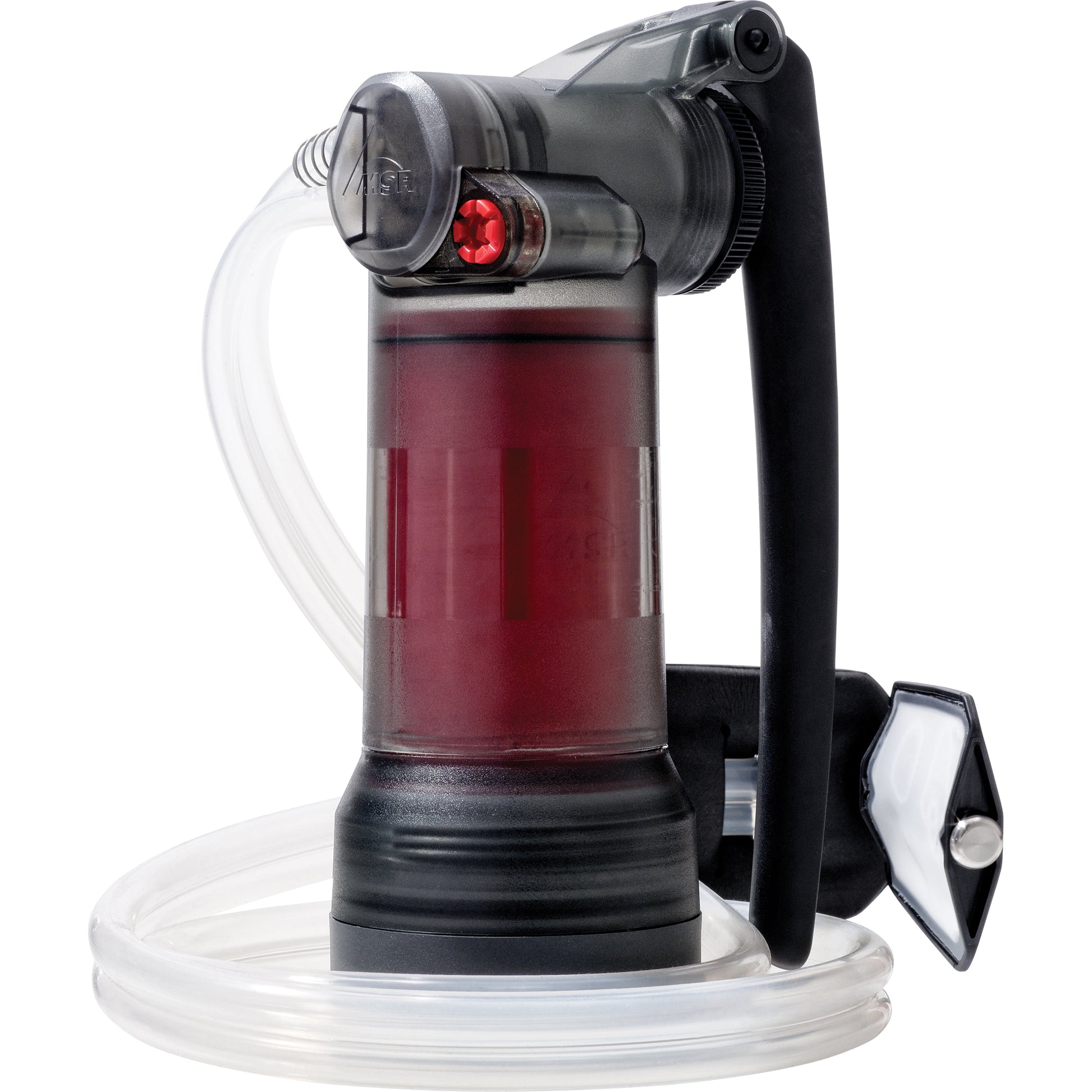
    The MSR Guardian Purifier is engineered for extreme conditions and situations where viral protection is critical, such as international travel to developing countries, disaster relief, or specific wilderness areas known for viral risks. This isn't just a filter; it's a purifier, meaning it removes viruses in addition to bacteria and protozoa. Its robust pump design and advanced hollow fiber techno

    $399.95
    Amazon link coming soon

The bottom line

The Katadyn BeFree remains our top overall pick for 2026, delivering an unmatched combination of flow rate, packability, and ease of use in a robust package. For a budget-conscious alternative that doesn't compromise on safety, the Sawyer Squeeze continues to offer exceptional value and reliability, making it a solid choice for most trips.

Frequently asked

What's the difference between a water filter and a water purifier?

A water filter typically removes bacteria and protozoa, which are larger pathogens, using mechanical methods. A water purifier goes a step further, effectively removing viruses as well, often employing chemical treatments, UV light, or extremely fine filtration. For most backcountry use in North America, a good filter is sufficient, but purifiers offer a higher level of protection.

Do I need to pre-filter turbid water before using my main filter?

Yes, absolutely. Pre-filtering turbid water, even with a bandana or a coffee filter, significantly extends the life of your primary filter cartridge. Silt, sediment, and organic debris clog pores rapidly, reducing flow rate and requiring more frequent backflushing or cleaning. It's a simple step that saves your filter.

Can I use my water filter with saltwater?

No, standard portable water filters are not designed to remove dissolved salts from saltwater. They only remove particulates, bacteria, and protozoa. To make saltwater potable, you would need a desalinator or reverse osmosis system, which are much more complex and expensive for backcountry use.

How do I prevent my water filter from freezing in cold weather?

To prevent freezing, always store your filter in a protected area, such as inside your sleeping bag at night or close to your body during the day. If a filter freezes, the integrity of its membranes can be compromised, rendering it unsafe to use. If freezing is suspected, replace the cartridge.

How often should I replace my filter cartridge?

Filter cartridge replacement depends on the manufacturer's stated capacity, usually measured in liters, and the quality of water you've processed. Even if the flow rate seems good, it's prudent to adhere to recommended replacement intervals. If flow rate significantly diminishes or you notice changes in taste/odor, replace it promptly regardless of stated capacity.