


Research-based film review and historical analysis | Spoilers for the film’s historical outcome
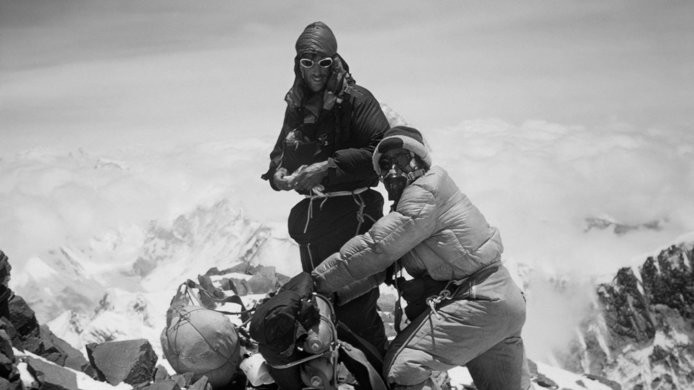
Cover: Edmund Hillary and Tenzing Norgay on Everest’s southeast ridge, 1953. Alfred Gregory © / RGS-IBG; source reproduction © RGS-IBG/Salto Ulbeek. Historical expedition photo, not a film still. Photo source · Low-resolution blog reproduction terms.
Methodology: This is a research-based film-and-history analysis, not a claim of firsthand viewing. Film details and critical observations are drawn from Apple’s official materials and attributed published reviews. Historical claims are checked against expedition accounts, the Royal Geographical Society, the Himalayan Club and biographical sources. Scene-by-scene accuracy still requires direct viewing; no star rating is assigned.
The short verdict
The case emerging from the published reviews is that Tenzing is a worthwhile film, while the real story offers more complexity than a feature-length biographical drama can comfortably contain. Its most important choice is putting Tenzing Norgay at the center of Everest’s first confirmed ascent. Its limitation is the familiar shape of the inspirational biopic: a childhood calling, obstacles, supportive relationships and an extraordinary achievement.
The documented story is not simply that an overlooked man finally received permission to follow his dream. It is that an already exceptional mountaineer brought years of experience to a large, technically demanding expedition, helped another climber survive a dangerous moment, and reached the summit through a partnership that depended on many people who never stood there. The aftermath then turned a shared achievement into competing national stories.
That makes the history more interesting, not less cinematic. It is a story about professional competence, endurance, judgment, labor, trust and who gets remembered.
What movie are we talking about?
Jennifer Peedom’s Tenzing, written by Luke Davies, stars Genden Phuntsok as Tenzing Norgay, Tom Hiddleston as Edmund Hillary, Willem Dafoe as John Hunt, Caitríona Balfe as Jill Henderson and Thinley Lhamo as Dawa. Apple announced select-theater release on October 9, 2026, followed by streaming on October 16. RogerEbert.com lists a runtime of 126 minutes. 2
Film details at a glance
- Director: Jennifer Peedom.
- Screenwriter: Luke Davies.
- Principal cast: Genden Phuntsok, Tom Hiddleston, Willem Dafoe, Caitríona Balfe and Thinley Lhamo; Apple’s announcement also names Tenzin Dalha.
- Format: Dramatized biographical feature, not a documentary.
- Release: Select theaters October 9, 2026; Apple TV October 16, 2026, according to Apple.
- Runtime: 126 minutes, as listed by RogerEbert.com.
- Review approach: Published criticism and historical research; no firsthand viewing claim or star rating.
Official film details · Apple release and cast announcement · Runtime and critical review 1
Apple’s synopsis sets up two connected conflicts: the physical ascent and Tenzing’s fight to be treated as a climber belonging to the British team, rather than a worker serving it. It also contrasts the language of conquering Everest with Tenzing’s reverence for Chomolungma. That is the film’s stated dramatic framing, not independent proof of every conversation it presents. 1
Peedom’s earlier work includes Sherpa and Mountain. That background matters: she approaches the subject with an established interest in mountain landscapes and the people whose work allows others to climb them. But experience with the subject does not turn a dramatized biography into a documentary transcript. 2
Where the film has its strongest footing
1. Tenzing becomes the protagonist, not the supporting character
The biggest correction is a change in perspective. In a simplified Western version of the ascent, Hillary is the adventurer and Tenzing is the Sherpa who accompanies him. A Tenzing-centered film reverses that hierarchy of attention without needing to diminish Hillary’s climbing achievement.
The real Tenzing was a mountaineer with an extensive Everest record. By 1953 he had been on the British expeditions of 1935, 1936 and 1938 and both Swiss Everest expeditions of 1952. Charles Wylie’s later Himalayan Club account describes his energy, judgment and authority within the Sherpa team. He was not an inexperienced local receiving a lucky invitation. 6
That is why Genden Phuntsok’s performance matters to the film’s purpose. Published reviews repeatedly praise his warmth and emotional presence; The Hindu emphasizes the film’s restoration of a legacy overshadowed by colonial recognition. The critical case is not just that the actor makes Tenzing likable, but that the film asks viewers to see him as the owner of his own ambition. 24
2. The mountain is more than a finish line
Apple’s synopsis makes reverence for Chomolungma central to the film. That challenges the convenient adventure-movie assumption that a mountain exists to be defeated. For outdoor readers, this is a useful change of emphasis: place can have cultural and spiritual meaning independent of an outsider’s objective. 1
The caution is not to exchange one cliché for another. Tenzing should not be reduced to a mystical foil for practical Western climbers. His documented expertise included expedition leadership, high-altitude experience and the hard work of sustaining an ascent. Spiritual meaning and professional skill belong in the same portrait. 6
3. The imagery gives the achievement scale
RogerEbert.com praises the mountain imagery and immersive sound, while other reviews identify the visual scale as a major strength. That is an appropriate attraction for an outdoor audience: a well-made mountain film can make exposure, distance and the smallness of a climbing party emotionally legible. 23
Beautiful scenery, however, cannot by itself explain the climb. The historical drama lives in food, oxygen, shelter, weather, fatigue and decisions about when to stop. A landscape can communicate awe; it takes narrative attention to communicate logistics.
4. The relationship is more compelling than a contest
The partnership between Hillary and Tenzing is the film’s natural emotional center. Apple describes two outsiders bound by respect and trust. Historically, the achievement belongs to both men, and the most useful outdoor lesson is interdependence rather than competitive glory. 15
The right question is not merely which man crossed an imaginary finish line first. It is how two climbers became capable of relying on each other at a place where mistakes could be fatal.
Where a good film can feel smaller than its subject
Peter Bradshaw’s Guardian review describes the film as watchable and well-intentioned but “soft-edged.” RogerEbert.com is more enthusiastic about its emotional and spiritual dimensions. That disagreement identifies a productive tension: an accessible, uplifting film can also smooth away the awkwardness that gives a historical life its texture. 23
Published accounts describe a nonlinear film moving among childhood, young adulthood and the mature climber. That can build emotional continuity, but it can also make a complicated career feel like the inevitable fulfillment of an early dream. In reality, Everest was not waiting for one perfectly destined hero. There were changing political routes, accumulated expedition knowledge, failed equipment, previous climbers and difficult reversals. 27
A fair criticism is therefore not “the movie is wrong because it leaves things out.” Every adaptation selects. The better question is whether its selection leaves viewers with an accurate understanding of Tenzing’s expertise and the collective nature of the ascent.
The real story, before 1953
An uncertain beginning, not a perfectly documented origin scene
Tenzing was born in 1914, but accounts disagree about his precise birthplace and aspects of his early life. Biographical traditions place his origins in Nepal’s Khumbu region or Tibet. A responsible history should preserve that uncertainty instead of presenting a neat childhood scene as settled evidence. 9
RogerEbert.com describes a film episode in which young Tenzing encounters George Mallory. That tells us what a reviewer reports seeing. It does not independently verify that the encounter happened as staged. The same distinction applies to intimate dialogue, courtship scenes and private moments that make a biography work as drama. 2
Experience earned over years
The three prewar British expeditions matter because they establish the scale of Tenzing’s experience. Reconnaissance, high-altitude carrying and summit assaults are not interchangeable activities, so simply counting “attempts” can mislead. What is clear is that 1953 was the culmination of a long professional relationship with Everest, not a first expedition transformed into a miracle. 6
His work outside Everest also matters. Wylie records his participation in the French Nanda Devi East expedition in 1951. The summit story becomes richer when we recognize a career rather than treating every earlier year as an introduction to one famous day. 6
1952: the Swiss near-success deserves its own spotlight
The partnership with Swiss climber Raymond Lambert is one of the most important parts of the real story. In spring 1952, Lambert and Tenzing reached roughly 8,600 metres on Everest before turning back. That was extraordinarily close to the summit, but close is not the same as safely attainable. 10
The 1953 expedition account explicitly credits the Swiss with pioneering the Nepalese route above the Icefall and nearly to the South Summit, then sharing their knowledge. The British success was not an isolated discovery. It inherited a practical route and hard-won information. 7
This is also an essential correction to the idea that Tenzing’s central struggle was simply being allowed to climb. He had already climbed very high with the Swiss. Recognition within a particular British hierarchy is one issue; his established standing as a mountaineer is another. The history makes him more capable and consequential than a generic underdog structure might suggest. 610
How the 1953 ascent actually worked
The summit began far below the summit
John Hunt led a staged expedition through the Khumbu Icefall, Western Cwm, Lhotse Face and South Col toward the southeast ridge. The Royal Geographical Society records Base Camp established on April 12, followed by nine further camps. This was a system of acclimatization, route preparation and supply movement, not an unsupported push by two men. 5
The contemporary Himalayan Journal account discusses oxygen, diet, protective clothing and acclimatization as accumulated knowledge underpinning the plan. It describes the establishment of an advanced base and the need to conserve climbers for their assigned work. The expedition’s success was organized before it was celebrated. 7
The Sherpa team was indispensable, not decorative
Wylie describes Hunt’s plan for a team of 35 Sherpas. His retrospective records 19 reaching the South Col, seven of them twice, and high-altitude loads that placed shelter, food and oxygen within reach of the summit parties. These are figures from that account, not a claim that every contribution can be reduced to a number. 6
Tenzing served as sirdar, the senior Sherpa leader and organizer, as well as a summit climber. The distinction matters. He had responsibility and authority, not merely a supporting role in somebody else’s adventure. And the other Sherpas deserve recognition as people doing consequential work, not an anonymous background workforce. 69
“Sherpa” also refers to an ethnic community; it should not be used as if it simply means anyone hired to carry a load. Precise language is part of giving the participants their due.
The first summit pair turned back
On May 26, Charles Evans and Tom Bourdillon reached the South Summit but did not continue to the main summit. The RGS account emphasizes that there was not enough time to complete the climb, and they returned. 5
That is not a disposable failure scene. It is part of the successful expedition. A retreat preserves lives, supplies information and keeps an objective from becoming an excuse to ignore limits. For an outdoor audience, judgment deserves at least as much attention as ambition.
The last high camp depended on other climbers
On May 28, Hillary and Tenzing established Camp IX at a reported 27,900 feet with support from George Lowe, Alfred Gregory and Ang Nyima. Their companions then descended. Giving those names space changes the image of the final push: the pair’s isolation was the end of a chain of assistance, not proof that they had done everything alone. 5
The RGS account records the pair rising at 4 a.m., leaving at 6:30 with open-circuit oxygen and reaching the South Summit at about 9. They negotiated the final rock-and-ice obstacle later known as the Hillary Step and reached the summit at approximately 11:30 a.m. on May 29, 1953. These times are reported historical details, not a timetable for contemporary climbers. 5
The famous summit photograph shows Tenzing; Hillary took it. It is a small but powerful detail: a history often narrated through Hillary also preserves Tenzing as its central visual figure. 8
The ascent is the first confirmed successful summit. That wording leaves room for the unresolved history of earlier climbers without turning speculation about Mallory and Irvine into an established alternative result.
Who reached the summit first?
The secure historical conclusion is a joint achievement by Hillary and Tenzing on May 29. Public arguments over the order of their final steps became entangled with national pride and competing ideas of credit. Later accounts of exact sequence should be attributed to their authors, not converted into an all-purpose verdict on whose achievement mattered more. 511
Even if a reader accepts a particular account of the final footsteps, that does not turn the second person into a passenger. The climb was a partnership and the expedition was a collective undertaking. The obsession with first place can obscure the much more significant story of mutual dependence.
The part after the summit may be the most revealing
News reached Britain in time for the June 2 coronation celebrations. An expedition organized through British institutions became a national symbol, but its meaning was not exclusively British. Tenzing’s recognition also carried significance in Nepal and India, while Hillary was a New Zealander. The achievement had multiple owners in public imagination. 11
A contemporaneous New Yorker profile describes the publicity and political pressures surrounding Tenzing. This is useful evidence of the aftermath, although it is an outside journalist’s account and should be read with that perspective in mind. Becoming famous did not automatically mean controlling the story told about you. 12
Nor did Tenzing’s meaningful life stop at Everest. The Himalayan Mountaineering Institute was founded in Darjeeling in 1954; he became its field-training leader. The Nehru Archive records his service there from 1954 to 1976. Teaching others is a substantial legacy, not an epilogue to the “real” achievement. 913
Movie and history: the distinctions to keep clear
| Topic | Film framing or reported treatment | What the historical record adds |
|---|---|---|
| Tenzing’s ambition | A lifelong calling, developed through biographical episodes | Early-life details have uncertainty; his competence was built through a long career |
| Joining the team | Apple emphasizes a struggle to belong rather than merely serve | He had already been a major climber with the Swiss and was the 1953 expedition’s sirdar |
| The mountain | Spiritual reverence contrasted with conquest | Cultural meaning and practical expertise coexist; neither needs to cancel the other |
| The summit | A powerful partnership between two protagonists | Many named climbers and Sherpas supplied, supported and enabled the final ascent |
| Private scenes | Relationships and dialogue make the biography legible | A scene is not verified history solely because it is emotionally convincing |
| Recognition | Restoring Tenzing to the center is the film’s corrective purpose | The aftermath involved empire, nationality, publicity and a long teaching career |
The film column draws on Apple and named reviews; the history column draws on the expedition and biographical sources cited above. This is a comparison of documented framing, not a certified list of film errors.
Jill Henderson’s specific intervention, and the film’s childhood Mallory encounter, require independent historical corroboration before being described as events that happened exactly as shown. Lack of corroboration here is not proof of fabrication; it is a reason to label the distinction honestly.
What outdoor people can take from the story
Competence accumulates. The summit came after years of work, not from confidence alone.
A retreat can be sound judgment. The Swiss near-success and the first 1953 summit pair’s return make the story more valuable than a simple lesson about refusing to quit.
Logistics are part of the adventure. Shelter, food, oxygen, acclimatization and support are not distractions from achievement. They are conditions that make achievement possible.
Partnership is more important than publicity. A trusted climbing partner and a capable team matter more on the mountain than the eventual headline.
Name the people who made it possible. Guides, local experts, high-altitude workers and supporting climbers should not disappear when an expedition becomes a heroic story.
These are historical lessons, not Everest instruction. Anyone planning high-altitude travel needs current professional guidance, regulations and a trip-specific assessment—not a route inferred from a movie or a 1953 account.
Final verdict: worth watching, worth reading beyond
The strongest argument for Tenzing is that it redirects attention toward a person whose full achievement deserves it. Its reported visual power and Phuntsok’s widely praised performance give viewers a compelling entrance to the subject. The reservation is that the real story resists being reduced to a smooth arc of destiny and recognition. 234
The history is better because it is more crowded, more uncertain and more practical: a long apprenticeship, a remarkable Swiss partnership, an expedition built on predecessors, high-altitude labor by a whole team, two men depending on each other, and a summit immediately pulled into the politics of credit.
Watch the film for the human connection. Read the real story for the full achievement. Tenzing was not simply the man beside Hillary. He was a mountaineer whose experience, leadership and partnership helped make the ascent possible.
Sources and further reading
- Apple TV Press: Tenzing and official trailer/release announcement.
- Cortlyn Kelly, RogerEbert.com: Tenzing review.
- Peter Bradshaw, The Guardian: Tenzing review.
- Ayaan Paul Chowdhury, The Hindu: Tenzing review.
- Royal Geographical Society: Everest 1953 expedition narrative and photographs.
- Charles Wylie, Himalayan Journal: Tenzing Norgay 1914–1986 and the Sherpa Team.
- Himalayan Journal: Everest, 1953, contemporary expedition account.
- Royal Geographical Society: Mount Everest, identifying the summit photograph.
- Nehru Archive: Tenzing Norgay; Oxford Dictionary of National Biography.
- Himalayan Mountaineering Institute: Legendary mountaineers, including the 1952 Lambert–Tenzing high point.
- Peter H. Hansen: Confetti of Empire, on the expedition’s imperial and national reception; NZ History: Everest summit.
- The New Yorker: Tenzing of Everest, June 5, 1954.
- Himalayan Mountaineering Institute: Origin and growth.