


15 skills
Food
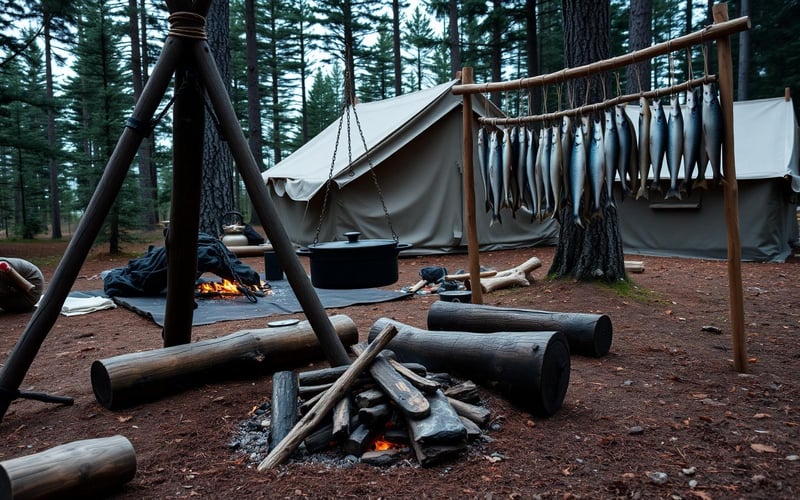
45 minCamp Cooking Tripod: The Definitive Guide
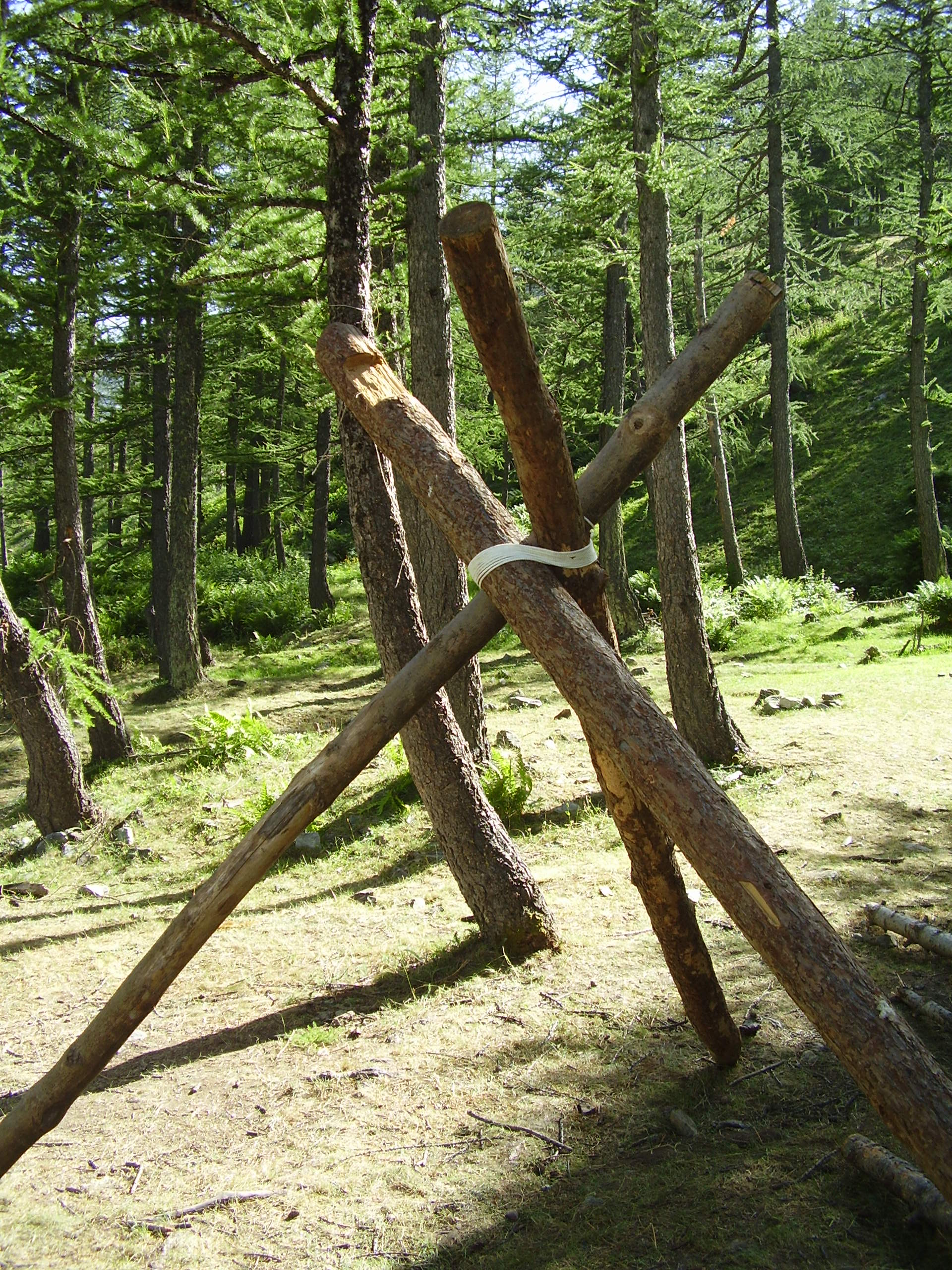
Choose poles, tie a tripod lashing, raise a stable tripod over the fire and hang a pot at the right height with a chain, pot hook or adjustable trammel.
- Select three sound, straight poles of similar length and thickness; trim side branches flush and test each by flexing—reject punky or cracked wood.
- Lay the poles side by side on the ground, butts even. Reverse the middle pole so its top points the other way, leaving the tops overlapping by about 18 in (45 cm).
- About 12–18 in (30–45 cm) from the top, tie a clove hitch around one outer pole and tuck the short tail under the first wraps.
Tip: Tie the tripod on the ground away from the fire, then carry it over. Spread the legs so one leg points into the prevailing wind; the pot can then swing away from you, not into you.
Warning: Do not hang a pot from cordage that sits directly in the smoke and heat column—use a chain or wire for the final stretch over the flames.

Food
15 minSet a simple wire snare
A well-placed snare beats a well-tied one. Read the trail before you set anything.
- Find a fresh, narrow game trail — droppings, tracks, low-brushed vegetation.
- Choose a natural pinch point where brush forces animals through single-file.
- Form a loop in snare wire the size of a fist for rabbits, larger for bigger game.
- Suspend the loop over the trail so the bottom sits at the animal's chin height.
- Anchor to a sapling or heavy branch. Brush around the loop so animals can't sidestep.
Warning: Check local law — snaring is regulated everywhere and prohibited in many places outside survival need.
Clay Hayes — 5 Survival Traps & Snares

Food
20 minIdentify wild edibles safely
You don't have to know every plant — you have to know a few, cold.
- Learn 5-10 edible species in your home region with 100% ID confidence — leaf, stem, fruit, and habitat.
- Learn their toxic look-alikes at the same time.
- Positive ID means multiple features match, not just one.
- Never rely on the Universal Edibility Test in the field — it's slow, error-prone, and can hurt you.
- When in doubt, leave it out.
Warning: Some deadly plants (water hemlock, false hellebore, death camas) resemble common edibles. Guess = don't eat.
Robin Greenfield — Easy Edible Plants

Food
30 minFish with a hand line
A hand line and a hook out-fish most improvised setups.
- Wrap 30-50 ft of line around a smooth stick or bottle to keep it tangle-free.
- Tie on a small hook and a stone or split-shot for weight.
- Bait with grubs from under bark, worms from wet soil, or minnows caught with a shirt seine.
- Cast underhand from cover; let the bait sink to where fish hold — undercut banks, log jams, current seams.
- Set the hook with a firm wrist snap the moment you feel the tap.
Tip: Fish are more active at dawn and dusk. If nothing hits in 15 minutes, move.
Fishing Yoyito — Simple Hand Reels
Food
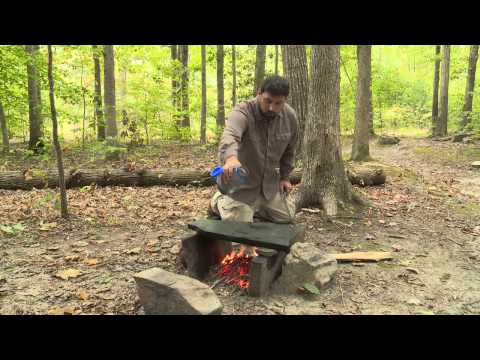
20 minCook on a hot rock
A flat, dry rock in the coals is a griddle for fish, meat, and bannock.
- Pick a flat, dry rock from well above the waterline — never from a stream or lakeshore.
- Bury it in the fire's coals for 20 minutes so it heats evenly.
- Brush off ash. Test with a drop of water — it should sizzle and skip.
- Lay fish or meat directly on the rock; flip once when the underside releases cleanly.
Warning: Wet or river rocks trap steam and can explode in a fire.
Outdoor Life — Cook Food on a Rock

Food
20 minUse cattail as an emergency food
Cattail is one of the most calorie-rich wild foods on the continent — the 'supermarket of the swamp' — and edible in all four seasons.
- Positively identify cattail: tall bladed leaves and the distinctive brown hot-dog seed head. It grows only in shallow standing fresh water.
- In spring, peel young shoots at the base and eat the tender white core raw or cooked like leek.
- In late spring, boil the green immature flower heads like corn on the cob.
- In summer, collect the yellow pollen by shaking flower heads into a bag and use it as a flour extender.
- In fall and winter, dig the starchy rhizomes, peel, and either roast whole or crush in water to separate the starch.
Warning: Only harvest cattail from clean water. Cattail bioaccumulates heavy metals and agricultural runoff from polluted sources.
Food
25 minSet a figure-four deadfall trap
A simple three-stick trigger drops a heavy weight when a small animal disturbs the baited trigger stick.
- Cut three sticks: a vertical post, a diagonal, and a horizontal trigger — each about pencil-thick and 6–8 inches long.
- Cut a chisel point on top of the post, a matching notch on the top of the trigger, and a locking notch where the diagonal crosses the post.
- Assemble so the diagonal locks between the post's chisel point and the trigger's notch, holding a flat weight (rock, log slab) above.
- Bait the outboard end of the trigger with something the target animal actively seeks in the current season.
- Set several traps along runs and near feeding sign — check at least twice daily and dispatch caught animals immediately.
Warning: Trapping laws vary widely. In non-survival conditions, only trap where legal, in season, and with a valid license.
Food
15 minGut and clean a small game animal
Cleaning a squirrel or rabbit within an hour of the kill prevents spoilage and gets useful meat off a small carcass.
- Make a shallow cut through the skin and belly wall from breastbone to pelvis, careful not to puncture the gut.
- Reach in, sever the diaphragm around the ribcage, and pull all internal organs out in one connected mass.
- Cut around and remove the anus and any waste-carrying tissue with a clean margin.
- Rinse the body cavity thoroughly with clean water and let it drain.
- Skin by pulling firmly toward the head or tail depending on species, then quarter and cook thoroughly.
Warning: Never eat any animal that looked sick, had visible parasites, ulcers, spots on the organs, or unusual smell. Cook all wild meat well-done.
Food
45 minBuild a fish basket trap
A conical willow basket set in a narrow channel can catch panfish, minnows, and crayfish while you attend to other tasks.
- Cut a bundle of long, flexible willow or dogwood switches.
- Bind one end of the bundle tight, then splay the switches into a cone shape and weave horizontal ribs around them.
- Weave a second, smaller cone that fits inside the mouth of the first, opening inward — this is the funnel that lets fish in but not out.
- Set the trap in a narrow channel, at an eddy tail, or in the outflow of a beaver dam, with the funnel facing upstream.
- Bait with crushed grasshoppers, worms, or fish scraps and check every 4–6 hours.
Warning: Fish traps are illegal in most jurisdictions outside a documented survival emergency. Know your local laws before setting one.
Food
20 minImprovise a fishing hook
A gorge hook or thorn hook can catch panfish and small trout when you have no store-bought tackle.
- Gorge hook: cut a straight sliver of hardwood 1–2 inches long, sharpen both ends, and notch the center so line ties around it.
- Bait with a worm, grub, or insect so the gorge is hidden lengthwise inside the bait.
- When a fish swallows the bait, it also swallows the gorge; a firm pull rotates it crossways in the throat.
- Alternatively, use a strong thorn tied to a stem so the thorn projects at an angle — same principle as a J-hook.
- Set multiple lines and check often; improvised hooks work but they lose fish that manufactured hooks would hold.
Warning: Improvised fishing techniques are only legal in a documented survival emergency in most areas. Know local regulations.
Food
180 minCook in an earth oven
An earth oven bakes fish, roots, and meat with steady buried heat — no pot required and impossible to burn dinner.
- Dig a pit about twice the size of what you're cooking, and line the bottom and sides with fist-sized rocks.
- Build a hot fire in the pit and burn it hard for 60–90 minutes until the rocks are glowing.
- Rake out any large embers, lay a thick pad of green leaves or grass over the rocks, then place food (wrapped in more leaves) on the pad.
- Cover with another thick pad of green vegetation, then a layer of dirt sealing all air.
- Wait 2–4 hours — small fish and roots take about 2 hours; meat takes 3–4. Open only when ready to eat, since opening halts cooking.
Tip: Add a stick as a poker before you seal the oven. Pull it out to check without disturbing the whole cover.

Food
120 minProcess acorns into edible flour
Acorns are a high-calorie staple once the bitter tannins are leached out.
- Collect ripe acorns and discard any with holes, mold, or dark stains.
- Shell them by cracking with a rock or hammer, then remove the papery skins.
- Grind the nutmeats into coarse meal using a mortar and pestle, two stones, or a blender at home.
- Leach the tannins by placing the meal in a cloth bag and running cold water through it until the water no longer tastes bitter.
- Spread the meal to dry, then use as flour for porridge, bread, or pancakes.
Warning: Unleached acorns are high in tannins and will cause nausea. Taste-test the water runoff — if it's bitter, keep leaching.
Insteading — Eating Acorns: Forage, Store & Cook
Food
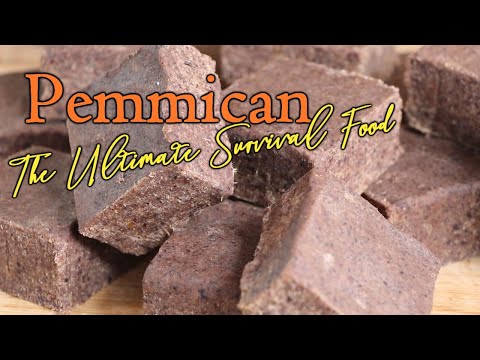
180 minMake pemmican
Pemmican is dried meat, rendered fat, and sometimes berries — a shelf-stable, calorie-dense food that lasts for months.
- Dry lean meat into jerky until it cracks, not bends.
- Pound the jerky into a fine powder or shred it as fine as possible.
- Render fat slowly over low heat until the liquid is clear and the solids have separated.
- Mix the dried meat with hot rendered fat at roughly 1:1 ratio by weight; add dried berries if you have them.
- Pack into a mold or bag while warm, then cool until firm.
Tip: The fat must fully coat every particle of meat to exclude air and prevent spoilage. Cut open a test piece — no dry meat should be visible.
2 Guys & A Cooler — Making Pemmican

Food
15 minBrew pine needle tea
Pine needles are rich in vitamin C and make a warming tea when you need a morale boost in the cold.
- Positively identify a pine or fir tree — needles grow in bundles of two to five for pines, flat and single for firs.
- Avoid yew, Norfolk Island pine, and ponderosa pine, which can be toxic.
- Collect a small handful of fresh green needles from young growth.
- Chop the needles and steep them in hot — not boiling — water for 5–10 minutes.
- Strain and drink. The flavor is citrusy and resinous.
Warning: Pregnant women should avoid pine needle tea. When in doubt about the species, don't drink it.
Off The Path Learning — White Pine Needle Tea
Food
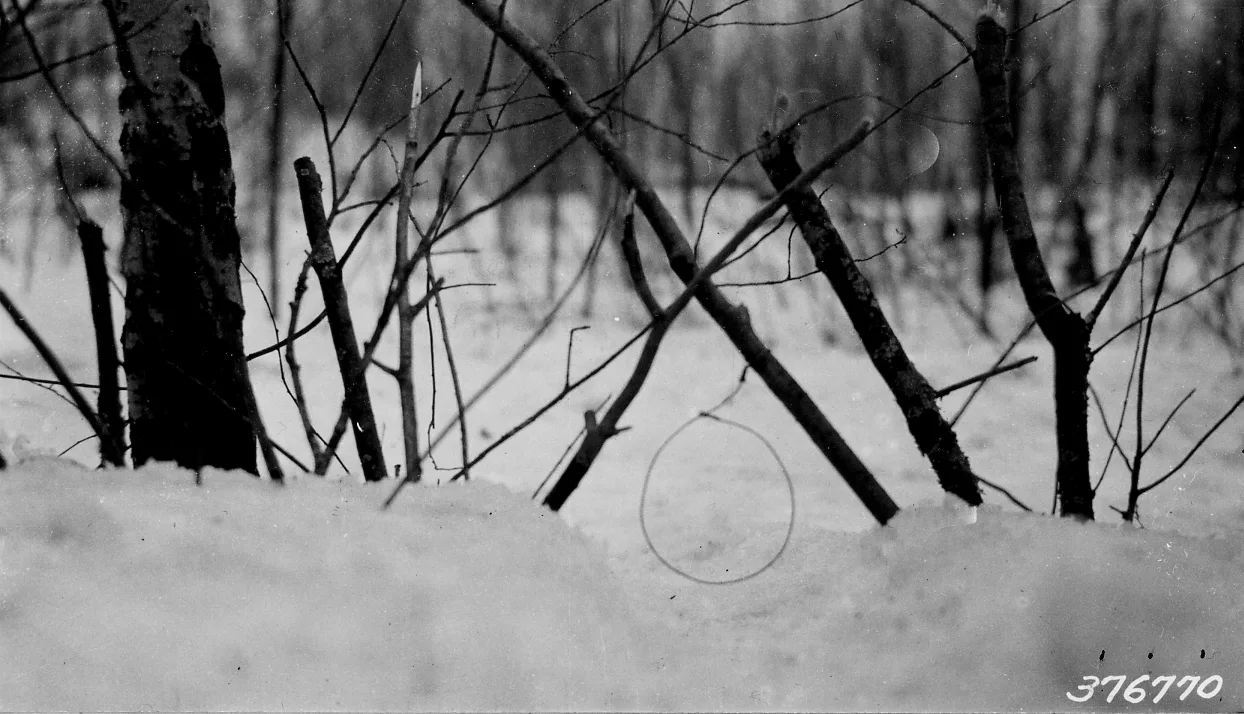
10 minSimple Wire Snare for Small Game
Learn to construct and deploy a basic wire snare for small game. This guide covers setup on a game trail, emphasizing ethical considerations.
- Identify an active game trail, indicated by tracks, droppings, and worn paths.
- Cut a length of snare wire (2-3 feet) and form a self-tightening loop using a simple twist or creating a small eyelet.
- Construct a support stick (a Y-shape or notched stick) to hold the snare loop at the correct height.
- Position the snare loop vertically over the trail, ensuring the bottom of the loop is 2-4 inches from the ground.
- Anchor the loose end of the snare wire to a sturdy tree or stake, ensuring it's secure enough to hold a struggling animal.
- Camouflage the snare setup, removing any debris or scent that might alert the animal.
- Check the snare frequently (at least every 24 hours) to retrieve any captured animals promptly.
Tip: When setting multiple snares, always place them along a run where convergence or natural pinch points are present, increasing the odds of success.
Warning: Snaring small game is illegal in many regions; always confirm local regulations before deploying. This skill is for survival situations only.


Before you head out
Put the lesson in context with our print-ready fieldcraft guides, compare outdoor equipment, and explore wilderness destination guides.
Educational reference only. Wilderness conditions change fast — practice in low-stakes settings, take a certified wilderness first-aid course, and confirm regional regulations (fire, fishing, foraging, snaring) before you rely on any of these skills in the field.