



#4 on this list
Heavy Duty
1Up
The 1Up Heavy Duty has developed a devoted following among backcountry drivers, mountain bikers, and gear purists who value all-metal industrial durability over plastic fairings. Machined and assembled in the United States, this hitch rack is constructed almost entirely of raw, anodized aluminum and stainless steel hardware. It is built specifically for users who venture down rutted Forest Service roads where plastic levers and spring-loaded pivots can crack or rattle apart. Rather than using a front hook and a rear wheel strap, the 1Up utilizes two slotted aluminum arms that pivot upward to clamp both tires simultaneously. This dual-arm approach keeps the entire rack free of frame contact while centering the bike directly over the aluminum tray. At 47 pounds for the base dual-bike configuration, it is lighter than most heavy-duty steel competitors while offering an unmatched modular design: riders can bolt on single-bike expansion trays as their group size changes. Operation requires a brief learning curve. Releasing the stepped sliding arms involves pulling an under-tray lever that can feel stiff until you master the leverage angle, and the rack does not come with integrated cable locks out of the box (relying instead on separate wheel locks). Additionally, the minimalist, machined-edge aesthetic looks distinctly utilitarian compared to the sleekly molded consumer competition. **Highlights** - All-aluminum and stainless steel construction with zero plastic wear parts - Dual-arm design clamps both tires without touching frame or fork - Modular design supports bolt-on add-on trays - Exceptional departure clearance for high-clearance off-road vehicles - Expander-ball hitch mechanism eliminates receiver rattle **Watch-outs** - Release lever mechanism requires finger strength and a practiced technique - No integrated cable locks; requires separate padlock accessories - Bare-metal, industrial look lacks the refined styling of mass-market brands
- Price
- Check current price
- Reader rating
- No reader votes yet
- How we assessed it
- Specification researched
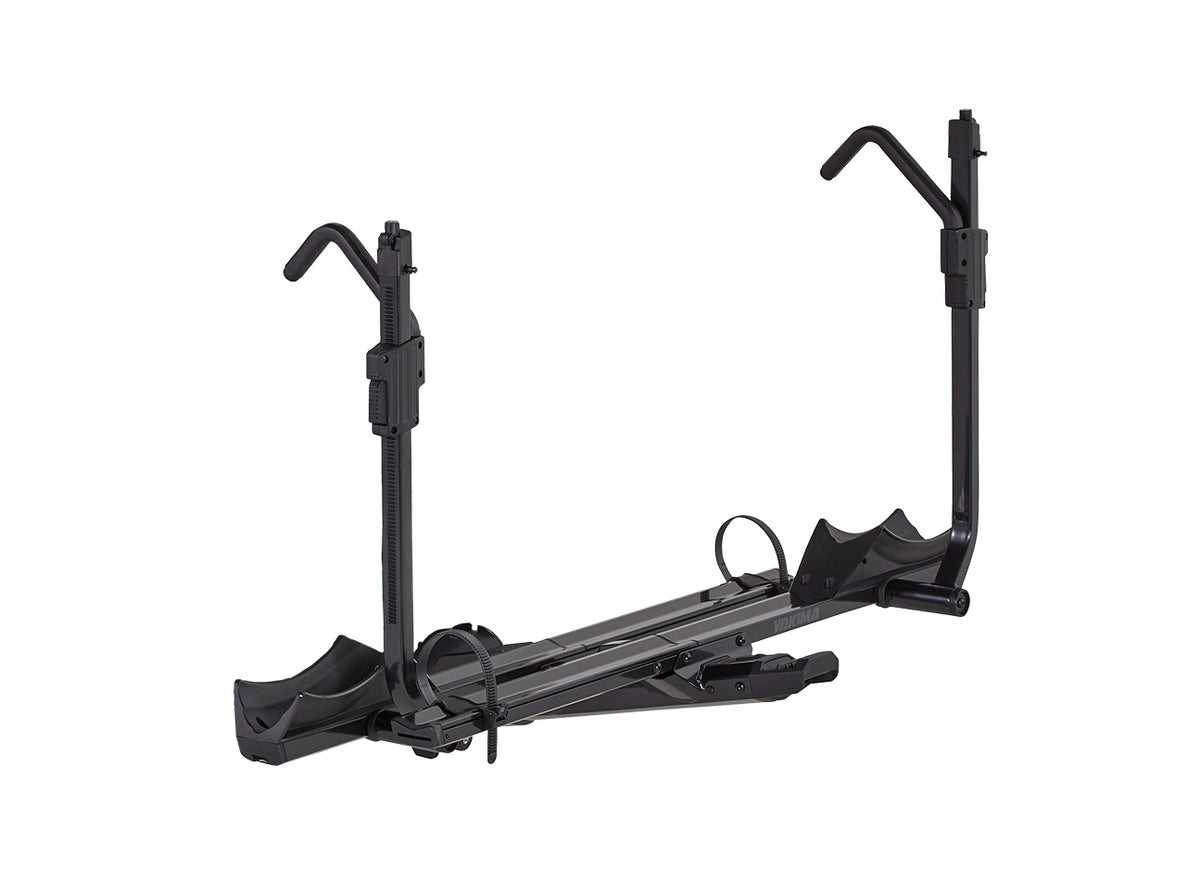
#5 on this list
StageTwo
Yakima
The Yakima StageTwo is built specifically for the realities of modern cycling: heavier electric mountain bikes, extended wheelbases, and wide fat-bike tires. Designed for outdoor travelers, RV owners, and e-bike enthusiasts, this burly platform carrier focuses on maximum load stability and eliminating bike-to-bike interference. Its staggered tray geometry steps bikes at different heights and allows side-to-side tray adjustment, ensuring handlebars and seatposts never grind against each other on transit. Testing across overland and outdoor publications emphasizes the StageTwo’s high load ratings and off-pavement composure. When mounted to a standard 2-inch receiver, it handles substantial weight per tray, making it one of the few platform carriers approved for use on travel trailers and RVs (which subject racks to extreme whip forces). Yakima’s heavy-duty front-wheel ratchets operate with solid clicks, and integrated steel locking cables route through both the frame and rear wheel for solid trailhead security. All of this stability comes at the cost of immense weight. Tipping the scales at 66 pounds unloaded, the StageTwo is a beast to carry from the garage to the bumper. Its wide base also extends the vehicle’s footprint significantly, which can obstruct backup cameras and rear parking sensors even when folded upright. The roughly $950 retail tag places it firmly in the premium category. **Highlights** - Tiered stadium seating prevents handlebar-to-saddle interference - High weight capacity per tray rated for heavy e-bikes and RV use - Fully integrated heavy-duty locking cables for frames and wheels - Side-to-side tray adjustability provides custom bike spacing - Accommodates wide fat tires and long modern wheelbases **Watch-outs** - Extremely heavy 66-pound frame makes mounting a multi-person job for many - High price point near $950 before adding optional ramps - Bulk easily obscures rear vehicle cameras and parking sensors
- Price
- Check current price
- Reader rating
- No reader votes yet
- How we assessed it
- Specification researched
Specs side by side
| Spec | Heavy Duty | StageTwo |
|---|---|---|
| Base Weight | 47 lbs | — |
| Standard Capacity | 2 bikes (expandable up to 4) | — |
| Receiver Compatibility | 2-inch hitch receiver | — |
| Frame Contact | Zero (clamps tires only) | — |
| Primary Materials | Anodized aluminum and stainless steel | — |
| Origin | Machined and assembled in the USA | — |
| Rack Weight | — | 66 lbs |
| Carrying Capacity | — | 2 bikes (expandable to 4) |
| Hitch Sizes | — | 2-inch or 1.25-inch variants |
| Max Tire Width | — | Up to 5 inches |
| RV Compatibility | — | Rated for RVs and trailers (2-inch model) |
| Security | — | Integrated SKS cable locks and hitch lock |
What our reviewers liked and didn't
Heavy Duty
- All-metal aluminum and stainless construction eliminates plastic failure points
- Dual-arm retention secures bikes firmly without touching frame or fork
- Stepped tray geometry preserves vehicle departure angle on rough roads
- Modular architecture allows adding or removing individual bike trays
- Arm releases and tilt bar require an awkward reach beneath the trays
- Lacks integrated locking cables in the standard base package
- Requires a proprietary hex tool to install and remove from the hitch
StageTwo
- Approved for RV and travel trailer use on 2-inch receiver models
- Tiered stadium tray design prevents handlebar and saddle interference
- Accommodates tires up to 5 inches wide and wheelbases up to 52 inches
- Integrated heavy-duty cable locks secure both frame and wheels
- At 66 pounds unloaded, installation and removal require significant effort
- Large folded footprint frequently blocks vehicle backup cameras and sensors
- Lacks built-in transport wheels found on some competing heavy carriers
Prices change constantly — the figure shown is the last verified catalog price, and the buy buttons always go to the current listing.