


T2 Pro XTR vs RidgeBack
Our #1 and #2 picks from The 10 Best Bike Racks, compared spec-by-spec with clear pros, cons, and a verdict.
Choosing between the Thule T2 Pro XTR and the Yakima RidgeBack fundamentally comes down to the classic rack architecture debate: premium platform versus economical hanging style. Hitch-mounted racks sit at the core of any cyclist's road-trip setup, but your bike quiver dictates your needs. The Thule T2 Pro XTR is a heavy-duty platform rack engineered to cradle bikes solely by their wheels, eliminating any frame contact. This design makes it a sanctuary for delicate carbon frames, slacker mountain bikes, and beefy electric bikes with weights up to sixty pounds each. In contrast, the Yakima RidgeBack utilizes a traditional hanging mast with rubber cradles and ratcheting straps, offering a budget-conscious, high-capacity transport solution capable of carrying up to four bikes straight out of the box. While the RidgeBack cuts down on initial cost and physical bulk, it struggles with non-traditional frames and heavy payloads, requiring top-tube adapters for step-through or modern full-suspension designs. We put these two hitch workhorses head-to-head across build quality, vehicle ergonomics, ease of loading, and day-to-day usability to help you invest wisely.
T2 Pro XTR
Thule

The Thule T2 Pro XTR sits at the top of the category because it consistently solves the biggest headaches of hitch-rack ownership: ground clearance, bike stability, and off-vehicle mobility. It is aimed at mountain, road, and gravel cyclists who want a secure, zero-frame-contact platform capable of withstanding rough access roads. Thule equips the carrier with small integrated wheels on the base, which makes rolling this hefty steel-and-aluminum rack between your garage and vehicle hitch remarkably painless. In field assessments across major review outlets, the T2 Pro XTR earns top marks for its ergonomic tilt lever. Located on the outer handle rather than hidden underneath near the hitch receiver, the tilt mechanism lets you drop the loaded rack away from your vehicle with one hand to open rear hatches. The ratcheting front-wheel arms swing wide and clamp down firmly over tires up to five inches wide, while deep rear wheel cradles eliminate side-to-side wobble on rough terrain. Trade-offs are mostly tied to footprint and price. At roughly $900, it represents a substantial investment, and the assembly is heavy enough that users without mechanical confidence may find initial setup tedious. While the integrated transport wheels help, lifting the unit into the receiver still takes reasonable strength. Over years of use, plastic components on the ratcheting levers require basic cleaning to keep road grime from binding the internal springs. **Highlights** - Integrated rolling wheels for easy transport and storage - Ergonomic tilt lever positioned at the rack's exterior - Tool-free AutoPin and locking hitch cam system - Accommodates tire widths from road slicks up to 5-inch fat tires - Integrated cable locks secure bikes directly to ratcheting arms **Watch-outs** - Significant overall weight makes hitch insertion physically demanding - Premium price point near the top of the standard hitch class - Cable locks offer basic deterrent but remain vulnerable to heavy bolt cutters
Find it on AmazonRidgeBack
Yakima
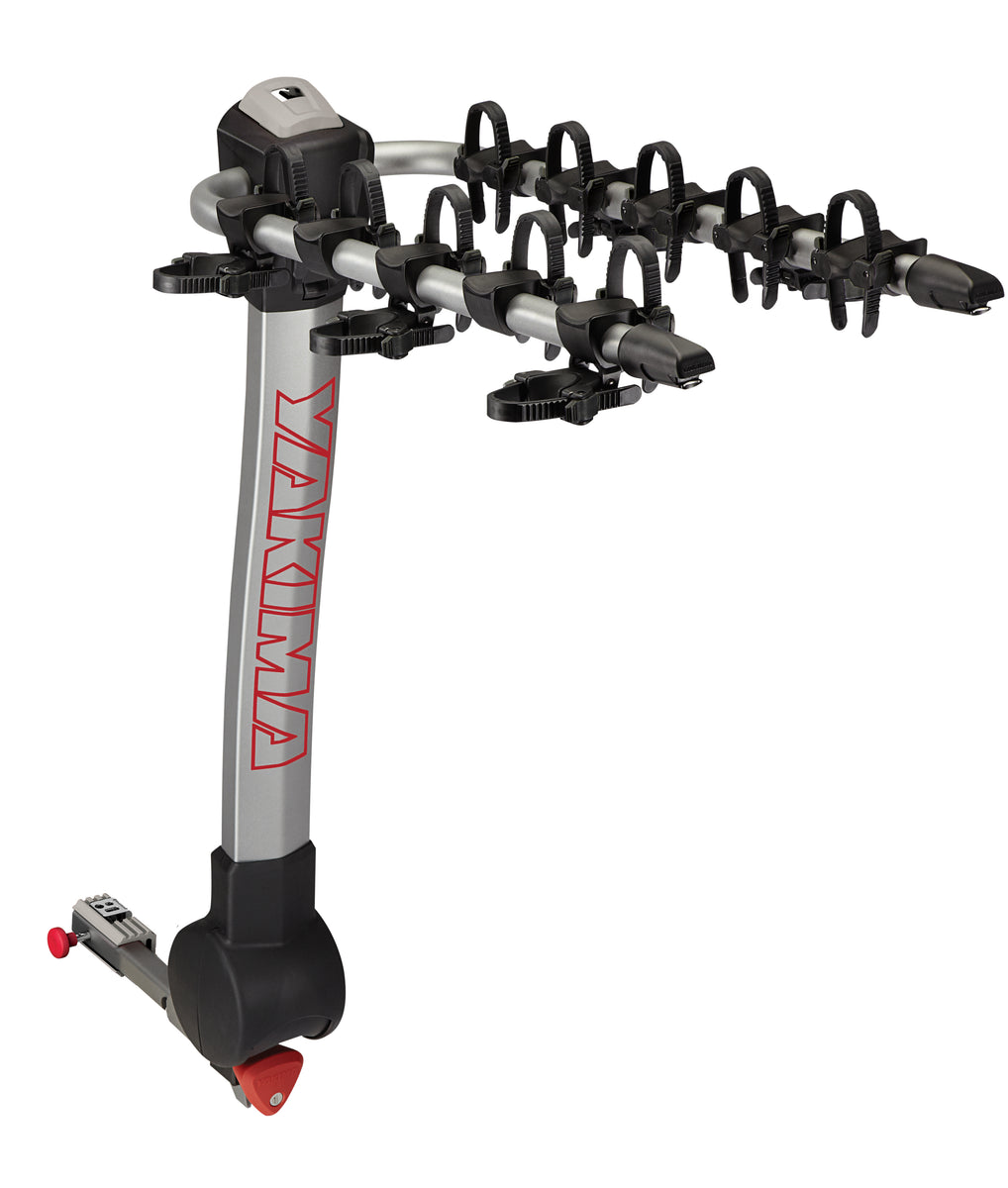
The Yakima RidgeBack targets families, casual cyclists, and camping groups needing to haul up to four bikes without spending four figures on an oversized tray system. Weighing around 35 pounds, it is substantially lighter and far easier to install or store in a closet than multi-bike platform racks. It operates via a traditional hanging mast, supporting bikes by the top tube using soft rubber cradles and ratcheting straps that hold frames in place during transit. Reviewers consistently praise the RidgeBack for its tool-free SpeedKnob hitch installation, which expands an internal wedge inside the receiver to eliminate wobble without requiring wrenches. Anti-sway cradles clip onto vertical frame tubes to minimize the front-to-back pendulum motion typical of older hanging designs. When bikes are removed, the dual support arms fold down flat against the mast with a single upper latch, keeping the vehicle compact for parallel parking or garage clearance. Because it is a hanging rack, the RidgeBack has inherent limitations compared to tray-style platforms. Step-through frames, kids' bikes, and modern full-suspension mountain bikes with horizontal rear shocks often require separate top-tube adapter bars to sit level. Furthermore, because bikes hang in close proximity, pedals and wheel rims can rub against adjacent frames unless you use supplementary bungee cords or padding on bumpy dirt roads. **Highlights** - Lightweight 35-pound build simplifies seasonal vehicle installation - Tool-free SpeedKnob locks rack securely to hitch receiver - Folding support arms reduce rear profile when unloaded - Upper-mast tilt lever provides rear tailgate access - Anti-sway cradles limit contact between bikes **Watch-outs** - Requires separate top-tube adapter bars for step-through and many full-suspension bikes - Bikes can swing into each other on uneven dirt roads without extra strapping - Upper arms can be a tight squeeze for four modern, wide-handlebar mountain bikes
Find it on AmazonSpec-by-Spec
| Spec | #1 T2 Pro XTR | #2 RidgeBack |
|---|---|---|
| Weight | 52.0 lbs | 35.0 lbs (4-bike configuration) |
| Capacity/Size | 2 bikes (expandable to 4); up to 60 lbs per bike (120 lbs total) | 4 bikes; 37.5 lbs per bike (150 lbs total) |
| Materials | High-strength steel chassis with aluminum trays | Reinforced tubular steel with rubber cradles |
| Price tier | Premium tier ($800–$900) | Mid-range tier ($380–$450) |
| Warranty | Limited Lifetime | Limited Lifetime |
| Best use | E-bikes, carbon road bikes, long-travel mountain bikes, and fat bikes | Standard road, hybrid, and lightweight hardtail bikes for family travel |
| Portability | Integrated rolling wheels for garage transport; cumbersome to lift | Lightweight mast; compact and easily lifted by one person |
| Durability | Exceptional; corrosion-resistant coatings with heavy-duty pivots | High; durable powder-coated steel with replaceable rubber ZipStrips |
| Feature highlights | Zero frame contact, integrated wheels, HitchSwitch tilt lever, integrated cable locks | SpeedKnob tool-free installation, UpperHand tilt lever, anti-sway ZipStrips, integrated bottle opener |
T2 Pro XTR
Best for: Serious mountain, gravel, or e-bike riders prioritizing pristine frame care and effortless bike loading.
Pros
- Zero frame contact protects fragile carbon fiber finishes and complex tube profiles
- High weight capacity accommodates modern electric bikes up to 60 pounds per tray
- Integrated rolling wheels ease garage-to-vehicle transport despite heavy base weight
- Wide tray spacing and side-to-side adjustability eliminate bike-to-bike contact
Cons
- Significantly higher initial financial investment compared to hanging models
- Heavy 52-pound chassis can be difficult to lift into the hitch receiver
- Requires purchasing an expensive two-bike add-on module to transport four bicycles
RidgeBack
Best for: Families and budget-minded road cyclists needing to transport up to four standard-frame bikes easily.
Pros
- Substantially lighter weight makes installation and seasonal removal effortless
- Carries up to four bikes immediately without needing an expensive expansion kit
- Tool-free SpeedKnob mechanism locks the rack firmly into the hitch receiver with zero play
- Far more economical purchase price for families and casual riders
Cons
- Hanging design requires separate crossbar adapters for step-through or modern full-suspension bikes
- Weight limit of 37.5 pounds per bike precludes almost all modern e-bikes
- Bikes can sway and make contact with each other on rough or undulating roads
The Verdict
The Thule T2 Pro XTR takes the overall victory as the far more capable, modern, and bike-friendly carrier. Although it commands a steep premium and adds noticeable mass to your vehicle's tongue, its platform layout delivers zero frame contact, rock-solid stability at highway speeds, and essential compatibility with heavy e-bikes, slack enduro rigs, and carbon aero frames. The integrated transport wheels soften the blow of its 52-pound heft, making off-vehicle logistics manageable. The Yakima RidgeBack remains an admirable, cost-effective choice for households hauling traditional diamond-frame bikes, offering four-bike carrying capability at half the price and considerably less weight. However, the hanging style's tendency to induce frame sway and its reliance on frame-adapter bars for unorthodox geometries keep it from outperforming the Thule. If you invest heavily in modern mountain or electric bikes, the T2 Pro XTR is worth every cent. For casual multi-bike family recreation on a budget, the RidgeBack still serves reliably.