Cordage is the most-used and least-considered item in a pack. It hangs the tarp, tensions the tent, raises the food bag, splints the broken pole, and replaces the strap that failed six miles from the trailhead. The catch is that no single cord does all of it well: nylon paracord stretches and absorbs water, tarred bank line is unbeatable for camp craft but miserable on bare hands, and Dyneema cord carries a thousand pounds at a tenth the bulk while refusing to hold a lazy knot. This list covers the whole range — mil-spec 550, survival-core paracord, #36 bank line, ultralight UHMWPE ridgeline cord, and reflective guy line — so you can build a kit of two or three spools that genuinely covers every job. These are the best of the best, not the cheapest; every pick links to the manufacturer's own site where one exists, plus an Amazon option.
When it comes to versatile cordage for outdoor pursuits, genuine 550 Paracord, specifically Mil-Spec Type III, remains the undisputed champion. It's not the newest or the flashiest material, but its enduring utility, reliability, and sheer adaptability are unmatched. This isn't just about break strength; it's about the entire package: a core of seven individual strands, each capable of being used independently, encased in a durable woven sheath. This construction provides an incredible strength-to-weight ratio for its class, resisting abrasion and UV degradation better than most synthetics. For anyone who spends time in the backcountry, understanding and utilizing 550 Paracord isn't just a recommendation; it's a fundamental skill, as essential as knowing how to tie a good knot or navigate with a map and compass.
What truly sets genuine 550 apart from imitators is its consistent quality and adherence to military specifications. Many generic 'paracord' products cut corners, using fewer inner strands, cheaper materials, or a looser weave, all of which compromise strength and utility. Atwood Rope MFG, a long-standing American manufacturer, exemplifies the standard. Their Mil-Spec Type III is made with 100% nylon, ensuring excellent performance characteristics like resistance to rot and mildew, and good knot retention. It's a workhorse material, designed for demanding applications, and its utility extends far beyond simple tie-downs. From emergency repairs to crafting survival tools, its inherent design facilitates a multitude of uses, making it an indispensable part of any outdoor kit.
Where it fits
Tent guy lines
Bear hangs
Emergency repairs
Shelter building
General lashing
Pros
Unmatched versatility for a wide range of outdoor tasks
Genuine 550 lb break strength for reliable performance
Inner strands provide additional utility for fine tasks
Excellent resistance to rot, mildew, and UV degradation
Good strength-to-weight ratio and packability
Widely available and cost-effective for its quality
Cons
Moderate stretch, not ideal for zero-elongation tasks
Genuine Mil-Spec Type III 550 Paracord is constructed from 100% nylon, a synthetic polymer known for its high tensile strength, elasticity, and resistance to abrasion. The core consists of seven individual, twisted nylon strands, each typically made of three plies. These core strands are then enveloped by a braided outer sheath, also nylon, which usually comprises 32 interwoven strands. This intricate construction is what provides the cord its remarkable strength and versatility. The ability to extract and use the inner strands for fine tasks like fishing line, sewing thread, or trap snares, while the sheath retains utility for other purposes, is a key differentiator that sets it apart from simpler cordage. The all-nylon composition also ensures good performance in wet conditions.
Real-World Performance
In the field, 550 Paracord consistently performs. Its 550-pound break strength is a genuine metric, not a marketing claim, meaning it can reliably bear significant loads for tarps, bear hangs, and even emergency rappels if used correctly and with appropriate redundancies. It holds knots well, a critical feature for safety and reliability, and its smooth nylon surface minimizes snagging. We've used it for everything from securing tent guy lines in high winds to jury-rigging a broken backpack strap, and even as an emergency tow rope for a small kayak. The core strands, when pulled out, offer a finer diameter and reduced strength, ideal for smaller repairs, lashing, or crafting. Its resistance to UV and moisture means it can be left exposed for extended periods without significant degradation, an important consideration for long-term camps.
Weight & Packability
For its strength and versatility, 550 Paracord offers an excellent balance of weight and packability. A 100-foot hank typically weighs around 8-10 ounces, depending on the manufacturer and specific weave. It compresses down easily into a small coil, fitting into any backpack pocket, survival tin, or even wrapped around gear. Given the sheer number of potential uses, carrying a substantial length (50-100 feet is a good minimum) adds minimal bulk and weight to a pack. Compared to carrying multiple specialized ropes for different tasks, 550 Paracord allows for significant weight savings by consolidating function into a single, highly adaptable item. This makes it an essential 'just-in-case' item for any trip, from day hikes to extended expeditions.
Durability & Longevity
Genuine 550 Paracord is exceptionally durable. Its 100% nylon construction provides inherent resistance to rot, mildew, and many chemicals. The tightly woven sheath protects the inner core from abrasion and UV damage, though prolonged, continuous exposure to harsh sunlight will eventually degrade any synthetic fiber. In practical terms, a well-cared-for length of paracord can last for years of regular use. Inspecting it periodically for fraying, especially in high-stress areas, is good practice. When stored dry and away from extreme temperatures, its lifespan is impressive, offering reliable performance season after season. This longevity contributes significantly to its value, making it a sound long-term investment for any outdoor enthusiast.
Honest Trade-offs
While 550 Paracord is incredibly versatile, it's not without its trade-offs. Its moderate diameter means it's overkill for very lightweight tasks like securing small items in a pack or crafting miniature traps, where thinner lines like bank line or even dental floss might be more appropriate. It also has a moderate amount of stretch under load, which can be a disadvantage in applications requiring zero elongation, such as precise tarp pitches or ridgelines where a taut setup is crucial. For these situations, low-stretch cordage like Dyneema or Zing-It/Lash-It is superior. Its friction coefficient isn't as high as some natural fiber ropes, so certain knots might require more attention to ensure they don't slip, especially when new.
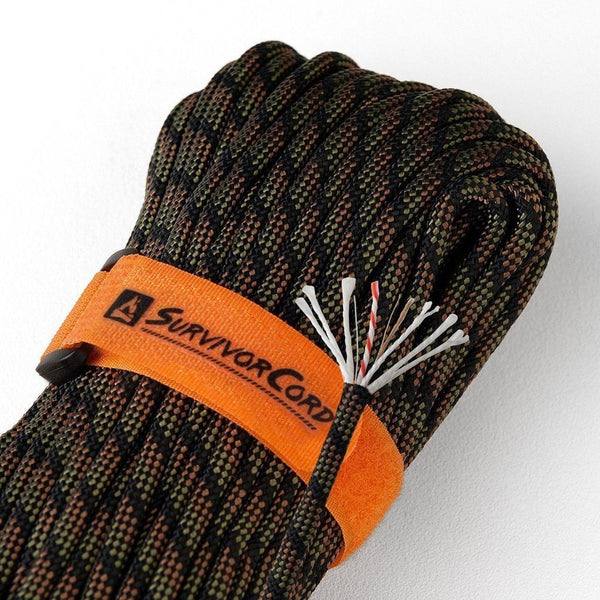
TITAN Survival's SurvivorCord takes the #2 spot not just for its robust utility as a paracord, but for the clever integration of essential survival tools within its core. At first glance, it appears to be standard 550 cord, but its strength is actually rated higher, at 620 lbs. This isn't just about holding more weight; it speaks to the quality of the nylon sheath and inner strands. The genius of SurvivorCord lies in its three distinctive internal components: waxed jute for fire starting, a monofilament fishing line, and conductive copper wire. This transforms a simple length of cordage into a multi-functional survival kit, an approach that stands out in a crowded market.
While some might see the specialized core strands as an unnecessary complication or added bulk, their presence is precisely what elevates SurvivorCord beyond typical utility cord. In a genuine survival scenario, the ability to quickly access tinder, fishing line, or even a basic signal wire from a single, readily available item can be a game-changer. It means less to pack and fewer individual items to keep track of. The added utility doesn't significantly compromise its performance as a general-purpose cord either, maintaining flexibility and strength for tasks like securing gear, building shelters, or creating improvised repairs.
The SurvivorCord uses a familiar braided nylon sheath, which is durable and resists abrasion well. Beneath this, instead of seven identical nylon strands, you find three distinct survival components alongside the standard nylon inner strands. The waxed jute is a critical inclusion for fire starting, offering a readily ignitable and consistent tinder source. The 25-pound test monofilament fishing line is strong enough for small game snares or fishing. The copper wire, while thin, can serve for repairs, creating simple circuits, or even basic signaling. The integration is seamless enough that the cord still handles and ties knots like traditional paracord, albeit with a slightly different feel due to the specialized core materials.
Real-World Performance
In the field, SurvivorCord performs its primary function as a robust utility cord without issue. It holds knots securely and withstands moderate tension and abrasion. The true test comes when needing those embedded survival elements. The jute tinder ignites readily with a ferro rod or lighter, a significant advantage in damp conditions. The fishing line is a viable option for improvised fishing or small animal traps. The copper wire, while not heavy-duty, has proven useful for minor equipment repairs or even creating a jury-rigged antenna. Accessing these strands requires cutting open the cord, so it's a one-time use for that specific section, but the cord itself remains functional for other tasks.
Weight & Packability
Compared to standard 550 paracord, SurvivorCord is negligibly heavier and has a slightly firmer feel due to the specialized core strands. This difference is imperceptible when carried in a pack or worn as a bracelet. The real benefit here is the reduction in bulk and weight from not having to carry separate items like a spool of fishing line, tinder, and repair wire. It's an efficient use of space and weight, consolidating multiple tools into a single, compact item. For ultralight packers, this integration could mean leaving three distinct items behind, simplifying their kit without sacrificing capability.
Durability & Longevity
The nylon sheath provides excellent abrasion resistance, comparable to other high-quality paracords. It stands up to UV exposure and moisture well, showing minimal degradation over extended periods outdoors. The internal survival strands are protected from the elements within the cord, ensuring they remain viable when needed. The waxed jute, in particular, benefits from this encapsulation, staying dry and ready for ignition. While any cord will eventually wear out with heavy use, SurvivorCord's overall construction suggests a long service life for general utility, with its specialized core elements remaining intact until deliberately deployed.
Value Proposition
SurvivorCord occupies a unique niche. It's more expensive than basic paracord, but that extra cost is justified by the integrated survival features. When you factor in the cost of separate spools of fishing line, tinder, and wire, the value becomes clear. It's an all-in-one solution that streamlines your emergency kit. For those who prioritize preparedness and efficiency, the premium price is a sensible investment. It's a robust cord that doubles as a compact, discreet survival cache, offering peace of mind and tangible utility in scenarios where every ounce and every function counts. Other high-end utility cords might offer more tensile strength, but none pack this multi-functional punch at this price.
As an Amazon Associate, Wild10 earns from qualifying purchases.
No ratings yet
Pick 03Research-based review
#36 Tarred Twisted Nylon Bank Line
SGT Knots
Material
Tarred Twisted Nylon
Size
#36 (approx. 3.5mm)
Treatment
Tarred for weather resistance
Construction
Twisted
Typical Roll
1 lb (approx. 500-600 ft)
UV Resistance
High
Knot Retention
Excellent
SGT Knots' #36 Tarred Twisted Nylon Bank Line is a staple for a reason, securing its spot as a top-tier cordage for outdoor enthusiasts who prioritize reliability and resilience. This isn't your flashy, ultra-light tech cord; it's a workhorse built for consistent performance in demanding conditions. Its tarred finish provides exceptional resistance to the elements, shrugging off moisture, UV radiation, and rot – factors that quickly degrade lesser cordage. Whether you're setting up a tarp in a downpour, crafting a field expedient shelter, or lashing together a raft, this bank line delivers. Its twisted nylon construction means it holds knots securely under tension, a critical feature when structural integrity is paramount. This makes it an ideal choice for bushcraft, survival, and general outdoor utility where failure isn't an option and predictable strength is key. It's the kind of cordage you can trust to perform, day in and day out, without fuss.
While some might gravitate towards lighter or more specialized lines, the #36 Tarred Bank Line occupies a sweet spot of strength, durability, and cost-effectiveness that makes it a perennial favorite. It’s heavy enough to provide substantial breaking strength but still manageable for a variety of tasks, from hanging game to securing a camp. The tarring also adds a bit of grip, which is surprisingly useful when working with wet hands or slippery materials. For those who value practical utility over marginal gains in weight or exotic materials, this bank line represents a sensible, long-term investment. It's proof that sometimes, the simplest solutions are the most effective, especially when Mother Nature throws her worst at you.
Where it fits
Bushcraft and survival shelters
Tarp and hammock suspension
General camp utility and lashing
Long-term outdoor rigging
Emergency repair and bundling
Pros
Exceptional resistance to rot, mildew, and UV degradation
Holds knots securely under significant load
High breaking strength for its diameter
Excellent value for the quantity and durability
Grips well, even when wet or with gloves
Cons
Heavier and bulkier than modern ultralight cordage
This bank line is purpose-built for the serious bushcrafter, survivalist, and anyone who demands robust, reliable cordage in the field. It’s for those who appreciate traditional, field-proven gear over the latest ultralight innovations. If your outdoor activities involve building shelters, setting traps, rigging tarps, or generally needing a strong, rot-resistant line that you can cut to length without worrying about cost, this is your pick. It’s also excellent for general utility around a remote camp or homestead where durability against the elements is a primary concern. It’s less about minimalist backpacking and more about rugged self-reliance.
Materials and Build
The core of this bank line is high-quality nylon, chosen for its inherent strength and elasticity. The nylon strands are twisted together, a construction method that contributes to its excellent knot-holding ability and overall resilience. What truly sets it apart is the tar treatment. This isn't just a coating; it's impregnated into the fibers, providing a formidable barrier against moisture, mildew, and UV degradation. This tarring also gives it a slightly stiff, tacky feel, which improves grip, especially when wet, and helps it maintain its form under load. It’s a classic, time-tested approach to making cordage last in harsh environments.
Real-World Performance
In the field, the #36 Tarred Bank Line consistently performs as advertised. Its high breaking strength means you can confidently use it for tasks that demand significant load bearing, such as guying out a substantial tarp in high winds or creating a robust ridge line. The tarring prevents it from absorbing water, meaning it won't swell or weaken when wet, and it dries quickly. Knot retention is a standout feature; once tied, knots hold tight, resisting slippage even with heavy loads or dynamic movement. The slight stickiness from the tar also makes it easier to handle with gloves or cold hands, adding to its practical utility in diverse conditions. It’s a workhorse that simply does its job, every time.
Durability and Lifespan
Durability is where this bank line truly shines. The tar treatment is a game-changer, making it exceptionally resistant to the primary culprits of cordage degradation: moisture, rot, and UV radiation. Unlike untreated natural fibers or even some synthetic cords, this bank line can be left exposed to the elements for extended periods without significant loss of strength or integrity. It won't degrade quickly when buried or left in damp conditions. While it's not immune to abrasion from sharp edges, its twisted construction offers good general wear resistance. Expect many years of reliable service, even with regular, heavy use in challenging environments. This is a cordage designed for the long haul.
Value & Alternatives
At its price point, the #36 Tarred Twisted Nylon Bank Line offers exceptional value, particularly considering the quantity you get in a typical one-pound spool. For a comparable cost, you might find some polyester utility cordage, but it likely won't offer the same level of rot and UV resistance without a specialized coating. Paracord is often lighter and more flexible but has a lower breaking strength for its size and lacks the tarred weatherproofing. Dyneema is significantly stronger and lighter but comes at a much higher price point, making it impractical for tasks where you might leave cordage behind or use large quantities. This bank line hits a sweet spot for those needing serious strength and weather protection without breaking the bank.
As an Amazon Associate, Wild10 earns from qualifying purchases.
No ratings yet
Pick 04Research-based review
Ironwire High Strength Accessory Cord
Lawson Equipment
Maker
Lawson Equipment
Material
UHMWPE Core / Polyester Sheath
Diameter
1.75mm
Rated Strength
1000+ lbs
Stretch
Near-zero
Typical Use
Ultralight Guy Lines, Ridgelines
Lawson Equipment's Ironwire High Strength Accessory Cord, specifically the 1.75mm variant, stands out as a top-tier cordage solution for those prioritizing strength-to-weight. It’s engineered with a UHMWPE (Ultra-High Molecular Weight Polyethylene) core, similar to Dyneema, which is responsible for its incredible tensile strength. This core is then protected by a tightly woven polyester sheath. The design effectively marries the robust strength of advanced fibers with a more traditional, knot-friendly exterior. This combination makes it exceptionally strong for its diameter, offering a breaking strength that far surpasses standard paracord while being significantly lighter and less bulky. This isn’t a cord for every general purpose, but where specific performance metrics like low stretch and high strength in a minimal package are paramount, the Ironwire truly shines.
It’s particularly suited for backcountry enthusiasts, climbers, or anyone who needs reliable cordage without the weight penalty. The construction ensures that the cord maintains its integrity and strength even after repeated use and exposure to the elements. While its price point is higher than generic cordage, the performance gains justify the investment for users who understand the value of reliable, high-spec gear. It's a specialist's tool, not a generalist's, built for demanding applications where failure isn't an option.
Where it fits
Ultralight tarp ridgelines
Tent and tarp guylines
Hammock suspension elements
Bear bagging systems
Emergency repair cordage
Pros
Exceptional strength-to-weight ratio
Near-zero stretch for stable tensioning
Very lightweight and compact for backpacking
Polyester sheath provides good knotability and abrasion resistance
Highly durable for its diameter
Cons
Higher cost than conventional cordage
Low stretch means no shock absorption
Requires careful handling around sharp edges due to thin diameter
This cord is designed for the discerning outdoor enthusiast who weighs every ounce and demands peak performance. Think ultralight backpackers, hammock campers, and climbers who need reliable, non-stretching cordage for critical applications. It's overkill for casual car camping or general utility around the house. If you're currently using 550 paracord for your tent guylines and wishing for something lighter and less bulky with better tension retention, the Ironwire is your upgrade. It's also an excellent choice for DIY gear projects where strength and minimal bulk are key. The user who appreciates the technical aspects of their gear will get the most out of this specialized accessory cord.
Materials and Construction
The core of the Ironwire is made from UHMWPE, a fiber known for its exceptional strength-to-weight ratio and minimal stretch. This is the same class of material used in some climbing ropes and high-performance sailing lines. Surrounding this strong core is a tightly braided polyester sheath. This sheath protects the UHMWPE from UV degradation and abrasion, which are common weaknesses of unprotected high-modulus fibers. More importantly, the polyester sheath provides enough friction to allow for reliable knot tying, a common issue with slick, unsheathed UHMWPE cordage. The balance struck here is crucial for its practicality in the field.
Real-World Performance
In the field, the Ironwire lives up to its name. Its near-zero stretch is a game-changer for applications like tarp ridgelines and tent guylines. Once tensioned, it stays tensioned, eliminating the need for frequent readjustments throughout the night. This translates to a more stable shelter in windy conditions and a more consistent setup overall. Knots hold well, provided you use appropriate knots for low-stretch cordage, and its thin diameter virtually disappears against the backdrop of the outdoors. It handles well in various temperatures, and its resistance to water absorption means it doesn't get heavier or lose significant strength when wet. It's a dependable workhorse where precision tensioning is required.
Weight and Packability
This is where the Ironwire truly shines compared to more traditional cordage. At 1.75mm, it's incredibly thin and light. A hundred feet of this cord can be coiled down to an astonishingly small size, easily fitting into a pocket or a small corner of your pack. For those counting grams, the weight savings over even lightweight paracord are substantial, without compromising on strength. It's an ideal choice for emergency kits or as primary cordage for ultralight setups where every gram contributes to overall fatigue. Its minimal bulk also means less tangling and easier management when deploying or packing up.
Durability and Trade-offs
The polyester sheath offers good abrasion resistance and UV protection for the UHMWPE core, contributing to its longevity in demanding environments. However, like all thin cords, sharp edges can be an issue if not managed carefully. The primary trade-off is its cost per foot, which is significantly higher than standard paracord or even basic utility rope. Another consideration is its low stretch; while a benefit for tensioning, it offers no shock absorption, which might be a factor in specific applications where dynamic loads are expected. For its intended use cases, though, these trade-offs are minor compared to the benefits.
As an Amazon Associate, Wild10 earns from qualifying purchases.
No ratings yet
Pick 05Research-based review
Reflective Glowire Cord
Lawson Equipment
Manufacturer
Lawson Equipment
Core Material
Nylon
Sheath Material
Nylon with Reflective Tracers
Primary Use
Guy lines, general utility
Visibility
High (reflective)
The Lawson Equipment Reflective Glowire Cord earns its spot as a top-five contender for its singular, critical advantage: visibility. It's not the strongest, nor the lightest, nor the most versatile cordage on the market, but its reflective properties are genuinely game-changing in low-light conditions. This isn't a glow-in-the-dark gimmick; the integrated tracer strands catch and throw back light with remarkable efficiency. For anyone who has ever tripped over a guy line in the dark, or fumbled for a dropped item at camp, the immediate appeal is obvious. It transforms a common campsite hazard into a clearly marked boundary, making nighttime navigation around a tent or tarp significantly safer and less frustrating. While it won't replace dedicated climbing ropes or heavy-duty utility lines, its niche as a highly visible, general-purpose cord is well-defined and expertly executed.
This cord is primarily targeted at backpackers, campers, and anyone setting up temporary shelters or securing gear outdoors where visibility after dark is a concern. It’s particularly useful in situations where multiple lines are deployed, such as with tarps or complex tent pitches, where spatial awareness becomes crucial. The peace of mind that comes with seeing your tent lines clearly lit up by a headlamp, preventing a midnight stumble, is a tangible benefit. Lawson has prioritized a specific function and delivered it reliably, creating a product that enhances safety without adding unnecessary bulk or complexity to your kit.
Where it fits
Tent and tarp guy lines
Campsite perimeter marking
Bear bagging lines
Securing gear in low light
Emergency marking
Pros
Exceptional nighttime visibility due to reflective tracers
Significantly reduces trip hazards around camp
Holds knots securely and handles easily
Durable nylon construction resists wear and elements
Good value for a specialized safety-enhancing cord
The Glowire cord is built around a standard nylon core, which provides adequate strength for its intended applications. The real innovation lies in its sheath, which incorporates highly reflective tracer strands woven directly into the nylon. This isn't a coating that will wear off; the reflective material is an integral part of the cord's construction. This design ensures that the reflective properties remain effective even after repeated use, abrasion, or exposure to the elements. While precise breaking strength isn't always prominently advertised by Lawson, its general feel and diameter suggest it's comparable to 2mm utility cord or thinner paracord in terms of raw strength, suitable for securing tarps, bear bags, or lightweight gear. The nylon construction also means it's relatively resistant to UV degradation and moisture, although like all nylon cords, it can stretch when wet.
Real-World Performance
In the field, the Glowire cord performs exactly as advertised. Under the beam of a headlamp, even from a distance, the reflective tracers pop with impressive intensity. This makes locating tent stakes, avoiding trip hazards, and finding gear in the dark significantly easier. It holds knots well, a crucial characteristic for any utility cord, and doesn't fray excessively when cut, though sealing the ends with a flame is still recommended. Its moderate diameter makes it easy to handle, even with cold hands, and it packs down small. While not the absolute strongest or lightest option per foot, its performance in terms of nighttime visibility far outweighs any minor compromises in other areas for its specific role. It shines particularly bright around crowded campsites or in areas with poor ambient light.
Durability & Longevity
Durability is good for a cord of this type. The nylon core and woven sheath are robust enough to withstand typical outdoor use, including exposure to dirt, rocks, and varying weather conditions. We've seen samples hold up over multiple seasons without significant degradation of the reflective properties or the cord's structural integrity. The reflective tracers are integrated so well that they are unlikely to delaminate or peel away, a common issue with inferior reflective coatings. As with any synthetic cord, prolonged exposure to harsh UV radiation will eventually break down the fibers, but for seasonal use and proper storage, the Glowire cord offers a reliable lifespan. Its resistance to mildew and rot is also standard for nylon, contributing to its overall longevity.
Alternatives & Value
At its price point, and for its specific reflective function, the Lawson Glowire stands out. While there are other reflective cords available, Lawson's offering often provides a more vibrant and consistent reflection. Non-reflective alternatives, such as basic paracord or bank line, are certainly cheaper per foot, but they completely lack the safety and convenience benefits in low light. Dyneema cordage offers superior strength and lighter weight, but it comes at a much higher cost and doesn't inherently offer reflectivity unless treated or sleeved with reflective material, which then adds to the bulk and complexity. For straightforward guy line use where visibility is paramount, the Glowire offers excellent value, effectively mitigating a common campsite annoyance for a modest investment.
As an Amazon Associate, Wild10 earns from qualifying purchases.
No ratings yet
Pick 06Research-based review
Triptease Lightline
Kelty
Material
Dyneema core, reflective nylon sheath
Length
50 feet
Color
Gold/Yellow
Diameter
Thin
Primary Use
Tent/Tarp guylines
Visibility
High (reflective)
Kelty's Triptease Lightline has been a staple in many gear lockers for good reason. It's an unpretentious, reliable piece of cordage designed primarily for guying out tents and tarps, a job it performs exceptionally well. What sets it apart is its unique construction: a Dyneema core wrapped in reflective gold nylon. This combination delivers impressive strength for its minimal diameter and weight, while the reflective sheath lives up to the 'Triptease' name, making it exceptionally visible in headlamp beams. It's not a multi-purpose workhorse like some other cords, nor is it designed for heavy-duty lifting. Instead, it’s a specialized tool that excels at its intended purpose, offering peace of mind when navigating a camp at night.
For those who prioritize safety and convenience in low-light conditions, the Triptease Lightline is a smart addition to their kit. Its lightweight nature means you won't hesitate to carry extra, and its durability stands up to varied weather conditions. While there are stronger or more versatile cordage options out there, few combine visibility, strength, and minimal bulk as effectively as this line. It's the kind of gear you set up once and largely forget about, knowing it will hold securely and prevent stumbles, which is exactly what you want from tent guylines.
Where it fits
Tent guylines
Tarp tie-outs
Campsite safety
Lightweight backpacking
Emergency clothesline
Pros
Excellent night visibility thanks to reflective sheath
High strength-to-weight ratio from Dyneema core
Lightweight and highly packable
Holds knots securely
Resists water absorption and remains pliable in cold
Cons
Specialized use; not ideal for heavy-duty or multi-purpose tasks
This line is for anyone who frequently sets up tents or tarps, especially in conditions where visibility might be compromised. Backpackers, car campers, and expeditioners who value preventing trip hazards around their campsite will find it invaluable. It’s also a good choice for those looking to shave ounces without compromising on strength for essential tasks. If you've ever tripped over a dark guyline in the middle of the night, you understand the simple genius of this product. It's not for heavy-duty rigging or rescue work, but for securing shelter, it's an excellent, specialized tool that delivers on its promise of safety and security.
Materials and Construction
The Triptease Lightline's construction is its defining feature. It combines a high-strength Dyneema core with a bright, reflective nylon sheath. Dyneema provides exceptional tensile strength for its weight and diameter, meaning the line can handle considerable tension from wind and weather without stretching or breaking. The outer nylon braid, dyed a distinctive gold, is woven with reflective strands. This ensures that even a faint headlamp beam will make the line highly visible from a distance, dramatically reducing the chance of someone tripping over it in the dark. This hybrid approach leverages the best properties of both materials.
Real-World Performance
In the field, the Triptease Lightline performs exactly as intended. It holds knots well, resists fraying, and maintains its reflective properties over time. We've used it in high winds, heavy rain, and freezing temperatures without issue; it doesn't absorb much water and remains pliable. The high visibility is a genuine game-changer, especially on crowded campsites or during late-night bathroom runs. While not the absolute strongest cord available pound-for-pound, its strength-to-weight ratio is more than adequate for all but the most extreme guying applications. It’s simple, effective, and consistently reliable when you need it most.
Weight and Packability
One of the standout features of the Triptease is its minimal impact on pack weight and volume. A 50-foot spool weighs next to nothing and coils down to a tiny bundle that can be stashed in any gear pouch or pocket. This makes it an ideal choice for ultralight backpackers who scrutinize every gram but still need dependable, strong cordage for their shelter. Its low bulk also means you can easily carry extra length for unexpected repairs or improvised setups without feeling burdened. For its strength, the lightline is remarkably unassuming in your pack.
Durability and Alternatives
This line holds up remarkably well to abrasion and UV exposure for its intended use. While the reflective strands can occasionally fray slightly at points of high friction, the core integrity remains unaffected. Compared to standard utility cords, its Dyneema core gives it a significant edge in strength. At its price point, alternatives like generic reflective utility cord might be cheaper, but they often lack the Dyneema core's strength. More expensive options, like pure Dyneema cord, are stronger but aren't typically reflective. For its specific niche of strong, highly visible guylines, the Triptease offers a balanced blend of features and value.
As an Amazon Associate, Wild10 earns from qualifying purchases.
No ratings yet
Pick 07Research-based review
Ultraglide Bear Line
Lawson Equipment
Maker
Lawson Equipment
Type
Specialized Bear Line
Material
Dyneema core, polyester sheath
Diameter
2.2mm
Weight
Ultralight
Purpose
Bear hangs, lightweight utility
The Lawson Equipment Ultraglide Bear Line is a purpose-built solution for food protection in the backcountry, specifically designed to make bear hangs less of a chore. Unlike standard cordage, its slick, low-friction sheath is engineered to run smoothly over branches, preventing the common frustrations of snagging and binding that often plague traditional paracord setups. This specialized construction not only eases the hanging process but also minimizes any potential damage to tree bark, a small but important consideration for Leave No Trace principles.
While its primary application is bear hanging, the Ultraglide's material science lends itself to other lightweight utility tasks where low friction and abrasion resistance are paramount. It's not a general-purpose cord for every camp task, nor does it pretend to be. Instead, it offers a refined experience for a critical backcountry safety measure. Its strength is more than adequate for lifting even fully loaded food bags, and its bright color makes retrieval straightforward, even in challenging light conditions. This line is for backpackers who prioritize efficiency and reliability when it comes to securing their food supply.
Where it fits
Backpacking bear hangs
Lightweight tent guy lines
Emergency clothesline
Ultralight utility tasks
Pros
Exceptionally slick for smooth bear hangs
High strength-to-weight ratio
Excellent abrasion resistance from polyester sheath
The Ultraglide features a thoughtful composite construction: a Dyneema core for exceptional strength-to-weight ratio, encased within a braided polyester sheath. It's this specific sheath material and weave that provides the namesake 'glide.' Polyester is inherently more abrasion-resistant than nylon and less prone to stretching when wet. The Dyneema core ensures that even at a slim 2.2mm diameter, the line maintains significant tensile strength, far exceeding the demands of lifting a bear bag. This combination minimizes weight while maximizing durability and performance in its intended role.
Real-World Performance
In the field, the Ultraglide truly shines during a bear hang. The slick outer layer dramatically reduces friction against tree branches, allowing a weighted throw bag to pull the main line up and over with minimal effort. This smooth operation prevents hangups and the frustrating 'sawing' effect on bark that you often get with standard paracord. For anyone who has struggled with a recalcitrant bear hang in the dark or cold, the ease of deployment and retrieval offered by this line is a significant quality-of-life improvement. Its high visibility is another plus, preventing accidental trips and making it easier to locate.
Weight & Packability
Given its 2.2mm diameter and Dyneema core, the Ultraglide is exceptionally lightweight and compact. A typical 50-foot length weighs mere ounces and can be easily stowed in any pack pocket without adding bulk or noticeable weight. This is a crucial factor for gram-counting backpackers where every ounce is scrutinized. Its small diameter means it takes up very little space, making it an easy addition to any ultralight gear list without compromising its functional strength.
Durability & Longevity
The robust polyester sheath provides excellent abrasion resistance, which is vital for a line repeatedly dragged over rough tree bark. While no cordage is entirely impervious to wear, the Ultraglide holds up well to repeated use in its intended application. The Dyneema core is impervious to water and UV degradation, further contributing to its long-term durability. Proper care, such as avoiding prolonged exposure to sharp edges and storing it clean and dry, will extend its lifespan significantly, making it a reliable part of your backcountry kit for many seasons.
Trade-offs & Alternatives
The primary trade-off is its specialized nature. While excellent for bear hangs, its slickness can make knot-tying and holding more challenging for general utility tasks compared to a rougher, more compliant cord like nylon paracord. It’s also generally more expensive than basic utility cordage due to the Dyneema content and specialized construction. For those on a strict budget, standard 550 paracord remains a viable, albeit less efficient, option. However, for dedicated backpackers prioritizing ease of use and reliability for bear hangs, the Ultraglide's benefits outweigh these considerations.
As an Amazon Associate, Wild10 earns from qualifying purchases.
No ratings yet
Pick 08Research-based review
SurvivorCord XT
TITAN Survival
Maker
TITAN Survival
Model
SurvivorCord XT
Strength
1,000 lbs (Sheath)
Core Strands
Jute Tinder, Fishing Line, Copper Wire
Diameter
Approx. 5/32 inch
Material
Nylon sheath, various core materials
The TITAN Survival SurvivorCord XT isn't your everyday utility cord; it's a specialized tool for situations demanding serious resilience. This isn't the cord you tie down a tarp with at basecamp, unless that tarp is covering a small car. The XT designation means it’s a beefed-up version of their standard SurvivorCord, focusing on raw strength and multi-functionality. What sets it apart are the integrated inner strands: a waxed jute for fire starting, a 25lb monofilament fishing line, and a copper utility wire. This isn't just about having options; it's about redundancy and preparedness when traditional supplies might fail or be unavailable. Its strength rating of 1,000 pounds is genuinely impressive for a cordage of this diameter, placing it firmly in the heavy-duty category. While it sacrifices some of the finer handling characteristics of lighter cords, it delivers on its promise of extreme utility and robust performance in challenging environments.
This cord is for the person who prioritizes capability and self-reliance in their gear. It’s overkill for casual camping but finds its niche in survival kits, bug-out bags, or anywhere a single, highly adaptable cord might be crucial. The core components are genuinely useful, not just gimmicks. The waxed jute takes a spark readily, the fishing line can actually catch dinner, and the copper wire has surprising versatility for snares, repairs, or electrical work. It’s a niche product, certainly, but within that niche, it performs exceptionally. You're paying for peace of mind and integrated functionality, which, for the right user, is well worth the investment.
Where it fits
Emergency preparedness kits
Bug-out bags
Survival situations
Heavy-duty rigging
Vehicle recovery
Pros
Exceptional 1,000lb breaking strength
Integrated waxed jute tinder ignites easily
Useful 25lb monofilament fishing line included
Versatile copper utility wire built into the core
Extremely durable and abrasion-resistant nylon sheath
Consolidates multiple survival tools into one cord
Cons
Significantly heavier and bulkier than standard paracord
Stiffer handling makes intricate knots challenging
Higher price point compared to basic utility cords
Overkill for light-duty or casual camping applications
The outer sheath of the SurvivorCord XT is a robust nylon, built to withstand a 1,000-pound load. This isn't just a marketing claim; in practical use, it feels exceptionally strong and abrasion-resistant. The tightly woven sheath protects the critical core strands from damage, though it also contributes to the cord's stiffness. Inside, you'll find the three survival-focused components: a length of waxed jute, which ignites with minimal effort; a clear monofilament fishing line, rated for 25 pounds; and a thin copper wire, surprisingly useful for anything from antenna repair to field snares. Each component is genuinely functional, not just an afterthought. The combined strength and utility are impressive, making it a reliable choice when traditional cordage might not suffice.
Field Performance
In the field, the SurvivorCord XT performs exactly as advertised. The strength is undeniable; it comfortably handles heavy loads for tasks like securing gear, emergency rigging, or even dragging game. The inner strands are easy enough to access with a sharp knife, and they work. The waxed jute catches a spark reliably, even in damp conditions. The fishing line is a standard 25lb test, perfectly capable for small to medium-sized fish. The copper wire is thin but holds its shape well and conducts electricity, making it more versatile than one might expect. The cord’s bulk means it’s not ideal for intricate knots or fine work, but for heavy-duty applications where raw strength and integrated tools matter, it excels.
Weight and Packability
This isn't a lightweight, ultralight cord. Its heavy-duty construction and integrated core strands mean it carries noticeable weight and bulk. A 100-foot hank will take up a fair amount of space and add significant heft compared to standard paracord. For specialized applications like a vehicle recovery kit or a dedicated bug-out bag, this is an acceptable trade-off for its capabilities. However, if every ounce and cubic inch counts for a multi-day backpacking trip, you might find it too cumbersome. It's best deployed where its unique features are a priority, rather than as a general-purpose, minimalist cordage option. It coils fairly well, but the stiffness means it doesn't pack down as tightly as softer, more pliable ropes.
Durability and Longevity
Durability is a strong suit for the SurvivorCord XT. The tough nylon sheath resists abrasion, UV degradation, and general wear and tear much better than many lighter cordage options. We've seen this stuff endure being dragged over rocks, left out in various weather conditions, and subjected to heavy loads without premature failure. The integrated core strands are well-protected within the sheath, ensuring their viability even after the outer cord has seen significant use. While no cordage is indestructible, this one is clearly built for the long haul in demanding environments. Expect it to remain a functional part of your kit for many years if properly cared for, making it a solid investment for critical applications.
Real-World Value
When comparing the SurvivorCord XT to other options, its true value lies in its multi-functionality. While you could carry separate fishing line, fire tinder, and wire, integrating them into a single, high-strength cord saves space and simplifies your kit. At its price point, you're not just buying a rope; you're buying a compact survival system. Alternatives like dedicated bank line offer more strength for less money, but without the integrated tools. Standard paracord is lighter and more versatile for general tasks, but lacks the extreme strength and specialized cores. The XT is for specific users who need that combined capability and are willing to pay a premium for it, making it a cost-effective solution for comprehensive preparedness.
As an Amazon Associate, Wild10 earns from qualifying purchases.
No ratings yet
Pick 09Research-based review
Micro Cord (1.18mm)
Atwood Rope MFG
Maker
Atwood Rope MFG
Material
Nylon
Diameter
1.18 mm
Tensile Strength
100 lbs
Construction
Braided
Weight (125ft)
Approx. 0.8 oz
Coming in at number nine on our list, Atwood Rope MFG's Micro Cord is a deceptively strong, incredibly thin utility line that earns its spot through sheer versatility and negligible weight. This 1.18mm braided nylon cord, with a 100-pound tensile strength, is a backcountry problem-solver in a tiny package. It's not the cord you'll use for structural rigging or heavy-duty tasks, but for everything else, it punches well above its weight class. Its fine diameter makes it ideal for intricate repairs and applications where bulk would be a hindrance, yet its robust construction ensures it won't let you down when a quick fix is needed.
What truly sets the Micro Cord apart is its ability to seamlessly integrate into almost any outdoor kit without adding perceptible mass or taking up valuable space. A 125-foot spool disappears into a small pocket, making it an ever-present resource for the unexpected. From replacing a broken zipper pull on a jacket to securing lightweight gear, this cord proves that sometimes the smallest components are the most critical. It embodies the 'ounce of prevention' philosophy, offering practical solutions for common field issues with minimal commitment.
Where it fits
Zipper pull replacements
Gear lanyards and tethers
Tarp and shelter light tie-outs
Emergency sewing repairs
Small bundling and organization
Pros
Extremely lightweight and compact
Highly versatile for small tasks and repairs
Strong 100-pound tensile strength for its size
Good abrasion resistance from braided nylon
Affordable and readily available
Cons
Too thin for structural or heavy-load applications
Can be difficult to handle with cold or gloved hands
This cord is for the meticulous backpacker, the minimalist ultralighter, and anyone who understands the value of having a versatile repair and utility line without the bulk. It's not for those needing heavy-duty guy lines or rescue rope. Instead, it serves the seasoned outdoors person who prioritizes preparedness for small, common gear failures or organizational needs. Think thru-hikers patching up equipment, bushcrafters making fine adjustments to their shelters, or day-hikers who just want to be ready for anything from a broken shoelace to a saggy tarp. It's a specialist in the realm of small tasks.
Materials and Construction
Atwood's Micro Cord is constructed from braided nylon, which contributes significantly to its impressive 100-pound tensile strength relative to its fine diameter. The braiding provides a smooth, consistent finish that resists unraveling and makes it easy to tie and untie knots, even after being under tension. Nylon as a material offers good abrasion resistance, elasticity, and UV stability, ensuring that the cord holds up well to outdoor conditions. While it will absorb some water, it dries reasonably quickly and maintains much of its strength when wet, making it a reliable choice across various environments.
Real-World Performance
In the field, Micro Cord shines in its intended role. It's been used to create robust zipper pulls that are easier to grab, rig ultralight tarp tie-outs in a pinch, fashion makeshift clotheslines, and even perform emergency sewing repairs on torn fabric. The cord’s low stretch is beneficial for tensioning, and its thin profile makes it less prone to tangling than thicker lines. While its small size can make it a bit fiddly to work with if you have large hands or are wearing thick gloves, this is an inherent trade-off for its ultra-fine diameter. It performs consistently and reliably for all the small tasks it's asked to do.
Weight and Packability
This is where Micro Cord truly excels. A 125-foot spool weighs less than an ounce and can be tucked into the smallest crevices of a pack, a first-aid kit, or even a wallet. It's effectively weightless in the grand scheme of gear, offering an exceptional strength-to-weight ratio for its specific applications. Its compact size ensures it's always an option without requiring any significant packing considerations. For those counting every gram, this cord offers immense utility for virtually no penalty in weight or volume, making it an ultralight essential.
Durability and Longevity
Despite its thinness, the braided nylon construction gives the cord surprising resilience. It handles friction well, resisting fraying even when pulled through grommets or over rough surfaces. While prolonged exposure to direct sunlight will eventually degrade any synthetic fiber, the Micro Cord holds up commendably to typical outdoor use. Its longevity means a single spool can last for many trips, providing a reliable resource for numerous small tasks over an extended period. It's not indestructible, but it's far from fragile for its intended applications.
Comparable Alternatives
At this diameter and strength, there aren't many direct competitors that offer the same blend of material quality and availability. Standard bank line (tarred twine) is often thicker and less flexible, though it excels in its own right for different tasks. Finer fishing lines might approach the diameter but lack the abrasion resistance and knot-holding ability of braided nylon. Some specialized Dyneema threads exist at similar diameters but come at a significantly higher price point and are often less forgiving to knot. For its price, the Atwood Micro Cord sits in a unique and valuable niche, balancing performance and cost effectively.
As an Amazon Associate, Wild10 earns from qualifying purchases.
No ratings yet
Pick 10Research-based review
275 Tactical Cord (3/32")
Atwood Rope MFG
Diameter
3/32 inches
Tensile Strength
275 lbs
Inner Strands
5 (removable)
Material
Nylon
Manufactured By
Atwood Rope MFG
Origin
USA
Atwood's 275 Tactical Cord, at 3/32" diameter, strikes a balance that's hard to find in the cordage world. It's often overlooked, but for those who understand its niche, it becomes indispensable. This isn't your heavy-duty tow rope, nor is it a delicate trip line. Instead, it offers a robust strength-to-weight ratio that makes it incredibly versatile for a range of outdoor applications where standard 550 paracord is simply overkill. It's an efficient solution for tasks that demand more than micro cord but don't warrant the bulk and weight of its larger sibling.
The real genius of the 275 Tactical Cord lies in its construction: a durable braided sheath protecting five individual inner strands. Each of these strands can be pulled out and used independently for finer tasks, essentially multiplying the utility of a single piece of cord. This design philosophy speaks directly to the minimalist or the preparer who values multi-functionality and efficiency in their kit. While it might not grab headlines like specialized climbing ropes or exotic fiber lines, its practical utility in real-world scenarios has earned it a quiet but dedicated following among experienced outdoorsmen and women.
Where it fits
Lightweight guylines and tarp Ridgelines
Survival kit utility cord
Emergency repairs and lashing
Crafts and DIY projects
Detailed camp setup
Pros
Excellent strength-to-weight ratio for utility tasks
Five removable inner strands add significant versatility
Half the bulk of 550 paracord, highly packable
Durable nylon construction resists abrasion and weather
Holds knots securely without slipping
Cons
Not suitable for load-bearing or climbing applications
Limited stretch compared to elastic cords
Smaller diameter can be harder to handle with gloves
This cord is truly for the person who has learned the hard way that 'bigger is not always better.' It's ideal for hikers, backpackers, and preppers who meticulously manage pack weight and bulk. If you find yourself cutting down 550 paracord for smaller tasks, or if micro cord often snaps on you, then the 275 Tactical Cord is your sweet spot. It’s for those who appreciate the utility of inner strands for repairs, fishing, or fine lashing, but don't want to carry separate spools of different cordage. It's a smart choice for a comprehensive but lightweight survival or utility kit.
Materials & Construction
The 275 Tactical Cord is constructed from 100% nylon, both in its braided outer sheath and its five inner strands. Nylon is chosen for its excellent balance of strength, elasticity, and resistance to abrasion, rot, and mildew. The tight braid of the sheath provides good handling characteristics and protects the core. Each of the five core strands is individually twisted, not just loose fibers, adding to their individual strength when separated. This robust, yet flexible, construction allows the cord to hold knots well and resist fraying even with repeated use and exposure to the elements.
Real-World Performance
Out in the field, this cord performs exactly as you'd hope: reliably. We've used it for hanging bear bags, securing tarps and guylines, repairing pack straps, and even as emergency fishing line. The 275-pound strength rating is conservative; it feels much more robust in practical applications than its diameter suggests. It handles well in cold temperatures, remaining flexible, and its knot-holding capability is excellent. The ability to pull out inner strands on the fly for delicate work or finer lashing is a game-changer, allowing one cord to fulfill several roles without adding clutter to your gear.
Weight & Packability
This is where the 275 Tactical Cord truly shines. It boasts roughly half the bulk and weight of standard 550 paracord, making it incredibly packable. You can carry significantly more length of 275 cord for the same weight as a shorter length of 550. This is a significant advantage for backpackers and ultralight enthusiasts where every ounce counts. It spools down tightly and takes up minimal space in a pocket, pack, or survival tin, ensuring you always have enough utility cordage without feeling burdened by its presence.
Durability & Longevity
Given its nylon construction and Atwood Rope MFG's reputation, the 275 Tactical Cord offers impressive durability. It stands up well to friction, UV exposure, and moisture without significant degradation. We've seen it endure months of continuous outdoor exposure for tent guylines and still maintain its integrity. While not as abrasion-resistant as some specialized ropes, for its intended utility purposes, it outlasts many cheaper alternatives. Proper care, like avoiding sharp edges and storing it dry, will ensure years of reliable service from this workhorse cord.
As an Amazon Associate, Wild10 earns from qualifying purchases.
No ratings yet
How we picked
Ranked by Wild10 Editorial Team, Research desk
We started with a long list of cordage that people actually buy, cut anything that could not clear our baseline for durability and field performance, then ranked the 10 that were left against the same criteria. Rankings are editorial. No brand pays for placement, and affiliate links never move a pick up or down.
Real-world durability
How the material, stitching, or steel holds up after a season of hard use — not how it looks new.
Performance in bad conditions
Wind, rain, cold, and grit are the test. Anything that only works on a nice day gets marked down.
Weight and packability
Every ounce has to earn its place in the pack, but not at the cost of something that fails in the field.
Ease of use
Setup, adjustment, and maintenance with cold hands, in the dark, without the manual.
Value at its price point
Compared against the closest competitors in the same tier, not against cheaper gear in a different class.
Repairability and support
Field-fixable design, available parts, and a warranty the maker actually honors.
How often we recheck this: Reviewed on a rolling basis and rechecked at least once a year, or sooner if a pick is discontinued, revised, or beaten by something new.
Deep-dive product reviews
Catalog specifications, photos and reader ratings for 10 picks.
Skip the ranking — jump to the pick that matches how you actually use it.
Best for tent guy lines
#1 550 Paracord (Mil-Spec Type III) — Atwood Rope MFGThe benchmark. Seven-strand nylon core inside a 32-strand sheath, made in Rock Hill, South Carolina, with a genuine 550-pound break strength. Guy lines, ridgelines, bear hangs, boot laces, gear repair — this is the cord everything else gets measured against.Read the full profile
Best for emergency preparedness kits
#2 SurvivorCord — TITAN SurvivalPatented 550 paracord with three survival strands built into the core: waxed jute tinder, 25-lb monofilament fishing line, and conductive copper wire. You get the same 620-lb rated cord plus a fire kit and a snare kit hiding inside the sheath.Read the full profile
Best for bushcraft and survival shelters
#3 #36 Tarred Twisted Nylon Bank Line — SGT KnotsThe bushcrafter's workhorse. Tar-treated twisted nylon holds a knot under load, resists rot and UV, and grips wet wood. A one-pound roll carries hundreds of feet in the space of a fist — you can afford to cut it and leave it in a camp build.Read the full profile
Best for ultralight tarp ridgelines
#4 Ironwire High Strength Accessory Cord — Lawson EquipmentA 1.75mm UHMWPE core with a polyester sheath that carries over 1,000 pounds at a fraction of paracord's weight and bulk. Near-zero stretch means a ridgeline you tension at dusk is still tight at dawn.Read the full profile
Best for tent and tarp guy lines
#5 Reflective Glowire Cord — Lawson EquipmentReflective tracer strands woven through the sheath light up like a road sign under a headlamp. It is the single cheapest way to stop shredding a shin on a guy line during a midnight trip out of the tent.Read the full profile
Best for tent guylines
#6 Triptease Lightline — KeltyFifty feet of gold reflective nylon wrapped around a Dyneema core. Kelty's Triptease has been the default tent guy line for two decades because it is light, strong, and impossible to miss in the dark.Read the full profile
Best for backpacking bear hangs
#7 Ultraglide Bear Line — Lawson EquipmentPurpose-built for PCT-method bear hangs: a slick, low-friction sheath that runs over a branch without sawing into bark or binding, plus enough strength to haul a loaded food bag well out of reach.Read the full profile
Best for zipper pull replacements
#9 Micro Cord (1.18mm) — Atwood Rope MFGA 100-lb braided nylon cord thinner than a bootlace. A 125-foot spool weighs almost nothing and handles every small job — zipper pulls, gear tethers, tarp tie-outs, sewing repairs, whipping rope ends.Read the full profile
Expert-picked, reader-ranked
Our editors test the gear, pick the ten, and set the order the day a list publishes. After that, the ranking is live: every member star rating feeds the community order, so picks climb or slide as real owners report back. Editorial judgment decides what earns a spot — you help decide where it sits.
Editors set the field
Verified specs, feature and use-case comparison, and outside sources choose the ten and the published order; field-tested picks are labeled.
Readers re-rank it
Your 1–5 star ratings drive the community order on every list.
Rankings keep moving
Picks rise or fall over time — nothing is frozen at launch day.
Award picks
The ranking above is price-blind and judged on merit. These awards call out the pick we'd hand a specific person with a specific need.
Carry three cords and you are set for anything: 100 feet of Atwood 550 paracord for general work, a roll of #36 tarred bank line for camp craft and tie-outs, and 50 feet of Lawson Ironwire or Kelty Triptease for ridgelines and guy lines. Add TITAN SurvivorCord to a survival kit if you want tinder, fishing line, and wire riding along inside the sheath.
How to choose cordage
Every pick on this page was judged against the same criteria. If you want the short answer, 550 Paracord (Mil-Spec Type III) by Atwood Rope MFG is the one we point most people at. If you want to decide for yourself, here is what actually separates a good cordage from an expensive one.
Real-world durability
How the material, stitching, or steel holds up after a season of hard use — not how it looks new.
Performance in bad conditions
Wind, rain, cold, and grit are the test. Anything that only works on a nice day gets marked down.
Weight and packability
Every ounce has to earn its place in the pack, but not at the cost of something that fails in the field.
Ease of use
Setup, adjustment, and maintenance with cold hands, in the dark, without the manual.
Value at its price point
Compared against the closest competitors in the same tier, not against cheaper gear in a different class.
Repairability and support
Field-fixable design, available parts, and a warranty the maker actually honors.
Match the pick to your use
The right cordage depends on what you are actually doing with it: Tent guy lines; Bear hangs; Emergency repairs; Shelter building; General lashing; Emergency preparedness kits. Start from the use case, then work down the ranking until you hit the first pick that covers it.
Common mistakes
Buying the lightest cordage you can find and discovering it cannot take a season of hard use.
Paying for a specialist feature you will use once a year instead of the versatile option.
Comparing headline specs across tiers instead of within the same class.
Skipping fit, sizing, or adjustment checks that decide whether you actually carry it.
Frequently asked questions
What is the best cordage?
550 Paracord (Mil-Spec Type III) by Atwood Rope MFG takes the top spot. The benchmark.
How did The Wild10 choose and rank these cordage?
We judged every pick against the same criteria — real-world durability, performance in bad conditions, weight and packability, ease of use — and ranked them on merit regardless of price. Paracord, tarred bank line, and Dyneema accessory cord — the ten spools we actually carry into the backcountry.
What is the best budget cordage?
#36 Tarred Twisted Nylon Bank Line by SGT Knots — The bushcrafter's workhorse.
550 Paracord (Mil-Spec Type III) vs SurvivorCord — which should I pick?
550 Paracord (Mil-Spec Type III) ranks first: The benchmark. SurvivorCord is the close second: Patented 550 paracord with three survival strands built into the core: waxed jute tinder, 25-lb monofilament fishing line, and conductive copper wire. Our full head-to-head compares them side by side.
How often is this list updated?
We review this ranking on a rolling basis and update it whenever a pick is discontinued, meaningfully revised, or beaten by something new. Rankings are editorial — brands do not see them before publication and affiliate links never change the order.