


UltaMid 2 vs 2.0
Our #1 and #2 picks from The 10 Best Four Season Tents, compared spec-by-spec with clear pros, cons, and a verdict.
Choosing a dedicated four-season shelter demands balancing weight, interior livability, and bombproof weather protection under severe wind and heavy snow loads. The Hyperlite Mountain Gear UltaMid 2 and the Samaya 2.0 approach winter mountaineering from two distinct design philosophies. The UltaMid 2 embraces an ultralight, non-freestanding pyramid architecture built from Dyneema Composite Fabric (DCF). It relies on trekking poles or ski-pole arrays to shed extreme alpine gales, prioritizing maximum space-to-weight ratio for long-distance traverses. In contrast, the Samaya 2.0 is a cutting-edge, freestanding, single-wall assault tent designed for technical high-altitude bivouacs. It pairs a puncture-resistant Dyneema tub floor with an ultra-breathable Nanovent membrane and DAC FeatherLite poles to virtually eliminate the classic single-wall condensation trap. While the UltaMid 2 appeals to gram-counting ski tourers and fast-packing mountaineers willing to manage modular pitches and floorless setups, the Samaya 2.0 targets alpinists demanding instantaneous freestanding setup on narrow ledges where stakes are impractical. Navigating this decision comes down to your operational terrain, camp footprint requirements, and pack-weight threshold.
UltaMid 2
Hyperlite Mountain Gear
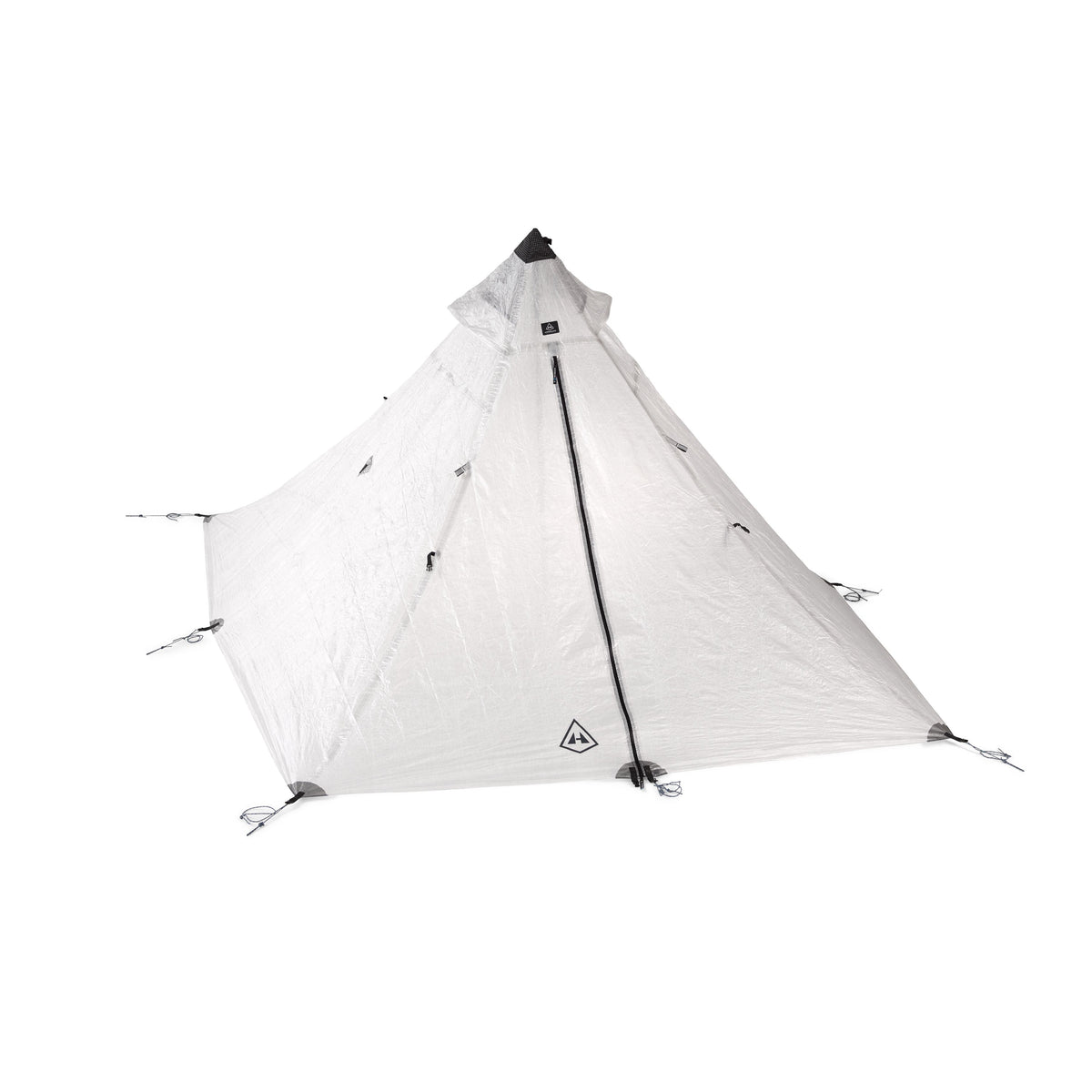
The Hyperlite Mountain Gear UltaMid 2 represents the pinnacle of ultralight winter shelter design. Built for ski mountaineers, winter thru-hikers, and packrafters who count every ounce, this pyramid shelter relies on steep, angled walls to shed heavy snowfall effortlessly. Independent testers across multiple gear platforms consistently praise its remarkable strength-to-weight ratio, noting that when properly staked out, the UltaMid 2 stands firm in severe winds that would flatten typical lightweight tents. Crafted from fully waterproof, non-sagging Dyneema Composite Fabric (DCF), the shelter does not stretch or absorb water when wet, eliminating the midnight fly-tightening ritual common with traditional silnylon shelters. It pitches using a single center support—either two trekking poles strapped together with ski straps or a dedicated carbon fiber pole—which drastically reduces pack weight and compressed volume. However, the pyramid architecture introduces distinct trade-offs. The UltaMid 2 is a floorless tarp in its standard configuration, meaning campers must purchase separate inner inserts or supply their own groundsheets to prevent moisture intrusion. Pitching requires a large footprint and secure anchor points, demanding ski anchors, snow stakes, or deadman setups in loose winter snowpacks. **Highlights** - Exceptional snow-shedding pyramid architecture - Constructed with fully waterproof, non-stretch Dyneema Composite Fabric - Extremely compact packed size for winter-grade protection - Pitches with trekking poles or a single center strut - Fully taped seams requiring no aftermarket sealing **Watch-outs** - Substantial investment at roughly $730 before buying accessories - Floorless baseline configuration requires an insert or groundsheet - Large footprint requires significant clearing space in tight alpine terrain
Find it on Amazon2.0
Samaya

The Samaya 2.0 is an uncompromising, purpose-built single-wall alpine shelter engineered for high-altitude ascents and technical mountaineering. Geared toward alpinists operating in fast-and-light pushes where traditional double-wall tents add too much bulk, the Samaya 2.0 tackles the historic weakness of single-wall shelters—condensation—by utilizing a proprietary, highly breathable Nanovent membrane paired with a Dyneema bathtub floor. Aggregated reviews from mountaineering outlets highlight the tent's balance between low packed weight and structural rigidity. Supported by high-end DAC Featherlite poles, its compact hexagonal footprint slots onto narrow mountain ledges where standard basecamp tents cannot fit. Reviewers note that the fabric breathes noticeably better than conventional polyurethane-coated textiles, significantly reducing the interior frost buildup typical of sub-freezing single-wall camping. That elite alpine focus comes with steep compromises. At over $1,200, it is among the priciest two-person shelters on the market. Liveable space is compact, offering just enough room for two climbers on standard sleeping pads with limited spare floor space. Campers desiring vestibule storage for bulky packs and cooking must purchase an external vestibule separately. **Highlights** - Nanovent three-layer breathable membrane minimizes internal frost - Ultra-durable Dyneema composite bathtub floor construction - Small footprint engineered specifically for narrow alpine bivies - Weighs just 3 pounds 5 ounces for a winter-rated shelter - High-grade DAC Featherlite pole architecture **Watch-outs** - Extremely expensive price tag - Vestibule is not included and must be purchased as an add-on - Snug interior dimensions offer minimal elbow room for extended confinement
Buy on AmazonSpec-by-Spec
| Spec | #1 UltaMid 2 | #2 2.0 |
|---|---|---|
| Weight | 531 g / 18.7 oz (tarp only); ~770 g with stakes | 1,360 g / 3.0 lbs (minimum); 1,510 g (packed) |
| Capacity/Size | 2-person (floor area: 5.85 m² / 63 sq ft; 163 cm peak height) | 2-person (floor area: 2.6 m² / 28 sq ft; 100 cm peak height) |
| Materials | DCF8 Dyneema Composite Fabric (fly); waterproof zippers | Nanovent 3-layer laminate wall (40,000 g/m² breathability), Dyneema floor |
| Price Tier | Premium (~$765 shelter only; $1,100+ with full inner) | Ultra-Premium (~$1,200 - $1,300) |
| Warranty | 2-year limited manufacturer warranty | Lifetime warranty against manufacturing defects |
| Best Use | Winter ski touring, ultralight thru-hiking, fast-and-light mountaineering | High-altitude mountaineering, alpine climbing, technical winter expeditions |
| Portability | Extremely packable; compresses to the size of a 1L water bottle | Highly compact for a framed shelter (4.5 L packed volume) |
| Durability | High tensile strength DCF; vulnerable to abrasion/punctures over time | Bomber composite floor with reinforced tie-outs; alpine-tested DAC poles |
| Feature Highlights | Pyramid wind shedding, steep snow-shedding walls, trekking pole pitch | Freestanding geodesic frame, breathable Nanovent fabric, fully integrated floor |
UltaMid 2
Best for: Fast-and-light winter traversers and ski tourers seeking maximum livable space at the lowest possible pack weight.
Pros
- Unbeatable space-to-weight ratio with vast 63-square-foot floor area
- Steep pyramid geometry easily sheds heavy snow accumulations and lateral wind
- Packs down exceptionally small and leverages ski or trekking poles instead of tent poles
- Highly modular system compatible with various floorless, mesh, or full-insert options
Cons
- Requires a wide, sprawling footprint with solid anchoring to achieve a taut pitch
- Floorless by default; requires expensive add-on inserts for complete insect and moisture protection
- Center pole bisects usable interior living space
2.0
Best for: Technical alpinists and high-altitude climbers needing a robust, freestanding assault tent for tight mountain bivouacs.
Pros
- Fully freestanding structure installs rapidly on narrow ledges or frozen rock
- Nanovent membrane dramatically reduces internal frost and condensation buildup
- Completely integrated, puncture-resistant Dyneema bathtub floor protects against ground moisture
- Aerodynamic geodesic pole geometry withstands turbulent multidirectional gale winds
Cons
- Significantly heavier packed weight than pyramid tarps
- Cramped interior living quarters for two occupants during multiday weather delays
- Extremely steep price point for a specialized assault shelter
The Verdict
Choosing between these two elite shelters hinges on whether your winter objective requires modular ultralight efficiency or bulletproof technical security. The Samaya 2.0 emerges as our clear category winner for dedicated four-season alpine endeavors. Its freestanding geometry, robust DAC FeatherLite skeleton, and breathable Nanovent single-wall construction make it the superior refuge when pitching on technical terrain, hard snow, or narrow granite bivy ledges where driving snow anchors is nearly impossible. However, the Hyperlite UltaMid 2 remains the benchmark for distance-oriented winter travel, providing more than double the floor area at roughly a third of the weight. The UltaMid 2 is best for ski mountaineers, winter packcrafters, and ultralight thru-hikers who traverse wide-open snow valleys with ski poles in hand. Conversely, the Samaya 2.0 is best for vertical alpinists and high-altitude climbers who demand immediate, freestanding shelter against catastrophic storms in constrained alpine environments.