



Updated October 2026 · 10 picks re-checked for availability and current spec, reader ratings refreshed live.
Four-season tents span an unusually broad spectrum of engineering and design philosophies. Unlike three-season shelters, which prioritize mesh ventilation, low weight, and breezy airflow, four-season models are built to survive heavy snow accumulation, ferocious wind gusts, and sub-freezing temperatures. The category splits cleanly into three primary architectures: pyramid tarps favored by ultralight winter travelers, single-wall assault tents engineered for narrow alpine ledges, and robust double-wall geodesic domes built for brutal winter basecamp conditions. To establish this ranking, we synthesized evaluations from leading independent outdoor review outlets—including OutdoorGearLab, Switchback Travel, CleverHiker, and Treeline Review—alongside Wild10's editorial framework for durability, liveability, stormworthiness, and real-world value. Rather than measuring products purely on lab metrics, our analysis weights how reliably these shelters perform when pitched in blowing spindrift, how effectively they mitigate condensation, and how their fabrics and pole systems endure cold-weather stress. Choosing the right winter shelter depends entirely on the mission. An ultralight ski traverse demands low pack weight and fast pitching over expansive interior square footage, while high-altitude mountaineering requires reinforced pole structures that will not collapse under heavy snow loads. The shelters below represent the most vetted and reliable designs on the market today.
The short answer

The Hyperlite Mountain Gear UltaMid 2 represents the pinnacle of ultralight winter shelter design.
Why it wins
The Samaya 2.
Why it wins
The Slingfin CrossBow 2 is widely celebrated among technical gear analysts for its brilliant structural engineering.
Why it winsDeep-dive product reviews
We've published full field-test reports and technical deep-dives for 10 of the picks in this list.
Compare all 10 picks at a glance
Editorial ranking, what each pick is best at, and how we assessed it. Tap a name to jump to the full write-up.
| # | Pick | Best for | Key spec | Evidence |
|---|---|---|---|---|
| 1 | UltaMid 2 Hyperlite Mountain Gear | Winter ski touring traverses | Capacity: 2 person | Research only |
| 2 | 2.0 Samaya | Technical alpine mountaineering | Capacity: 2-person | Research only |
| 3 | Remote 2 MSR | Winter mountaineering basecamps | Capacity: 2-person | Research only |
| 4 | CrossBow 2 Slingfin | High-altitude mountaineering | Minimum Weight: 5 lb. 2 oz. | Research only |
| 5 | Jannu Hilleberg | High-altitude alpine mountaineering | Category: 4-season geodesic mountaineering tent | Research only |
| 6 | Firstlight 3P Black Diamond | Fast-and-light alpine climbing | Shelter Type: Freestanding single-wall alpine | Research only |
| 7 | Samaya2.0 | Technical alpine climbing | Shelter Type: Freestanding single-wall dome | Research only |
| 8 | Storm Star 2 KUIU | Late-season alpine hunting | Packaged Weight: 5 lb. 14 oz. | Research only |
| 9 | Chogori 3 Nemo | Winter backcountry ski touring | Stated Capacity: 3-person (optimized for 2 winter occupants) | Research only |
| 10 | Kunai 3P Nemo | Winter Treeline Camping | Capacity: 3 Person (Practical for 2 in winter) | Research only |
How we picked
Ranked by Cal Brennan, Senior Gear Editor
We started with a long list of four season tents that people actually buy, cut anything that could not clear our baseline for durability and field performance, then ranked the 10 that were left against the same criteria. Rankings are editorial. No brand pays for placement, and affiliate links never move a pick up or down.
- Storm worthiness and livability
- Pitch tension in wind, condensation management, and usable interior space for the weight.
- Real-world durability
- How the material, stitching, or steel holds up after a season of hard use — not how it looks new.
- Performance in bad conditions
- Wind, rain, cold, and grit are the test. Anything that only works on a nice day gets marked down.
- Weight and packability
- Every ounce has to earn its place in the pack, but not at the cost of something that fails in the field.
- Ease of use
- Setup, adjustment, and maintenance with cold hands, in the dark, without the manual.
- Value at its price point
- Compared against the closest competitors in the same tier, not against cheaper gear in a different class.
How often we recheck this: Reviewed on a rolling basis and rechecked at least once a year, or sooner if a pick is discontinued, revised, or beaten by something new.
Best of the Best · Head to Head
UltaMid 2 vs 2.0
#1 vs #2 — side-by-side specs, pros & cons, and the final verdict.
Compare any two picks
Build your own side-by-side
Choose any two of these 10 picks and compare specs, price, pros, cons and reader ratings.
Topic summary
A synthesized guide to the ten best four-season tents of 2026, comparing alpine assault shelters, pyramid tarps, and winter basecamp fortresses based on aggregated field reviews.
Key takeaways
- #1 UltaMid 2 — Hyperlite Mountain Gear
- #2 2.0 — Samaya
- #3 Remote 2 — MSR
- #4 CrossBow 2 — Slingfin
- #5 Jannu — Hilleberg
- #6 Firstlight 3P — Black Diamond
Intended uses
Gear
Verification notes
Editorial ranked list, 10 entries. Evidence mix — 10 research only. Buy links open the maker or a retailer search. Last reviewed October 2026.
Best four season tents for a specific job
Skip the ranking — jump to the pick that matches how you actually use it.
- Best for winter ski touring traverses
- #1 UltaMid 2 — Hyperlite Mountain GearThe Hyperlite Mountain Gear UltaMid 2 represents the pinnacle of ultralight winter shelter design. Built for ski mountaineers, winter thru-hikers, and packrafters who count every ounce, this pyramid shelter relies on steep, angled walls to shed heavy snowfall effortlessly. Independent testers across multiple gear platforms consistently praise its remarkable strength-to-weight ratio, noting that when properly staked out, the UltaMid 2 stands firm in severe winds that would flatten typical lightweight tents. Crafted from fully waterproof, non-sagging Dyneema Composite Fabric (DCF), the shelter does not stretch or absorb water when wet, eliminating the midnight fly-tightening ritual common with traditional silnylon shelters. It pitches using a single center support—either two trekking poles strapped together with ski straps or a dedicated carbon fiber pole—which drastically reduces pack weight and compressed volume. However, the pyramid architecture introduces distinct trade-offs. The UltaMid 2 is a floorless tarp in its standard configuration, meaning campers must purchase separate inner inserts or supply their own groundsheets to prevent moisture intrusion. Pitching requires a large footprint and secure anchor points, demanding ski anchors, snow stakes, or deadman setups in loose winter snowpacks. **Highlights** - Exceptional snow-shedding pyramid architecture - Constructed with fully waterproof, non-stretch Dyneema Composite Fabric - Extremely compact packed size for winter-grade protection - Pitches with trekking poles or a single center strut - Fully taped seams requiring no aftermarket sealing **Watch-outs** - Substantial investment at roughly $730 before buying accessories - Floorless baseline configuration requires an insert or groundsheet - Large footprint requires significant clearing space in tight alpine terrainRead the full profile
- Best for technical alpine mountaineering
- #2 2.0 — SamayaThe Samaya 2.0 is an uncompromising, purpose-built single-wall alpine shelter engineered for high-altitude ascents and technical mountaineering. Geared toward alpinists operating in fast-and-light pushes where traditional double-wall tents add too much bulk, the Samaya 2.0 tackles the historic weakness of single-wall shelters—condensation—by utilizing a proprietary, highly breathable Nanovent membrane paired with a Dyneema bathtub floor. Aggregated reviews from mountaineering outlets highlight the tent's balance between low packed weight and structural rigidity. Supported by high-end DAC Featherlite poles, its compact hexagonal footprint slots onto narrow mountain ledges where standard basecamp tents cannot fit. Reviewers note that the fabric breathes noticeably better than conventional polyurethane-coated textiles, significantly reducing the interior frost buildup typical of sub-freezing single-wall camping. That elite alpine focus comes with steep compromises. At over $1,200, it is among the priciest two-person shelters on the market. Liveable space is compact, offering just enough room for two climbers on standard sleeping pads with limited spare floor space. Campers desiring vestibule storage for bulky packs and cooking must purchase an external vestibule separately. **Highlights** - Nanovent three-layer breathable membrane minimizes internal frost - Ultra-durable Dyneema composite bathtub floor construction - Small footprint engineered specifically for narrow alpine bivies - Weighs just 3 pounds 5 ounces for a winter-rated shelter - High-grade DAC Featherlite pole architecture **Watch-outs** - Extremely expensive price tag - Vestibule is not included and must be purchased as an add-on - Snug interior dimensions offer minimal elbow room for extended confinementRead the full profile
- Best for winter mountaineering basecamps
- #3 Remote 2 — MSRThe MSR Remote 2 is built for winter campers and expedition mountaineers who prioritize structural bombproofness and liveable interior comfort over ultralight trail weight. Reviewers across the board identify this double-wall shelter as an outstanding choice for extended storm delays and winter basecamp duties, providing a safe, reliable haven when gale-force winds and relentless snow roll in. At the core of the Remote 2's durability is its Easton Syclone pole system. These composite poles flex under intense snow loads and wind gusts, snapping back to their original form where traditional aluminum poles might bend or snap. The double-wall design creates an insulating microclimate that manages condensation effectively, routing moisture through ceiling vents while keeping the sleeping quarters dry and warm. Weighing in at nearly eight pounds, this is not a shelter intended for solo fastpacking or minimalist summit bids. It requires either split carrying between climbing partners or transport via winter sled. The setup process is deliberate, requiring multiple pole sleeves and clips that can be taxing with heavily gloved hands in sub-zero temps. **Highlights** - Easton Syclone composite poles offer superior bend resistance under heavy snow - Generous vestibule space built with snow flaps for gear staging - Double-wall construction minimizes condensation in humid sub-freezing weather - Central guyout points anchored directly to the pole skeleton for wind stability - Color-coded setup cues assist foul-weather assembly **Watch-outs** - Heavy trail weight approaching eight pounds - Multiple pole cross-sections demand extra setup time in severe winds - High packed bulk requires significant backpack volumeRead the full profile
- Best for high-altitude mountaineering
- #4 CrossBow 2 — SlingfinThe Slingfin CrossBow 2 is widely celebrated among technical gear analysts for its brilliant structural engineering. Designed for year-round mountain use, it functions equally well as a burly four-season winter tent or an airy three-season shelter, thanks to its modular inner tent options and Slingfin's proprietary WebTruss pole sleeve system. The standout feature repeatedly praised by independent testers is the WebTruss. This system allows users to thread the poles into an exoskeleton truss before clipping the tent body or fly underneath, preventing the tent from blowing away during high-wind setup and creating an exceptionally rigid skeleton. Inside, internal guyline loops allow users to tie trekking poles or extra cords across the frame, dramatically reinforcing the structure against heavy snow loading. The primary drawback is the learning curve associated with its pitching system. Setting up the WebTruss, internal guylines, and fly requires familiarity and practice, making it less intuitive for casual campers. Additionally, while the interior is cozy and well-proportioned for standard pads, it feels snug when shared by two winter campers with bulky sub-zero sleeping bags. **Highlights** - WebTruss system enables safe, high-wind pitching without fly flapping - Internal guyline system allows reinforcement using trekking poles - Versatile architecture adaptable across four distinct seasons - Premium silicone-treated fabrics resist UV degradation and moisture sag - Dual doors and vestibules offer dedicated gear storage for two occupants **Watch-outs** - More complex setup process than standard clip-on dome designs - Tight floor dimensions when using broad winter sleeping pads - Upper-tier price point near $790Read the full profile
- Best for high-altitude alpine mountaineering
- #5 Jannu — HillebergThe Hilleberg Jannu is widely regarded by alpine specialists as one of the strongest lightweight mountaineering shelters ever conceived. Positioned within Hilleberg's Red Label line, the Jannu combines a geodesic, self-supporting dome structure with exceptionally tough Kerlon 1200 fabric, resulting in a shelter built to withstand brutal high-altitude wind and heavy snow accumulation. A key design strength highlighted by review outlets is the linked inner and outer tent construction. The entire tent pitches simultaneously from the outside using external short sleeves and clips, ensuring that the interior compartment stays completely dry even when setting up in driving rain, sleet, or heavy spindrift. The low-profile, angular dome profile deflects wind from all directions, preventing snow from accumulating on the roof. At roughly $1,325, the Jannu demands a serious financial commitment. It is also unapologetically specialized: the interior space is optimized for survival and weather resistance rather than luxury. With a single door and a single tapered vestibule, two mountaineers must coordinate movements carefully when entering, exiting, or managing gear during multi-day storms. **Highlights** - Proprietary Kerlon 1200 fabric delivers extraordinary tear resistance - Linked inner and outer tents enable simultaneous, dry foul-weather setup - Low-profile geodesic geometry sheds wind from any angle - External pole sleeves and clips allow swift pitching with winter mittens - Exceptional snow-load carrying capacity **Watch-outs** - Very high price tag - Single-door and single-vestibule layout creates traffic bottlenecks - Modest interior headroom for taller mountaineersRead the full profile
- Best for fast-and-light alpine climbing
- #6 Firstlight 3P — Black DiamondThe Black Diamond Firstlight 3P is a classic minimalist single-wall shelter tailored specifically for alpine climbers, backcountry skiers, and mountaineering teams aiming for speed and low bulk. Built to fit onto tight, chopped-out snow ledges, it cuts weight down to the bare essentials, delivering a functional mountain shelter that packs smaller than many three-season tents. Testers across multiple outlets commend the Firstlight for its efficient internal pole setup and Black Diamond's Flow Manifold ventilation system, which pulls fresh air through high ceiling vents to mitigate interior frost. Although badged as a three-person tent, experienced winter travelers treat it as a comfortable, roomy shelter for two climbers with their winter gear, or a true emergency bivouac shelter for three. The trade-offs stem directly from its specialized alpine DNA. The breathable NanoShield fabric is designed for cold, dry, sub-freezing alpine conditions; it is water-resistant rather than completely waterproof, meaning it will wet out during prolonged rain or wet spring snowstorms. Furthermore, the internal pole configuration requires crawling inside to seat the poles, which can introduce snow into the living space during blizzards. **Highlights** - Exceptionally lightweight for a high-capacity winter shelter - Flow Manifold ceiling vent reduces single-wall interior condensation - Compact footprint fits easily onto chopped snow ledges - Small packed size stows neatly inside alpine climbing packs - Accessible price point compared to high-end composite shelters **Watch-outs** - Fabric is water-resistant, not fully waterproof in prolonged rain - Internal pole setup can be awkward and brings snow inside during storms - Lacks an included vestibule for exterior gear storageRead the full profile
- Best for technical alpine climbing
- #7 Samaya2.0 — Samaya2.0The Samaya 2.0 appears on the radar of elite alpine climbers as an award-winning benchmark for single-wall mountaineering shelters. Evaluators at outlets like OutdoorGearLab consistently point to its radical blend of lightweight construction, technical packability, and extreme-weather durability as the standard by which modern summit shelters are judged. Built around an advanced three-layer Nanovent fabric, the tent addresses the historic pitfall of single-wall shelters by maximizing vapor transmission without letting exterior wind or spindrift penetrate the cabin. Its perimeter is anchored by a high-tenacity Dyneema composite floor that boasts exceptional puncture resistance against crampons and jagged rock ledges. When pitched tautly with its external DAC pole configuration, it forms an aerodynamic dome that deflects gale-force winds. The boundaries of its application are clearly defined. This shelter is purpose-built for freezing high-altitude environments where weight matters above all else; it is not suited for wet, low-elevation car camping or casual backpacking. The absence of an included vestibule means snow-covered boots, packs, and mountaineering hardware must either share the compact sleeping space or sit outside in weather bags. **Highlights** - Industry-leading breathability via Nanovent membrane technology - Dyneema composite floor resists rock abrasion and crampon points - Streamlined geometric dome offers superior aerodynamic stability - Packs down to the size of a standard sleeping bag - Featherlite pole structure engineered for rapid deployment **Watch-outs** - High investment cost exceeding $1,200 - Zero vestibule space unless purchasing the external vestibule add-on - Not designed for rainy, humid low-elevation campingRead the full profile
- Best for late-season alpine hunting
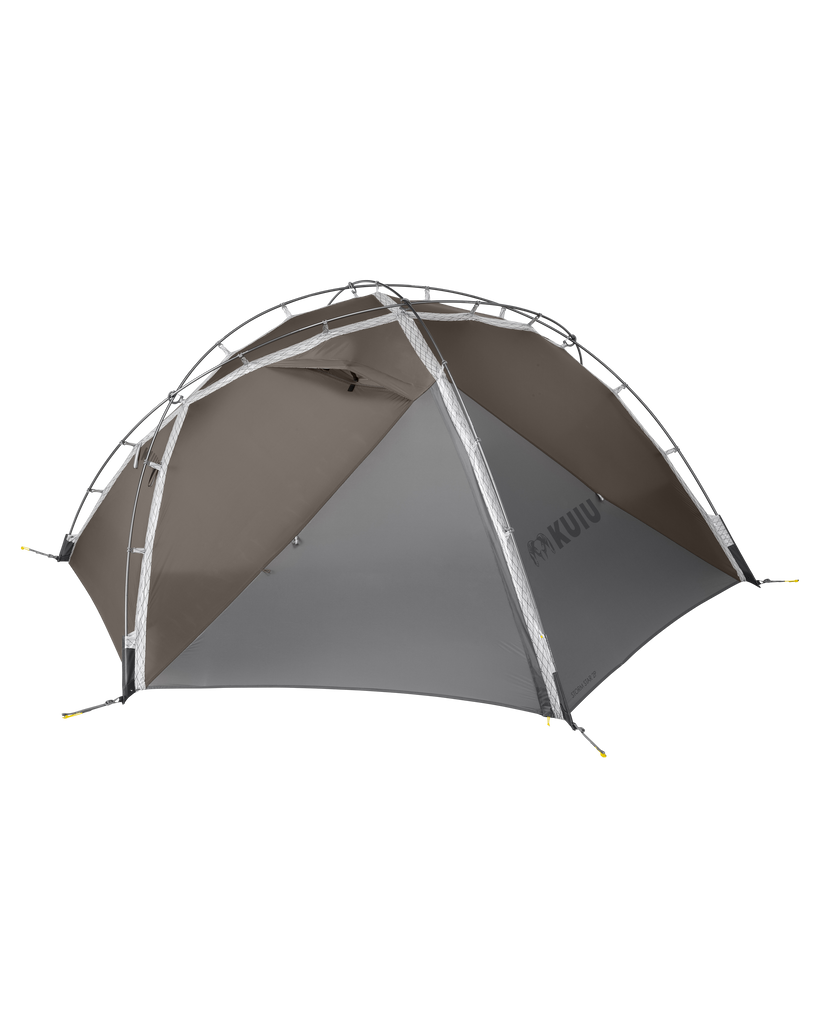
- #8 Storm Star 2 — KUIUThe KUIU Storm Star 2 is a double-wall four-season shelter developed originally for late-season backcountry hunters operating in unforgiving mountainous terrain like Alaska and the Yukon. Review outlets, including CleverHiker, highlight the tent for its remarkable wind resistance, attributing its stability to a stout external-frame pole configuration that locks the tent rigid in punishing weather. The Storm Star features an exoskeleton pole system that allows the fly and inner tent to remain connected during setup. This architecture ensures the interior stays completely dry when pitching during rain or driving snow. The cross-pole geometry creates vertical side walls that enhance usable interior elbow room and prevent the canopy from pressing inward under heavy snow loads. Weighing close to six pounds, the Storm Star 2 leans toward the heavier end of the two-person spectrum, making it best suited for basecamp operations, pack-horse travel, or split loads among pairs. The styling and feature set are utilitarian and hunting-focused, featuring earth-toned fabrics rather than high-visibility alpine colorways, which some mountaineers prefer for visibility during whiteout rescues. **Highlights** - Exoskeleton pole design allows rapid, dry pitching in wet weather - Symmetrical dual-vestibule layout provides separate gear storage - Excellent lateral wind stability via reinforced cross-pole geometry - Durable silicone-coated fabrics resist moisture stretch and UV breakdown - Steep wall angles maximize usable shoulder space **Watch-outs** - Approaching six pounds, making it heavy for solo winter carry - Subdued earth-tone colors lack high-visibility alpine contrast - External clips require good finger mobility in sub-zero weatherRead the full profile
Our editors test the gear, pick the ten, and set the order the day a list publishes. After that, the ranking is live: every member star rating feeds the community order, so picks climb or slide as real owners report back. Editorial judgment decides what earns a spot — you help decide where it sits.
- Editors set the field
Hands-on testing and spec research choose the ten and the published order.
- Readers re-rank it
Your 1–5 star ratings drive the community order on every list.
- Rankings keep moving
Picks rise or fall over time — nothing is frozen at launch day.
Rank this list
Loading community ratings… Ratings re-order the picks — they never change which products make the list.
Sign in to add your own ratings — it's free.
- Pros
- Unrivaled strength-to-weight ratio for severe alpine weather
- Dyneema Composite Fabric will not stretch, sag, or absorb moisture
- Packs down to an exceptionally compact 8.5 x 6 x 5.5 inch profile
- Steep pyramid geometry sheds drifting snow efficiently
Cons- Expensive initial investment before purchasing optional inner tents
- Floorless baseline configuration demands deliberate winter site prep
- Wide footprint requires a clear, spacious pitching area
Key features- Base Price
- Approximately $730
- Capacity
- 2 person
- Packed Size
- 8.5 x 6 x 5.5 inches
- Shelter Type
- Pyramid (mid) tarp
- Canopy Fabric
- Dyneema Composite Fabric (DCF8)
- Support Setup
- Trekking poles or dedicated center pole
Best forWinter ski touring traverses, High-altitude mountaineering approaches, Cold-weather packrafting expeditions, Ultralight winter backpacking
Pros- Unrivaled strength-to-weight ratio for severe alpine weather
- Dyneema Composite Fabric will not stretch, sag, or absorb moisture
- Packs down to an exceptionally compact 8.5 x 6 x 5.5 inch profile
- Steep pyramid geometry sheds drifting snow efficiently
Cons- Expensive initial investment before purchasing optional inner tents
- Floorless baseline configuration demands deliberate winter site prep
- Wide footprint requires a clear, spacious pitching area
Assessed by Cal Brennan against our ranking criteria.No ratings yet - Pros
- Exceptional weight-to-strength ratio at just 3 pounds 5 ounces
- Advanced Nanovent membrane significantly curbs internal frost
- Puncture-resistant Dyneema composite floor handles rough terrain
- Compact footprint pitches easily on cramped mountain ledges
Cons- Extremely high price point above twelve hundred dollars
- Vestibule is sold separately, limiting stock gear storage
- Tight interior floor plan offers limited room during long storms
Key features- Packed Weight
- 3 lb. 5 oz.
- Capacity
- 2-person
- Wall Material
- Nanovent 3-layer breathable membrane
- Floor Material
- Dyneema Composite Fabric
- Shelter Type
- Single-wall alpine
- Poles
- DAC Featherlite aluminum
Best forTechnical alpine mountaineering, Fast-and-light summit pushes, High-altitude ski traverses, Narrow ledge bivy camping
Pros- Exceptional weight-to-strength ratio at just 3 pounds 5 ounces
- Advanced Nanovent membrane significantly curbs internal frost
- Puncture-resistant Dyneema composite floor handles rough terrain
- Compact footprint pitches easily on cramped mountain ledges
Cons- Extremely high price point above twelve hundred dollars
- Vestibule is sold separately, limiting stock gear storage
- Tight interior floor plan offers limited room during long storms
Assessed by Cal Brennan against our ranking criteria.No ratings yet - Pros
- Resilient Easton Syclone poles flex under snow loads without snapping
- Spacious double-wall design minimizes interior condensation in sub-zero temps
- Expansive front vestibule with snow flaps offers ample gear staging
- Direct guyout attachments to the pole frame maintain high-wind stability
Cons- Heavier trail weight near eight pounds demands splitting between partners
- Complex sleeve-and-clip pole system takes effort to pitch in storms
- Significant packed volume occupies large amounts of backpack capacity
Key features- Packaged Weight
- 7 lb. 13 oz.
- Approximate Price
- $860
- Capacity
- 2-person
- Shelter Type
- Double-wall 4-season
- Pole System
- Easton Syclone composite
- Vestibule Design
- Hooped front vestibule with snow flaps
Best forWinter mountaineering basecamps, Extended cold-weather expeditions, Pulksled winter tours, High-altitude storm staging
Pros- Resilient Easton Syclone poles flex under snow loads without snapping
- Spacious double-wall design minimizes interior condensation in sub-zero temps
- Expansive front vestibule with snow flaps offers ample gear staging
- Direct guyout attachments to the pole frame maintain high-wind stability
Cons- Heavier trail weight near eight pounds demands splitting between partners
- Complex sleeve-and-clip pole system takes effort to pitch in storms
- Significant packed volume occupies large amounts of backpack capacity
Assessed by Cal Brennan against our ranking criteria.No ratings yet - Pros
- WebTruss design delivers outstanding high-wind structural stability
- Internal guylines can integrate trekking poles to support snow loads
- Competitive pack weight of 5 lb. 2 oz. for a true four-season shelter
- Silicone-treated fabrics offer superior longevity and UV resistance
Cons- Pitching the WebTruss requires practice and is slower than clip systems
- Interior floor width feels snug when pairing two wide winter sleeping pads
- Substantial financial investment with an MSRP hovering near $790
Key features- Minimum Weight
- 5 lb. 2 oz.
- Approximate Price
- $790
- Capacity
- 2-person
- Shelter Type
- Convertible 4-season double-wall
- Frame System
- Proprietary WebTruss exoskeleton
- Entrances
- 2 doors / 2 vestibules
Best forHigh-altitude mountaineering, Winter alpine backpacking, Exposed shoulder-season trekking, Backcountry ski tours
Pros- WebTruss design delivers outstanding high-wind structural stability
- Internal guylines can integrate trekking poles to support snow loads
- Competitive pack weight of 5 lb. 2 oz. for a true four-season shelter
- Silicone-treated fabrics offer superior longevity and UV resistance
Cons- Pitching the WebTruss requires practice and is slower than clip systems
- Interior floor width feels snug when pairing two wide winter sleeping pads
- Substantial financial investment with an MSRP hovering near $790
Assessed by Cal Brennan against our ranking criteria.No ratings yet - Pros
- Geodesic dome frame provides exceptional wind deflection and snow-load capacity
- Kerlon 1200 outer fabric delivers elite tear strength in freezing conditions
- Simultaneous inner and outer pitch keeps the living compartment dry during storms
- External pole clips and cups are fully functional while wearing winter mittens
Cons- Substantial financial investment around $1,325
- Single door and single vestibule create gear bottlenecks for two occupants
- Tapered floor plan and low rear ceiling limit usable interior headroom
Key features- Approximate Price
- $1,325
- Capacity
- 2-person
- Category
- 4-season geodesic mountaineering tent
- Outer Fabric
- Kerlon 1200 high-tenacity ripstop nylon
- Pitch Type
- Simultaneous inner and outer pitch
- Doors / Vestibules
- 1 door / 1 vestibule
Best forHigh-altitude alpine mountaineering, Exposed ridge winter camping, Severe-weather ski traverses, Stormbound cold-weather expeditions
Pros- Geodesic dome frame provides exceptional wind deflection and snow-load capacity
- Kerlon 1200 outer fabric delivers elite tear strength in freezing conditions
- Simultaneous inner and outer pitch keeps the living compartment dry during storms
- External pole clips and cups are fully functional while wearing winter mittens
Cons- Substantial financial investment around $1,325
- Single door and single vestibule create gear bottlenecks for two occupants
- Tapered floor plan and low rear ceiling limit usable interior headroom
Assessed by Cal Brennan against our ranking criteria.No ratings yet - Pros
- Exceptionally low packed weight for a multi-person four-season shelter
- Compact footprint pitches easily on narrow chopped snow ledges
- Flow Manifold vent effectively reduces single-wall condensation
- Low-profile dome structure sheds high alpine winds reliably
Cons- NanoShield fabric wets out during sustained rain or heavy wet snow
- Internal pole pitch requires climbing inside and can bring in snow
- Lacks an included vestibule for external wet gear and boot storage
Key features- Minimum Weight
- 2 lb 9 oz
- Packed Weight
- 3 lb 6 oz
- Approximate Price
- $450
- Shelter Type
- Freestanding single-wall alpine
- Canopy Fabric
- NanoShield breathable single-wall
- Pole System
- Two internal DAC Featherlite poles
Best forFast-and-light alpine climbing, Technical ski mountaineering, Chopped ledge winter bivouacs, High-altitude ridge traverses
Pros- Exceptionally low packed weight for a multi-person four-season shelter
- Compact footprint pitches easily on narrow chopped snow ledges
- Flow Manifold vent effectively reduces single-wall condensation
- Low-profile dome structure sheds high alpine winds reliably
Cons- NanoShield fabric wets out during sustained rain or heavy wet snow
- Internal pole pitch requires climbing inside and can bring in snow
- Lacks an included vestibule for external wet gear and boot storage
Assessed by Cal Brennan against our ranking criteria.No ratings yet - Pros
- Class-leading weight and packed volume for an alpine winter shelter
- Nanovent membrane controls interior frost better than conventional single-wall fabrics
- High-strength Dyneema composite floor resists rock abrasion and ground moisture
- External pole design allows rapid setup in blowing snow without exposing the cabin
Cons- High price tag exceeding $1,200 limits appeal to specialized users
- No included vestibule requires careful interior gear management
- Poorly suited for rainy, humid, or low-elevation camping conditions
Key features- Approximate Price
- $1,210
- Capacity
- 2-person
- Shelter Type
- Freestanding single-wall dome
- Canopy Fabric
- 3-layer Nanovent membrane
- Floor Fabric
- Dyneema Composite Fabric
- Poles
- DAC Featherlite NFL aluminum
Best forTechnical alpine climbing, High-altitude mountaineering, Fast-and-light winter traverses, Exposed ridgeline bivouacs
Pros- Class-leading weight and packed volume for an alpine winter shelter
- Nanovent membrane controls interior frost better than conventional single-wall fabrics
- High-strength Dyneema composite floor resists rock abrasion and ground moisture
- External pole design allows rapid setup in blowing snow without exposing the cabin
Cons- High price tag exceeding $1,200 limits appeal to specialized users
- No included vestibule requires careful interior gear management
- Poorly suited for rainy, humid, or low-elevation camping conditions
Assessed by Cal Brennan against our ranking criteria.No ratings yet - Pros
- External pole design keeps interior completely dry during wet-weather pitching
- Exceptional lateral stability against severe gusts and heavy wind loads
- Dual-door, dual-vestibule layout offers separate gear storage for two users
- Steep wall angles maximize usable shoulder room and headroom
Cons- At nearly six pounds, it is excessively heavy for solo winter travel
- Earth-tone fabric options lack high visibility for alpine rescue situations
- External pole clips require finger dexterity that is difficult with thick gloves
Key features- Packaged Weight
- 5 lb. 14 oz.
- Approximate Price
- $600
- Capacity
- 2-person
- Shelter Type
- Double-wall exoskeleton
- Doors / Vestibules
- 2 doors / 2 vestibules
- Primary Focus
- Extreme wind resistance and foul-weather pitching
Best forLate-season alpine hunting, Exposed ridge backpacking, Wind-prone basecamp setups, Shoulder-season mountain travel
Pros- External pole design keeps interior completely dry during wet-weather pitching
- Exceptional lateral stability against severe gusts and heavy wind loads
- Dual-door, dual-vestibule layout offers separate gear storage for two users
- Steep wall angles maximize usable shoulder room and headroom
Cons- At nearly six pounds, it is excessively heavy for solo winter travel
- Earth-tone fabric options lack high visibility for alpine rescue situations
- External pole clips require finger dexterity that is difficult with thick gloves
Assessed by Cal Brennan against our ranking criteria.No ratings yet - Pros
- External pole architecture enables fast, dry pitches during heavy snowfall
- Silicone-treated canopy avoids water absorption and overnight fabric sag
- Generous front vestibule easily accommodates bulky winter expedition gear
- Steep profile sheds accumulating snow efficiently to protect the frame
Cons- High price tag approaching $900 represents a serious financial investment
- Interior floor width is cramped for three full-sized winter sleeping pads
- Substantial weight and packed volume require splitting loads between partners
Key features- Approximate Price
- $899
- Stated Capacity
- 3-person (optimized for 2 winter occupants)
- Design Type
- External pole four-season dome
- Fly Fabric
- Silicone-treated nylon
- Doors & Vestibules
- 2 doors, 2 vestibules
Best forWinter backcountry ski touring, Alpine mountaineering basecamps, Deep-snow winter camping, High-wind cold-weather expeditions
Pros- External pole architecture enables fast, dry pitches during heavy snowfall
- Silicone-treated canopy avoids water absorption and overnight fabric sag
- Generous front vestibule easily accommodates bulky winter expedition gear
- Steep profile sheds accumulating snow efficiently to protect the frame
Cons- High price tag approaching $900 represents a serious financial investment
- Interior floor width is cramped for three full-sized winter sleeping pads
- Substantial weight and packed volume require splitting loads between partners
Assessed by Cal Brennan against our ranking criteria.No ratings yet - Pros
- Substantially lighter than traditional four-season mountaineering domes
- Zippered canopy panels effectively block drifting spindrift and wind
- Reinforced frame geometry sheds moderate snow loads with ease
- Versatile enough to serve across shoulder seasons and midwinter trips
Cons- Floor dimensions are uncomfortably tight for three adults in winter gear
- Cannot withstand the severe snow loads of high-altitude expedition tents
- Single door and vestibule limits gear access for multiple campers
Key features- Packaged Weight
- 5 lb. 10 oz.
- Approximate Price
- $750
- Capacity
- 3 Person (Practical for 2 in winter)
- Tent Category
- Hybrid 3-4 season double-wall
- Canopy Style
- Convertible solid and mesh panels
- Primary Focus
- Treeline ski touring and mountaineering
Best forWinter Treeline Camping, Backcountry Ski Touring, Shoulder Season Mountaineering, Late Autumn Backpacking
Pros- Substantially lighter than traditional four-season mountaineering domes
- Zippered canopy panels effectively block drifting spindrift and wind
- Reinforced frame geometry sheds moderate snow loads with ease
- Versatile enough to serve across shoulder seasons and midwinter trips
Cons- Floor dimensions are uncomfortably tight for three adults in winter gear
- Cannot withstand the severe snow loads of high-altitude expedition tents
- Single door and vestibule limits gear access for multiple campers
Assessed by Cal Brennan against our ranking criteria.No ratings yet




Award picks
The ranking above is price-blind and judged on merit. These awards call out the pick we'd hand a specific person with a specific need.
Best Overall: UltaMid 2 — Hyperlite Mountain Gear
The Hyperlite Mountain Gear UltaMid 2 represents the pinnacle of ultralight winter shelter design.
Ranked #1Runner-Up: 2.0 — Samaya
The Samaya 2.
Ranked #2Best Value: Remote 2 — MSR
The MSR Remote 2 is built for winter campers and expedition mountaineers who prioritize structural bombproofness and liveable interior comfort over ultralight trail weight.
Ranked #3Best Ultralight Pick: Firstlight 3P — Black Diamond
The Black Diamond Firstlight 3P is a classic minimalist single-wall shelter tailored specifically for alpine climbers, backcountry skiers, and mountaineering teams aiming for…
Ranked #6Best for Rough Use: CrossBow 2 — Slingfin
The Slingfin CrossBow 2 is widely celebrated among technical gear analysts for its brilliant structural engineering.
Ranked #4Best for Beginners: Storm Star 2 — KUIU
The KUIU Storm Star 2 is a double-wall four-season shelter developed originally for late-season backcountry hunters operating in unforgiving mountainous terrain like Alaska and…
Ranked #8For the best balance of ultralight packability and snow-shedding geometry, the Hyperlite Mountain Gear UltaMid 2 leads the pack, while technical mountaineers seeking an uncompromising single-wall summit shelter should look to the Samaya 2.0. If your winter adventures prioritize bombproof double-wall storm protection and extended liveability during multi-day blizzards, the MSR Remote 2 and Hilleberg Jannu remain the premier heavy-weather bastions.
How to choose four season tents
Every pick on this page was judged against the same criteria. If you want the short answer, UltaMid 2 by Hyperlite Mountain Gear is the one we point most people at. If you want to decide for yourself, here is what actually separates a good four season tent from an expensive one.
Storm worthiness and livability
Pitch tension in wind, condensation management, and usable interior space for the weight.
Real-world durability
How the material, stitching, or steel holds up after a season of hard use — not how it looks new.
Performance in bad conditions
Wind, rain, cold, and grit are the test. Anything that only works on a nice day gets marked down.
Weight and packability
Every ounce has to earn its place in the pack, but not at the cost of something that fails in the field.
Ease of use
Setup, adjustment, and maintenance with cold hands, in the dark, without the manual.
Value at its price point
Compared against the closest competitors in the same tier, not against cheaper gear in a different class.
Match the pick to your use
The right four season tents depends on what you are actually doing with it: Winter ski touring traverses; High-altitude mountaineering approaches; Cold-weather packrafting expeditions; Ultralight winter backpacking; Technical alpine mountaineering; Fast-and-light summit pushes. Start from the use case, then work down the ranking until you hit the first pick that covers it.
Common mistakes
- Buying the lightest four season tents you can find and discovering it cannot take a season of hard use.
- Paying for a specialist feature you will use once a year instead of the versatile option.
- Comparing headline specs across tiers instead of within the same class.
- Skipping fit, sizing, or adjustment checks that decide whether you actually carry it.
Frequently asked questions
- What is the best four season tents in 2026?
- UltaMid 2 by Hyperlite Mountain Gear takes the top spot. The Hyperlite Mountain Gear UltaMid 2 represents the pinnacle of ultralight winter shelter design.
- How did The Wild10 choose and rank these four season tents?
- We judged every pick against the same criteria — storm worthiness and livability, real-world durability, performance in bad conditions, weight and packability — and ranked them on merit regardless of price. A synthesized guide to the ten best four-season tents of 2026, comparing alpine assault shelters, pyramid tarps, and winter basecamp fortresses based on aggregated field reviews.
- What is the best budget four season tents?
- 2.0 by Samaya — The Samaya 2.
- UltaMid 2 vs 2.0 — which should I pick?
- UltaMid 2 ranks first: The Hyperlite Mountain Gear UltaMid 2 represents the pinnacle of ultralight winter shelter design. 2.0 is the close second: The Samaya 2. Our full head-to-head compares them side by side.
- How often is this list updated?
- We review this ranking on a rolling basis and update it whenever a pick is discontinued, meaningfully revised, or beaten by something new. Rankings are editorial — brands do not see them before publication and affiliate links never change the order.
Related gear comparisons
Get The Field List
One short, honest email a week: gear we actually trust, planning guides, and survival-TV coverage. Free, unsubscribe anytime.