


Reader rating
Rate it and you move it. Community ratings re-rank this product inside its Top 10 list.
Expert-picked, reader-ranked. Our editors choose the products and the launch order; member star ratings move picks up or down over time.
Best traditional cable knit
Pros
- Heavy British wool construction traps immense thermal heat
- Natural lanolin content sheds light rain, sleet, and ocean spray
- Dense cable knit resists abrasions from brush and cordwood
- Knit entirely in England using domestically sourced fleece
Cons
- Coarse wool texture requires a long-sleeve shirt underneath
- Substantial bulk makes it difficult to pack in standard rucksacks
- Becomes exceptionally heavy when saturated in steady downpours
Best uses
- Autumn coastal trekking
- Campfire chores in freezing temperatures
- Vehicle-based backcountry touring
- Casual winter everyday wear
Specifications
- Material
- 100% British wool
- Knit Gauge
- Heavyweight traditional Aran cable knit
- Country of Origin
- Made in England
- Fit
- Standard traditional fit
- Care
- Hand wash cold, dry flat
Pricing
We don't publish a price we haven't verified. The retailer links below open the live listing for this exact model.
Best for
Autumn coastal trekking, Campfire chores in freezing temperatures, Vehicle-based backcountry touring, Casual winter everyday wear
Where to buy the Hudson Aran Jumper
We don't have a direct Amazon listing on file yet — this opens an Amazon search for the exact make and model.
Some links are affiliate links. Buying through them supports our testing at no extra cost to you.
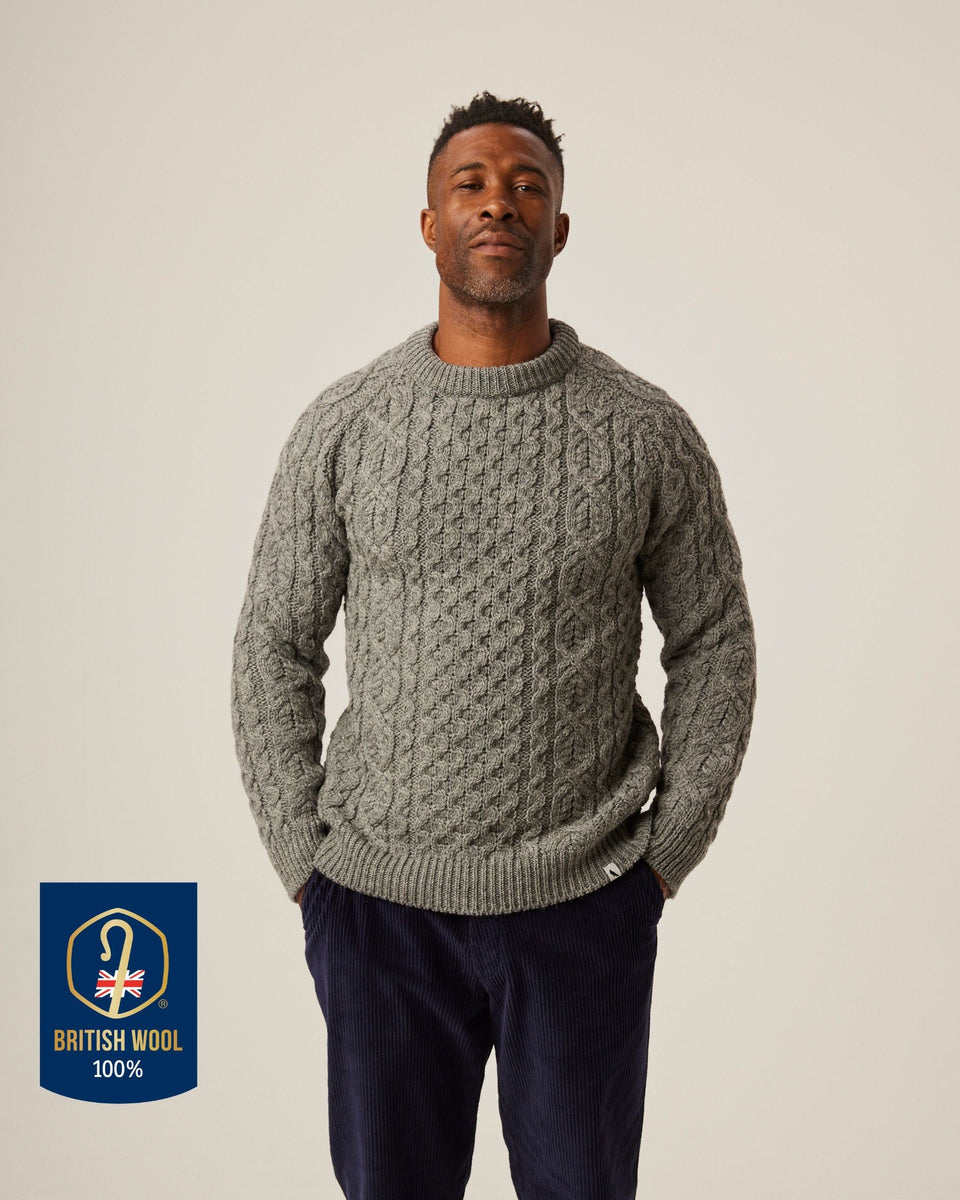
Traditional Aran sweaters earned their maritime reputation over centuries of foul weather on the North Atlantic, but many modern boutique interpretations trade utility for indoor softness. Peregrine refuses that compromise. Knit entirely in England from fleece sheared from domestic sheep, the Hudson Aran is a dense, unapologetic slab of wool built to handle raw coastal winds and damp mountain valleys. The substantial cable pattern is not merely decorative. Those thick dimensional ribs and honeycombs trap generous pockets of dead air, turning your own body heat into an impenetrable microclimate. Because the wool retains a fair amount of its natural oils, the garment stubbornly sheds sea mist and light precipitation before dampness can reach your inner layers. This is not a delicate sweater to pack into an ultralight trekking kit. It has real heft, a scratchy traditional hand, and a substantial drape that demands an undershirt. In return for carrying that bulk, you get an enduring cold-weather fortress that synthetic fleeces and fragile cashmeres cannot match.
Materials and Construction
Peregrine sources raw fleece from British flocks and processes the fiber locally, resulting in a coarse, long-staple yarn that feels distinctly robust. The Hudson is knit with tight tension across the complex cable panels, eliminating the loose gaps where wind typically penetrates looser heritage knits. Ribbing at the crew collar, cuffs, and hem uses doubled yarn to prevent the sagging common to untreated wool garments over extended wear. The seams are fully fashioned and securely linked rather than cut and sewn, creating clean interior transitions that do not abrade against midlayers. Natural lanolin remains present in the yarn, giving the sweater a faint earthy scent and providing an innate hydrophobic barrier against morning fog and sleet.
Real-World Thermal Performance
In the field, this sweater behaves more like an unlined wool jacket than an ordinary pullover. In freezing conditions paired with a modest breeze, the dense Aran knit arrests air movement far better than open-gauge knits, though a howling gale will eventually cut through without a shell. The loft generated by the textured cable channels maintains consistent core warmth even during intermittent stop-and-go activity like splitting firewood or setting up camp. When exposed to persistent dampness, the wool absorbs roughly a third of its weight in moisture before feeling wet, continuously generating a faint chemical warmth as the fibers take on water vapor.
Weight and Bulk Profile
There is no way around the numbers: this is a heavy garment that commands significant volume. Rolling the Hudson up takes as much pack space as a three-season down sleeping bag, making it an impractical choice for minimalist backpacking or fast-and-light mountain travel. It belongs on your back from the trailhead onward, stashed behind the seat of a truck, or packed in a duffel for basecamp duty. If you warm up on a steep ascent, you will need to tie it externally to your pack or drape it across a rucksack lid, because cramming it into an internal compartment alongside standard gear is a losing battle.
Fit and Layering Dynamics
The cut strikes a deliberate balance between traditional boxiness and modern ergonomics. The torso provides enough room to layer comfortably over a flannel shirt or thermal henley without pulling tight across the chest, yet it avoids excessive fabric pooling around the waist. The sleeve length accommodates reach during physical chores, and the ribbed cuffs grip the wrists firmly enough to stay pushed up your forearms when working. Because British wool possesses a crisp, somewhat prickly texture, wearing this sweater over bare skin is uncomfortable for all but the most calloused users; plan on a dedicated long-sleeve base layer beneath it.
Durability and Longevity
Where delicate fine-micron merino garments fail from friction against pack straps and brush, British sheep fleece thrives on abuse. The Hudson exhibits exceptional resistance to surface pilling because the coarser fibers do not break and tangle easily. Pushing through thorny underbrush or hauling abrasive split logs produces minimal fuzzing on the cable faces. Elbows and cuffs hold their shape across seasons without blowing out, and the inherent elasticity of the tightly spun wool prevents permanent bagging at the joints. Given basic care—infrequent cold hand washes, seasonal cedar storage, and flat drying—this sweater will easily outlive modern synthetic midlayers.
Comparable Field Alternatives
In this price bracket, the Hudson competes primarily against Scandinavian heavyweights like the Dale of Norway Blyfjell and Devold Nansen. The Devold Nansen uses similarly burly Norwegian wool but opts for a simpler, flatter rib knit that feels somewhat stiffer and less pliable on the body. Dale of Norway delivers tighter, weather-treated knits with finer yarns and technical zip collars, but at a noticeably higher cost and with a dressier aesthetic. Peregrine's distinct advantage lies in its traditional cable topography, domestic UK sourcing, and balanced classic cut that transitions from cold woodland campsites to coastal taverns without looking overly technical.
How we chose
We compared widely available outdoor wool sweaters using maker specifications, retailer listings and published reviews, then ranked 10 against the same criteria below. This is desk research unless a pick is marked field tested. Rankings are editorial. No brand pays for placement, and affiliate links never move a pick up or down.
- Real-world durability
- How the material, stitching, or steel holds up after a season of hard use — not how it looks new.
- Performance in bad conditions
- Wind, rain, cold, and grit are the test. Anything that only works on a nice day gets marked down.
- Weight and packability
- Every ounce has to earn its place in the pack, but not at the cost of something that fails in the field.
- Ease of use
- Setup, adjustment, and maintenance with cold hands, in the dark, without the manual.
- Value at its price point
- Compared against the closest competitors in the same tier, not against cheaper gear in a different class.
- Repairability and support
- Field-fixable design, available parts, and a warranty the maker actually honors.
Hudson Aran Jumper — frequently asked questions
- Is the Hudson Aran Jumper worth it?
- We rank it #7 in Outdoor Wool Sweaters. Best traditional cable knit
- What is the Hudson Aran Jumper best for?
- Best for autumn coastal trekking, campfire chores in freezing temperatures, vehicle-based backcountry touring and casual winter everyday wear. Standouts: heavy british wool construction traps immense thermal heat and natural lanolin content sheds light rain, sleet, and ocean spray.
- What are the downsides of the Hudson Aran Jumper?
- Coarse wool texture requires a long-sleeve shirt underneath, Substantial bulk makes it difficult to pack in standard rucksacks and Becomes exceptionally heavy when saturated in steady downpours.
- What are the key specs of the Hudson Aran Jumper?
- Material: 100% British wool · Knit Gauge: Heavyweight traditional Aran cable knit · Country of Origin: Made in England · Fit: Standard traditional fit · Care: Hand wash cold, dry flat
- Materials and Construction — what should I know about the Hudson Aran Jumper?
- Peregrine sources raw fleece from British flocks and processes the fiber locally, resulting in a coarse, long-staple yarn that feels distinctly robust. The Hudson is knit with tight tension across the complex cable panels, eliminating the loose gaps where wind typically penetrates looser heritage knits.
- Real-World Thermal Performance — what should I know about the Hudson Aran Jumper?
- In the field, this sweater behaves more like an unlined wool jacket than an ordinary pullover. In freezing conditions paired with a modest breeze, the dense Aran knit arrests air movement far better than open-gauge knits, though a howling gale will eventually cut through without a shell.
Compare side by side
Put the Hudson Aran Jumper against any other pick on this list — specs, price, pros, cons and reader ratings.