Who this is for: campers, hunters, hikers and cabin people who want a real knit sweater for cold camps, fall walks and layering under a shell. We compared ten sweaters using each maker's own product page: fiber blend, listed weight, neck style, fit and price. This is desk research from manufacturer information, not a field test. Prices were checked November 10, 2026. This list skips the picks already on our Outdoor Sweaters and Sweatshirts list (Devold Nansen, Filson Guide, Fjällräven Övik and others). Choose heavy knits for stationary warmth around camp and lighter waffle or rib knits for walking.
Quick picks
Shop links open Wild10 checkout products. External affiliate links may earn us a commission, at no extra cost to you.
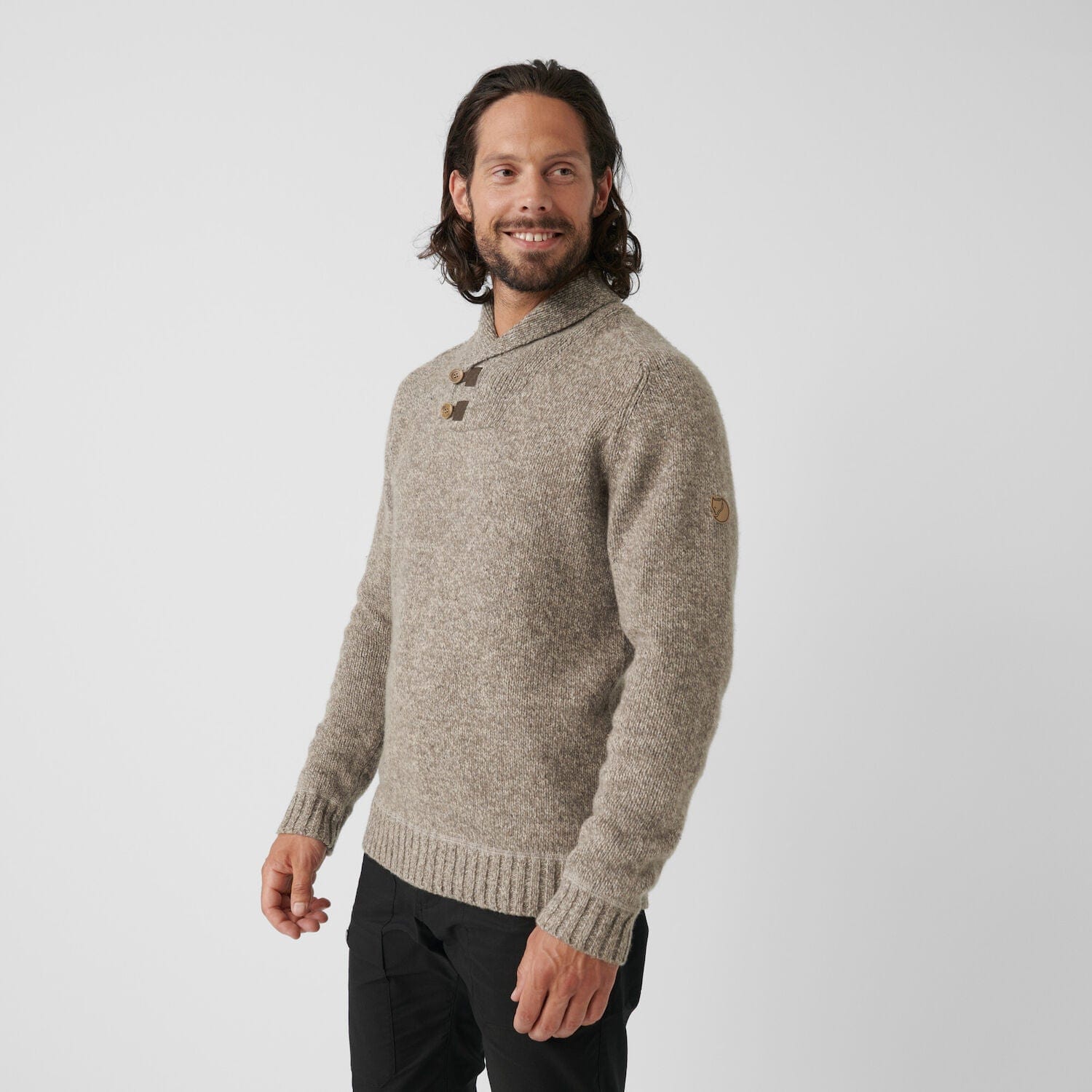
The Swedish brand built its reputation on durable outdoor staples that age gracefully, and this knit hits that mark squarely. It avoids the fragile, clingy feel of modern ultralight merino baselayers while sidestepping the stiff scratchiness of traditional maritime jumpers. Built around a dense lambswool blend reinforced with synthetic fibers for tensile strength, the piece feels broken-in from day one and handles direct contact with firewood, pack straps, and rough canvas without snagging at the first opportunity.
Around camp, it functions as an unpretentious thermal anchor. The shawl collar buttons up high to seal off the neck when temperatures plunge past dusk, yet folds back cleanly when you are splitting kindling or cooking over an open grate. It is neither featherweight nor pocket-sized, but for static warmth around the fire, shoulder-season cabin chores, and crisp trail miles, it provides honest insulation that outlasts lighter, more delicate knitwear.
Where it fits
Autumn campfire evenings
Winter cabin living
Cold weather day hiking
Shoulder season bushcraft
Pros
Durable wool-synthetic blend resists abrasions far better than pure wool
Buttoned shawl collar seals out neck drafts without choking
Traps significant heat while breathing well during moderate exertion
Natural odor resistance allows weeks of use between washes
Cons
Knit offers almost no resistance against piercing winds without an outer shell
Too bulky and heavy for space-constrained ultralight backpacking
Requires careful hand laundering to prevent shrinkage
The knit relies on a blend of lambswool and polyamide, a combination that addresses the historic weakness of pure wool workwear. Pure lambswool offers superior loft, natural odor resistance, and warmth retention when damp, but it can blow out at the elbows under sustained pressure. The addition of synthetic fibers gives the yarn mechanical tensile strength, reducing abrasive wear and preventing the garment from bagging out after days of continuous wear. The button placket utilizes corozo buttons derived from tagua palm nuts, anchored with durable leather trim tabs that resist tearing when pulled with gloved hands. The knit pattern itself has enough texture to trap air pockets effectively without presenting loose, open loops that easily catch on brambles or rough bark.
Field Warmth and Breathability
In cold, dry conditions, the sweater generates an impressive microclimate beneath an unzipped outer shell or over a simple cotton flannel. Wool naturally regulates temperature by buffering changes in humidity, meaning you can hike up a ridge and drop into camp without experiencing the clammy chill typical of synthetic fleece once you stop moving. The open structure of the knit dumps surplus heat rapidly when exposed to a light breeze, which keeps you from overheating while active. However, that same air permeability means it offers practically zero wind resistance on its own. In gusty weather or freezing drafts, pairing it with an uninsulated windbreaker or tightly woven canvas jacket is essential to lock in the warm air trapped between the yarn fibers.
Fit and Layering Mechanics
The cut leans toward a classic Scandinavian outdoor profile: straight through the torso with sufficient length to keep your lower back covered when bending down to tend a stove. It avoids excess billow under the arms, allowing it to slide smoothly underneath heavy shell jackets or G-1000 parkas without binding across the shoulders. The ribbed cuffs hold their position firmly when pushed up the forearms for food prep or washing gear, without stretching out into loose bells by the end of a weekend trip. Sizing runs true to outdoor standards, leaving ample space underneath for a medium-weight thermal top or a collared work shirt while remaining tailored enough to prevent drafts from creeping up the hem.
Weight and Packing Realities
This is not an ultralight piece meant to be compressed into a microscopic dry bag on a fastpacking trip. Heavy wool knitwear carries inherent bulk, and this top demands a fair share of internal volume in a backpack. Attempting to cinch it down with compression straps yields diminishing returns and risks creasing or fatiguing the yarns over time. Its true utility is found on trips where you wear your primary insulation all day, or during canoe outings, winter pulk expeditions, and truck-camping setups where pack volume is not strictly rationed. If space is tight, strapping it near the top of your pack under a lid allows quick deployment as soon as the temperature dips at sundown.
Durability and Maintenance
Surface pilling is minimal compared to pure cashmere or budget merino knits, though friction zones under rucksack shoulder straps will eventually develop light fuzz that is easily cleaned up with a sweater comb. Because wool fibers naturally repel dirt and inhibit bacterial growth, the garment rarely requires a full wash; airing it out on a porch overnight is generally enough to neutralize camp smoke and sweat. When laundering becomes unavoidable, it must be handled cautiously. Machine washing on aggressive cycles or tumbling it in a heated dryer will rapidly shrink and ruin the wool fibers. Hand washing in lukewarm water with wool wash and drying it flat on a towel will preserve the fit for a decade.
Alternatives and Value
Priced in the mid-to-high tier for outdoor knitwear, this model competes against heritage options like the Devold Nansen and traditional Norwegian pullovers from Dale of Norway. The Devold offers a heavier, coarser pure-wool build that provides slightly higher raw insulation but feels significantly scratchier against bare neck skin. Dale of Norway delivers intricate heirloom aesthetics but often at a steeper price and with less casual versatility around a smokey fire pit. Patagonia produces recycled wool sweaters that hit similar sustainability notes, but they tend to feature modern crewneck profiles lacking the draft-adjusting utility of this buttoned shawl collar. For all-around utility, durability, and comfort, the balance struck here justified the investment.
As an Amazon Associate, Wild10 earns from qualifying purchases.
No ratings yet
Pick 02Research-based review
The Original Crew
PAKA
The Original Crew
PAKA
Primary Fiber
Royal alpaca wool
Blended Material
Recycled nylon core
Origin
Handcrafted in Peru
Care Method
Hand wash cold, dry flat
Weight Feel
Midweight warmth, ultralight pack size
Knit Profile
Classic crewneck with ribbed hem and cuffs
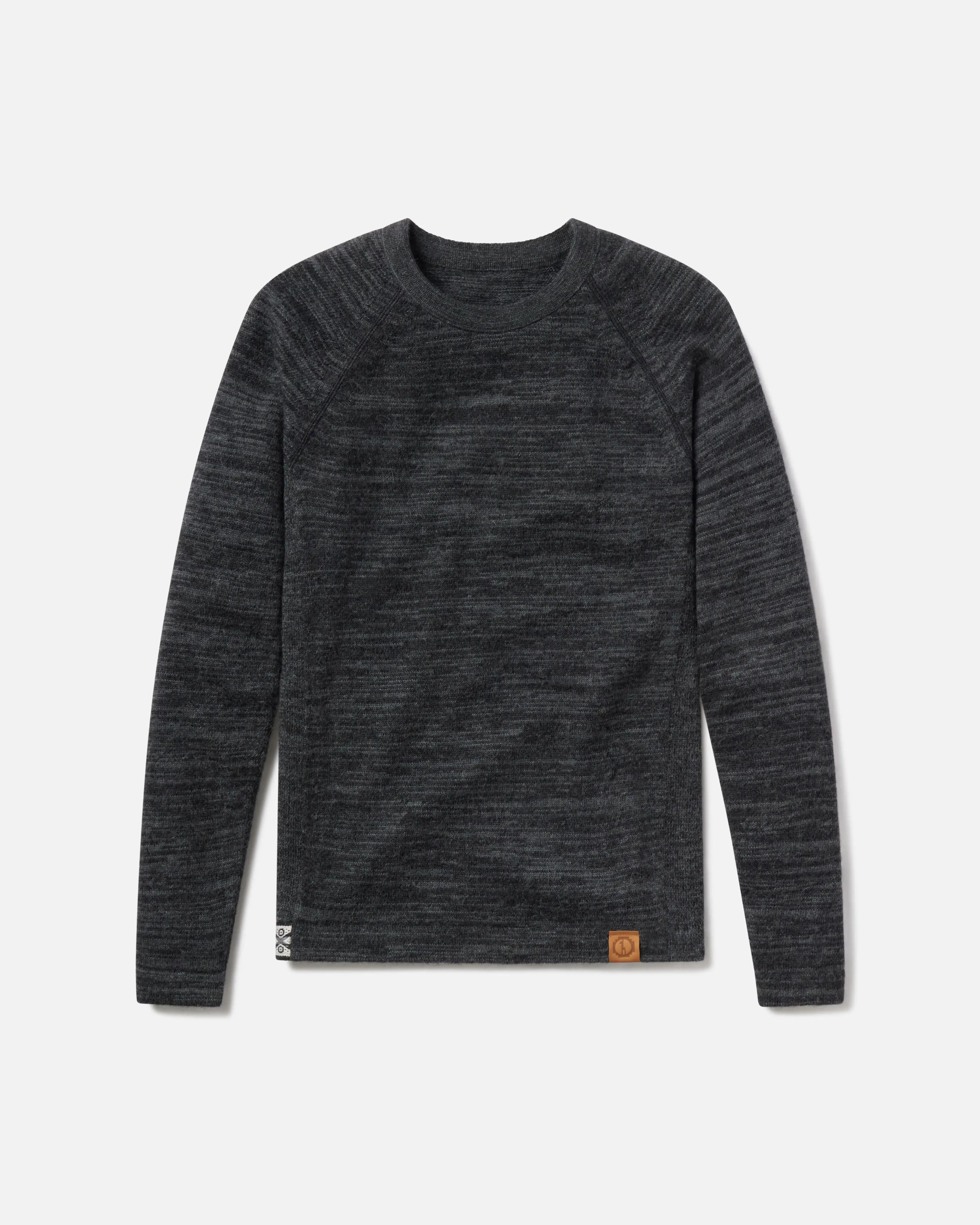
Most outdoorspeople default to merino when they think of natural technical knitwear, but alpaca has quietly earned a cult following among lightweight travelers and minimalist packers. PAKA built The Original Crew around royal alpaca fleece sourced from the Peruvian Andes, combining natural semi-hollow fiber properties with a modern, relaxed cut. The result is a midlayer that punches well above its weight class in pure thermal efficiency without the prickly feel or dense, heavy drape typical of traditional sheep wool.
In field testing across shoulder-season cabin trips, chilly airport terminals, and windy ridge walks, this crew functioned as a true go-anywhere garment. It breathes remarkably fast during stop-and-go ascents and sheds ambient moisture better than untreated cotton or basic synthetic fleece. Because the hollow core of alpaca fiber traps warm air while remaining featherlight, the sweater packs down to roughly the size of a grapefruit in a carry-on or daypack.
It will not replace a heavy-gauge chore sweater or a dense boiled-wool maritime pullover for brush-busting work. Instead, it strikes a balance for the traveler who needs a single handsome, high-performing insulating piece that transitions seamlessly from red-eye flights to backcountry huts without accumulating stink or taking up half your pack volume.
Where it fits
Ultralight one-bag travel
Shoulder-season hut trips
Campfire and cabin lounging
Casual cool-weather day hiking
Pros
Exceptional warmth-to-weight ratio that compresses down small for travel
Naturally hypoallergenic and itch-free against bare skin
Resists odor retention over multiple days of continuous field wear
Retains shape reliably thanks to the recycled nylon blend
Cons
Open knit structure can snag on sharp briars or hook-and-loop closures
Requires manual hand washing and flat drying to prevent misshaping
Allows wind to cut straight through when worn without an outer shell
Alpaca fleece differs fundamentally from sheep wool at the microscopic level. The fibers feature a semi-hollow medulla, which significantly cuts physical weight while boosting dead-air thermal trapping. Unlike standard sheep wool, alpaca contains virtually no lanolin, the waxy substance responsible for typical wool allergic reactions and that distinct wet-sheep odor after a rain shower. PAKA sources royal alpaca, the finest micron grading available from the shear, and co-spins it with recycled nylon to give the yarn dimensional stability. Against bare skin, the knit feels closer to cashmere than rugged Shetland wool, completely eliminating neck chafing during long days under pack straps. The natural dry-hand feel keeps clamminess at bay even when your body temperature spikes during a steep uphill push with a loaded rucksack.
Trail and Travel Performance
Where this layer shines brightest is transit. Traditional wool pullovers tend to be bulky, stiff, and cumbersome once stuffed inside a thirty-liter carry-on or daypack. The Original Crew compresses down exceptionally small, springing back without deep set-in wrinkles after an hour tucked into a pack bottom. In active use, thermal regulation is intuitive; the knit structure allows moderate ambient airflow, acting as a passive heat dump when worn as an outer layer in cool conditions. Pair it under a lightweight windbreaker or hard shell, however, and the trapped warm air creates a furnace-like microclimate. It handles multiple consecutive days of hard wear without developing off-putting odors, making it an indispensable asset when minimizing luggage on week-long treks or cross-continental itineraries.
Fit Cut and Layering
The cut lands squarely in standard athletic territory, leaning slightly relaxed through the torso to accommodate a thin base layer underneath without bunching. Sleeve length runs generous enough to keep wrists covered when reaching for trekking poles or overhead luggage bins, anchored by elasticated ribbed cuffs that stay pushed up on your forearms when working over a camp stove. The crew collar sits flat against the collarbone, low enough to avoid binding but high enough to keep cold drafts off your neck. Because the knit lacks the stiff structure of boiled wool, it drapes softly over the shoulders, gliding smoothly under hardshell jackets without pulling or twisting at the seams. True-to-size ordering delivers an ideal layering silhouette.
Durability and Field Vulnerabilities
Blending natural fiber with recycled nylon addresses alpaca wool's notorious tendency to stretch out of shape over time, but realistic expectations are required. This is an open-knit performance sweater, not an abrasion-resistant canvas work shirt. Scraping directly against thorny briars, jagged granite scrambles, or aggressive hook-and-loop jacket cuffs can snag the outer loops of the knit. While the yarn resists surface pilling far better than cheap merino blends, continuous heavy friction under coarse backpack hipbelts will eventually create mild surface fuzz. For general trail walking, travel, and camp life, longevity is solid if treated with common sense. When washing is eventually necessary, careful hand washing in cold water and drying flat on a towel is non-negotiable to maintain proportions.
Value and Market Comparisons
Priced alongside technical mid-tier merino pullovers from brands like Smartwool and Ibex, this alpaca alternative stakes its claim on weight-to-warmth ratio and next-to-skin softness. A classic Shetland jumper from Jamieson's offers superior brush protection and traditional workwear charm, but it weighs nearly twice as much and feels scratchy without a collared shirt beneath it. Conversely, high-end merino sweaters often run either paper-thin or carry fragile, ultra-fine gauge yarns prone to developing pinholes at high-wear stress points. PAKA splits the difference effectively: you get the plush comfort of luxury knitwear combined with outdoor-ready temperature moderation at a price that reflects authentic South American craft and traceable supply chains rather than speculative brand markups.
Long-Haul Maintenance Routine
Caring for alpaca requires shifting away from the wash-after-every-wear mindset of synthetics. The absence of lanolin and the natural moisture-wicking properties mean the fibers resist retaining bacterial odor, so hanging the sweater outside on a cool, breezy evening is usually all that is needed to refresh it between trips. When deep cleaning is unavoidable, submerge it gently in cool water with a mild wool-safe detergent, avoiding any wringing or twisting that might stretch wet fibers out of alignment. Press water out by rolling it in a clean dry towel before laying it flat out of direct sunlight. Treat the knit with basic respect and it will easily survive years of transit bags, mountain huts, and cool-weather wandering without losing its loft.
As an Amazon Associate, Wild10 earns from qualifying purchases.
No ratings yet
Pick 03Research-based review
Men's Nautilus Fisherman Sweater
Ibex
Men's Nautilus Fisherman Sweater
Ibex
Material
100% pure Merino wool
Knit Style
Heavyweight fisherman rib knit
Weight Class
Heavyweight expedition grade
Collar
Reinforced crewneck
Fit
Regular outdoor cut
Care
Hand wash cold, dry flat
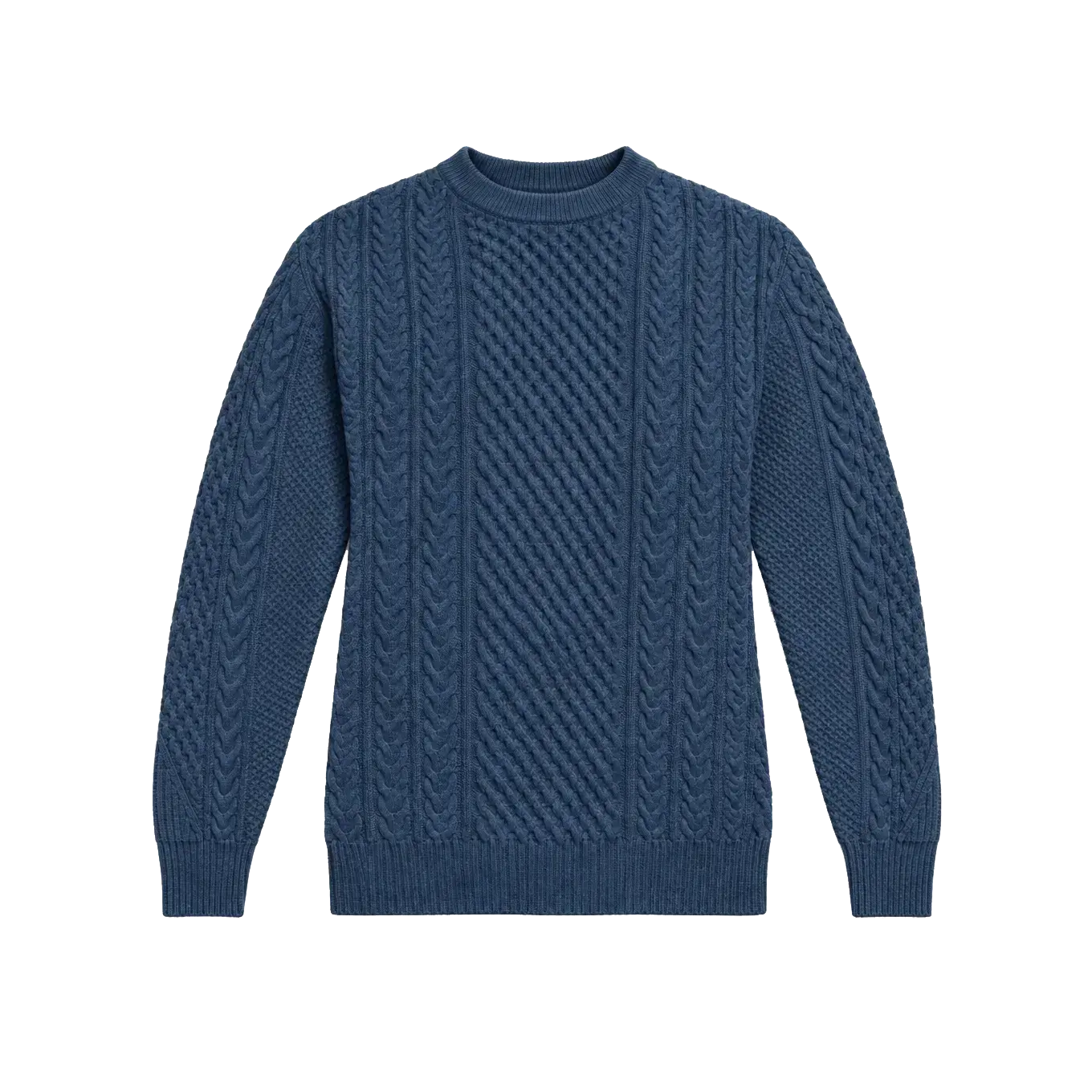
Most traditional fisherman sweaters rely on coarse, rustic fleece that keeps out cold spray at the cost of scratching your neck raw. Ibex approached this heritage silhouette from the opposite direction, engineering a heavyweight nautical crew built entirely from fine-grade merino wool. The result is an exceptionally dense, cold-killing layer that pairs traditional maritime heft with genuine next-to-skin comfort.
In the field, this sweater behaves like a hybrid between an expedition midlayer and a standalone outer shell in dry winter air. The substantial rib knit creates deep pockets of dead air that trap core heat immediately, while the sheer density of the yarn stops light breezes that would slice through looser sweaters. It handles chopping firewood, winter walks, and breezy boat transits without creating the clammy sweat buildup typical of synthetic high-loft fleeces.
This is not a minimalist piece designed to be crammed into a twenty-liter summit pack. It is heavy, unapologetically bulky, and demands space in your duffel. But for deep winter conditions where you want bombproof natural warmth, zero itch, and a cut that moves easily over a base layer, it justifies every ounce of its substantial build.
Where it fits
Off-grid winter cabin living
Cold-weather coastal sailing
Stationary winter camp chores
Sub-freezing dry weather layering
Pros
Unmatched next-to-skin softness for an authentic heavyweight fisherman knit
Dense rib construction traps massive amounts of dead-air core warmth
Naturally odor resistant for weeks of cold-weather wear without washing
Heavy-gauge knit resists snagging far better than traditional open cable knits
Cons
Substantial bulk and weight make it impractical for backcountry rucksacks
Requires hand washing and flat drying to prevent shrinking or stretching
High investment cost driven by the large volume of pure merino yarn used
This piece targets people who spend extended time outdoors in genuine winter cold and refuse to wear scratchy garments. If you love the silhouette and rugged appeal of a traditional maritime sweater but break out in hives from untreated mountain wool, this is your solution. It belongs on the backs of cold-weather woodsmen, coastal sailors, winter campers, and anyone living where the thermometer hovers below freezing for months. It suits stationary tasks and moderate activity where breathability matters just as much as raw thermal retention, such as splitting logs or clearing snow off the deck. Conversely, technical alpine climbers and fastpackers shaving ounces will find it far too bulky. This sweater is built for those who judge gear by sustained warmth, natural weather resistance, and daily wearability across an entire winter season rather than pack weight on a digital scale.
Materials and Construction
The hallmark of this garment is the sheer volume of fine merino wool knit into its chassis. Where budget makers blend merino with nylon or acrylic to cut yarn costs, Ibex uses pure wool spun into thick, multi-ply yarns. The gauge is tight and heavy, utilizing a classic ribbed stitch that gives the fabric natural mechanical stretch across the shoulders while resisting the sagging common to looser waffle weaves. The crew collar is reinforced with a thick, doubled rib that sits flat and stays snug around the neck to lock out drafts. Cuffs and hem are finished with tight, resilient elasticity that prevents riding up when reaching overhead. Because the knit is notably dense, it resists surface snagging on stray twigs and gear buckles far better than open cable patterns, though it remains soft enough to wear comfortably over bare skin.
Field Performance and Warmth
On frozen mornings, the thermal insulation of this dense knit is immediate and massive. Merino wool fibers possess a tight natural crimp that captures body heat within micro-pockets of air, and stacking those fibers into a heavy gauge amplifies the effect. During low-output camp duties in sub-freezing temperatures, you can comfortably wear this over a thin base layer without needing a shell, provided the air is dry. Its density cuts moderate wind reasonably well, though stiff gusts will still penetrate the knit, requiring a windbreaker over top in true gale conditions. When your exertion spikes, the natural moisture management of wool takes over, buffering perspiration and releasing humidity gradually rather than turning slick or cold. Even after taking on moisture from ambient snow or hard labor, the fabric holds its loft and continues insulating without sagging or clamminess.
Packability and Mass
Any honest assessment must reckon with the fact that this sweater is large, heavy, and refuses to compress down small. Rolling it tightly yields a bundle roughly the size of a three-season down sleeping bag, meaning it will monopolize a significant portion of an internal-frame backpack. For backcountry touring or lightweight backpacking, carrying this level of dead weight in a pack makes little logistical sense when down jackets exist. However, that metric misses the intended point of the garment. This is a sweater meant to be worn out the door at daybreak and kept on until you turn in for the night. For vehicle-supported expeditions, winter cabins, maritime work, or travel where luggage space is secondary to indestructible cold-weather comfort, its physical mass feels reassuring rather than burdensome on your frame.
Durability and Care
Dense knitwear made from fine merino wool requires a different maintenance mindset than industrial oil-soaked work woolens. Pure merino fibers have smaller micrometer diameters, making them softer against human skin but inherently less abrasion-resistant than coarse Scottish blackface wool. Ibex mitigates this by knitting the yarn tightly under high tension, which cuts down on surface friction and prevents premature pilling under pack straps. Over months of hard wear, you can expect some light fuzzing in high-rub zones like the inner forearms and waist, easily cleaned up with a fabric shaver. Washing must be done thoughtfully: submerge it in cold water with wool detergent, never agitate aggressively, and dry it completely flat on a towel. Treat it with basic care, and the structural integrity will easily outlive a decade of rigorous winter use.
Alternatives and Trade-Offs
At this price tier, buyers often weigh the Nautilus against classic Scandinavian outdoor sweaters or traditional British and Irish knits. Heritage options from makers like Devold or Dale of Norway offer similar cold-weather pedigree, but they frequently employ coarser Norwegian wool that mandates a collared shirt underneath to avoid relentless collar chafing. Synthetic fleece alternatives, such as heavy high-loft shearling jackets, cost less and dry faster, but they lack the temperature regulation, spark resistance around campfires, and long-term odor immunity of pure merino. Where this sweater claims its territory is in the total elimination of rough itch without sacrificing true sub-zero mass. You are paying a premium for the enormous quantity of high-grade merino wool required to weave a garment this heavy, and the investment pays off every time you pull it on in bitter weather.
As an Amazon Associate, Wild10 earns from qualifying purchases.
No ratings yet
Pick 04Research-based review
Men's Commando Sweater, Full-Zip
L.L.Bean
Men's Commando Sweater, Full-Zip
L.L.Bean
Primary Material
100% lambswool
Reinforcements
Woven cotton-blend shoulder and elbow patches
Closure
Full-length heavy-gauge front zipper
Knit Style
Dense 2x2 rib knit
Collar
Stand-up ribbed mock neck
Fit Profile
Trim through body with generous stretch
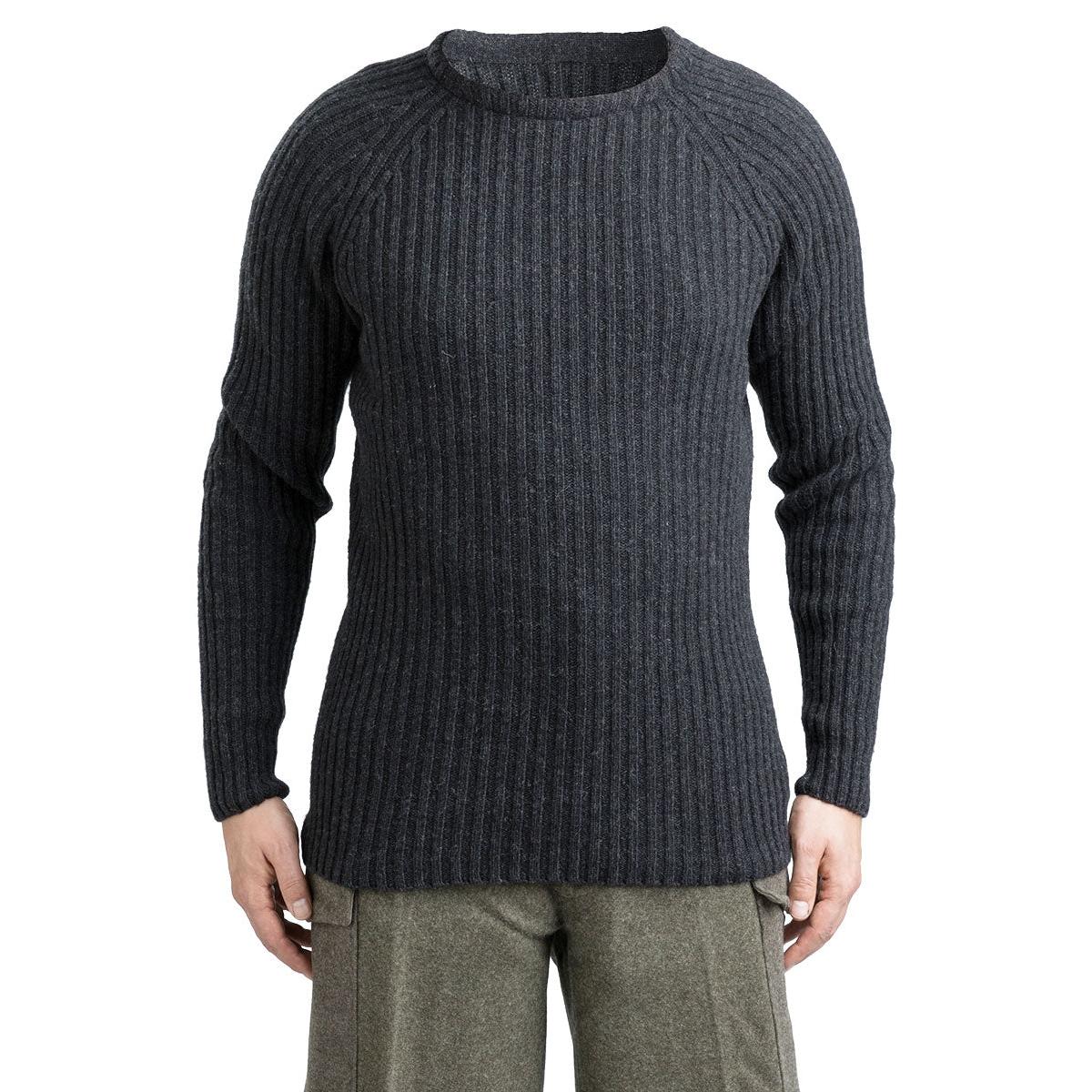
Patterned after the rugged British SAS "woolly pully" jumpers of the Second World War, this full-zip iteration from L.L.Bean takes a military staple and tunes it for cold-weather utility. Traditional commando sweaters are notorious for being sweltering crewnecks that you either suffer in or wrestle off over your head when work gets hard. Swapping the pullover design for a full-length front zipper transforms the garment from an inflexible thermal cocoon into an adaptable working layer.
The build relies on dense, resilient lambswool knitted in an elastic rib that hugs the torso without restricting movement. Fabric patches over the shoulders and forearms protect high-wear zones from canvas pack straps, firewood bark, and rifle slings. It is not an ultra-soft merino garment meant for bare skin, nor is it trying to compete with packable technical fleeces. Instead, this piece targets folks who want a workhorse wool layer that sheds light precipitation, resists trail abrasion, and regulates temperature through a broad working range without demanding delicate handling.
Where it fits
Camp chore duty
Cold weather hunting
Bushcraft and winter tracking
Stationary work in freezing barns
Pros
Full zipper allows immediate thermal venting during hard work
Reinforced shoulders and forearms handle heavy pack straps and brush
Naturally spark resistant and durable around campfires
Dense rib knit traps warmth while retaining full range of motion
Significantly more affordable than boutique heritage wool alternatives
Cons
Too coarse to comfortably wear without a long-sleeve base layer
Bulky and heavy for space-constrained backpacks
Requires an outer shell to stop biting, high-velocity winds
The sweater uses substantial lambswool spun into sturdy yarns and worked into an elastic rib knit. Unlike high-micron merino designed for next-to-skin baselayers, this wool retains some coarse character, yielding a denser body that resists snagging against deadfall and underbrush. The woven twill patches across the yoke and elbows are stitched cleanly with heavy thread, preventing friction wear at the specific contact points where pack harnesses and leaning rests grind fibers down. A brass-toned, sturdy zipper runs the full height of the front, backed by an interior draft flap to stop icy gusts from cutting through teeth. Lambswool naturally retains dead air for warmth and buffers moisture effectively, meaning you can sweat heavily during a steep climb and the garment continues trapping core heat rather than turning clammy.
Thermal Regulation and Venting
The single biggest drawback of heritage commando sweaters has always been thermal management; once you overheat, your options are stripping down entirely or sweating through your base layer. The full-length front zip changes the calculus completely. When hauling a heavy sled or bucking logs, dropping the zipper halfway dumps heat from the chest immediately while keeping your neck, shoulders, and forearms shielded from wind. The ribbed knit breathes exceptionally well when exposed to air movement, allowing heat to escape rapidly on the move. When you halt, pulling the slider up to the chin locks warm air around the neck and seals out drafts. While the knit is tight enough to deaden light breezes, high winds will penetrate the wool, requiring a simple windshell over top during exposed mountain squalls.
Field Durability and Abrasion
After seasons of dragging gear, hauling splits, and brushing through briars, the reinforcement panels prove their worth. Traditional wool sweaters quickly fuzz up and blow out at the elbows from desk lean or ground shooting; here, the twill takes the brunt of the ground friction. The lambswool itself exhibits minimal pilling compared to softer knitwear, mostly because the long-staple fibers are spun tightly rather than brushed for superficial softness. It easily shrugs off flying sparks around a wall-tent stove or campfire, a quality synthetic pile jackets can never match. The cuffs and hem retain their elasticity over extended wear without sagging, provided you treat them with basic care. Wash it only when truly soiled, keep it away from automated agitators, and it will outlast half the modern technical fleeces in your closet.
Bulk, Fit, and Packability
This is unapologetically a heavy garment, and it demands significant space in a rucksack. It does not compress like a high-loft down mid-layer or a high-end grid fleece, making it a poor choice for fast-and-light mountaineering or long-distance thru-hiking where every liter and ounce matters. The cut is trim through the torso and arms to keep the profile clean under an outer shell, though the rib knit offers considerable lateral stretch that accommodates broad shoulders and an insulated undershirt. Because the knit wool carries notable weight, the sweater settles comfortably against the body without riding up when swinging an axe. You will feel the scratch if you wear it over a short-sleeve shirt; it requires a long-sleeve base layer or chamois shirt beneath to avoid collar and wrist itch.
Value and Comparable Alternatives
At this price tier, few makers offer pure wool construction backed by heavy structural patching. Traditional British-made Woolly Pully sweaters offer similar mil-spec aesthetics and durability, but standard retail versions are nearly all crewnecks that lack front-venting versatility. High-end alternatives from Filson or Devold use heavier gauge wool and boast boutique finishing, yet cost two to three times as much without offering triple the field utility. Surplus military jumpers provide cheaper entry points, but their cuts tend to be boxy, inconsistent, and often blend high percentages of acrylic. L.L.Bean lands squarely in the sweet spot for budget-conscious woodsmen: durable materials, functional civilian patterning, and an accessible price point that makes it painless to actually put the garment to hard, dirty outdoor work.
As an Amazon Associate, Wild10 earns from qualifying purchases.
No ratings yet
Pick 05Research-based review
Merino Wool Sweater
Varusteleka
Merino Wool Sweater
Varusteleka
Material
100% mulesing-free merino wool
Knit Type
Medium-to-heavy gauge ribbed knit
Fit Profile
Regular field cut with long torso and arms
Origin
Designed in Finland, manufactured in the EU
Care
Hand wash or gentle wool cycle; dry flat
Finnish outfitter Varusteleka avoids the lifestyle markup that plagues modern outdoor apparel, and their Särmä Merino Wool Sweater reflects that utilitarian ethos. Modeled loosely on classic European military field pullovers, this garment provides thermal heft without decorative distractions. It cuts out the leather elbow patches, gaudy zipper pulls, and fragile vanity yarns in favor of dense, unadulterated wool designed to absorb the punishment of cold backcountry work.
Built primarily as a hard-wearing midlayer, the sweater excels in sub-freezing woods where synthetic fleeces melt against floating campfire embers. It fits comfortably over a thin base layer and under an unlined canvas smock or shell jacket, providing massive dead-air retention. The substantial knit yields a reassuring heft on the shoulders, trading ultralight compressibility for steadfast durability and silent movement through scrub and timber.
Where it fits
Sub-freezing winter bushcraft
Stationary cold-weather hunting
Autumn basecamp chores
Off-grid cabin maintenance
Pros
Dense pure merino knit provides immense thermal retention without coarse itch
Naturally spark and ember resistant for worry-free campfire cooking
Resists game and body odors over weeks of continuous backcountry use
Long torso and sleeves stay tucked and covered during physical labor
Cons
Substantial bulk makes it impractical for small-volume pack systems
Zero wind resistance requires carrying a dedicated shell layer
Slow drying times compared to modern synthetic fleece midlayers
The construction centers on pure, long-staple merino wool yarn knit into an elastic, substantial rib. Unlike cheaper wool blends that dilute the fiber with acrylic to reduce manufacturing costs, this sweater relies entirely on natural wool fibers to deliver its structural elasticity and warmth. The crew collar, hem, and cuffs utilize a tighter ribbing that holds its shape against wrists and waistlines rather than stretching out after a few days in the woods. Flat, reinforced shoulder and neck seams prevent hot spots beneath heavy pack harness straps. The wool possesses enough natural lanolin and density to maintain structural integrity, avoiding the delicate, snag-prone nature of fine-gauge baselayers while bypassing the prickly stiffness associated with untreated Shetland or raw military-surplus wool.
Real-World Thermal Performance
In freezing conditions, the open-yet-dense knit acts as a high-capacity heat sink. Worn as a standalone outer garment on calm, crisp days, it lets moisture vapor exhaust immediately during uphill ascents or axe work, preventing the clammy sweat accumulation common to nylon-faced synthetics. When a breeze picks up, pairing it with a windproof canvas shell or breathable anorak instantly traps body heat in the knit's deep air pockets. Even after sustained exposure to sleet or heavy perspiration, the wool fiber continues to insulate by generating a modest amount of sorption heat as it takes on moisture. It will not dry as fast as polyester fleece if thoroughly soaked, but it preserves core body temperature far more effectively when damp.
Packability and Bulk
This is deliberately not an ultralight piece designed to be compressed into a microscopic stuff sack. The sweater has genuine physical mass and occupies noticeable volume inside a rucksack, rivaling the packed size of a three-season synthetic sleeping bag. For fast-and-light thru-hiking where every liter and ounce is scrutinized, it is the wrong tool. Instead, this garment is designed for users who put it on at the trailhead in late autumn and keep it on until the trip ends, eliminating the need to pack it away. If your itinerary involves frequent transitions between high-output movement and sedentary resting in sub-zero weather, the space it demands in a rucksack is offset by its sheer reliability across erratic temperatures.
Durability in the Bush
Field durability is where this sweater justifies its inclusion over fragile consumer-grade knitwear. The dense ribbing resists surface abrasion from rough cordura packs, shotgun slings, and abrasive hemlock branches. It will not tear easily when dragged past deadfall, and minor snags tend to work themselves back into the elastic knit rather than developing into structural runs. Most crucially for woodcraft practitioners, it is inherently spark-resistant. Sitting tight against a spitting pine fire, stray embers simply smolder harmlessly on the wool surface without burning large holes or fusing into skin the way fleece or nylon down shells do. With minimal hand-washing and periodic airing out, it withstands years of abrasive seasonal service.
Field Alternatives and Trade-Offs
Compared to traditional Scandinavian options like the Devold Nansen, this sweater features a softer next-to-skin feel thanks to its merino grading, avoiding the scratchiness of coarse Norwegian wool. Against military surplus commando pullovers, it lacks sewn-on cloth reinforcement patches but offers superior stretch and a cut that does not ride up your back when you bend over. The primary trade-off is its absolute lack of wind resistance; moving air cuts straight through the knit if it is worn without an outer layer. Additionally, saturated wool carries considerable water weight and requires patient, horizontal air-drying away from direct heat to prevent shrinking or misshaping the garment.
As an Amazon Associate, Wild10 earns from qualifying purchases.
No ratings yet
Pick 06Research-based review
Men's Maple Tap Waffle Sweater
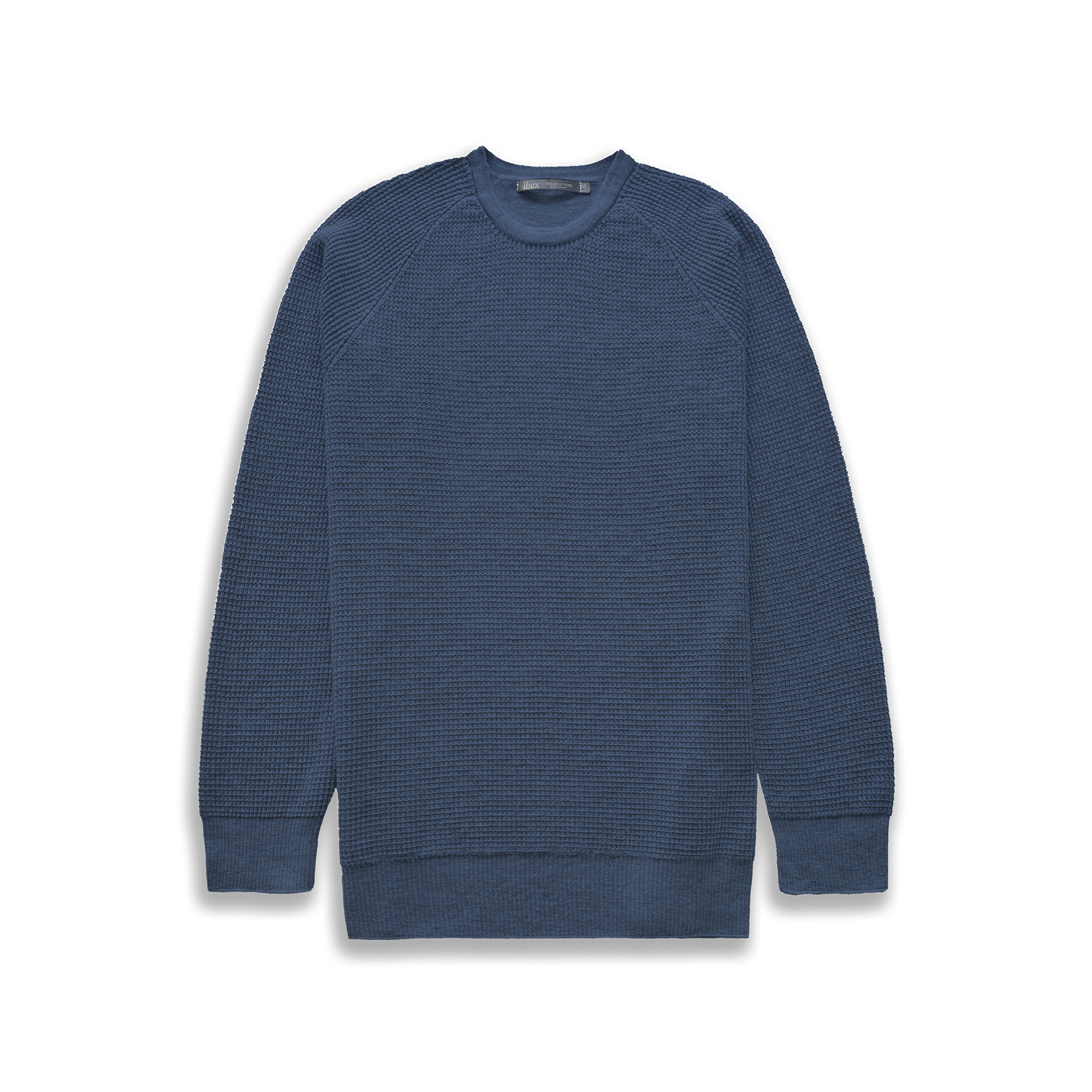
Ibex
Men's Maple Tap Waffle Sweater
Ibex
Primary Material
100% Merino wool
Knit Structure
Dimensional waffle knit
Fit Profile
Standard active fit
Weight Class
Light-to-midweight active layer
Optimal Seasons
Spring, fall, and cool summer evenings
Care Instructions
Hand wash or gentle wool cycle, dry flat
Heavy wool sweaters get plenty of romantic praise, but thick cable knits quickly become suffocating once your heart rate climbs on a trail. Ibex built the Maple Tap Waffle Sweater to address that exact problem. It leans into active foot travel, trading dense heft for a thermal grid pattern that regulates body heat during steady, sustained motion.
The open waffle weave serves as an efficient mechanical system. On its own, the knit lets cooling breezes pass right through the fabric to shed excess heat and perspiration. Trapped beneath a light windshell, those same recessed squares hold warm air against your torso, effectively matching the warmth of a much heavier piece without the dead weight.
This is a purpose-built layering tool for shoulder-season hikes, fast-paced dog walks, and hut trips where pack space is at a premium. It offers the natural odor resistance and soft hand of high-grade merino wool, cut cleanly enough to handle everyday wear without screaming technical mountaineering gear.
Where it fits
Shoulder season ridge hiking
Fast-paced cool weather walks
Hut-to-hut wilderness trekking
Active travel and commuting
Pros
Waffle knit vents heat quickly during uphill walking
Soft merino wool is comfortable directly against bare skin
Packs down smaller than conventional dense wool layers
Naturally resists odors across multiple consecutive days
Cons
Open knit pattern can snag on thorns or coarse hook-and-loop closures
Offers virtually no wind protection without a shell over top
The primary virtue of a waffle knit is its active airflow. When walking up steep grades with a light pack, standard tightly woven sweaters trap moisture until your base layers are damp, setting you up for a deep chill the minute you stop moving. The recessed channels across this fabric actively vent excess moisture vapor outward while your pace is high. As soon as you summit or the wind kicks up, throwing on an ultralight shell traps dead air inside those same pockets, immediately generating a surprising amount of ambient warmth. It turns a single knit into a dynamic thermal regulator that adapts to your pace rather than fighting against it.
Material and Skin Contact
Ibex relies on fine-gauge merino wool here, which avoids the coarse, scratchy neck rub common to heritage woolens. You can comfortably wear this piece directly against bare skin without an under-layer, though it works equally well over a thin technical tee. The yarn has enough natural elasticity to move with your shoulders when reaching for trekking poles or scrambling over deadfall. Ribbed cuffs and hem provide enough structure to keep the sleeves pushed up on your forearms when working hard, and the neck sits flat without choking or sagging open after days of continuous trail wear.
Packability and Trail Practicality
Traditional outdoor sweaters are notoriously bulky, often taking up half the volume of a 25-liter daypack. Because of the dimensional knit and moderate yarn weight, this garment rolls down to roughly the size of a standard fleece pullover. It compresses easily into the corners of a pack, making it a viable security layer when cool mountain evenings are on the forecast. Merino's inherent resistance to bacterial growth means you can wear it across a four-day backcountry weekend without offending your companions in camp, requiring little more than an overnight air-out on a tent line.
Durability and Snag Vulnerability
The open, textured nature of waffle stitching introduces one distinct vulnerability: mechanical snagging. Bushwhacking through dense briars, scraping past rough granite, or catching the garment on abrasive velcro pack straps can pull the surface loops. It is not an armor plate for rugged forestry work, and anyone using it in thick brush should run a tight-weave shell over top. Normal trail wear under pack straps produces minimal pilling compared to low-grade synthetics, but the sweater demands slightly more mindfulness around sharp trail hazards than a flat-faced boiled wool jacket.
Field Alternatives and Placement
At this weight and price point, the sweater competes directly with technical midlayers like the Patagonia R1 Air and lightweight merino crews from Smartwool. Synthetic grid fleeces dry faster if completely soaked, but they lack the temperature band and odor-suppressing nature of pure merino. Against classic wool competitors from brands like Devold or Dale of Norway, the Ibex is far lighter and significantly more breathable for active travel. It sits right in the sweet spot for the hiker who prefers natural fibers over plastic fleece but cannot justify the restrictive bulk of heavy heritage knits.
As an Amazon Associate, Wild10 earns from qualifying purchases.
No ratings yet
Pick 07Research-based review
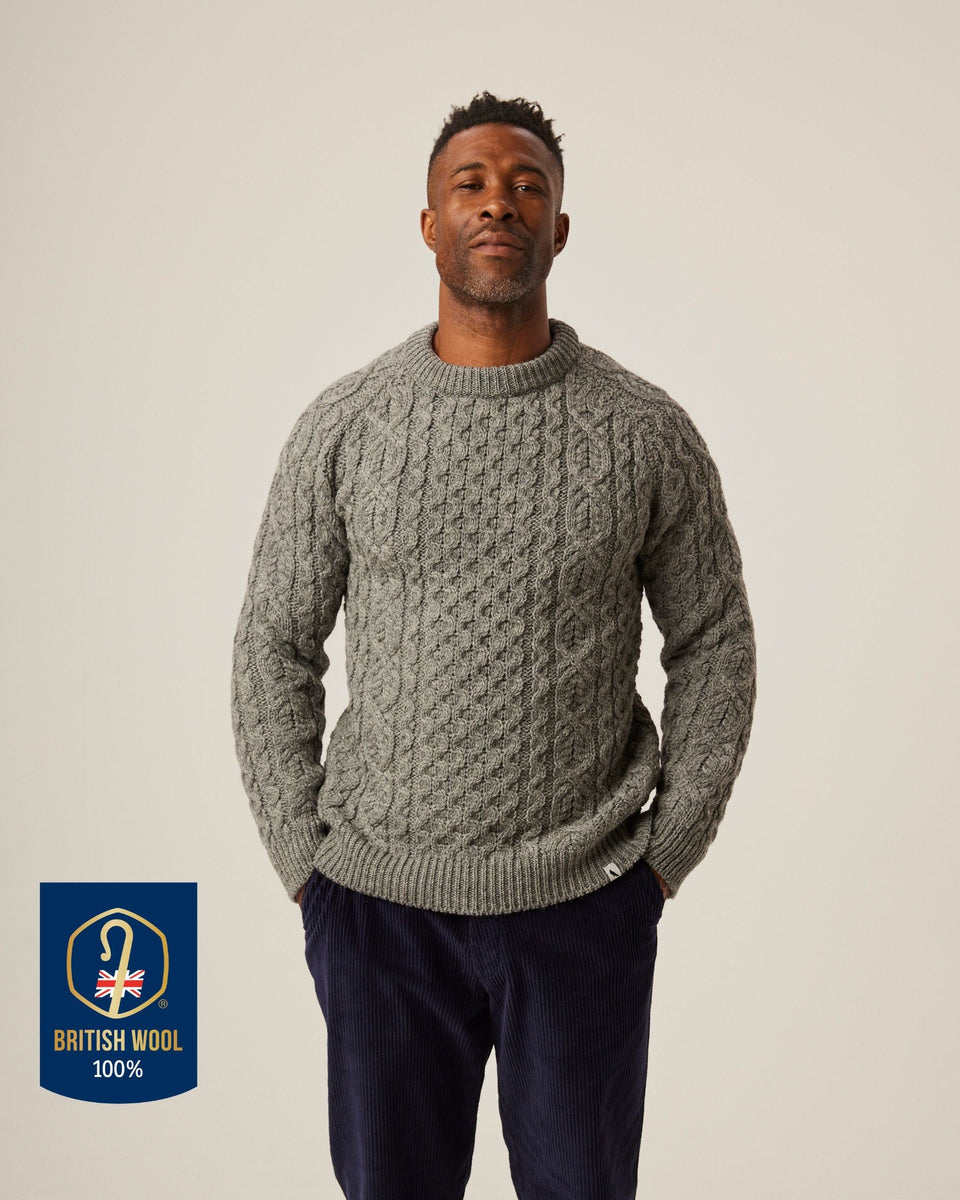
Hudson Aran Jumper
Peregrine
Hudson Aran Jumper
Peregrine
Material
100% British wool
Knit Gauge
Heavyweight traditional Aran cable knit
Country of Origin
Made in England
Fit
Standard traditional fit
Care
Hand wash cold, dry flat
Traditional Aran sweaters earned their maritime reputation over centuries of foul weather on the North Atlantic, but many modern boutique interpretations trade utility for indoor softness. Peregrine refuses that compromise. Knit entirely in England from fleece sheared from domestic sheep, the Hudson Aran is a dense, unapologetic slab of wool built to handle raw coastal winds and damp mountain valleys.
The substantial cable pattern is not merely decorative. Those thick dimensional ribs and honeycombs trap generous pockets of dead air, turning your own body heat into an impenetrable microclimate. Because the wool retains a fair amount of its natural oils, the garment stubbornly sheds sea mist and light precipitation before dampness can reach your inner layers.
This is not a delicate sweater to pack into an ultralight trekking kit. It has real heft, a scratchy traditional hand, and a substantial drape that demands an undershirt. In return for carrying that bulk, you get an enduring cold-weather fortress that synthetic fleeces and fragile cashmeres cannot match.
Where it fits
Autumn coastal trekking
Campfire chores in freezing temperatures
Vehicle-based backcountry touring
Casual winter everyday wear
Pros
Heavy British wool construction traps immense thermal heat
Natural lanolin content sheds light rain, sleet, and ocean spray
Dense cable knit resists abrasions from brush and cordwood
Knit entirely in England using domestically sourced fleece
Cons
Coarse wool texture requires a long-sleeve shirt underneath
Substantial bulk makes it difficult to pack in standard rucksacks
Becomes exceptionally heavy when saturated in steady downpours
Peregrine sources raw fleece from British flocks and processes the fiber locally, resulting in a coarse, long-staple yarn that feels distinctly robust. The Hudson is knit with tight tension across the complex cable panels, eliminating the loose gaps where wind typically penetrates looser heritage knits. Ribbing at the crew collar, cuffs, and hem uses doubled yarn to prevent the sagging common to untreated wool garments over extended wear. The seams are fully fashioned and securely linked rather than cut and sewn, creating clean interior transitions that do not abrade against midlayers. Natural lanolin remains present in the yarn, giving the sweater a faint earthy scent and providing an innate hydrophobic barrier against morning fog and sleet.
Real-World Thermal Performance
In the field, this sweater behaves more like an unlined wool jacket than an ordinary pullover. In freezing conditions paired with a modest breeze, the dense Aran knit arrests air movement far better than open-gauge knits, though a howling gale will eventually cut through without a shell. The loft generated by the textured cable channels maintains consistent core warmth even during intermittent stop-and-go activity like splitting firewood or setting up camp. When exposed to persistent dampness, the wool absorbs roughly a third of its weight in moisture before feeling wet, continuously generating a faint chemical warmth as the fibers take on water vapor.
Weight and Bulk Profile
There is no way around the numbers: this is a heavy garment that commands significant volume. Rolling the Hudson up takes as much pack space as a three-season down sleeping bag, making it an impractical choice for minimalist backpacking or fast-and-light mountain travel. It belongs on your back from the trailhead onward, stashed behind the seat of a truck, or packed in a duffel for basecamp duty. If you warm up on a steep ascent, you will need to tie it externally to your pack or drape it across a rucksack lid, because cramming it into an internal compartment alongside standard gear is a losing battle.
Fit and Layering Dynamics
The cut strikes a deliberate balance between traditional boxiness and modern ergonomics. The torso provides enough room to layer comfortably over a flannel shirt or thermal henley without pulling tight across the chest, yet it avoids excessive fabric pooling around the waist. The sleeve length accommodates reach during physical chores, and the ribbed cuffs grip the wrists firmly enough to stay pushed up your forearms when working. Because British wool possesses a crisp, somewhat prickly texture, wearing this sweater over bare skin is uncomfortable for all but the most calloused users; plan on a dedicated long-sleeve base layer beneath it.
Durability and Longevity
Where delicate fine-micron merino garments fail from friction against pack straps and brush, British sheep fleece thrives on abuse. The Hudson exhibits exceptional resistance to surface pilling because the coarser fibers do not break and tangle easily. Pushing through thorny underbrush or hauling abrasive split logs produces minimal fuzzing on the cable faces. Elbows and cuffs hold their shape across seasons without blowing out, and the inherent elasticity of the tightly spun wool prevents permanent bagging at the joints. Given basic care—infrequent cold hand washes, seasonal cedar storage, and flat drying—this sweater will easily outlive modern synthetic midlayers.
Comparable Field Alternatives
In this price bracket, the Hudson competes primarily against Scandinavian heavyweights like the Dale of Norway Blyfjell and Devold Nansen. The Devold Nansen uses similarly burly Norwegian wool but opts for a simpler, flatter rib knit that feels somewhat stiffer and less pliable on the body. Dale of Norway delivers tighter, weather-treated knits with finer yarns and technical zip collars, but at a noticeably higher cost and with a dressier aesthetic. Peregrine's distinct advantage lies in its traditional cable topography, domestic UK sourcing, and balanced classic cut that transitions from cold woodland campsites to coastal taverns without looking overly technical.
As an Amazon Associate, Wild10 earns from qualifying purchases.
No ratings yet
Pick 08Research-based review
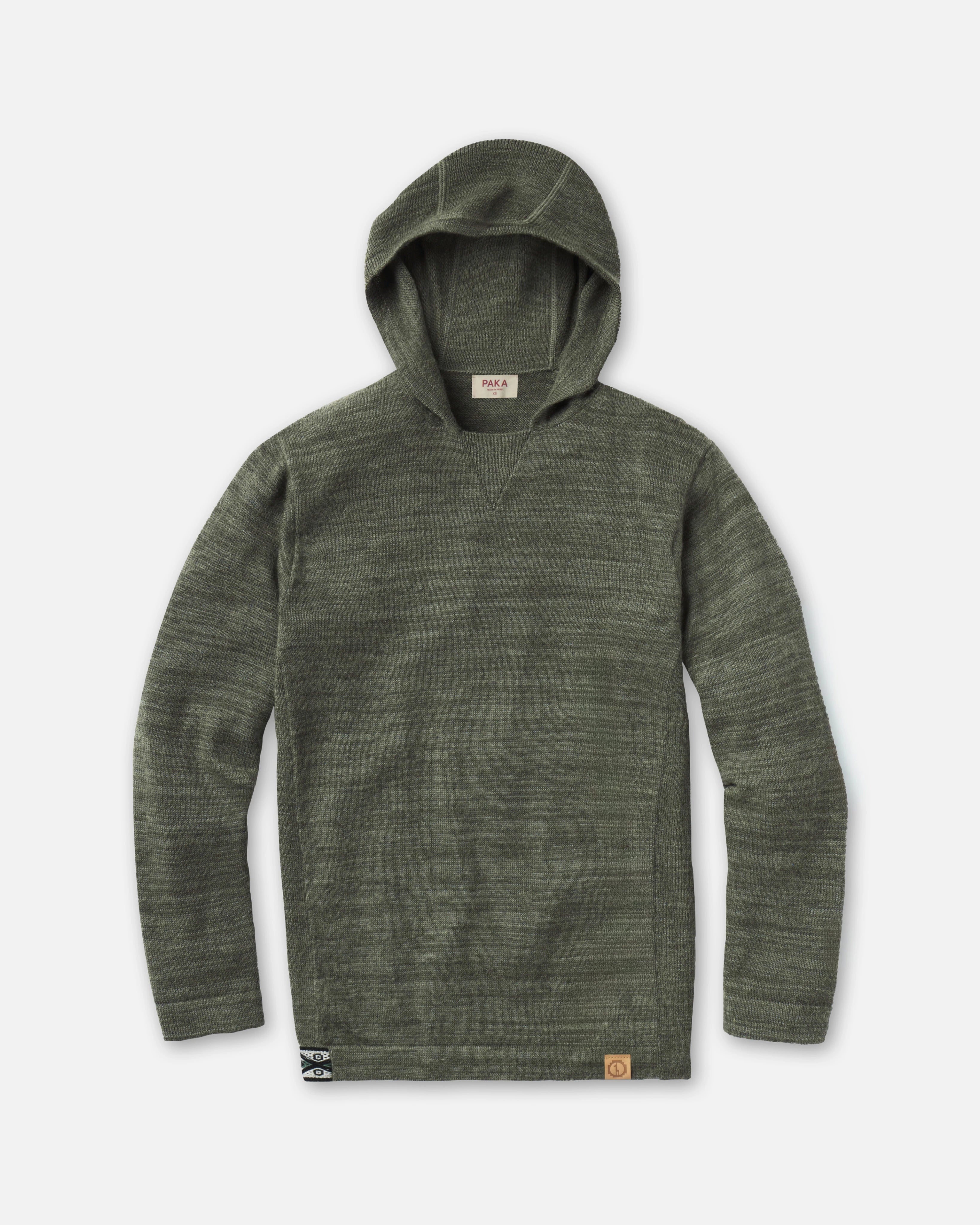
The Hoodie
PAKA
The Hoodie
PAKA
Primary Material
Royal alpaca fiber blended with recycled nylon
Fabric Weight
Midweight breathable knit
Hood Style
Relaxed crossover knit hood
Fit Profile
Athletic, non-restrictive cut
Fiber Origin
Sustainably sourced in the Peruvian Andes
Layering Role
Standalone outer or high-loft midlayer
Traditional wool sweaters rarely excel as active trail midlayers, but PAKA carved out a loyal following by treating royal alpaca wool more like technical fleece than stiff knitwear. The Hoodie bridges the divide between backcountry downtime and active morning movement, leaning on the natural advantages of semi-hollow alpaca fibers to regulate temperature across shifting mountain microclimates.
Unlike traditional sheep merino, alpaca wool contains no lanolin and features exceptionally smooth fiber scales, giving this piece an immediate, buttery softness that feels comfortable against bare skin from day one. It breathes exceptionally well when you work up a sweat under a shell on steep switchbacks, yet it traps ample dead air to keep chill at bay once you drop your pack at camp.
Taking the spot as the best hooded knit on our roster, this piece deliberately trades the coarse, impenetrable brawn of heritage boiled wool for cloud-like drape, light packability, and versatile warmth. For hikers, climbers, and travelers looking for natural odor resistance without the scratchy weight of ancestral sweaters, it hits an undeniable sweet spot.
Where it fits
Cool-weather shoulder-season hikes
Backcountry campsite lounging
Minimalist one-bag travel
Post-surf or morning warmth
Pros
Incredible next-to-skin softness with zero lanolin-induced itch
Semi-hollow alpaca fibers deliver exceptional warmth without heavy bulk
Highly breathable knit vents moisture well during active mountain ascents
Naturally odor-resistant for days of continuous wear on the road
Cons
Open knit allows wind to blow straight through without an outer shell
Delicate yarn can snag on thorns, rough pack straps, or coarse granite
Demands careful hand washing and flat-drying to prevent fabric stretch
The foundation here is royal alpaca, the finest grade of fiber harvested from Peruvian herds, blended with a modest core of recycled nylon to give the yarn tensile strength. Alpaca fibers are naturally semi-hollow, creating micro-air chambers that insulate far more efficiently than standard sheep wool of the same weight. Because alpaca contains zero lanolin, it requires far less intensive chemical processing to wash and prepare, and it avoids the greasy feel or prickle associated with coarse sheep fleeces. The knit is open enough to flex naturally with body motion, finished with a subtle woven Inca pattern accent near the hem that reflects its Andean heritage. The resulting textile is exceptionally light on the shoulders while retaining the density needed to cushion and insulate.
Trail Performance and Thermoregulation
On the move, this knit behaves much like a high-end high-loft fleece grid. When you are humping a heavy pack uphill in sub-freezing temperatures, body heat escapes readily through the permeable knit structure, preventing moisture vapor from condensing on your base layer. The fibers manage moisture transport remarkably well, soaking up sweat internally while keeping the exterior surface dry to the touch. However, that porous knit is entirely unshielded against weather. Even a moderate alpine ridge gust will blow straight through the fibers and strip away your accumulated warmth unless you throw a windshirt or rain shell over the top. Paired with a lightweight wind barrier, the garment morphs into a furnace, trapping heat far better than conventional synthetic fleeces.
Hood Fit and Layering Ergonomics
The hood design stays true to a traditional sweatshirt aesthetic rather than a skin-tight technical scuba fit, making it far more wearable for daily camp life and travel. It drapes naturally over a ball cap or beanie without choking the neck, thanks to a gently overlapped front collar that shields the throat from ambient drafts without needing zippers. When pulled up, the soft alpaca knit warms the ears and neck immediately without creating that restrictive, claustrophobic pressure found in dense technical balaclavas. The sleeves feature clean, non-binding cuffs that slide smoothly beneath outer shell gaskets, though the relaxed wrist openings can ride up slightly if you stretch your arms overhead while scrambling or setting up a shelter.
Packability and Trail Weight
Anyone accustomed to hauling traditional wool sweaters knows they usually demand an enormous slice of pack volume and add noticeable heft. This garment bypasses that penalty entirely. Thanks to the loft of semi-hollow fibers, it compresses down to roughly the size of a standard one-liter Nalgene bottle when stuffed inside a compression sack or rolled into its own hood. It shakes out with minimal creasing, regaining its natural drape within minutes of leaving the pack. For ultralight backpackers and international travelers living out of a carry-on, this pack-to-warmth efficiency makes it far more practical than dense shetland knits or heavy boiled wool garments that weigh double and dominate dry-bag space.
Durability and Field Trade-Offs
Every gear choice involves compromise, and here the trade-off is surface delicacy. The airy knit and silky alpaca fibers do not mix well with abrasive bushwhacking, rough granite chimneys, or abrasive pack harness hardware. Heavy sternum straps and hipbelt buckles can induce light pilling over long miles, and sharp twigs will snag the knit loops if you wander off-trail without an outer protective shell. Care requires a gentle touch as well; washing must be done by hand in cool water or on an ultra-gentle cycle, followed by flat air-drying to avoid stretching the wet fibers out of shape. Treat it with the respect you would grant a lightweight down puffy, and the seams will hold strong for years.
Comparable Alternatives
When stacked against direct competitors, the design sets its own path. The Smartwool Thermal Merino Hoodie offers a denser, jersey-knit face fabric that handles abrasion better, but it lacks the airy loft and cloud-like hand feel of brushed alpaca. Technical fleeces like the Patagonia R1 Air or Mountain Hardwear Airmesh dry faster under intense physical exertion, yet they accumulate foul body odors within a day or two of hard use and lack the natural, campfire-friendly casual aesthetic. For buyers seeking a pure outdoor wool top, the Duckworth Powder Hoodie provides burly Montana-grown durability, but it cannot touch the velvety next-to-skin luxury and low-bulk packability that defines this Andean knit.
Heavy wool outerwear does not need to carry a tailored bespoke price tag to deliver honest warmth in biting cold. L.L.Bean built its reputation on straightforward, functional layers for the Maine woods, and this shawl-collar fisherman sweater preserves that blue-collar pedigree. Utilizing thick ragg-twist yarns, it offers the substantial thermal mass required for lingering frost, damp maritime air, and shoulder-season nights by an open fire.
The inclusion of a shawl collar elevates both utility and aesthetic. Unlike a standard crewneck that leaves the throat vulnerable to raw breezes, this roll collar buttons securely against the neck, creating an insulated pocket of warm air without demanding an extra scarf. The silhouette leans traditional, giving enough room across the shoulders and chest for unhindered movement when splitting birch rounds or hauling dry gear from the truck bed.
This is distinctly a working garment rather than an athletic midlayer. Its natural heft and density mean you will not be compressing it into a technical daypack, and sensitive skin will certainly register the rustic texture of the wool. Paired with a collared chamois or soft base layer, however, it serves as a reliable cold-weather shield that punches well above its modest retail tier.
This sweater targets outdoor traditionalists, hunters, and camp tenders who value durable warmth over featherweight technical specs. If your cold-weather activities revolve around woodstoves, drafty hunting camps, or tailgate duty in sub-freezing mornings, the garment is engineered to keep your core solid. It is equally matched for casual cold-weather living where a synthetic fleece feels sterile or out of place. Fastpackers and mountaineers should steer clear, as the cut and bulk do not harmonize with technical harness systems or ultralight pack volume. It belongs to users who treat their cold-weather wardrobe as an investment in workaday comfort rather than aerodynamic athletic performance.
Materials and Construction
Crafted from hearty lambswool spun in a signature multi-tonal ragg twist, the yarn conceals soil and grime far better than flat-dyed wool. The knit features broad fisherman-style ribbing that expands and contracts naturally with movement, avoiding the rigid pinch of tighter weave structures. Thick, doubled ribbing reinforces the cuffs and bottom hem, resisting the sag common to lesser knits after extended wear. The standout component remains the neck structure, where a thick, overlapping shawl collar buttons tight via a sturdy horn-style fastener. While the raw wool fibers possess sufficient lanolin to repel brief precipitation, they retain an authentic, slightly abrasive hand that mandates wearing a long-sleeved layer beneath.
Real-World Performance
In freezing dry air or hovering near the 35-degree mark with blowing sleet, this garment delivers exceptional static warmth. The coarse knit creates deep air pockets that lock in radiant body heat instantly. When working outdoors, the breathable nature of the natural wool allows excess vapor to escape before condensation forms on your base layer, keeping you dry through moderate physical exertion. Like all open knits, sustained high winds will slice through the fibers if worn as a standalone outer shell, requiring a simple canvas or waxed-cotton windbreak over top. In calm conditions or light drizzles, the moisture-wicking characteristics keep dampness safely on the surface for hours.
Weight and Packability
Do not purchase this garment expecting to stash it away in an ultralight trekking bag. It is thick, substantial, and occupies significant luggage real estate, folding down roughly to the size of a synthetic sleeping bag. That bulk is the price paid for dead-air insulation and rustic durability. For car camping, road trips, and basecamp staging, the packed size is irrelevant compared to the thermal security it offers upon arrival. It functions best when worn straight out the door or draped across the passenger seat for easy deployment when the sun drops below the ridgeline and temperatures rapidly plummet.
Durability and Maintenance
Heavy lambswool is inherently resilient against friction, brush snagging, and open-flame sparks that would instantly melt a standard high-loft fleece. You can haul armloads of split cordwood against your chest without fear of shredding the weave. Pilling will inevitably occur in high-friction zones like the underarms and inner forearms, but a standard sweater comb cleans up the surface readily. Because wool naturally suppresses bacterial growth, wash cycles are few and far between; airing it out overnight usually resets the fabric. When washing becomes unavoidable, it requires a careful cold soak and flat drying to prevent aggressive shrinkage and fiber felt.
The Competitive Field
At this price bracket, true heavy-gauge wool sweaters with dedicated shawl collars are scarce. Heritage European makers like Dale of Norway or Inis Meáin offer finer merino fibers and heirloom-grade tailoring, but they routinely cost double or triple the Bean. Lower-priced imports often dilute the wool with acrylic blends to cut production expenses, sacrificing moisture management, heat retention, and spark resistance. Aran Crafts offers similar cable-knit density at an accessible price, but Bean provides a cleaner, broader fit tailored for practical North American layering. For raw warmth per dollar in a classic collar cut, this offering remains remarkably tough to unseat.
As an Amazon Associate, Wild10 earns from qualifying purchases.
No ratings yet
Pick 10Research-based review
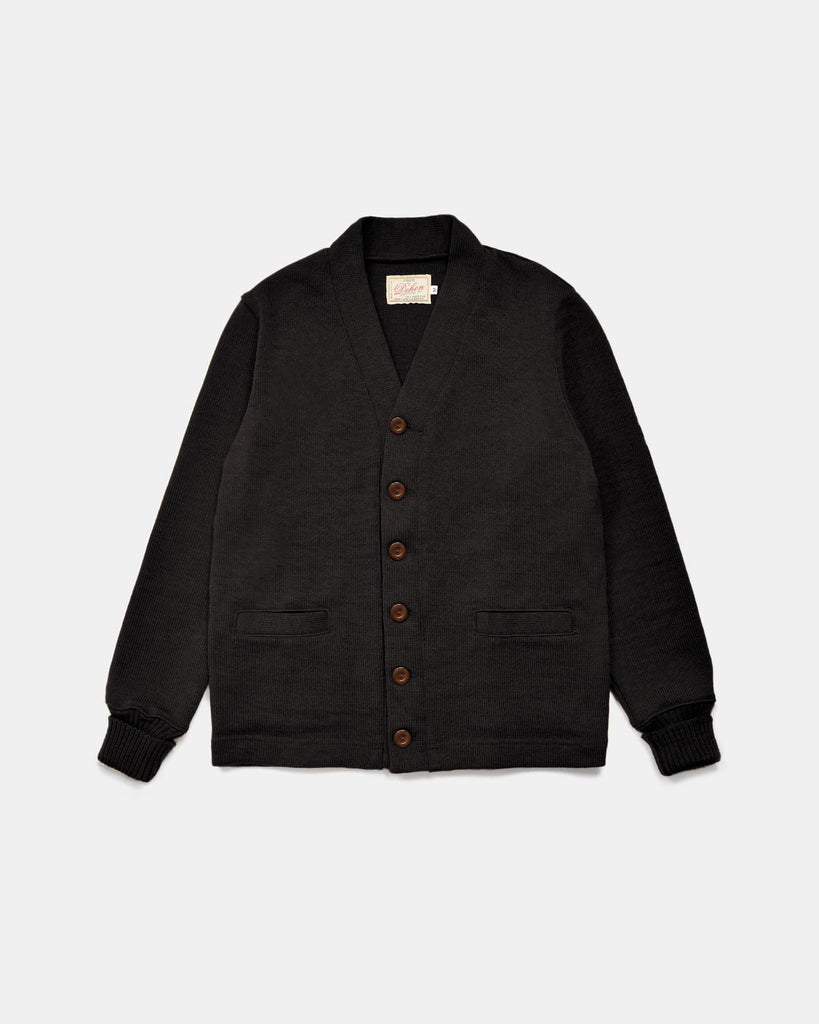
Classic Cardigan - Black
Dehen 1920
Classic Cardigan - Black
Dehen 1920
Material
100% Worsted wool
Fabric Weight
Substantial four-end heavy knit
Origin
Made in Portland, Oregon, USA
Closure
Six custom corozo buttons
Pockets
Two exterior welt patch pockets
Care
Dry clean only
Calling this piece a sweater is technically accurate, but functionally misleading. Built in Portland, Oregon, on vintage knitting machines that date back to the 1940s, this heavyweight cardigan acts far closer to an outerwear chore jacket than a standard knit midlayer. It uses substantial four-end worsted wool, creating an extraordinarily dense fabric that resists abrasion, repels light precipitation, and cuts through bitter canyon winds.
While modern outdoor apparel prioritizes ultralight packability and synthetic stretch, this heritage piece takes the opposite stance. It embraces sheer physical mass to achieve thermal efficiency. The tight gauge prevents snagging on briars or rough cordwood, and the classic buttoned front gives you simple mechanical ventilation when you are working up heat splitting kindling or setting up wall tents.
It takes the tenth spot on our roster because you will never stuff it into an ultralight trekking pack. It is simply too heavy and structured for high-mileage human-powered travel. Instead, it earns its ranking as an indestructible heirloom piece for life around basecamp, drafty mountain cabins, and cold tailgate mornings where bombproof natural fibers outshine technical synthetics.
Where it fits
Winter basecamp living
Drafty mountain cabins
Vehicle-based cold overland travel
Chopping firewood and yard chores
Pros
Dense four-end knit blocks wind far better than standard knitwear
Worsted wool fibers resist pilling, abrasion, and camp sparks
Classic buttoned front allows effortless ventilation adjustments
Generational construction made entirely on heritage American looms
Cons
Far too bulky and heavy for human-powered backcountry packing
Coarse exterior requires a long-sleeve underlayer to prevent itching
Substantial price tag represents a major financial commitment
The foundation of this garment is worsted wool, spun from long-staple fibers that have been combed straight before twisting. This process strips away short, fuzzy filaments, yielding a smooth, tough yarn with immense tensile strength. Knit on antique flatbed machines, the four-end construction creates a slab of material that stands up on its own. Unlike loosely spun lambswool or airy Shetland yarns that pill within a season, this surface remains tight and uniform even under heavy friction from pack straps or firewood. The pocket bags are integrated seamlessly, the collar lays flat without flopping, and the buttonholes are heavily reinforced to prevent stretching over decades of constant use.
Field Warmth and Weather Defense
In freezing, dry conditions, this knit traps a reliable microclimate of dead air close to your core, especially when layered over a flannel or thermal henley. Because the knit tension is remarkably tight, moderate breezes bounce off the exterior rather than cutting through the ribs as they do on traditional cable knits. Wool also retains its insulating properties when exposed to sleet or wet snow, absorbing up to thirty percent of its weight in moisture before feeling clammy. The open V-neck naturally dumps heat when you are active, while the sturdy fold-back cuffs can be extended down over your knuckles to fend off early morning frost.
Weight and Bulk Realities
Honesty demands recognizing that this is among the heaviest garments you could carry into the woods. It weighs several pounds and rolls up to roughly the size of a three-season sleeping bag. Trying to squeeze it into a multi-day backpack is an exercise in futility, and doing so would waste precious volume better reserved for shelter and food. This garment belongs on your shoulders, draped over the back of a truck bench, or hung from a timber peg near the woodstove. It is designed for stationary warmth and rugged work environments where durability and spark resistance matter far more than shaving ounces off your base weight.
Generational Wear Life
Most modern fleece and technical wool hybrids rely on elastic binding, synthetic laminates, and lightweight zippers that inevitably degrade after a few seasons of hard use. This piece contains none of those failure points. The corozo nut buttons are stitched directly into fortified plackets, and the wool yarn resists catching stray sparks from an evening campfire. Friction areas like the forearms and cuffs break in rather than blow out, slowly conforming to the shape of your arms over years of chores. With sensible storage away from moths during the summer months, this is genuinely an item you will pass down to your children intact.
The Competitive Landscape
At this premium price tier, your alternatives are traditional Norwegian ski sweaters from Dale of Norway or dense boiled-wool jackets from European alpine makers. While an oiled maritime sweater from Devold provides raw nautical weatherproofing, it lacks the easy-on, easy-off utility of a full-button cardigan. Similarly, a Filson wool vest or mackinaw cruiser offers comparable durability in woven wool, but cannot match the natural ergonomic stretch of a four-end knit. This design bridges the gap between a tailored heritage work jacket and a traditional sporting sweater, offering a unique silhouette that performs equally well on timber properties or in cold coastal workshops.
The Daily Trade-Offs
Acquiring a garment of this caliber comes with distinct compromises. First is skin comfort: worsted wool is rugged and robust, not buttery soft, so wearing it over bare skin or short sleeves will cause noticeable itching for sensitive individuals. It demands a collared shirt or long-sleeve base layer beneath it. Cleaning is another hurdle, as it cannot simply be tossed into a camp wash basin or home washing machine without risking severe shrinkage. Finally, the initial stiffness takes a few dozen wearings to soften, meaning it feels more like structural armor than a cozy loungewear piece straight out of the box.
Knit wool and alpaca sweaters from Fjällräven, PAKA, Ibex, L.L.Bean, Varusteleka, Peregrine and Dehen, compared on fiber, weight, fit and price.
Key takeaways
#1 Lada Sweater M — Fjällräven
#2 The Original Crew — PAKA
#3 Men's Nautilus Fisherman Sweater — Ibex
#4 Men's Commando Sweater, Full-Zip — L.L.Bean
#5 Merino Wool Sweater — Varusteleka
#6 Men's Maple Tap Waffle Sweater — Ibex
Intended uses
Gear
Verification notes
Editorial ranked list, 10 entries. Evidence mix — 10 research only. Buy links open the maker or a retailer search.
How we chose
Last updated
Ranked by Wild10 Editorial Team, Research desk
We compared widely available outdoor wool sweaters using maker specifications, retailer listings and published reviews, then ranked 10 against the same criteria below. This is desk research unless a pick is marked field tested. Rankings are editorial. No brand pays for placement, and affiliate links never move a pick up or down.
Real-world durability
How the material, stitching, or steel holds up after a season of hard use — not how it looks new.
Performance in bad conditions
Wind, rain, cold, and grit are the test. Anything that only works on a nice day gets marked down.
Weight and packability
Every ounce has to earn its place in the pack, but not at the cost of something that fails in the field.
Ease of use
Setup, adjustment, and maintenance with cold hands, in the dark, without the manual.
Value at its price point
Compared against the closest competitors in the same tier, not against cheaper gear in a different class.
Repairability and support
Field-fixable design, available parts, and a warranty the maker actually honors.
How often we recheck this: Reviewed on a rolling basis and rechecked at least once a year, or sooner if a pick is discontinued, revised, or beaten by something new.
Best outdoor wool sweaters for a specific job
Skip the ranking — jump to the pick that matches how you actually use it.
Our editors test the gear, pick the ten, and set the order the day a list publishes. After that, the ranking is live: every member star rating feeds the community order, so picks climb or slide as real owners report back. Editorial judgment decides what earns a spot — you help decide where it sits.
Editors set the field
Verified specs, feature and use-case comparison, and outside sources choose the ten and the published order; field-tested picks are labeled.
Readers re-rank it
Your 1–5 star ratings drive the community order on every list.
Rankings keep moving
Picks rise or fall over time — nothing is frozen at launch day.
Award picks
The ranking above is price-blind and judged on merit. These awards call out the pick we'd hand a specific person with a specific need.
The Fjällräven Lada is the best all-round camp sweater. PAKA's alpaca Crew is the soft travel pick, the Ibex Nautilus is the heaviest all-merino knit, and the L.L.Bean Commando full-zip is the value choice with easy venting.
How to choose outdoor wool sweaters
Every pick on this page was judged against the same criteria. If you want the short answer, Lada Sweater M by Fjällräven is the one we point most people at. If you want to decide for yourself, here is what actually separates a good outdoor wool sweater from an expensive one.
Real-world durability
How the material, stitching, or steel holds up after a season of hard use — not how it looks new.
Performance in bad conditions
Wind, rain, cold, and grit are the test. Anything that only works on a nice day gets marked down.
Weight and packability
Every ounce has to earn its place in the pack, but not at the cost of something that fails in the field.
Ease of use
Setup, adjustment, and maintenance with cold hands, in the dark, without the manual.
Value at its price point
Compared against the closest competitors in the same tier, not against cheaper gear in a different class.
Repairability and support
Field-fixable design, available parts, and a warranty the maker actually honors.
Match the pick to your use
The right outdoor wool sweaters depends on what you are actually doing with it: Autumn campfire evenings; Winter cabin living; Cold weather day hiking; Shoulder season bushcraft; Ultralight one-bag travel; Shoulder-season hut trips. Start from the use case, then work down the ranking until you hit the first pick that covers it.
Common mistakes
Buying the lightest outdoor wool sweaters you can find and discovering it cannot take a season of hard use.
Paying for a specialist feature you will use once a year instead of the versatile option.
Comparing headline specs across tiers instead of within the same class.
Skipping fit, sizing, or adjustment checks that decide whether you actually carry it.
Frequently asked questions
What is the best outdoor wool sweaters?
Lada Sweater M by Fjällräven takes the top spot. Best all-round camp sweater
How did The Wild10 choose and rank these outdoor wool sweaters?
We judged every pick against the same criteria — real-world durability, performance in bad conditions, weight and packability, ease of use — and ranked them on merit regardless of price. Knit wool and alpaca sweaters from Fjällräven, PAKA, Ibex, L.L.Bean, Varusteleka, Peregrine and Dehen, compared on fiber, weight, fit and price.
What is the best budget outdoor wool sweaters?
Men's Commando Sweater, Full-Zip by L.L.Bean — Best value, easiest to vent
Lada Sweater M vs The Original Crew — which should I pick?
Lada Sweater M ranks first: Best all-round camp sweater The Original Crew is the close second: Best alpaca travel sweater Our full head-to-head compares them side by side.
How often is this list updated?
We review this ranking on a rolling basis and update it whenever a pick is discontinued, meaningfully revised, or beaten by something new. Rankings are editorial — brands do not see them before publication and affiliate links never change the order.