


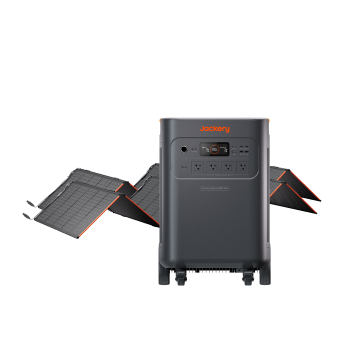
#6 on this list
Explorer 300 Plus
Jackery
Jackery’s Explorer 300 Plus is a purpose-built weekend battery designed for car campers, van lifers, and tailgaters who want simple, reliable low-draw power. By pairing an upgraded 288Wh LiFePO4 battery pack with a lightweight, briefcase-style housing, Jackery created a companion station that fits under vehicle seats or into plastic storage totes. It sheds the bulk of larger power stations while offering significant cycle-life improvements over legacy models. For real-world performance, the 300 Plus is optimized for consumer electronics and low-power DC gear. It features dual USB-C ports—including a 100W PD port capable of fast-charging a high-end laptop—alongside a pure sine wave AC socket for low-wattage electronics. Running a 12-volt CPAP without heat will get you through an eight-hour night with power to spare, though cold ambient temperatures will decrease efficiency. The 12V DC car port is fully regulated, preventing low-voltage drops. Recharging is straightforward across all inputs. You can replenish the unit via standard AC wall power, through USB-C, or by plugging in a compact solar panel. Because the capacity is small, solar recovery is practical even with a lightweight 40W or 80W panel. The trade-off is strictly capacity: this is not a platform for running 12V compressor fridges for whole weekends or powering camp kitchen heating appliances. It is an organized, dependable hub for field gadgets. **Highlights** - Long-lasting LiFePO4 cell pack in a highly compact, 8.2-pound form factor - 100W USB-C Power Delivery port powers modern laptops directly - Folding handle folds flush into the top panel for easy packing - Regulated 12V cigarette port maintains stable power for small coolers - Quiet operation with minimal fan noise under typical camp usage **Watch-outs** - 300W inverter ceiling prevents the use of any kitchen cooking gear - Capacity is insufficient for multi-day overland refrigeration
- Price
- Check current price
- Reader rating
- No reader votes yet
- How we assessed it
- Specification researched

#7 on this list
SOLIX C1000
Anker
The Anker SOLIX C1000 brings heavy-duty industrial design to the mid-tier power station market. Aimed at campers who beat up their gear in dusty environments and demand rapid turnaround times, the C1000 pairs a 1,056Wh LiFePO4 pack with an 1,800-watt continuous pure sine-wave inverter. Anker leverages its power-brick pedigree here to deliver some of the most reliable and efficient charging circuitry in this category. In field trials, the C1000 handles demanding basecamp responsibilities with ease. It runs a 12V overland fridge for upwards of three days on its regulated DC socket and provides roughly four nights of CPAP support without heat. If you need hot water at camp, Anker's SurgePad tech pushes output up to 2,400 watts for resistive heating appliances, boiling water in an electric kettle without overloading the inverter. Its wall recharge is blistering, hitting a full charge in roughly 58 minutes when plugged into AC mains. The unibody construction feels tough enough to withstand tailgate drops, and the flat-top design means you can stack camp bins or gear directly on top of it when cargo space is tight. Anker's companion app allows precise control over recharge rates to prolong battery life when you aren't in a hurry. The primary trade-off is weight: at over 28 pounds, it requires deliberate lifting, and the internal fans whine during max-speed AC recharging. **Highlights** - Robust 1,056Wh LiFePO4 battery pack built for heavy seasonal use - 1,800W continuous output with 2,400W surge overhead for heating gear - Sub-one-hour AC wall recharge via internal HyperFlash technology - Flat-top design allows convenient stacking inside packed vehicles - Integrated LED ambient light strip on the front for dark campsites **Watch-outs** - Cooling fans produce a high-pitched hum during high-wattage charging - Unit feels dense and heavy for solo hand-carries over distance
- Price
- Check current price
- Reader rating
- No reader votes yet
- How we assessed it
- Specification researched
Specs side by side
| Spec | Explorer 300 Plus | SOLIX C1000 |
|---|---|---|
| Battery Type | LiFePO4 (3,000 cycles to 80% capacity) | — |
| Usable Capacity | 288 Watt-hours (Wh) | — |
| AC Output | 300W continuous, 600W peak surge | — |
| Total Weight | 8.2 lbs (3.72 kg) | — |
| AC Wall Charge | Approximately 2 hours to 100% | — |
| Solar Input | 100W maximum (12V-27V) | — |
| Battery Capacity | — | 1,056Wh (expandable to 2,112Wh) |
| Battery Chemistry | — | LiFePO4 (3,000+ cycles to 80% capacity) |
| Continuous Output | — | 1,800W continuous pure sine (2,400W SurgePad) |
| Unit Weight | — | 28.4 lbs (12.9 kg) |
| Wall Recharge Time | — | 58 minutes (HyperFlash AC input) |
| Max Solar Input | — | 600W (XT60 connector, 11-60V) |
What our reviewers liked and didn't
Explorer 300 Plus
- LiFePO4 battery delivers over 3,000 cycles to 80 percent original capacity
- Flat-folding handle creates an easily stackable profile in packed vehicles
- Bi-directional 100W USB-C port charges laptops without bulky AC adapters
- Exceptionally quiet internal fan operation during sustained charging and discharge
- 300W continuous inverter ceiling prevents the use of any camp cooking gear
- Single AC wall outlet limits simultaneous standard plug-in accessories
- 288Wh capacity is insufficient for multi-day overland refrigeration
SOLIX C1000
- Sub-one-hour AC wall recharge provides rapid turnaround between camping trips.
- LFP battery chemistry delivers more than 3,000 cycles to 80% original capacity.
- Flat-top chassis design easily nests beneath cargo bins in crowded vehicles.
- Inverter sustains 1,800 watts continuously with a 2,400-watt resistive surge mode.
- Cooling fans produce an audible high-pitched hum during high-wattage charging.
- At 28.4 pounds, the dense unit is unwieldy for long single-handed hauls.
- 12V car socket rubber weather flap can be difficult to seat firmly.
Prices change constantly — the figure shown is the last verified catalog price, and the buy buttons always go to the current listing.