


Lightning Ascent vs Evo Trail
Our #1 and #2 picks from The 10 Best Snowshoes, compared spec-by-spec with clear pros, cons, and a verdict.
When venturing into winter terrain, your choice of snowshoe dictates whether you are conquering icy alpine ridges or simply enjoying packed woodland paths. Cascade Designs' MSR brand sets the benchmark in both categories with the Lightning Ascent and the Evo Trail. The MSR Lightning Ascent is an aggressive, premium backcountry weapon built around a 360-degree perimeter traction frame, engineered specifically to bite into bulletproof ice, steep traverses, and deep mountaineering ascents. In contrast, the MSR Evo Trail relies on a nearly bombproof injection-molded plastic UniBody deck paired with essential steel traction rails, offering no-nonsense dependability for flat to rolling trails at a fraction of the cost. Choosing between them comes down to terrain severity, budget, and vertical ambition: do you need an ultralight, high-traction platform featuring heel lifts for grueling climbs, or a low-maintenance, indestructible workhorse for weekend trail wanderings? Understanding where these platforms diverge will prevent you from either overspending on extreme features you will never touch or sliding dangerously on steep, icy slopes.
Lightning Ascent
MSR

The MSR Lightning Ascent sits atop the technical snowshoe category for good reason. Engineered primarily for mountaineers, winter peak baggers, and backcountry explorers, this model excels wherever steep angles, firm crust, and exposed ice make footing hazardous. Its hallmark feature is the 360-degree Traction Frame, which integrates serrated teeth directly into the vertical aluminum perimeter frame. Combined with aggressive toe crampons and crossbars, it bites into off-camber slopes with far more security than traditional tubular aluminum designs. Underfoot, the Paragon binding utilizes a pliable, one-piece mesh strap that contours over the boot without creating pinch points or freezing up. It holds footwear securely with minimal fuss, eliminating the loose alignment that causes fatigue on sustained sidehill climbs. The deck itself uses durable polyurethane, maintaining high tensile strength in sub-zero temperatures. For steep ascents, the Ergo Televator heel lifts flip up easily with a ski pole, reducing calf strain significantly on sustained vertical climbs. The main compromise with the Lightning Ascent is its price and performance in very light, bottomless powder. At around $400, it is an investment piece meant for unforgiving terrain, and without MSR’s modular flotation tails attached, the relatively narrow profile provides less surface area than large-format powder shoes. However, for sheer gripping power, build quality, and technical prowess, it remains the gold standard. **Highlights** - 360-degree Traction Frame with perimeter teeth for biting into icy sidehills. - Paragon mesh contour binding eliminates pressure points and resists icing. - Ergo Televator heel lifters engage quickly with pole grips on steep inclines. - Compatible with modular flotation tails for deep snow versatility. - Rugged polyurethane deck built for sub-zero impact resistance. **Watch-outs** - Premium price point makes it overkill for casual flat-trail walkers. - Narrow footprint requires add-on tails for deep, untracked powder.
Buy on AmazonEvo Trail
MSR
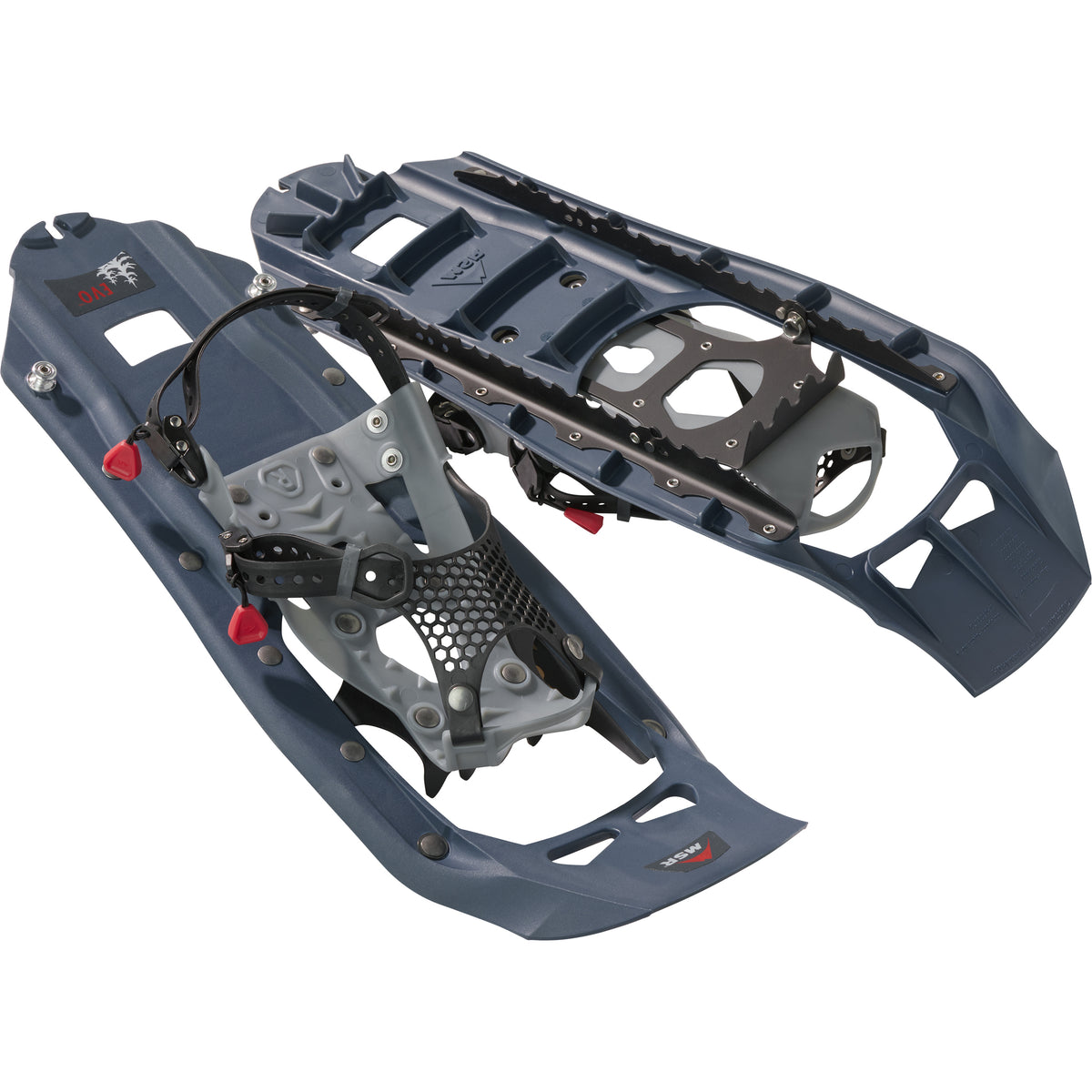
The MSR Evo Trail is widely regarded as the benchmark for entry-level to mid-range winter hikers who want bombproof durability without paying technical alpine prices. Built around an injection-molded plastic UniBody deck with steel traction rails running along the underside, this snowshoe is virtually indestructible. It thrives on rolling forest trails, frozen lakes, and packed snowpack where rocks, roots, and hidden debris might easily puncture a softer fabric deck. While simpler than high-end backcountry models, the Evo Trail does not cut corners on security. Its DuoFit binding system relies on straightforward, freeze-resistant elastomer straps that secure a wide variety of footwear, from standard hiking boots to bulky pac boots. The forward crampon delivers reliable forward bite on moderate climbs, while molded brake bars integrated into the deck prevent sliding backward or sideways on packed routes. The trade-offs center on weight and flexibility. The rigid plastic frame can feel stiff and clattery underfoot over hardpack or icy trails, lacking the smooth, natural roll of flexible composite decks. It also omits the heel lift bars found on steep-climbing models, making sustained ascents more tiring. Still, for dependable performance, minimal maintenance, and long service life at around $180, it offers the best value on the market. **Highlights** - Indestructible UniBody plastic deck resists rock strikes and punctures. - Full-length steel side traction rails provide solid grip on hardpack. - Simple DuoFit elastomer bindings remain pliable in extreme cold. - Modular tail compatibility allows added flotation when carrying heavier packs. - Molded-in deck brake bars assist with downhill control. **Watch-outs** - Rigid plastic deck is loud and stiff on hard, crusted trails. - Lacks a heel lift for comfortable sustained climbing.
Buy on AmazonSpec-by-Spec
| Spec | #1 Lightning Ascent | #2 Evo Trail |
|---|---|---|
| Weight (Pair) | 4 lbs 2 oz / 1.87 kg (22 in) | 3 lbs 10 oz / 1.64 kg (22 in) |
| Capacity / Sizing | 22 in (up to 180 lbs), 25 in (120-220 lbs), 30 in (150-280+ lbs) | 22 in standard (up to 180 lbs; up to 250 lbs with modular tails) |
| Materials | 7075-T6 aluminum frame, polyurethane-coated nylon deck | Martensite steel traction rails, injection-molded polypropylene UniBody deck |
| Price Tier | Premium (~$380 - $440) | Budget-Friendly (~$150 - $180) |
| Warranty | 3-Year Limited Warranty | 3-Year Limited Warranty |
| Best Use | Technical mountaineering, steep backcountry, off-trail exploration | Rolling trails, packed snow, casual winter hiking |
| Portability | Low-profile flat-pack design; binds relatively flat against packs | Rigid molded plastic deck; bulkier profile when strapped to packs |
| Durability | High, but nylon fabric decking can suffer abrasion over exposed rock | Exceptional; plastic UniBody deck is virtually indestructible |
| Feature Highlights | 360° Traction Frames, DTX crampons, Ergo Televator heel lifts, Paragon binding | Molded UniBody traction rails, Paraglide binding, modular flotation tail compatibility |
Lightning Ascent
Best for: Ambitious winter mountaineers, backcountry splitboarders, and technical peak-baggers facing steep, icy terrain.
Pros
- Unmatched 360-degree perimeter grip on steep traverses and hard ice
- Ergo Televator heel risers significantly reduce calf fatigue on steep ascents
- Glove-friendly, pressure-free Paragon mesh binding eliminates hot spots
- Available in multiple deck lengths tailored to user weight and pack loads
Cons
- High price point represents a serious financial investment
- Fabric decking is susceptible to tearing on sharp scree or hidden logs over time
Evo Trail
Best for: Recreational winter hikers and budget-conscious adventurers sticking to established, rolling woodland trails.
Pros
- Significantly more affordable while maintaining renowned MSR quality
- Injection-molded UniBody deck withstands severe abuse on rocks and hidden roots
- Intuitive Paraglide bindings are simple, secure, and freeze-resistant
- Accepts 6-inch modular tails for added flotation in variable snow conditions
Cons
- Lacks heel lifters, making extended steep climbing grueling on calves
- Perimeter traction is limited compared to full-frame 360-degree aluminum teeth
- Only manufactured in a single 22-inch base size
The Verdict
The MSR Lightning Ascent is our clear overall winner for technical prowess and demanding alpine adventures. With its aggressive 360-degree perimeter traction, precision DTX crampons, and calf-saving Ergo Televator heel lifts, it provides unmatched security on steep, icy slopes and backcountry expeditions where gear failure is not an option. However, its high price tag makes it excessive for hikers sticking to local trail systems and gentle grades. For those who prioritize value and brute durability, the MSR Evo Trail remains one of the best budget snowshoes ever built. Its molded plastic UniBody design can take a severe beating across exposed rocks, roots, and hardpack without flinching. Choose the Lightning Ascent if your routes involve significant vertical gain, alpine summits, or mixed backcountry traverses. Choose the Evo Trail if you want a reliable, indestructible snowshoe for rolling winter forest trails that leaves plenty of room in your wallet.