



Updated October 2026 · 10 picks re-checked for availability and current spec, reader ratings refreshed live.
Choosing the right snowshoes comes down to matching terrain, snow conditions, and weight load to the correct frame geometry and traction system. Packed recreational trails require far less biting power than windswept alpine ridges, while untracked powder demands generous surface area that would feel clumsy on rolling forest paths. Modern snowshoes generally split between molded plastic composite decks, perimeter traction frames, and traditional tubular aluminum designs, each offering distinct trade-offs between torsional rigidity, weight, and stride mechanics. To build this ranking, we synthesized evaluations from leading independent outdoor review outlets—including OutdoorGearLab, Switchback Travel, CleverHiker, GearJunkie, SectionHiker, and Treeline Review—alongside technical specs and long-term user durability reports. We balanced aggressive technical capability against cost and user-friendliness, ensuring winter hikers of all experience levels find reliable footing without paying for features they will not use.
The short answer

The MSR Lightning Ascent sits atop the technical snowshoe category for good reason.
Why it wins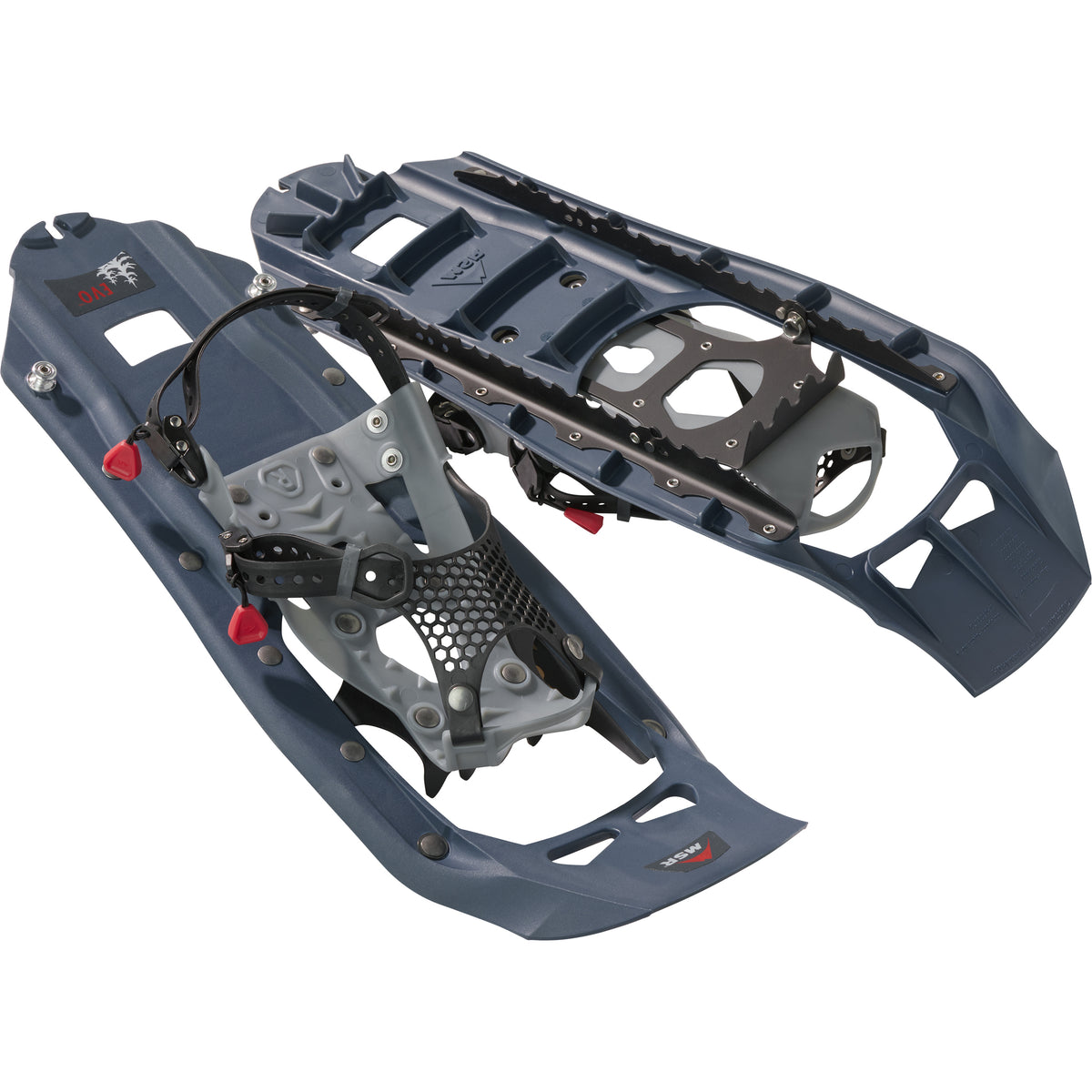
The MSR Evo Trail is widely regarded as the benchmark for entry-level to mid-range winter hikers who want bombproof durability without paying…
Why it wins
The Tubbs Mountaineer is built for deep powder, rolling wilderness treks, and carrying heavy winter loads.
Why it winsDeep-dive product reviews
We've published full field-test reports and technical deep-dives for 9 of the picks in this list.
Compare all 10 picks at a glance
Editorial ranking, what each pick is best at, and how we assessed it. Tap a name to jump to the full write-up.
| # | Pick | Best for | Key spec | Evidence |
|---|---|---|---|---|
| 1 | Lightning Ascent MSR | Alpine mountaineering | Frame Material: 7075-T6 aluminum perimeter | Research only |
| 2 | Evo Trail MSR | Packed forest trail hiking | Deck Material: Injection-molded UniBody plastic | Research only |
| 3 | Mountaineer Tubbs | Deep powder trail breaking | Frame Material: Tubular aluminum | Research only |
| 4 | Revo Explore MSR | Rolling backcountry day hikes | Weight per pair: 4 lb. 4 oz. (22-inch model) | Research only |
| 5 | Evo Ascent MSR | Steep alpine climbing | Deck Material: Injection-molded plastic | Research only |
| 6 | Drifter Retrospec | Packed woodland trail walking | Frame Material: Round tubular aluminum | Research only |
| 7 | Flex VRT Tubbs | Steep mountain peak bagging | Weight Per Pair: 4 lb. 5.9 oz. (Men's 25 in.) | Research only |
| 8 | Symbioz Hyperflex Elite TSL | Packed mountain trail hiking | Weight Per Pair: 4.31 lbs (measured) | Research only |
| 9 | Moon Big Sky 32 Crescent | Deep powder trail breaking | Length: 32 inches | Research only |
| 10 | Wayfinder Tubbs | Packed nature park trails | Weight Per Pair: 3 lbs. 6 oz. | Research only |
How we picked
Ranked by Renata Cho, Apparel & Layering Editor
We started with a long list of snowshoes that people actually buy, cut anything that could not clear our baseline for durability and field performance, then ranked the 10 that were left against the same criteria. Rankings are editorial. No brand pays for placement, and affiliate links never move a pick up or down.
- Fabric behavior over time
- Breathability, DWR life, loft retention, and how the piece performs after repeated washing.
- Real-world durability
- How the material, stitching, or steel holds up after a season of hard use — not how it looks new.
- Performance in bad conditions
- Wind, rain, cold, and grit are the test. Anything that only works on a nice day gets marked down.
- Weight and packability
- Every ounce has to earn its place in the pack, but not at the cost of something that fails in the field.
- Ease of use
- Setup, adjustment, and maintenance with cold hands, in the dark, without the manual.
- Value at its price point
- Compared against the closest competitors in the same tier, not against cheaper gear in a different class.
How often we recheck this: Reviewed on a rolling basis and rechecked at least once a year, or sooner if a pick is discontinued, revised, or beaten by something new.
Best of the Best · Head to Head
Lightning Ascent vs Evo Trail
#1 vs #2 — side-by-side specs, pros & cons, and the final verdict.
Compare any two picks
Build your own side-by-side
Choose any two of these 10 picks and compare specs, price, pros, cons and reader ratings.
Topic summary
Field-proven snowshoes ranked by traction, flotation, frame durability, and value, synthesizing cross-industry testing and backcountry expertise.
Key takeaways
- #1 Lightning Ascent — MSR
- #2 Evo Trail — MSR
- #3 Mountaineer — Tubbs
- #4 Revo Explore — MSR
- #5 Evo Ascent — MSR
- #6 Drifter — Retrospec
Intended uses
Gear
Verification notes
Editorial ranked list, 10 entries. Evidence mix — 10 research only. Buy links open the maker or a retailer search. Last reviewed October 2026.
Best snowshoes for a specific job
Skip the ranking — jump to the pick that matches how you actually use it.
- Best for alpine mountaineering
- #1 Lightning Ascent — MSRThe MSR Lightning Ascent sits atop the technical snowshoe category for good reason. Engineered primarily for mountaineers, winter peak baggers, and backcountry explorers, this model excels wherever steep angles, firm crust, and exposed ice make footing hazardous. Its hallmark feature is the 360-degree Traction Frame, which integrates serrated teeth directly into the vertical aluminum perimeter frame. Combined with aggressive toe crampons and crossbars, it bites into off-camber slopes with far more security than traditional tubular aluminum designs. Underfoot, the Paragon binding utilizes a pliable, one-piece mesh strap that contours over the boot without creating pinch points or freezing up. It holds footwear securely with minimal fuss, eliminating the loose alignment that causes fatigue on sustained sidehill climbs. The deck itself uses durable polyurethane, maintaining high tensile strength in sub-zero temperatures. For steep ascents, the Ergo Televator heel lifts flip up easily with a ski pole, reducing calf strain significantly on sustained vertical climbs. The main compromise with the Lightning Ascent is its price and performance in very light, bottomless powder. At around $400, it is an investment piece meant for unforgiving terrain, and without MSR’s modular flotation tails attached, the relatively narrow profile provides less surface area than large-format powder shoes. However, for sheer gripping power, build quality, and technical prowess, it remains the gold standard. **Highlights** - 360-degree Traction Frame with perimeter teeth for biting into icy sidehills. - Paragon mesh contour binding eliminates pressure points and resists icing. - Ergo Televator heel lifters engage quickly with pole grips on steep inclines. - Compatible with modular flotation tails for deep snow versatility. - Rugged polyurethane deck built for sub-zero impact resistance. **Watch-outs** - Premium price point makes it overkill for casual flat-trail walkers. - Narrow footprint requires add-on tails for deep, untracked powder.Read the full profile
- Best for packed forest trail hiking
- #2 Evo Trail — MSRThe MSR Evo Trail is widely regarded as the benchmark for entry-level to mid-range winter hikers who want bombproof durability without paying technical alpine prices. Built around an injection-molded plastic UniBody deck with steel traction rails running along the underside, this snowshoe is virtually indestructible. It thrives on rolling forest trails, frozen lakes, and packed snowpack where rocks, roots, and hidden debris might easily puncture a softer fabric deck. While simpler than high-end backcountry models, the Evo Trail does not cut corners on security. Its DuoFit binding system relies on straightforward, freeze-resistant elastomer straps that secure a wide variety of footwear, from standard hiking boots to bulky pac boots. The forward crampon delivers reliable forward bite on moderate climbs, while molded brake bars integrated into the deck prevent sliding backward or sideways on packed routes. The trade-offs center on weight and flexibility. The rigid plastic frame can feel stiff and clattery underfoot over hardpack or icy trails, lacking the smooth, natural roll of flexible composite decks. It also omits the heel lift bars found on steep-climbing models, making sustained ascents more tiring. Still, for dependable performance, minimal maintenance, and long service life at around $180, it offers the best value on the market. **Highlights** - Indestructible UniBody plastic deck resists rock strikes and punctures. - Full-length steel side traction rails provide solid grip on hardpack. - Simple DuoFit elastomer bindings remain pliable in extreme cold. - Modular tail compatibility allows added flotation when carrying heavier packs. - Molded-in deck brake bars assist with downhill control. **Watch-outs** - Rigid plastic deck is loud and stiff on hard, crusted trails. - Lacks a heel lift for comfortable sustained climbing.Read the full profile
- Best for deep powder trail breaking
- #3 Mountaineer — TubbsThe Tubbs Mountaineer is built for deep powder, rolling wilderness treks, and carrying heavy winter loads. Unlike the narrow, technical snowshoes favored by alpine climbers, the Mountaineer relies on a broad, traditional tubular aluminum frame that prioritizes pure surface area. It is the go-to platform for off-trail winter backpackers, hunters, and larger individuals who consistently sink deep into untracked snow when using standard trail shoes. Underneath, Tubbs outfits the Mountaineer with its aggressive Anaconda toe crampon and full-length perimeter teeth, providing ample bite when you encounter crusted layers beneath the powder. The ActiveFit 2.0 binding cradles the foot with a wide, padded strap and an intuitive cinch mechanism that stays centered, distributing pressure evenly across the instep. When the trail tilts upward, an integrated heel lift bar flips up to relieve stress on the calves and Achilles tendons. The trade-off for this massive flotation and robust construction is sheer bulk. Weighing well over four pounds per pair and featuring a wide, elongated footprint, the Mountaineer requires a slightly wider gait and can feel clumsy in dense brush or on narrow, packed singletrack. If you primarily walk groomed loops, this shoe will feel like overkill; if you break trail through deep northern snowfields with a heavy pack, its performance is unmatched. **Highlights** - Generous surface area provides industry-leading flotation in deep powder. - Robust tubular aluminum frame supports heavy gear and body weight. - Anaconda carbon steel toe crampon bites through hard crust and packed snow. - ActiveFit 2.0 binding delivers secure hold and simple adjustment with gloves. - Built-in heel lift bar reduces fatigue on steep wilderness climbs. **Watch-outs** - Noticeably heavy and bulky on packed or narrow trails. - Wide frame requires an adjusted stride to prevent clacking decks.Read the full profile
- Best for rolling backcountry day hikes
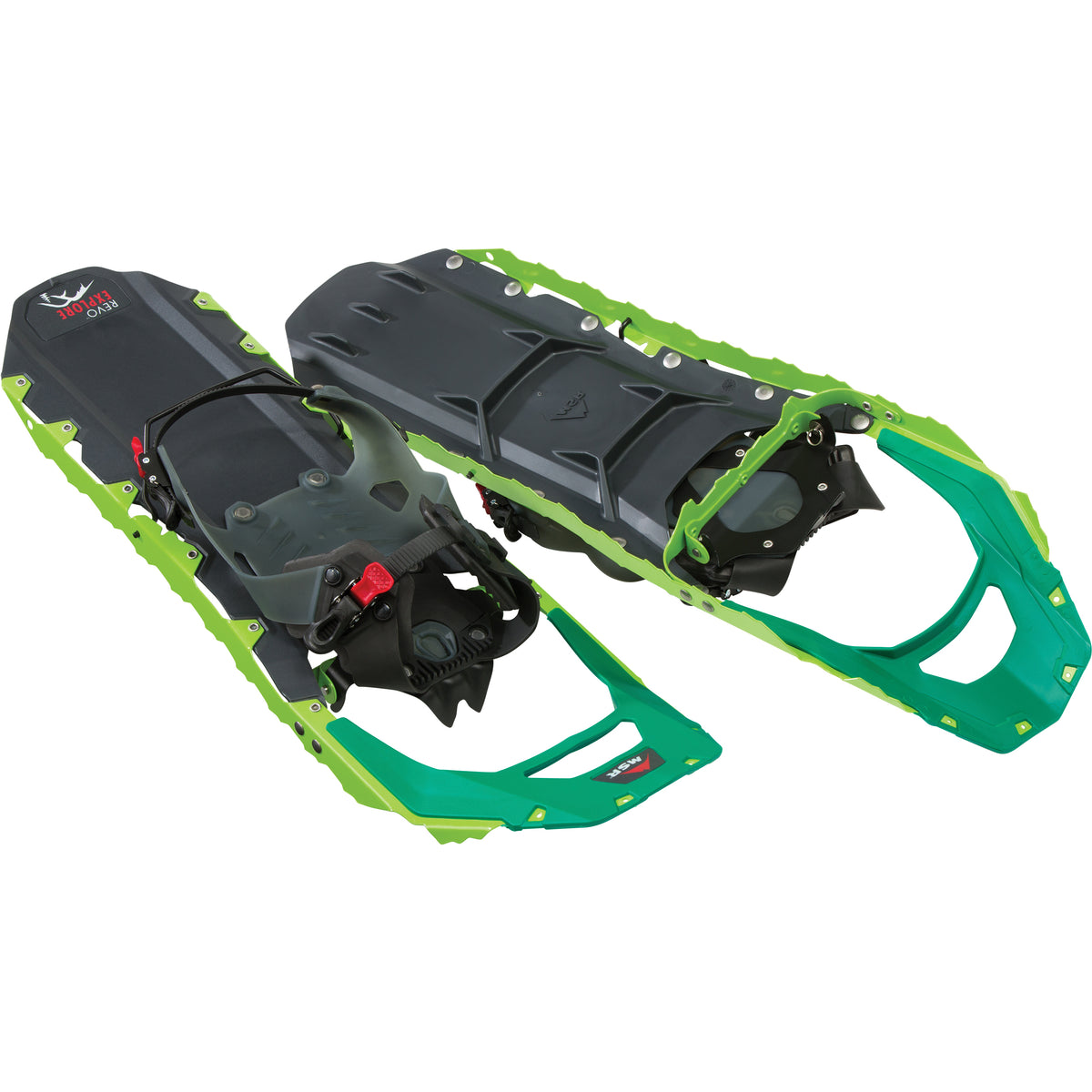
- #4 Revo Explore — MSRThe MSR Revo Explore strikes an intentional middle ground between the featherweight agility of perimeter-frame snowshoes and the rock-solid durability of injection-molded plastic. Built for all-terrain explorers who tackle varied winter landscapes—from dense woodland to rolling alpine bowls—the Revo pairs an ExoTract steel perimeter frame with a tough, injection-molded plastic deck. This construction delivers rigid torsional strength, allowing the steel teeth to dig into firm sidehills while the plastic center flexes slightly underfoot. Where the Revo Explore distinguishes itself from MSR’s more Spartan models is in ease of entry. It utilizes the HyperLink binding, which replaces standard pull-through rubber straps with a two-strap ratchet system and an EVA foam cradle. This setup is exceptionally fast to secure, even while wearing heavy winter mittens, and provides a comfortable, pressure-free fit for all-day trail hiking. Ergo Televator heel lifts are also standard, offering welcome relief on moderate to steep ascents. At over four pounds for the 22-inch model, the Revo Explore is not an ultralight option, and the ratchet bindings add mechanical parts that could theoretically collect wet, freezing slush if not cleared. However, for hikers who find minimalist straps uncomfortable and desire aggressive edge traction paired with a rugged deck, the Revo Explore delivers an exceptionally balanced package. **Highlights** - ExoTract steel frame delivers high torsional rigidity and edge grip. - Injection-molded deck withstands heavy rock strikes without puncturing. - HyperLink ratchet binding allows rapid entry and glove-friendly adjustments. - Built-in Ergo Televator heel lifters ease calf strain on climbs. - Compatible with MSR modular tails for added flotation in powder. **Watch-outs** - Heavier than minimalist alpine-specific models. - Ratchet binding mechanisms have more moving parts to clear of wet ice.Read the full profile
- Best for steep alpine climbing
- #5 Evo Ascent — MSRThe MSR Evo Ascent takes the ultra-durable, cost-effective platform of the classic Evo Trail and equips it for steeper, more aggressive backcountry terrain. It is built specifically for snowshoers, winter peak baggers, and snowboarders who require the rock-defying toughness of a molded plastic UniBody deck but need technical climbing features to handle steep, icy terrain safely. The key upgrade over the base Evo Trail is the inclusion of the steel Ergo Televator heel lift bar. On sustained uphill climbs, engaging the heel lift keeps the foot in a neutral position, substantially reducing strain on calf muscles and tendons. Grip is provided by steel traction rails molded directly into the underside of the deck, paired with a robust steel toe crampon that drives deep into hard snowpack. The shoe utilizes MSR's secure, freeze-proof TriFit binding system, wrapping three rugged elastomer straps over the instep and one behind the heel. Because it shares the UniBody construction of the Evo line, the Evo Ascent is rigid and noticeably loud on firm, frozen crust. Its relatively short base length is nimble and easy to maneuver through thick trees, but heavier users or those in deep, uncompressed powder will definitely need to purchase the optional modular tails to stay afloat. For steep, rugged routes where durability is paramount, it is a proven workhorse. **Highlights** - UniBody plastic deck offers near-indestructible defense against rocks and roots. - Ergo Televator heel lift significantly eases steep mountain ascents. - Steel side rails and forward crampon provide aggressive hardpack grip. - Multi-strap elastomer binding remains flexible and reliable in deep sub-zero cold. - Compact frame enhances agility in dense forest cover. **Watch-outs** - Stiff plastic construction creates loud clatter on firm, crusty snow. - Short base footprint provides limited flotation without accessory tails.Read the full profile
- Best for packed woodland trail walking
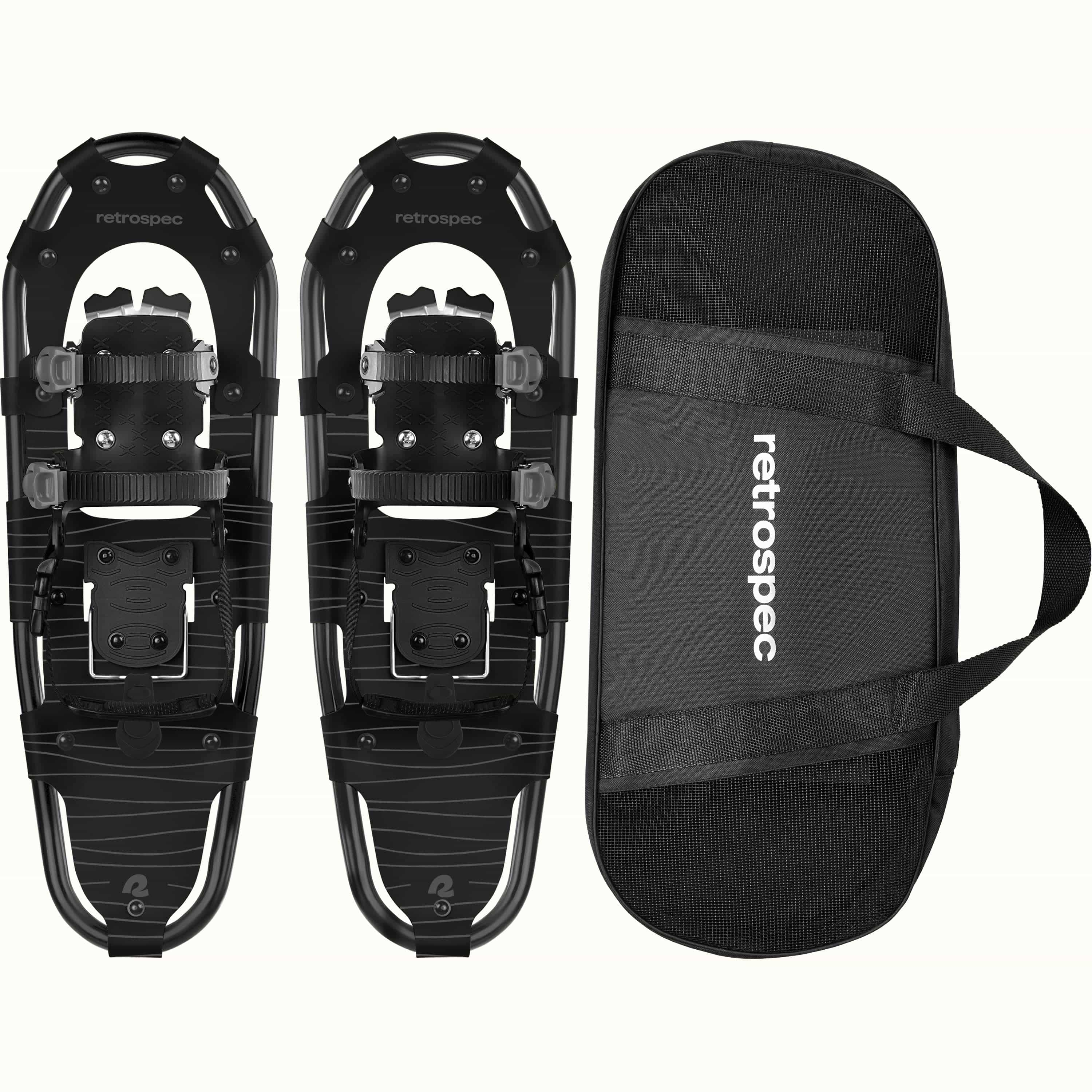
- #6 Drifter — RetrospecThe Retrospec Drifter targets casual winter walkers, families, and budget-conscious hikers looking to explore packed trails, rolling parkland, and mild woodland terrain. Rather than chasing technical mountain summits, this snowshoe focuses on affordability and accessible ease of use. It is constructed with a classic round aluminum frame and a flexible polyethylene (HDPE) deck, a proven combination that keeps the initial cost well below that of technical models. On the snow, the Drifter performs reliably on flat to moderately rolling terrain. The aluminum frame provides reasonable flotation for its length, and the front and rear aluminum crampons offer adequate traction for packed snow and light crust. The binding system utilizes a dual-ratchet strap design over the instep paired with a molded heel band, making it relatively quick to put on and take off for beginners who do not want to wrestle with complex webbing setups. The limitations become evident if you take the Drifter outside its intended recreational comfort zone. The aluminum crampons wear faster on rock than hardened steel, and the absence of aggressive perimeter side rails means the shoe can slip sideways on steep or icy traverses. Additionally, it lacks a heel lift for sustained uphill climbing. For relaxed weekend outings on established trails, however, it delivers honest, capable performance at a wallet-friendly price. **Highlights** - High-value pricing makes winter hiking accessible for casual trail users. - Lightweight aluminum tubing frame paired with durable HDPE deck. - Double-ratchet binding system enables quick, intuitive adjustments. - Dual crampon layout handles packed trails and moderate rolling slopes. - Available in multiple sizing lengths to match different user weights. **Watch-outs** - Lacks edge traction rails for secure traversing on icy sidehills. - Aluminum crampons are prone to wearing down quickly on rocky stretches.Read the full profile
- Best for steep mountain peak bagging
- #7 Flex VRT — TubbsThe Tubbs Flex VRT is designed for technical mountain ascents where agility, rapid adjustments, and a natural gait are critical. The core of this shoe is the Flex Deck, an ergonomic composite plastic frame that tapers toward the tail. By flexing naturally under the heel strike, the deck absorbs shock and allows the foot to roll through its natural motion, significantly reducing the joint stiffness common with fully rigid plastic or oversized aluminum snowshoes. Aggressive traction is a standout strength of the Flex VRT. It combines heavy-duty Viper 2.0 carbon steel toe crampons with curved 3D-Curved Traction Rails that run along the underside, biting firmly into wind-scoured ice, hard crust, and steep sidehill traverses. Its most defining feature, however, is the DynamicFit binding, which incorporates the BOA Fit System. A simple turn of the dial tightens an integrated cable harness evenly across the boot, creating an exceptionally precise, secure fit that can be micro-adjusted on the fly without removing gloves. With a shorter, tapered profile, the Flex VRT emphasizes grip and climbing efficiency over sheer powder flotation. In light, deep, bottomless snow, users will sink more than they would on a wider, traditional powder shoe like the Tubbs Mountaineer. Additionally, while the BOA system is fast and reliable, users should keep it clear of freezing wet slush. For steep, crusty mountain ascents, it remains an exceptionally nimble climber. **Highlights** - BOA Fit System provides micro-adjustable, glove-friendly binding security. - Torsionally flexible deck absorbs shock and enables a natural walking stride. - 3D-Curved Traction Rails deliver outstanding grip on steep sidehills. - Viper 2.0 carbon steel toe crampon bites deep into icy crust. - ActiveLift heel bar reduces calf strain during prolonged vertical ascents. **Watch-outs** - Tapered tail reduces surface area, limiting flotation in deep powder. - BOA mechanism requires care in slushy conditions to prevent icing.Read the full profile
- Best for packed mountain trail hiking
- #8 Symbioz Hyperflex Elite — TSLThe TSL Symbioz Hyperflex Elite represents a modern, biomechanically focused approach to snowshoe design. Engineered in the French Alps, this shoe is built for trail hikers and backcountry enthusiasts who prioritize a natural walking stride over rigid flotation platforms. Its Hyperflex concept utilizes an ultra-flexible frame reinforced with carbon inserts, allowing the entire body of the snowshoe to twist and bend with the terrain beneath your feet. This structural flexibility transforms how the shoe grips uneven ground. Instead of bridging awkwardly over bumps or tilting the ankle on off-camber slopes, the Symbioz molds to the contour of the surface, keeping its stainless steel crossbars, perimeter crampons, and front teeth in constant contact with the snowpack. The binding setup is equally advanced, featuring a memory-lock ratchet system and an ankle strap that holds footwear firmly in place with zero forward heel-lift lag. The trade-off of this hyper-flexible composite structure is its performance in deep, untracked powder. Because the frame flexes readily under load, it does not act as a stiff, floating platform, meaning users will experience more sinkage in deep snow than they would on a rigid deck of similar dimensions. However, for firm trails, rolling terrain, and variable conditions where foot fatigue and natural mobility are top concerns, the Symbioz is an engineering marvel. **Highlights** - Hyperflex frame twists and flexes to match ground contours naturally. - Carbon reinforcement inserts store and return energy through the stride. - Multiple stainless steel crampon teeth provide constant surface contact. - Memory-lock binding stores boot dimensions for quick subsequent entry. - Easy-to-engage heel lift relieves calf fatigue on uphill pitches. **Watch-outs** - Flexible deck yields less flotation in soft, deep powder. - Higher price point compared to standard recreational trail models.Read the full profile
Our editors test the gear, pick the ten, and set the order the day a list publishes. After that, the ranking is live: every member star rating feeds the community order, so picks climb or slide as real owners report back. Editorial judgment decides what earns a spot — you help decide where it sits.
- Editors set the field
Hands-on testing and spec research choose the ten and the published order.
- Readers re-rank it
Your 1–5 star ratings drive the community order on every list.
- Rankings keep moving
Picks rise or fall over time — nothing is frozen at launch day.
Rank this list
Loading community ratings… Ratings re-order the picks — they never change which products make the list.
Sign in to add your own ratings — it's free.
- Pros
- Unrivaled 360-degree perimeter grip on icy and off-camber slopes
- Paragon mesh binding eliminates painful pressure points and resists icing
- Ergo Televator heel lifters reduce calf fatigue during sustained ascents
- Field-replaceable hardware and repairable modular components
Cons- Steep retail price around $400 is excessive for casual, flat outings
- Narrow deck profile requires add-on tails for deep, unconsolidated powder
- Serrated metal perimeter creates loud, jarring feedback on firm hardpack
Key features- Measured Weight
- 3.94 lbs per pair
- Frame Material
- 7075-T6 aluminum perimeter
- Decking Material
- Polyurethane-coated nylon
- Terrain Rating
- Technical backcountry and alpine
- Binding Style
- Paragon TPU mesh harness
- Heel Lift
- Ergo Televator bar
Best forAlpine mountaineering, Technical backcountry ascents, Steep sidehill traverses, Winter peak bagging
Pros- Unrivaled 360-degree perimeter grip on icy and off-camber slopes
- Paragon mesh binding eliminates painful pressure points and resists icing
- Ergo Televator heel lifters reduce calf fatigue during sustained ascents
- Field-replaceable hardware and repairable modular components
Cons- Steep retail price around $400 is excessive for casual, flat outings
- Narrow deck profile requires add-on tails for deep, unconsolidated powder
- Serrated metal perimeter creates loud, jarring feedback on firm hardpack
Assessed by Renata Cho against our ranking criteria.No ratings yet - Pros
- Nearly indestructible injection-molded deck resists rocks and roots.
- Full-length steel rails deliver exceptional edge bite on hard crust.
- Freeze-resistant elastomer bindings fit standard boots and bulky pac boots.
- Modular design allows tail extensions for added flotation in powder.
Cons- Lacks a heel lift bar for reducing fatigue on steep climbs.
- Rigid plastic frame is noticeably loud on hard, icy trails.
- Modest out-of-the-box flotation in deep, dry powder.
Key features- Weight
- 3 lbs. 8 oz. per pair
- Deck Material
- Injection-molded UniBody plastic
- Traction System
- Full-length steel rails and steel toe crampon
- Binding Style
- DuoFit freeze-resistant elastomer straps
- Heel Lift
- None
- Flotation Expansion
- Compatible with modular tails
Best forPacked forest trail hiking, Rolling terrain day hikes, Early-season low snowpack exploration, General recreational winter walking
Pros- Nearly indestructible injection-molded deck resists rocks and roots.
- Full-length steel rails deliver exceptional edge bite on hard crust.
- Freeze-resistant elastomer bindings fit standard boots and bulky pac boots.
- Modular design allows tail extensions for added flotation in powder.
Cons- Lacks a heel lift bar for reducing fatigue on steep climbs.
- Rigid plastic frame is noticeably loud on hard, icy trails.
- Modest out-of-the-box flotation in deep, dry powder.
Assessed by Renata Cho against our ranking criteria.No ratings yet - Pros
- Class-leading flotation and surface area for deep, untracked powder
- Heavy-duty tubular aluminum frame reliably supports heavy pack weights
- Aggressive Anaconda toe crampon bites securely through crust and hardpack
- ActiveFit 2.0 binding distributes tension evenly without cold spots
Cons- Heavier than technical alpine models at roughly 4.56 pounds per pair
- Wide frame requires an adjusted gait on packed or narrow singletrack
- Cumbersome maneuverability in dense deadfall and tight forest brush
Key features- Measured Weight
- 4.56 lbs per pair
- Approximate Price
- $280
- Frame Material
- Tubular aluminum
- Underfoot Traction
- Anaconda carbon steel toe crampon and side rails
- Binding System
- ActiveFit 2.0 cinch strap harness
- Heel Lifter
- Integrated flip-up climbing wire
Best forDeep powder trail breaking, Winter backcountry backpacking, Off-trail wilderness hunting, Heavy load carrying
Pros- Class-leading flotation and surface area for deep, untracked powder
- Heavy-duty tubular aluminum frame reliably supports heavy pack weights
- Aggressive Anaconda toe crampon bites securely through crust and hardpack
- ActiveFit 2.0 binding distributes tension evenly without cold spots
Cons- Heavier than technical alpine models at roughly 4.56 pounds per pair
- Wide frame requires an adjusted gait on packed or narrow singletrack
- Cumbersome maneuverability in dense deadfall and tight forest brush
Assessed by Renata Cho against our ranking criteria.No ratings yet - Pros
- ExoTract steel perimeter frame delivers excellent bite on icy, off-camber traverses.
- HyperLink ratchet binding allows rapid entry and adjustments with thick mittens.
- Injection-molded plastic deck withstands harsh impacts against hidden rocks and roots.
- Ergo Televator heel lifter significantly reduces calf fatigue on steep ascents.
Cons- Heavier than minimalist alpine decks at over four pounds per pair.
- Ratchet mechanisms can collect freezing slush and require periodic clearing.
- Perimeter steel teeth generate loud scraping noises on shallow, rocky snow.
Key features- Weight per pair
- 4 lb. 4 oz. (22-inch model)
- Approximate price
- $290
- Deck material
- Injection-molded polypropylene
- Available lengths
- 22 inches, 25 inches
- Frame construction
- ExoTract serrated perimeter steel
- Binding system
- HyperLink ratchet with EVA foam cradle
Best forRolling backcountry day hikes, Icy and packed trail trekking, Off-camber hillside traverses, Winter backpacking trips
Pros- ExoTract steel perimeter frame delivers excellent bite on icy, off-camber traverses.
- HyperLink ratchet binding allows rapid entry and adjustments with thick mittens.
- Injection-molded plastic deck withstands harsh impacts against hidden rocks and roots.
- Ergo Televator heel lifter significantly reduces calf fatigue on steep ascents.
Cons- Heavier than minimalist alpine decks at over four pounds per pair.
- Ratchet mechanisms can collect freezing slush and require periodic clearing.
- Perimeter steel teeth generate loud scraping noises on shallow, rocky snow.
Assessed by Renata Cho against our ranking criteria.No ratings yet - Pros
- Molded UniBody plastic deck shrugs off direct hits from rocks and roots.
- Ergo Televator heel lift substantially reduces calf fatigue on sustained climbs.
- Full-length steel rails provide exceptional purchase during icy sidehill traverses.
- Freeze-proof elastomer straps remain completely flexible in severe cold.
Cons- Rigid plastic deck is noticeably loud on hard, frozen crust.
- Short 22-inch footprint requires purchasing accessory tails for deep powder.
- Multiple individual straps take longer to secure than modern dial bindings.
Key features- Weight
- 3 lbs, 15 oz per pair
- Deck Material
- Injection-molded plastic
- Binding Style
- TriFit freeze-proof elastomer
- Traction System
- Steel side rails and toe crampon
- Heel Lift
- Ergo Televator wire bar
- Standard Length
- 22 inches
Best forSteep alpine climbing, Winter peak bagging, Rocky mixed terrain, Backcountry snowboard approaches
Pros- Molded UniBody plastic deck shrugs off direct hits from rocks and roots.
- Ergo Televator heel lift substantially reduces calf fatigue on sustained climbs.
- Full-length steel rails provide exceptional purchase during icy sidehill traverses.
- Freeze-proof elastomer straps remain completely flexible in severe cold.
Cons- Rigid plastic deck is noticeably loud on hard, frozen crust.
- Short 22-inch footprint requires purchasing accessory tails for deep powder.
- Multiple individual straps take longer to secure than modern dial bindings.
Assessed by Renata Cho against our ranking criteria.No ratings yet - Pros
- Accessible price point makes winter trail exploration affordable
- Dual-ratchet bindings adjust easily even while wearing thick winter gloves
- Proven aluminum frame and HDPE deck deliver dependable flotation
- Available in three sizes to accommodate different body weights and loads
Cons- No perimeter traction rails, causing slippage on icy sidehills
- Aluminum crampons wear quickly if exposed to rock or gravel
- Lacks an uphill heel television bar for sustained steep climbing
Key features- Weight per Pair
- 4 lb. 3 oz. (25 in.)
- Frame Material
- Round tubular aluminum
- Deck Material
- High-density polyethylene (HDPE)
- Available Lengths
- 21 in, 25 in, 30 in
- Binding Style
- Dual ratchet straps with molded heel band
- Traction Type
- Front and rear aluminum crampons
Best forPacked woodland trail walking, Flat nature center paths, Casual rolling hill hiking, Budget-friendly family winter recreation
Pros- Accessible price point makes winter trail exploration affordable
- Dual-ratchet bindings adjust easily even while wearing thick winter gloves
- Proven aluminum frame and HDPE deck deliver dependable flotation
- Available in three sizes to accommodate different body weights and loads
Cons- No perimeter traction rails, causing slippage on icy sidehills
- Aluminum crampons wear quickly if exposed to rock or gravel
- Lacks an uphill heel television bar for sustained steep climbing
Assessed by Renata Cho against our ranking criteria.No ratings yet - Pros
- BOA Fit System allows rapid, even tensioning without removing heavy winter gloves.
- Flexible composite deck absorbs heel impact and supports a natural walking stride.
- Aggressive carbon steel crampons and 3D side rails bite reliably into steep ice.
- ActiveLift 19-degree heel riser substantially cuts calf fatigue on sustained climbs.
Cons- Tapered frame provides limited flotation in deep, unconsolidated powder.
- BOA dial mechanism can be susceptible to icing if exposed to wet, slushy snow.
- Heavier than minimalist ultralight snowshoes at over 4 pounds 5 ounces per pair.
Key features- Weight Per Pair
- 4 lb. 5.9 oz. (Men's 25 in.)
- Approximate Price
- $280
- Deck Construction
- Molded composite plastic Flex Deck
- Binding System
- DynamicFit with BOA dial harness
- Traction Components
- Viper 2.0 toe crampon and 3D side rails
- Heel Lift
- ActiveLift 19-degree climbing bar
Best forSteep mountain peak bagging, Hard-packed winter trail hiking, Technical icy alpine climbs, Off-camber sidehill traverses
Pros- BOA Fit System allows rapid, even tensioning without removing heavy winter gloves.
- Flexible composite deck absorbs heel impact and supports a natural walking stride.
- Aggressive carbon steel crampons and 3D side rails bite reliably into steep ice.
- ActiveLift 19-degree heel riser substantially cuts calf fatigue on sustained climbs.
Cons- Tapered frame provides limited flotation in deep, unconsolidated powder.
- BOA dial mechanism can be susceptible to icing if exposed to wet, slushy snow.
- Heavier than minimalist ultralight snowshoes at over 4 pounds 5 ounces per pair.
Assessed by Renata Cho against our ranking criteria.No ratings yet - Pros
- Unmatched natural walking stride enabled by a multi-axis flexible frame.
- Carbon inserts maintain ground contact across uneven, off-camber surfaces.
- Memory-lock binding retains boot dimensions for rapid subsequent entry.
- Pole-activated heel lift reduces calf fatigue on steep uphill sections.
Cons- Flexible deck sinks deeper in light, untracked powder than rigid models.
- Premium $300 price point sits high for dedicated trail-oriented use.
- Binding assembly is somewhat bulky to lash flat against a backpack.
Key features- Weight Per Pair
- 4.31 lbs (measured)
- Deck Material
- Flexible composite with carbon inserts
- Traction Components
- Stainless steel crampons and crossbars
- Binding Closure
- Ratchet ankle strap with memory toe lock
- Heel Lift
- Pole-activated climbing wire
- Target Terrain
- Packed trails, rolling hills, variable snow
Best forPacked mountain trail hiking, Rolling variable terrain, Hardpack and icy ascents, Long-distance winter trekking
Pros- Unmatched natural walking stride enabled by a multi-axis flexible frame.
- Carbon inserts maintain ground contact across uneven, off-camber surfaces.
- Memory-lock binding retains boot dimensions for rapid subsequent entry.
- Pole-activated heel lift reduces calf fatigue on steep uphill sections.
Cons- Flexible deck sinks deeper in light, untracked powder than rigid models.
- Premium $300 price point sits high for dedicated trail-oriented use.
- Binding assembly is somewhat bulky to lash flat against a backpack.
Assessed by Renata Cho against our ranking criteria.No ratings yet - Pros
- Outstanding flotation in deep, untracked powder for heavy loads.
- Tapered teardrop frame prevents snowshoe overlap and promotes a natural gait.
- Single-pull binding is comfortable, durable, and easy to operate with mittens.
- Sturdy aircraft-grade aluminum frame and tear-resistant decking.
Cons- Lacks a heel lift for reducing fatigue on steep climbs.
- Tubular frame lacks perimeter teeth for secure hard-snow sidehilling.
- At 32 inches, it can feel cumbersome in tight, dense brush.
Key features- Weight Capacity
- Up to 300 lbs (user plus pack)
- Length
- 32 inches
- Frame
- Aircraft-grade aluminum tubing
- Traction
- Stainless steel claw crampons
- Binding Style
- Single-pull loop harness
- Terrain
- Deep powder, rolling backcountry
Best forDeep powder trail breaking, Winter backpacking with packs, Rolling backcountry exploration, Heavier hiker snowshoeing
Pros- Outstanding flotation in deep, untracked powder for heavy loads.
- Tapered teardrop frame prevents snowshoe overlap and promotes a natural gait.
- Single-pull binding is comfortable, durable, and easy to operate with mittens.
- Sturdy aircraft-grade aluminum frame and tear-resistant decking.
Cons- Lacks a heel lift for reducing fatigue on steep climbs.
- Tubular frame lacks perimeter teeth for secure hard-snow sidehilling.
- At 32 inches, it can feel cumbersome in tight, dense brush.
Assessed by Renata Cho against our ranking criteria.No ratings yet - Pros
- BOA Fit System allows effortless, micro-adjustable tension with gloves on.
- Comfortable CustomWrap binding eliminates painful instep pressure points.
- Lightweight tubular frame provides natural walking motion on flat trails.
- Generous deck flotation handles semi-packed snow and rolling paths cleanly.
Cons- Lacks a heel lift bar, increasing calf fatigue on steep ascents.
- Modest crampons lack lateral bite for hard ice and technical sidehill traverses.
- Ice buildup can occasionally impede the BOA dial mechanism in freezing slush.
Key features- Weight Per Pair
- 3 lbs. 6 oz.
- Approximate Price
- $205
- Frame Material
- Tubular aluminum
- Terrain Rating
- Flat to rolling recreational trails
- Binding System
- CustomWrap with BOA Fit System
- Heel Lift
- None
Best forPacked nature park trails, Rolling forest paths, Recreational winter exercise, Casual day hiking
Pros- BOA Fit System allows effortless, micro-adjustable tension with gloves on.
- Comfortable CustomWrap binding eliminates painful instep pressure points.
- Lightweight tubular frame provides natural walking motion on flat trails.
- Generous deck flotation handles semi-packed snow and rolling paths cleanly.
Cons- Lacks a heel lift bar, increasing calf fatigue on steep ascents.
- Modest crampons lack lateral bite for hard ice and technical sidehill traverses.
- Ice buildup can occasionally impede the BOA dial mechanism in freezing slush.
Assessed by Renata Cho against our ranking criteria.No ratings yet



Award picks
The ranking above is price-blind and judged on merit. These awards call out the pick we'd hand a specific person with a specific need.
Best Overall: Lightning Ascent — MSR
The MSR Lightning Ascent sits atop the technical snowshoe category for good reason.
Ranked #1Runner-Up: Evo Trail — MSR
The MSR Evo Trail is widely regarded as the benchmark for entry-level to mid-range winter hikers who want bombproof durability without paying technical alpine prices.
Ranked #2Best Value: Mountaineer — Tubbs
The Tubbs Mountaineer is built for deep powder, rolling wilderness treks, and carrying heavy winter loads.
Ranked #3Best Ultralight Pick: Revo Explore — MSR
The MSR Revo Explore strikes an intentional middle ground between the featherweight agility of perimeter-frame snowshoes and the rock-solid durability of injection-molded plastic.
Ranked #4Best for Rough Use: Evo Ascent — MSR
The MSR Evo Ascent takes the ultra-durable, cost-effective platform of the classic Evo Trail and equips it for steeper, more aggressive backcountry terrain.
Ranked #5Best for Beginners: Drifter — Retrospec
The Retrospec Drifter targets casual winter walkers, families, and budget-conscious hikers looking to explore packed trails, rolling parkland, and mild woodland terrain.
Ranked #6For demanding alpine ascents and icy traverses, the MSR Lightning Ascent remains the undisputed benchmark, while the MSR Evo Trail offers unmatched value and indestructible reliability for general winter hiking; if deep powder and heavy pack loads are your primary reality, the Tubbs Mountaineer delivers unbeatable flotation.
How to choose snowshoes
Every pick on this page was judged against the same criteria. If you want the short answer, Lightning Ascent by MSR is the one we point most people at. If you want to decide for yourself, here is what actually separates a good snowshoe from an expensive one.
Fabric behavior over time
Breathability, DWR life, loft retention, and how the piece performs after repeated washing.
Real-world durability
How the material, stitching, or steel holds up after a season of hard use — not how it looks new.
Performance in bad conditions
Wind, rain, cold, and grit are the test. Anything that only works on a nice day gets marked down.
Weight and packability
Every ounce has to earn its place in the pack, but not at the cost of something that fails in the field.
Ease of use
Setup, adjustment, and maintenance with cold hands, in the dark, without the manual.
Value at its price point
Compared against the closest competitors in the same tier, not against cheaper gear in a different class.
Match the pick to your use
The right snowshoes depends on what you are actually doing with it: Alpine mountaineering; Technical backcountry ascents; Steep sidehill traverses; Winter peak bagging; Packed forest trail hiking; Rolling terrain day hikes. Start from the use case, then work down the ranking until you hit the first pick that covers it.
Common mistakes
- Buying the lightest snowshoes you can find and discovering it cannot take a season of hard use.
- Paying for a specialist feature you will use once a year instead of the versatile option.
- Comparing headline specs across tiers instead of within the same class.
- Skipping fit, sizing, or adjustment checks that decide whether you actually carry it.
Frequently asked questions
- What is the best snowshoes in 2026?
- Lightning Ascent by MSR takes the top spot. The MSR Lightning Ascent sits atop the technical snowshoe category for good reason.
- How did The Wild10 choose and rank these snowshoes?
- We judged every pick against the same criteria — fabric behavior over time, real-world durability, performance in bad conditions, weight and packability — and ranked them on merit regardless of price. Field-proven snowshoes ranked by traction, flotation, frame durability, and value, synthesizing cross-industry testing and backcountry expertise.
- What is the best budget snowshoes?
- Evo Trail by MSR — The MSR Evo Trail is widely regarded as the benchmark for entry-level to mid-range winter hikers who want bombproof durability without paying technical alpine prices.
- Lightning Ascent vs Evo Trail — which should I pick?
- Lightning Ascent ranks first: The MSR Lightning Ascent sits atop the technical snowshoe category for good reason. Evo Trail is the close second: The MSR Evo Trail is widely regarded as the benchmark for entry-level to mid-range winter hikers who want bombproof durability without paying technical alpine… Our full head-to-head compares them side by side.
- How often is this list updated?
- We review this ranking on a rolling basis and update it whenever a pick is discontinued, meaningfully revised, or beaten by something new. Rankings are editorial — brands do not see them before publication and affiliate links never change the order.
Get The Field List
One short, honest email a week: gear we actually trust, planning guides, and survival-TV coverage. Free, unsubscribe anytime.