


Reader rating
Rate it and you move it. Community ratings re-rank this product inside its Top 10 list.
Expert-picked, reader-ranked. Our editors choose the products and the launch order; member star ratings move picks up or down over time.
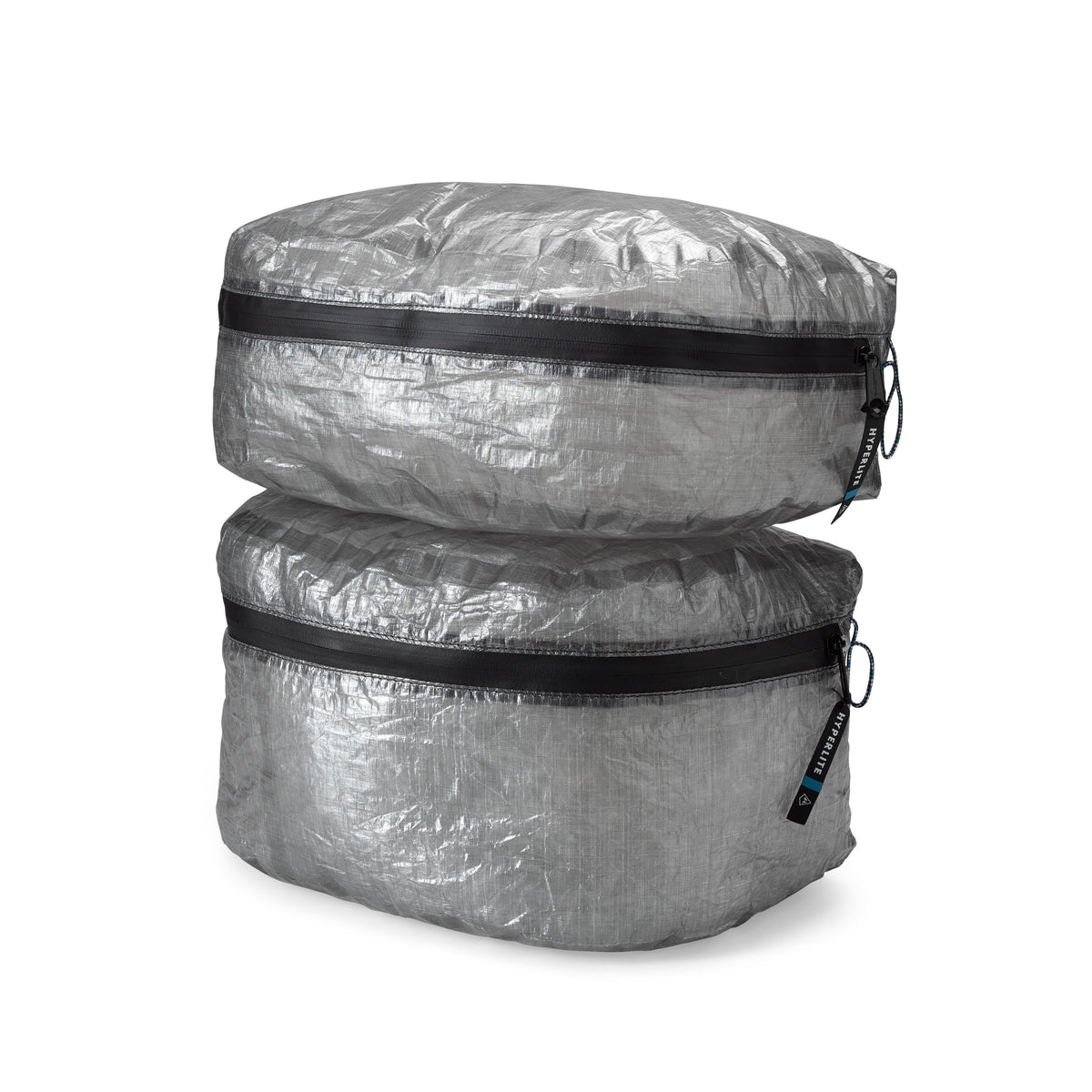
The Hyperlite Mountain Gear Pod is designed for hikers using frameless or ultralight backpacks who want to optimize internal packing volume. Unlike traditional cylindrical stuff sacks that create dead airspace when packed side-by-side, Pods are shaped to match the curved contour of a backpack's interior, stacking neatly on top of one another like building blocks. Built from waterproof Dyneema Composite Fabric with fully taped seams and a water-resistant zipper, a Pod functions as an organized gear drawer inside your pack. Independent reviews praise how efficiently they distribute weight against the spine and eliminate bulging pack walls. Packing a sleeping bag or warm clothing into a Pod produces a flat, stable platform upon which food bags and shelter components can rest securely. The zipper closure is highly weather-resistant but not completely submersible, so total immersion should be avoided. Additionally, the structured, curved shape means they work best inside packs with compatible dimensional profiles—primarily Hyperlite's own packs or similarly proportioned ultralight models. They represent a significant financial investment, but for pack stability and modular organization, their space efficiency is exceptional. **Highlights** - Contoured shape conforms directly to backpack internal profiles - Built from ultralight, fully taped Dyneema Composite Fabric - Weather-resistant zippered clamshell opening allows rapid access - Eliminates dead space and maintains an even, balanced pack shape - Offered in multiple capacities (9 to 16 liters) to stack sequentially **Watch-outs** - Premium cost per unit represents a notable investment - Fixed curved shape is less adaptable to irregularly shaped pack interiors
Pros
- Curved shape matches pack geometry to eliminate dead space
- Stacks cleanly to build a balanced, stable internal frame
- Wide clamshell zipper allows easy access to packed items
- Taped Dyneema Composite Fabric delivers outstanding weather protection
Cons
- High price point makes outfitting a full pack expensive
- Zipper closure is water-resistant but not fully submersible
- Inflexible shape fits poorly in round or irregularly tapered packs
Best uses
- Ultralight Thru-Hiking
- Frameless Backpack Packing
- Down Insulation Storage
- Modular Pack Organization
Specifications
- Weight
- 34 g / 1.2 oz (9 L capacity)
- Available Volumes
- 9 L, 11 L, 13 L, 16 L
- Fabric
- Dyneema Composite Fabric (DCF)
- Closure Style
- Water-resistant zipper
- Seam Construction
- Fully taped seams
- Approximate Price
- Around $60 per pod
Pricing
We don't publish a price we haven't verified. The retailer links below open the live listing for this exact model.
Full catalog listing & offersBest for
Ultralight Thru-Hiking, Frameless Backpack Packing, Down Insulation Storage, Modular Pack Organization
Where to buy the Pod
We don't have a direct Amazon listing on file yet — this opens an Amazon search for the exact make and model.
Some links are affiliate links. Buying through them supports our testing at no extra cost to you.
The Hyperlite Mountain Gear Pod takes a radically different approach to gear organization than conventional cylindrical stuff sacks. Instead of forcing round shapes into square spaces—a method that inevitably creates dead airspace and awkward barrel bulges against your spine—the Pod is tailored with a curved profile specifically matched to the internal dimensions of ultralight backpacks. Stacking multiple units creates a stable, structural column inside a pack, functioning more like a modular chest of drawers than a traditional loose pouch. Constructed from Dyneema Composite Fabric with fully taped seams and a water-resistant zippered entry, the Pod offers significant weather protection alongside its space-maximizing geometry. CleverHiker recognized it as the Best Packing Pod for its ability to transform how gear rides in a pack, especially for long-distance hikers using frameless or minimalist internal-frame bags where internal load stability is paramount. At roughly $60 per unit, it is undeniably an expensive commitment for gear storage. It also sacrifices the malleable adaptability of standard roll-top dry bags, as its tailored footprint works best in packs with compatible dimensional cross-sections. However, for hikers obsessive about pack balance and pack volume efficiency, the utility of the design is difficult to replicate.
Who It Is For
The Pod is built specifically for ultralight backpackers and long-distance thru-hikers seeking to optimize the internal organization of minimalist packs. Traditional stuff sacks create rounded gaps and bulging pack panels that require stuffing small clothing items into empty voids to maintain balance. The Pod eliminates this fuss by mirroring the natural curve of a pack body, making it ideal for hikers carrying low-volume, frameless, or minimalist packs where load shifting directly impacts comfort. Anyone looking for a quick, repeatable packing system that sets up an orderly base for heavy items like bear canisters or food bags will appreciate the layout. Conversely, casual weekenders using cavernous 65-liter traditional framed packs with complex internal dividers will find little benefit from such an exactingly shaped, high-dollar accessory.
Materials and Construction
Hyperlite builds the Pod using Dyneema Composite Fabric, an ultralight non-woven laminate celebrated for its exceptional strength-to-weight ratio and inherent waterproofness. The construction features fully taped seams, which guard against moisture ingress along every stitch line. Rather than relying on a roll-top buckle system, the Pod utilizes a water-resistant zipper that arcs across the top perimeter in a clamshell layout. This design gives wide access to contents without forcing the user to unpack everything to reach an item at the bottom. The zipper pulls and anchor points are reinforced to withstand tension when clothing or sleeping insulation is compressed into the cavity. While the fabric exhibits zero stretch, the tensile strength of the Dyneema fibers prevents seam blowout under heavy compression forces.
Real-World Packing Performance
In practical trail use, the primary virtue of the Pod is how it transforms pack loading into a predictable, modular routine. A 9-liter or 11-liter Pod fits a down sleeping quilt or cold-weather apparel layer securely, creating a flat, level deck inside the pack. Successive Pods stack cleanly on top, establishing a straight, vertical center of gravity directly against the hiker's back. Because the clamshell zipper opens wide, it acts as a shelf organizer inside a shelter; you can slide a garment out without disturbing the surrounding layers. However, unlike roll-top compression dry sacks, the Pod does not purge trapped air via a purge valve or mechanical roll-down compression. Users must manually squeeze air out while pulling the zipper shut, requiring deliberate two-handed management when handling lofty insulation.
Durability and Weather Resistance
Dyneema Composite Fabric provides outstanding resistance to water penetration and tearing along trail surfaces, but it does have specific wear characteristics. While tensile strength is exceptionally high, repeated folding along hard creases and abrasive contact with rough shelter floors can slowly degrade the internal mylar film over seasons of heavy use. The taped seams keep external condensation and pack seepage away from sensitive gear, making it highly weatherproof against prolonged rainstorms. It is critical to note that the zippered closure is water-resistant, not fully waterproof or submersible. If a pack takes an accidental swim during a river ford, water can eventually penetrate the zipper coil under hydrostatic pressure. For general foul-weather backpacking, however, the barrier is robust and reliable.
Pack Compatibility and Sizing
The Pod's fixed footprint means that compatibility depends heavily on the cross-sectional shape of your backpack. While designed to mate seamlessly with Hyperlite's Southwest, Windrider, and Junction packs, it also fits well in similarly contoured ultralight bags from makers like Mountain Laurel Designs, Gossamer Gear, or Zpacks. In contrast, packs with deeply oval or circular barrel profiles will leave unoccupied gaps along the edges, reducing the space-saving advantage. Sizing also demands attention: a 9-liter Pod generally accommodates smaller, summer-weight quilts or midlayers, while the larger 13-liter and 16-liter sizes are better suited for bulky winter bags or larger torso pack models. Measuring the interior base of your pack prior to purchasing prevents mismatching dimensions.
Trade-Offs and Alternatives
The most immediate hurdle with the Pod is its price. At roughly $60 per sack, outfitting an entire pack interior with three or four units can exceed the cost of many high-end backpacks. Conventional ultralight alternatives, such as silnylon or DCF roll-top dry sacks from Sea to Summit or Zpacks, cost significantly less and offer superior adaptability to irregular spaces. Standard cylindrical dry sacks with roll-top closures also provide true submersion protection, which the Pod's zippered opening cannot guarantee. Furthermore, because Dyneema has no elasticity, overstuffing the Pod puts direct strain on the zipper coils rather than allowing the fabric to stretch. The trade-off is purely structural: you are paying a premium for engineered geometry, stacked stability, and clamshell convenience over general-purpose versatility.
How we picked
We started with a long list of stuff sacks that people actually buy, cut anything that could not clear our baseline for durability and field performance, then ranked the 10 that were left against the same criteria. Rankings are editorial. No brand pays for placement, and affiliate links never move a pick up or down.
- Real-world durability
- How the material, stitching, or steel holds up after a season of hard use — not how it looks new.
- Performance in bad conditions
- Wind, rain, cold, and grit are the test. Anything that only works on a nice day gets marked down.
- Weight and packability
- Every ounce has to earn its place in the pack, but not at the cost of something that fails in the field.
- Ease of use
- Setup, adjustment, and maintenance with cold hands, in the dark, without the manual.
- Value at its price point
- Compared against the closest competitors in the same tier, not against cheaper gear in a different class.
- Repairability and support
- Field-fixable design, available parts, and a warranty the maker actually honors.
Pod — frequently asked questions
- Is the Pod worth it?
- We rank it #10 in Stuff Sacks. The Hyperlite Mountain Gear Pod is designed for hikers using frameless or ultralight backpacks who want to optimize internal packing volume. Unlike traditional cylindrical stuff sacks that create dead airspace when packed side-by-side, Pods are shaped to match the curved contour of a backpack's interior, stacking…
- What is the Pod best for?
- Best for ultralight thru-hiking, frameless backpack packing, down insulation storage and modular pack organization. Standouts: curved shape matches pack geometry to eliminate dead space and stacks cleanly to build a balanced, stable internal frame.
- What are the downsides of the Pod?
- High price point makes outfitting a full pack expensive, Zipper closure is water-resistant but not fully submersible and Inflexible shape fits poorly in round or irregularly tapered packs.
- What are the key specs of the Pod?
- Weight: 34 g / 1.2 oz (9 L capacity) · Available Volumes: 9 L, 11 L, 13 L, 16 L · Fabric: Dyneema Composite Fabric (DCF) · Closure Style: Water-resistant zipper · Seam Construction: Fully taped seams
- Who It Is For?
- The Pod is built specifically for ultralight backpackers and long-distance thru-hikers seeking to optimize the internal organization of minimalist packs. Traditional stuff sacks create rounded gaps and bulging pack panels that require stuffing small clothing items into empty voids to maintain balance.
- Materials and Construction — what should I know about the Pod?
- Hyperlite builds the Pod using Dyneema Composite Fabric, an ultralight non-woven laminate celebrated for its exceptional strength-to-weight ratio and inherent waterproofness. The construction features fully taped seams, which guard against moisture ingress along every stitch line.
Compare side by side
Put the Pod against any other pick on this list — specs, price, pros, cons and reader ratings.