


Reader rating
Rate it and you move it. Community ratings re-rank this product inside its Top 10 list.
Expert-picked, reader-ranked. Our editors choose the products and the launch order; member star ratings move picks up or down over time.
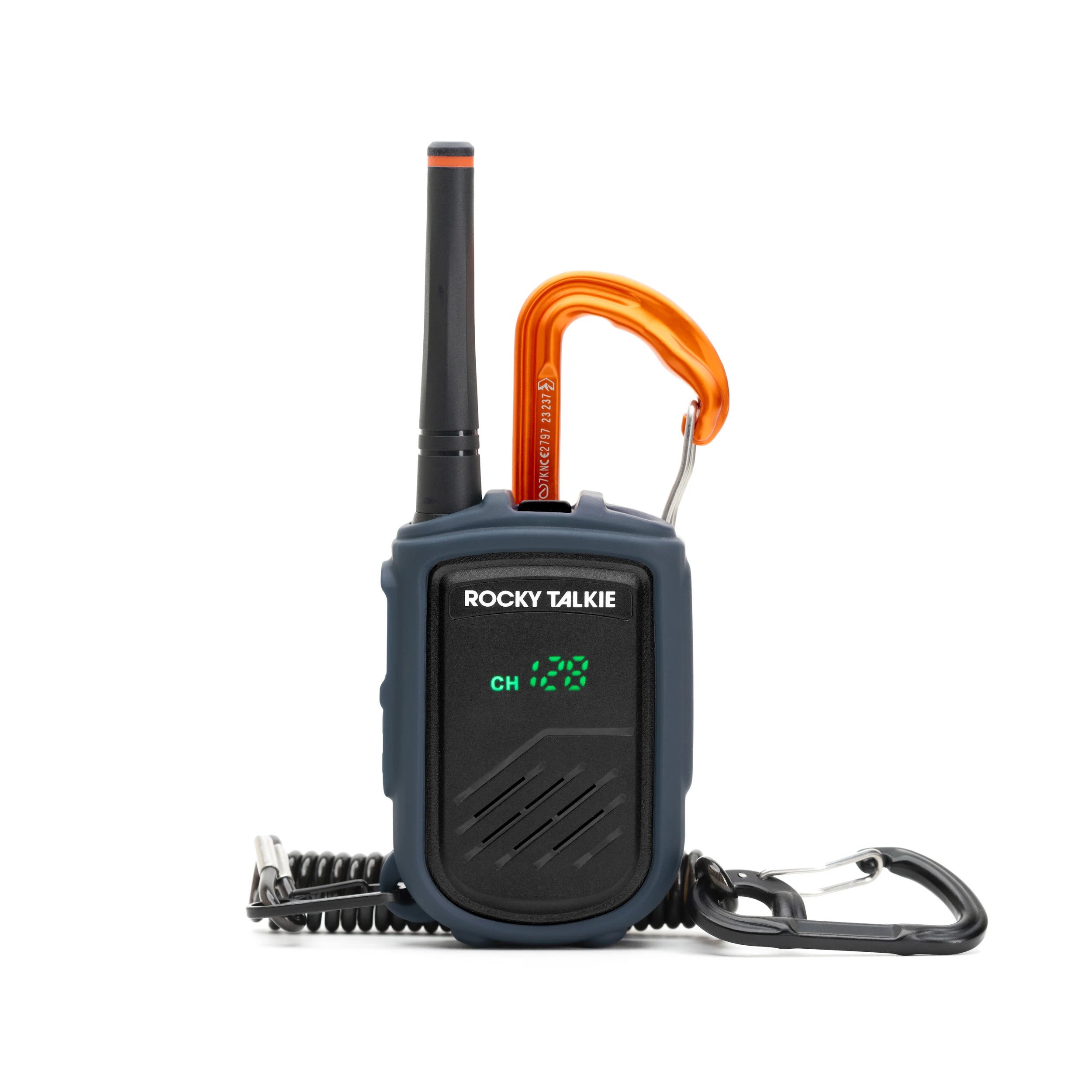
Designed specifically for climbers, mountaineers, and off-grid adventurers, the Rocky Talkie Mountain Radio has rapidly established itself as the modern outdoor standard. Independent reviews from GearJunkie, OutdoorGearLab, and Switchback Travel consistently rate it as the top all-around pick, praising its minimalist, durable construction that strips away extraneous buttons in favor of bulletproof reliability. Operating on standard license-free FRS frequencies, it allows seamless group communication straight out of the box without regulatory paperwork. Where the Mountain Radio separates itself from legacy blister-pack radios is its cold-weather battery chemistry and harness integration. Powered by a specialized lithium-ion cell, it maintains battery life deep into sub-freezing conditions where traditional alkaline or NiMH cells fail within hours. The radio comes housed in a thick thermoplastic case and includes an integrated steel-reinforced leash paired with a climbing-rated carabiner, ensuring the unit stays anchored to a pack strap or harness gear loop during high-consequence movement. Because it adheres strictly to FRS power limits, the Mountain Radio cannot match the raw wattage of high-output GMRS or amateur units. Transmission range is bound by line-of-sight physics; heavy timber, ridge spurs, and deep granite couloirs will truncate your signal. It also lacks a remote shoulder microphone, meaning users must tilt their heads toward the pack strap or unclip the handset to transmit, though its oversized push-to-talk button is easy to work with bulky winter gloves. **Highlights** - Specialized thermoplastic shell with shatterproof LED screen - Cold-weather lithium-ion battery rated down to freezing temperatures - Integrated steel-reinforced backup leash and climbing-spec carabiner - License-free FRS operation with 128 privacy channel combinations - Large, glove-friendly push-to-talk button and volume controls **Watch-outs** - Lower wattage output limits penetration through dense mountain topography - No native remote speaker-mic attachment - Premium price point for an FRS-class radio
Pros
- Specialized lithium-ion battery retains charge reliably in deep winter conditions
- Integrated steel-core leash and rated carabiner prevent accidental drops
- Straightforward interface with large push-to-talk button works easily with gloves
- License-free FRS operation works right out of the box without paperwork
Cons
- FRS wattage limits signal penetration across dense timber and complex terrain
- Significantly higher upfront cost than conventional consumer radio multi-packs
- Lacks a remote shoulder mic in the standard configuration
Best uses
- Backcountry Ski Touring
- Multi-Pitch Rock Climbing
- Alpine Mountaineering
- Four-Season Wilderness Trekking
Specifications
- Weight
- 7.9 oz with leash and carabiner
- Radio Service
- License-free FRS
- Attachment
- Steel-reinforced leash and climbing carabiner
- Battery Cell
- Cold-weather rated lithium-ion
- Approximate Price
- Around $220 per pair
- Channels
- 22 FRS channels with 128 privacy codes
Pricing
We don't publish a price we haven't verified. The retailer links below open the live listing for this exact model.
Full catalog listing & offersBest for
Backcountry Ski Touring, Multi-Pitch Rock Climbing, Alpine Mountaineering, Four-Season Wilderness Trekking
Where to buy the Talkie Mountain Radio
We don't have a direct Amazon listing on file yet — this opens an Amazon search for the exact make and model.
Some links are affiliate links. Buying through them supports our testing at no extra cost to you.
The Rocky Talkie Mountain Radio was conceived by backcountry recreationists frustrated with fragile, overly complicated consumer walkie talkies. Across prominent gear outlets including OutdoorGearLab, GearJunkie, and Switchback Travel, it stands out as the consensus top pick for mountain athletes and off-grid travellers. Rather than loading the handset with dozens of rarely used scanning menus, the design focuses squarely on survivability, drop protection, and dependable voice transmission. What distinguishes this unit from traditional recreational radios is its intentional integration with climbing harnesses and backpack shoulder straps. Encased in a heavy-duty thermoplastic housing and secured by a steel-reinforced tether, the radio is engineered to remain attached during high-angle movement or chaotic weather. Its battery chemistry is calibrated to endure freezing temperatures, solving a common failure mode where standard lithium or alkaline cells deplete rapidly in the snow. Because it operates on the standard, license-free Family Radio Service band, the Mountain Radio requires no federal licensing or technical programming. That convenience means it obeys strict regulatory power ceilings, so users should not expect the raw transmission muscle of high-wattage commercial or amateur rigs. Still, for backcountry travelers who need reliable close-to-mid-range team communication without unnecessary operational hurdles, it sets the current benchmark.
Target User and Backcountry Focus
The Mountain Radio is aimed squarely at backcountry skiers, rock climbers, mountaineers, and outdoor professionals who need hands-on reliability rather than multi-channel scanning complexity. If your outings involve wearing bulky gloves, hanging at a belay station, or navigating avalanche terrain, the stripped-down functionality is an asset. It removes the risk of inadvertently bumping a dial to the wrong frequency or getting trapped in an esoteric menu tree mid-descent. Conversely, motorized trail riders, basecamp operators, or overlanders seeking long-distance cross-valley coverage might find the radio under-spec'd. The Mountain Radio is not built for multi-mile communication across multiple mountain ridges; it is designed to keep rope teams, ski partners, and trail parties in continuous contact where visual communication fails and cell towers do not exist.
Materials and Drop Protection
Durability is the primary calling card of the Rocky Talkie. The body is wrapped in a thick, impact-absorbing thermoplastic casing that withstands impacts against rock and ice. Its screen is a simple, shatter-resistant LED display recessed behind the housing, avoiding the fragile glass panels found on many handheld electronics. Even more critical is the attachment system: the radio connects via an integrated, steel-reinforced leash coupled to a full-strength Mammut carabiner. This rigging allows users to tether the unit directly to a pack strap daisy chain or harness gear loop, virtually eliminating the hazard of dropping the unit down a couloir or off a multi-pitch ledge. The push-to-talk button is oversized and knurled, providing unambiguous tactile feedback even through heavy ski mittens.
Real-World Range and Battery
The unit operates across the 22 standard FRS channels with 128 privacy codes. Because FRS output power is legally capped, signal reach adheres strictly to line-of-sight propagation. Reviewers note that in open terrain with direct line of sight, range easily extends across valleys, but dense timber, ridgelines, and rock features degrade signal clarity rapidly. Where the radio genuinely separates itself from blister-pack alternatives is its cold-weather power management. Rocky Talkie employs a specialized lithium-ion cell engineered to perform down into sub-zero temperatures. In environments where conventional alkaline or budget rechargeable cells shut down after a couple of hours, the Mountain Radio regularly delivers multiple days of typical intermittent transmitting in snow and freezing temperatures, with recharging handled via a standard USB-C port.
Operation and Usability Notes
Ergonomics are tuned for minimalist utility. There are five physical controls: an on/off power switch, volume toggles, a channel selector, and the primary push-to-talk button. A secondary button provides access to privacy codes and battery level readouts. There are no distracting NOAA weather alerts or radio repeaters to navigate. For field use, the leash is sized to allow the radio to be unclipped and brought to the mouth if wind noise is high, though most users leave it permanently secured to an upper chest strap and lean in to speak. Users should note that the unit lacks a direct 3.5mm audio jack for standard third-party shoulder mics; Rocky Talkie sells a proprietary waterproof mic attachment separately, which may be a necessary upgrade for skiers who dislike lifting their packs to communicate.
Market Alternatives and Value
Priced at roughly $220 for a pair, the Mountain Radio sits well above standard consumer two-way radios from Motorola or Midland, which often sell for under $80 a pair. Those cheaper alternatives typically provide more nominal channels and weather alerts, but their flimsy belt clips, fragile plastic screens, and poor cold-weather batteries routinely cause field failures in alpine environments. For users needing significantly greater transmission range, GMRS radios like the Midland GXT1000 or specialized amateur radios offer higher wattage and repeater capabilities, but they require FCC licensing, more complex interfaces, and heavier chassis. For non-motorized backcountry users prioritizing ruggedness, foolproof operation, and secure hardware, reviewers consistently conclude that the Mountain Radio justifies its higher entry cost over budget consumer packs.
Inherent Technical Trade-offs
The main limitation of the Mountain Radio stems from its regulatory category. Operating under FRS guidelines means transmission wattage cannot compete with full-power GMRS units or commercial VHF/UHF radios. When a physical barrier like a granite ridge or an intervening mountain peak blocks the transmission path, the signal cuts out completely. The radio also avoids Bluetooth integration or location tracking, features that tech-forward backcountry explorers might expect at this price point. Furthermore, the inclusion of a proprietary accessory port limits immediate plug-and-play compatibility with universal tactical earpieces or headsets. Buyers are trading extended functional range and high-tech connectivity for mechanical toughness, exceptional battery endurance in the cold, and an interface that requires almost zero cognitive overhead in high-stress situations.
How we picked
We started with a long list of walkie talkies that people actually buy, cut anything that could not clear our baseline for durability and field performance, then ranked the 10 that were left against the same criteria. Rankings are editorial. No brand pays for placement, and affiliate links never move a pick up or down.
- Real-world durability
- How the material, stitching, or steel holds up after a season of hard use — not how it looks new.
- Performance in bad conditions
- Wind, rain, cold, and grit are the test. Anything that only works on a nice day gets marked down.
- Weight and packability
- Every ounce has to earn its place in the pack, but not at the cost of something that fails in the field.
- Ease of use
- Setup, adjustment, and maintenance with cold hands, in the dark, without the manual.
- Value at its price point
- Compared against the closest competitors in the same tier, not against cheaper gear in a different class.
- Repairability and support
- Field-fixable design, available parts, and a warranty the maker actually honors.
Talkie Mountain Radio — frequently asked questions
- Is the Talkie Mountain Radio worth it?
- We rank it #1 in Walkie Talkies. Designed specifically for climbers, mountaineers, and off-grid adventurers, the Rocky Talkie Mountain Radio has rapidly established itself as the modern outdoor standard. Independent reviews from GearJunkie, OutdoorGearLab, and Switchback Travel consistently rate it as the top all-around pick, praising its…
- What is the Talkie Mountain Radio best for?
- Best for backcountry ski touring, multi-pitch rock climbing, alpine mountaineering and four-season wilderness trekking. Standouts: specialized lithium-ion battery retains charge reliably in deep winter conditions and integrated steel-core leash and rated carabiner prevent accidental drops.
- What are the downsides of the Talkie Mountain Radio?
- FRS wattage limits signal penetration across dense timber and complex terrain, Significantly higher upfront cost than conventional consumer radio multi-packs and Lacks a remote shoulder mic in the standard configuration.
- What are the key specs of the Talkie Mountain Radio?
- Weight: 7.9 oz with leash and carabiner · Radio Service: License-free FRS · Attachment: Steel-reinforced leash and climbing carabiner · Battery Cell: Cold-weather rated lithium-ion · Approximate Price: Around $220 per pair
- Target User and Backcountry Focus — what should I know about the Talkie Mountain Radio?
- The Mountain Radio is aimed squarely at backcountry skiers, rock climbers, mountaineers, and outdoor professionals who need hands-on reliability rather than multi-channel scanning complexity. If your outings involve wearing bulky gloves, hanging at a belay station, or navigating avalanche terrain, the stripped-down…
- Materials and Drop Protection — what should I know about the Talkie Mountain Radio?
- Durability is the primary calling card of the Rocky Talkie. The body is wrapped in a thick, impact-absorbing thermoplastic casing that withstands impacts against rock and ice.
Compare side by side
Put the Talkie Mountain Radio against any other pick on this list — specs, price, pros, cons and reader ratings.