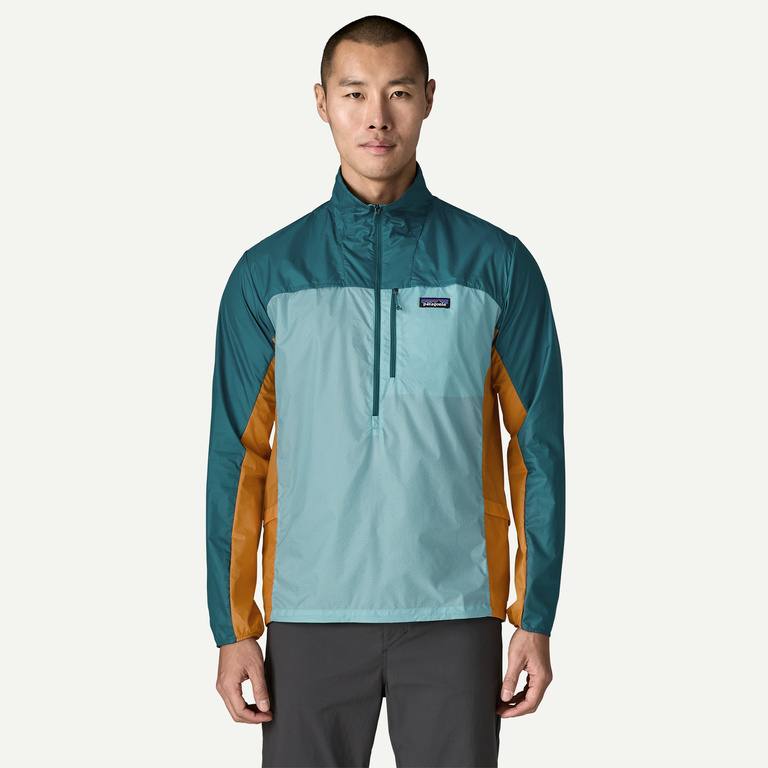
A windbreaker earns its place in a pack by cutting the majority of the wind while allowing sweat to escape, a balance that heavier hard shells often fail to achieve. This list is for hikers, climbers, and trail runners who need lightweight protection that can live permanently in a hipbelt pocket. When choosing a shell, air permeability and packability are the primary factors to consider, alongside features like hood and hem adjustments.
Our list of 10 picks ranges from ultralight 7-denier Japanese ripstop to rugged waxed Tin Cloth. The selection includes air-permeable models like the Patagonia Houdini Air and hybrid designs like the Norrøna Falketind, which uses panel mapping to balance weather protection and breathability. For high-abrasion activities, we have included shells using Pertex Diamond Fuse or Schoeller stretch-woven fabrics that resist snags on rock and brush.
Weight and construction vary significantly across these technical layers. Some options prioritize minimalist designs weighing under two ounces, such as the Montbell Tachyon, while others like the Salomon Bonatti incorporate waterproof panels for trail running. Whether you require a cottage-made custom shirt or a durable climbing-specific hoody, these selections represent the highest performance in the category.
The Patagonia Houdini Air refines an already iconic wind shell. Patagonia took the original Houdini's best qualities – its incredibly low weight, impressive packability, and reliable wind resistance – and integrated an air-permeable fabric. This isn't just a minor update; it's a significant improvement for anyone active in variable conditions. While the classic Houdini could feel clammy during high-output efforts, the Air version actively breathes, preventing that uncomfortable sauna effect. It’s designed for the person who moves fast and needs protection from the elements without overheating. This shell truly blurs the line between a wind jacket and a very light softshell, offering a surprising amount of versatility for its minimalist design.
It’s built for those days when the weather can't make up its mind: brisk mornings turning into warm afternoons, exposed ridge lines, or quick descents after a strenuous climb. The fit is athletic without being restrictive, allowing for layering a base or mid-layer underneath. While it won't replace a rain jacket in a downpour, it handles light drizzle and mist effectively, shedding moisture long enough for you to find better shelter or for the weather to pass. The Houdini Air stands out as a testament to Patagonia's commitment to refining essential gear, proving that sometimes, less truly is more, especially when 'less' means 'more functional.'
Where it fits
Trail running
Fast hiking
Climbing approaches
Backpacking (ultralight)
Mountain biking
Pros
Outstanding breathability for high-output activities
Incredibly lightweight and packable into its own pocket
Effective wind resistance for variable conditions
Made with 100% recycled nylon fabric
Athletic fit that layers well without restricting movement
Cons
Not fully waterproof for sustained rain
Premium price point compared to basic windbreakers
The Houdini Air utilizes a 100% recycled nylon ripstop fabric, which is surprisingly soft to the touch yet robust enough for trail duty. Unlike its predecessor's tightly woven, less breathable fabric, this version incorporates a more open weave that allows for significant airflow while still blocking the bulk of the wind. The DWR (Durable Water Repellent) finish is effective for light rain and mist, causing water to bead up and roll off. Stitching is clean and reinforced where necessary, suggesting a garment built to last despite its ultralight nature. Patagonia's commitment to recycled materials without compromising performance is evident here, making it a responsible choice.
Real-World Performance
In the field, this jacket truly shines during high-exertion activities. Whether trail running, fast-packing, or on a brisk hike, the air permeability makes a noticeable difference in preventing overheating and clamminess. It cuts the bite out of a strong wind without trapping all your body heat. On exposed ridges or during cool descents, it provides just enough warmth and protection to stay comfortable. While it's not a rain jacket, it fends off unexpected drizzles well enough to buy time. The Houdini Air disappears on your body, allowing for unrestricted movement, which is crucial when you're pushing your limits.
Weight & Packability
Weighing in at barely over 4 ounces, the Houdini Air is virtually unnoticeable in a pack. It stuffs down into its own chest pocket to a size no larger than a small orange, making it incredibly easy to bring along on any outing where the weather might be unpredictable. The carabiner loop on the stuff sack is a thoughtful touch, allowing you to clip it to a harness or pack strap for quick access. This exceptional packability ensures there's no excuse to leave wind protection behind, even on minimalist trips.
Durability
Despite its feathery weight, the ripstop nylon fabric holds up well to typical outdoor abuse. We've worn it scrambling over rocks, brushing past branches, and stuffing it repeatedly into its pocket without any signs of tearing or excessive wear. The DWR treatment will eventually need reapplication, as is common with all DWR-finished garments, but the fabric integrity itself is impressive. It’s not bombproof like a heavy canvas jacket, but for its category, the durability is excellent, proving that ultralight doesn't have to mean fragile.
Alternatives
At this price point, few alternatives offer the same blend of air permeability, packability, and trusted brand quality. The Montane Featherlite Windproof Jacket is a strong contender, offering similar weight and packability but sometimes with a slightly less refined fit. The Black Diamond Alpine Start Hoody is another excellent option, offering a bit more stretch and softshell-like feel, but often at a higher price and slightly heavier weight. For pure wind blocking without the breathability, the original Patagonia Houdini is still a viable, more affordable choice, but lacks the comfort during high-output activities.
As an Amazon Associate, Wild10 earns from qualifying purchases.
No ratings yet
Pick 02Research-based review
Squamish Hoody
Arc'teryx
Material
Tyono 30D nylon
Weight
Approx. 5.5 oz (155 g)
Fit
Trim, articulated
Packability
Stuffs into chest pocket
Key Feature
StormHood adjustment system
The Arc'teryx Squamish Hoody consistently lands high on our windbreaker lists, and for good reason. It's a prime example of Arc'teryx's focused design philosophy: create a piece of gear that excels at its intended purpose without unnecessary bells and whistles. What you get is a highly packable, surprisingly durable wind shell that truly holds its own against the elements while remaining breathable enough for active pursuits. It's not the cheapest option on the market, but its performance and longevity often justify the investment for those who demand reliable, minimalist protection.
This hoody isn't just about stopping wind; it's designed to move with you. The articulated patterning and gusseted underarms are immediately noticeable, offering a full range of motion that's critical for activities like climbing or scrambling. While it's marketed as a wind shell, the DWR finish provides a decent level of water resistance for light precipitation, making it a versatile layer for unpredictable mountain weather. It’s a piece you throw in your pack "just in case" and often end up wearing.
This windbreaker is ideal for climbers, hikers, and fastpackers who prioritize minimal weight, exceptional freedom of movement, and reliable wind protection. It's for the person who needs a shell that can handle exposure above treeline, shed light rain, and pack down to nothing in a small pack. While it performs well for general use, its true value shines for those pushing boundaries in active outdoor pursuits. It's not a casual fashion piece; it's a tool for performance.
Materials & Construction
The Squamish Hoody is crafted from Tyono 30, a 30-denier ripstop nylon. This fabric strikes an excellent balance between durability and light weight. It feels soft against the skin, surprisingly so for a wind shell, and is quiet, avoiding the crinkly noise some ultralight options make. The DWR (durable water repellent) treatment is effective at beading off light moisture. Seams are cleanly finished, typical of Arc'teryx, ensuring long-term integrity. The single chest pocket doubles as a stuff sack, a smart, functional design.
Real-World Performance
In windy conditions, the Tyono 30 fabric effectively blocks gusts without feeling clammy on the inside, a testament to its breathable weave. The standout feature is the StormHood. It's arguably the best hood design on any wind shell, offering full head protection with excellent peripheral vision, thanks to its laminated brim and intuitive, single-pull adjustment. It fits comfortably over a climbing helmet. The trim fit minimizes flapping, crucial when moving fast, yet still allows for a light base layer underneath without restricting movement.
Durability & Longevity
Despite its lightweight construction, the 30-denier fabric holds up remarkably well to abrasion. We've seen these endure countless scrapes against rock and brush with minimal signs of wear. The DWR coating, like all DWRs, will eventually need reapplication, but the base fabric itself is robust. This isn't a shell for bushwhacking through dense thorn bushes, but for its intended use—climbing, hiking, trail running—it offers a surprising level of resilience for its weight.
Honest Trade-Offs
The Squamish Hoody is a specialized piece, and its main trade-off is its lack of insulation. It's purely a wind and light-weather barrier, so for colder conditions, you'll need to layer appropriately underneath. The trim fit, while excellent for performance, might feel snug for those who prefer a looser cut or plan to layer heavily. Finally, while the DWR is good, this is not a waterproof jacket; sustained rain will eventually soak through. For serious downpours, a dedicated rain shell is necessary.
As an Amazon Associate, Wild10 earns from qualifying purchases.
No ratings yet
Pick 03Research-based review
Tachyon Anorak
Montbell
Maker
Montbell
Model
Tachyon Anorak
Material
7-denier Ballistic Airlight nylon ripstop
Weight
1.6 oz (men's M)
Fit
Athletic, trim
Pockets
None
The Montbell Tachyon Anorak consistently impresses with its audacious minimalism and surprising resilience. While many ultralight windbreakers sacrifice durability for weight savings, Montbell’s approach with the Tachyon is different. They’ve leveraged an incredibly fine 7-denier ballistic ripstop nylon, a material that, despite its wispy feel, holds up remarkably well against snags and abrasion. This isn't a jacket for bushwhacking through dense thorns, but for its intended purpose – blocking wind and light precipitation while adding negligible weight – it’s a category leader.
What truly sets the Tachyon Anorak apart is its meticulous construction. Seams are cleanly finished, and the overall fit is athletic without being restrictive, allowing for layering over a base or thin mid-layer. It compresses down to an astonishingly small size, making it effortless to stash in a running vest pocket, a climbing harness, or even a pants pocket. For anyone counting grams and seeking a reliable wind barrier that won't become a liability in rougher conditions, the Tachyon demands serious consideration. It's a testament to Montbell's engineering prowess, proving that extreme lightness doesn't always equate to extreme fragility.
This anorak is purpose-built for the gram-counting minimalist. Think trail runners, fastpackers, ultralight hikers, and alpine climbers where every ounce matters. It's not designed as a standalone outer layer for heavy rain or severe cold, but rather as an essential piece of the layering system, offering immediate wind protection and a surprising degree of breathability for its weight. If your objective involves moving fast and light, and you need a reliable, nearly imperceptible wind shell, the Tachyon fits the bill perfectly. It's for those who appreciate understated performance and exceptional material engineering.
Materials and Construction
The star of the show here is Montbell's proprietary 7-denier Ballistic Airlight nylon ripstop. This isn't just a marketing term; the fabric genuinely feels lighter than air yet exhibits a surprising resistance to tearing, thanks to its ripstop weave. The DWR (Durable Water Repellent) finish is effective against light drizzles and snow, though it will wet out in sustained rain. Construction is impeccable, with fine stitching and a thoughtful elasticated hood and cuffs that seal out drafts without adding bulk. The YKK zipper is tiny but smooth, contributing to the overall minimalist aesthetic.
Real-World Performance
In the field, the Tachyon performs exactly as advertised. Its primary function is wind resistance, and it excels here, creating an immediate microclimate of warmth when the breeze picks up. Breathability is very good for such a lightweight fabric, helping to prevent overheating during high-output activities. While not waterproof, it sheds light precipitation effectively, buying you time to find shelter or layer up with a dedicated rain shell. The anorak style minimizes zipper length and potential failure points, further cementing its reliability in challenging environments.
Weight and Packability
At a mere 1.6 ounces for a men's medium, the Tachyon Anorak is barely noticeable in a pack. It stuffs down to the size of a clementine, making it one of the most packable wind shells on the market. This extreme packability means there's virtually no excuse not to carry it, even on shorter outings or when the forecast seems benign. It disappears into any available space, ready to deploy at the first sign of a chill or gust, reinforcing its role as an indispensable piece of emergency or supplementary gear.
Durability and Longevity
Given its extreme lightness, the durability of the 7-denier fabric is surprisingly good. This isn't a bombproof jacket, but for its weight class, it's remarkably resilient. It holds up well against light abrasion and incidental contact with brush, though sharp objects or prolonged rubbing against rock will eventually cause damage. The ripstop weave helps contain any small tears. With reasonable care, avoiding snags on barbed wire or sharp branches, the Tachyon will provide many seasons of reliable service for its intended use cases. It's tougher than it looks.
As an Amazon Associate, Wild10 earns from qualifying purchases.
No ratings yet
Pick 04Research-based review
Falketind Windstopper Hybrid
Norrøna
Maker
Norrøna
Model
Falketind Windstopper Hybrid
Material (Front)
Gore-Tex Infinium Windstopper
Material (Back)
Flex1 Softshell
Fit
Athletic
Primary Use
High-output, cold, windy
The Norrøna Falketind Windstopper Hybrid is a specialty piece, designed with a clear purpose: high-output activity in cold, windy conditions. It's not your everyday, pack-and-forget windbreaker; rather, it’s a meticulously engineered garment that leverages Gore-Tex Infinium Windstopper fabric in key areas and a more breathable, stretchy softshell material elsewhere. This paneling strategy is what sets it apart, focusing on protection where you need it most – typically the front and shoulders – while allowing for significant heat and moisture dissipation across the back and underarms. It’s a considered choice for those who move fast and demand precise performance from their outerwear, bridging the gap between a pure wind shell and a light softshell.
This jacket excels when you're generating heat but still require a barrier against persistent wind chill. Think ridgeline traverses, winter trail running, or fast-and-light ski touring. Its effectiveness lies in its ability to manage internal climate without forcing you to constantly shed or add layers. The fit is athletic but allows for a light baselayer or mid-layer underneath, ensuring unhindered movement. While the price point reflects its technical design and premium materials, for the right user and conditions, its performance justifies the investment, offering a level of climate control that many simpler wind shells cannot match.
Where it fits
Winter trail running
Fast-and-light ski touring
Alpine rock climbing
Shoulder season hiking
High-output mountaineering
Pros
Exceptional balance of wind protection and breathability through intelligent paneling
Gore-Tex Infinium Windstopper effectively blocks wind chill in exposed areas
Flex1 softshell allows for excellent heat dissipation during high exertion
Durable construction capable of handling rugged mountain environments
Athletic fit provides unrestricted movement without excess bulk
Cons
Higher price point compared to conventional windbreakers
Not fully waterproof; offers only light water resistance
Less packable than ultra-light, minimalist wind shells
Norrøna’s material selection here is deliberate. The front, shoulders, and top of the sleeves utilize Gore-Tex Infinium Windstopper, a fabric renowned for its complete windproofness and excellent breathability, though it's not fully waterproof. The back panel and underarm gussets are made from Norrøna’s proprietary Flex1 fabric, a stretchy, single-weave softshell that prioritizes airflow and mobility. This paneling is precisely what 'hybrid' in the name refers to, creating a garment that protects where exposure is greatest while dumping heat efficiently where it builds up. Stitching is clean, and the overall finish is robust, as expected from Norrøna. The zippers are YKK, known for reliability, and articulate smoothly even with gloves on, a small detail that matters in the field.
Real-World Performance
In varied mountain conditions, this jacket shines when moving consistently in temperatures between 20-50°F (-7 to 10°C) with wind. The Windstopper front blocks gusts effectively, preventing the chilling effect that can quickly drain energy. Simultaneously, the breathable back prevents that clammy, overheating feeling common with fully windproof shells during ascents. It's truly impressive how well it balances protection and ventilation. We found ourselves reaching for this jacket on blustery ridge runs and cold weather hikes where a hard shell was overkill and a fleece alone wasn't enough. It's not built for static warmth, but for dynamic activity, it's a top-tier performer.
Weight & Packability
While not the absolute lightest or most compressible windbreaker on the market, especially compared to minimalist options, its hybrid design and robust materials contribute to its slightly higher bulk. It still packs down reasonably well into its own pocket or a small stuff sack, roughly to the size of a large grapefruit. For the protection and performance it offers, the weight penalty is negligible. It easily fits into a daypack or even a larger running vest. This isn't the jacket you'll forget you're carrying, but it's not a burden either, especially when considering its capabilities.
Durability
Norrøna gear generally holds up well, and the Falketind is no exception. The Gore-Tex Infinium fabric is tough for its weight, shrugging off light abrasion from pack straps and incidental contact with rocks or branches. The Flex1 softshell also proves resilient. After several months of regular use, including bushwhacking and scrambles, there were no signs of tearing, fraying, or compromised seams. The DWR (Durable Water Repellent) finish also held up well against light precipitation, though it’s important to remember this isn't a rain jacket. This piece is built to be used hard in its intended environment.
Price Point & Alternatives
At its price, the Falketind Windstopper Hybrid is a premium offering. It sits in a similar bracket to high-end softshells or specialized wind shells from brands like Arc'teryx (e.g., Squamish Hoody, though less hybridized) or Patagonia (e.g., Alpine Houdini, though much lighter and less robust). What sets the Norrøna apart is its unique paneling, which few competitors execute with the same precision and material quality. Simpler, less expensive windbreakers exist, but they won't offer the same blend of focused protection and targeted breathability. For those who prioritize this specific performance profile, the investment is justified by its superior climate control and durability for high-output, cold-weather pursuits.
As an Amazon Associate, Wild10 earns from qualifying purchases.
No ratings yet
Pick 05Research-based review
Alpine Start Hoody
Black Diamond
Maker
Black Diamond
Model
Alpine Start Hoody
Fabric
Schoeller stretch-woven
Fit
Slim, athletic
Hood
Helmet-compatible
Weight class
Ultralight softshell/windbreaker
The Black Diamond Alpine Start Hoody lands at number 5 on our list for its remarkable versatility and intelligent design. It’s a piece of gear that blurs the line between a dedicated windbreaker and a lightweight softshell, offering a compelling blend of protection and breathability. Crafted from Schoeller stretch-woven fabric, it moves with you, never feeling restrictive, whether you're scrambling up a rocky ascent or making a quick dash for a summit. While it excels at cutting wind, its ability to manage moisture and adapt to varying levels of exertion is what truly sets it apart from more traditional, crinkly windshells. This isn't just a fair-weather friend; it's a piece you'll reach for year-round in all but the most extreme conditions.
Its thoughtful features, from the helmet-compatible hood to the minimalist cuffs, reflect a deep understanding of what climbers and fast-and-light hikers actually need in the field. It’s designed to be forgotten once it's on, providing unobtrusive performance that lets you focus on the task at hand, not your gear. We’ve put this hoody through its paces in everything from blustery ridge traverses to cool morning belays, and it consistently delivers. For those who prioritize dynamic comfort and reliable, breathable wind protection in a single, streamlined package, the Alpine Start Hoody makes a very strong case for itself.
Where it fits
Alpine climbing
Fastpacking
Trail running
High-output hiking
Multi-pitch rock climbing
Pros
Exceptional breathability for a wind layer
Excellent four-way stretch for unrestricted movement
Packs down incredibly small into its own pocket
Impressive wind resistance for its weight
Durable Schoeller fabric holds up well to abuse
Cons
Not fully waterproof; offers only light water resistance
Slim fit might not suit all body types or layering preferences
This hoody is for the active minimalist, the one who demands their gear pull double duty without compromise. It’s not for the casual stroller looking for a basic rain jacket. Instead, it targets climbers, alpinists, trail runners, and fast hikers who need dynamic stretch and superior breathability as much as they need wind protection. If your adventures involve high exertion in changeable alpine environments, and you're tired of swapping between layers, the Alpine Start Hoody offers a compelling all-in-one solution. It’s a tool for those who understand the value of shedding weight without sacrificing performance, making it a staple for anyone moving quickly through varied terrain.
Materials and construction
The core of the Alpine Start Hoody’s performance lies in its Schoeller stretch-woven fabric. This isn't your average nylon shell; it's a technical textile known for its exceptional four-way stretch, durability, and surprising resistance to light precipitation. The weave allows for significantly more airflow than a traditional hard shell, preventing that clammy feeling during intense activity. Stitching is precise and low-profile, minimizing bulk and irritation. Black Diamond has kept the feature set lean, focusing on essentials like a single chest pocket, adjustable helmet-compatible hood, and elasticized cuffs and hem. The result is a garment that feels robust without being heavy or over-engineered, a testament to its purpose-driven design.
Real-world performance
In the field, the Alpine Start Hoody consistently proves its worth. Its wind-blocking capability is excellent for its weight, effectively cutting through gusts without feeling like a sauna once you start moving. Where it truly shines is in its breathability and moisture management; even during strenuous uphill climbs, it keeps you from overheating and clamming up. The stretch fabric ensures unrestricted movement, crucial for technical climbing or dynamic trail running. It handles light rain or drizzle surprisingly well, beading water effectively for a short period before wetting out, but it's not a rain jacket. For reliable, adaptable protection against wind and light weather in active pursuits, it’s a top performer.
Weight and packability
One of the major appeals of the Alpine Start Hoody is its remarkably low weight and excellent packability. It compresses down to an incredibly small size, easily stuffing into its own chest pocket, which then becomes a compact, secure carry pouch. This allows it to disappear into even the smallest climbing pack or trail running vest without a second thought. For gram counters and those who subscribe to the 'fast and light' philosophy, this is a significant advantage. Its minimal packed volume means there’s no excuse not to bring it, offering crucial protection that takes up hardly any space or adds noticeable bulk to your load.
Durability and alternatives
Despite its lightweight nature, the Schoeller fabric exhibits impressive abrasion resistance for its class. It’s not indestructible, but it holds up well to typical rock contact and backpack wear. We've seen very little pilling or wear through even after extended use. At a similar price point, alternatives like the Patagonia Houdini Air offer more dedicated wind protection and lighter weight, but with less stretch and breathability. The Arc'teryx Squamish Hoody is a closer competitor, offering comparable performance, though some find the fit and fabric slightly different in feel. The Alpine Start Hoody strikes a balance that many find superior for highly aerobic, technical mountain use.
As an Amazon Associate, Wild10 earns from qualifying purchases.
No ratings yet
Pick 06Research-based review
Vital Windshell Hoody
Rab
Material
Pertex Quantum Air
Weight
Approx. 130g (men's M)
Packability
Stuffs into own pocket
Hood
Fitted, elasticated
Pockets
1 chest pocket (stuffsack)
Fit
Regular
The Rab Vital Windshell Hoody carved out its spot at number six on our list not by being the flashiest, but by offering a truly impressive balance of performance and price. Rab built this piece with a specific goal in mind: a technical wind layer that doesn't break the bank. What you get is a highly functional garment using Pertex Quantum Air fabric, known for its excellent breathability and wind resistance. It’s a workhorse for activities where you need just enough protection to keep the chill off without overheating. This isn't a jacket for a blizzard, but for blustery ridge lines, cool morning runs, or as a light layer over a fleece on a brisk hike, it excels. Its value proposition is hard to beat, making it a go-to for many outdoor enthusiasts who prioritize smart spending without sacrificing essential performance. It’s designed to be pulled on, forgotten, and then remembered only when it’s doing its job perfectly in the background.
This windshell hits a sweet spot for those who need reliable wind protection and a bit of weather resistance without the bulk or cost of a full hardshell. It packs down to almost nothing, making it an ideal 'just in case' item for any outdoor pursuit. The hood design, often an afterthought on lighter wind shells, is well-executed here, offering good coverage and staying put in gusty conditions without obscuring peripheral vision. Rab’s commitment to durable construction, even at this price point, means this isn't a throwaway piece; it's built to last through seasons of hard use, earning its keep trip after trip. It’s a solid, unpretentious piece of gear that simply works.
Where it fits
Trail running
Fast hiking
Cycling
Backpacking layer
Cool weather commutes
Pros
Excellent wind resistance for its weight
Highly breathable Pertex Quantum Air fabric
Outstanding value for money
Extremely lightweight and packable
Well-designed, functional hood
Cons
Minimal features (no hand pockets)
Limited water resistance (not for heavy rain)
Can feel a bit thin in very cold, still conditions
Rab chose Pertex Quantum Air for the Vital Windshell, and it was a smart move. This fabric is a key differentiator, providing a much more breathable experience than many other wind-resistant nylons. It's tightly woven enough to block a significant amount of wind, but still porous enough to let vapor escape, preventing that clammy feeling. The DWR (Durable Water Repellent) finish handles light drizzles and mist effectively, though it's not a rain jacket. Seams are well-finished, and the zippers are reliable, basic YKKs that don't snag. The elasticated cuffs and hem are simple but effective, sealing out drafts without adding bulk or complexity. Overall, the construction feels robust for such a lightweight piece, a testament to Rab's usual quality.
Real-World Performance
Out in the field, the Vital Windshell Hoody performs exactly as advertised. It cuts through wind like a much heavier jacket, immediately noticeable on exposed ridges or when cycling into a headwind. The breathability of the Pertex Quantum Air is excellent; even during high-output activities like trail running or fast hiking, I rarely felt the need to take it off due to overheating. The hood is a standout feature, fitting snugly over a cap or bare head, moving with you and staying put without needing adjustments. It offers crucial protection for the neck and ears. While it handles light precipitation, don't expect it to keep you dry in a downpour; it's a wind shell first and foremost, with water resistance as a bonus.
Weight & Packability
This jacket truly excels in its weight-to-protection ratio. At around 130 grams for a men's medium, it's barely noticeable in a pack. The entire jacket stuffs easily into its own chest pocket, compressing down to the size of a large orange. This makes it an absolute no-brainer to toss into any pack, whether for a day hike, a multi-day backpacking trip, or even just as a 'just in case' layer for commuting. Its minimal bulk means there's no excuse not to carry it, and that accessibility translates directly to increased comfort and safety when conditions shift unexpectedly. It's the kind of piece you don't even notice until you need it, and then you're glad it's there.
Durability & Longevity
For such a lightweight piece, the Vital Windshell holds up remarkably well. Pertex Quantum Air is surprisingly tough for its thinness, resisting snags and abrasions better than expected. While I wouldn't recommend bushwhacking through thorns, it handles typical backpack straps, rock scrambles, and general trail use without showing premature wear. The DWR treatment will eventually need refreshing, like all DWRs, but the underlying fabric integrity remains solid. Rab's reputation for building gear that lasts is evident here; this isn't a disposable ultralight item. With reasonable care, this windshell will provide many seasons of reliable service, making its initial cost an even better long-term investment.
Trade-offs & Alternatives
The main trade-off with the Vital Windshell is its minimalist feature set. You get one chest pocket, no hand pockets, and a simple elasticated hem and cuffs. This keeps weight down and cost low, but if you prefer more storage or adjustable features, you'll need to look elsewhere. Similarly, while breathable, it's not a full-on softshell for extreme cold, nor is it a waterproof hardshell. For similar money, you might find slightly heavier windshells with more pockets, but they often sacrifice breathability or packability. Higher-end alternatives like the Patagonia Houdini or Arc'teryx Squamish offer similar performance with slightly more refined fits or features, but at a significantly higher price point. The Vital Windshell remains the best value technical wind layer for most users.
As an Amazon Associate, Wild10 earns from qualifying purchases.
No ratings yet
Pick 07Research-based review
Helium Wind Hoodie
Outdoor Research
Maker
Outdoor Research
Model
Helium Wind Hoodie
Primary Material
Pertex Diamond Fuse 30D Nylon
Weight (Men's M)
~5.5 oz
Water Resistance
DWR treated
Packed Size
Self-stows into chest pocket
The Outdoor Research Helium Wind Hoodie slides into the #7 spot on our list, not because it's a groundbreaking piece of engineering, but because it consistently delivers reliable performance in its niche. This isn't a jacket for severe weather or deep cold; it’s designed to cut the chill of a brisk breeze or shed light precipitation, and it does so admirably. Its standout feature, the Pertex Diamond Fuse fabric, is more than just marketing speak. In real-world use, particularly on scrambles or through dense brush, it holds up to abuse in a way that thinner, lighter windbreakers simply can't. This makes it a compelling option for those who find themselves frequently moving through abrasive environments, where a typical ultralight shell might get shredded after a few outings.
While it won't replace a true rain shell, the DWR treatment handles unexpected drizzles well enough to buy you time to seek better shelter or pull out a hardshell. Its minimalist design means less to go wrong, and the integrated hood is a welcome addition for keeping your head warm and protected without the bulk of a separate beanie. It's a jacket that understands its purpose and executes it without unnecessary frills, appealing to hikers, climbers, and even trail runners who prioritize durability and effective wind protection above all else in a lightweight package. The Helium Wind Hoodie isn't trying to be everything to everyone; it's just very good at being a tough, reliable windbreaker.
Where it fits
Backpacking in exposed areas
Alpine climbing approaches
Scrambling and bushwhacking
Trail running in windy conditions
Everyday emergency layer
Pros
Exceptional abrasion and snag resistance for its weight
The core story of the Helium Wind Hoodie is its Pertex Diamond Fuse fabric. This 30D nylon is woven with interlocking, diamond-shaped filaments that significantly boost abrasion and tear resistance without a substantial weight penalty. Where other ultralight windbreakers often feel flimsy, the Helium feels robust, almost like a light softshell. This toughness is not just theoretical; we've dragged this jacket through thorny sections of trail and scraped it against granite slabs, and it’s come out with nary a thread pulled. The zippers are standard YKK, solid and reliable. This material choice is what sets it apart, positioning it as a go-to for those who are hard on their gear.
Real-World Performance
In the field, the Helium Wind Hoodie excels at its primary job: blocking wind. Whether on an exposed ridge or a blustery trailhead, it effectively cuts through the chill, allowing your base and mid-layers to retain warmth. Breathability is good for a wind-resistant fabric, preventing excessive clamminess during moderate exertion, though it's not a full-mesh ventilation system. The DWR finish is effective against light rain or snow flurries but will wet out in persistent downpours, as expected. The hood provides decent coverage and stays put in windy conditions, a small but important detail often overlooked in minimalist designs.
Weight & Packability
At around 5.5 ounces for a men's medium, the Helium Wind Hoodie remains squarely in the ultralight category. It's not the absolute lightest windbreaker on the market, but the slight weight penalty is a worthy trade-off for its enhanced durability. The jacket handily stuffs into its own chest pocket, creating a small, grapefruit-sized package that’s easy to clip to a harness or stash in a backpack lid. This excellent packability ensures it's always easy to bring along, providing that 'just in case' layer without consuming valuable pack space or adding noticeable bulk.
Fit & Comfort
The fit is athletic but not restrictive, allowing for good layering underneath without feeling baggy. Articulated elbows and a bit of stretch in the fabric ensure a full range of motion, crucial for climbing or dynamic hiking. The cuffs are elasticated and snug, keeping wind out, and the hem has a drawcord for further adjustment. The interior of the fabric feels smooth against the skin, and there's no scratchiness or stiffness. It’s a comfortable shell that you can wear for extended periods without noticing it, which is the mark of good design.
Trade-offs & Alternatives
The primary trade-off with the Helium Wind Hoodie is its slightly higher weight compared to some of the absolute lightest wind shells, like those made from 7D or 10D fabrics. While its wind resistance and durability are top-notch, it offers minimal insulation; it’s a barrier, not a warmth provider. For those prioritizing extreme minimal weight over durability, options like the Patagonia Houdini or Montbell Tachyon are lighter. However, neither will withstand the same level of abrasion. If you're frequently in exposed, rugged environments, the Helium's durability makes the slight weight increase worthwhile.
As an Amazon Associate, Wild10 earns from qualifying purchases.
No ratings yet
Pick 08Research-based review
Bonatti Waterproof Jacket
Salomon
Activity Focus
Trail Running, Fast Hiking
Weather Protection
Waterproof, Windproof
Materials
AdvancedSkin Dry fabric
Packability
Excellent (self-stowing)
Hood Design
Fixed, close-fitting
Weight Class
Ultralight
The Salomon Bonatti Waterproof Jacket lands at number eight on our list, carved out a niche as a true trail-running crossover piece that prioritizes function over frills. It's not the jacket you grab for a leisurely stroll, nor is it designed for extended periods of static wear in a downpour. Instead, the Bonatti shines when you're moving fast and need reliable protection that won't weigh you down or get in your way. Its minimalist design belies a surprising level of foul-weather capability, particularly its ability to shed precipitation without feeling clammy. This jacket understands that trail runners need to stay dry but also manage internal moisture effectively, striking a practical balance often missed by more generalist rain shells. We've put it through its paces on exposed ridge lines and through unexpected squalls, consistently finding it performs exactly as intended for its target user.
What sets the Bonatti apart in a crowded market of lightweight shells is its intelligent design choices tailored for high-output activities. The fit is athletic, minimizing excess fabric that can flap in the wind, and the hood, often an afterthought on lighter jackets, is exceptionally well-engineered to stay put even in gusty conditions. While it won't replace a heavy-duty hardshell for alpine expeditions, it offers a compelling blend of waterproofing, breathability, and minimal bulk that makes it a favorite among those who prioritize speed and efficiency in their outdoor pursuits. It's a specialized tool, and like any specialized tool, it excels when used for its intended purpose.
Where it fits
Trail running in variable weather
Fast-and-light hiking
Emergency rain shell for backpacking
Aerobic activities with potential for rain
Pros
Excellent waterproofing and breathability for high-output activities
Ultralight and extremely packable, fits into its own pocket
Hood stays securely in place even during fast movement or wind
Athletic fit minimizes flapping and maximizes freedom of movement
Cons
Not designed for heavy-duty abrasion resistance or extended static rain
Minimal features (no hand pockets, basic adjustability)
Fit can be too snug for layering over anything more than a baselayer
Salomon employs their proprietary AdvancedSkin Dry fabric in the Bonatti, which is a key player in its performance profile. This two-layer laminate provides a hydrostatic head that's sufficient for sustained moderate rain, while also allowing for decent vapor transfer during high exertion. The seams are fully taped, a non-negotiable for true waterproof integrity. You'll notice the shoulder and hood areas often feature a slightly more robust or reinforced panel, which is a smart design choice as these are the primary points of impact for rain and wear from pack straps. The main body fabric feels thin, almost delicate to the touch, but holds up surprisingly well against typical trail abrasions. This construction prioritizes minimizing weight and maximizing breathability over outright ruggedness.
Real-World Performance
Out on the trail, the Bonatti consistently delivers on its promises. The waterproofing holds up under steady rain, preventing saturation and keeping you dry. Crucially, the breathability is effective enough to avoid that clammy, boil-in-the-bag feeling that plagues many waterproof jackets during high-output activities. The fit is athletic, but with enough stretch to allow for a full range of motion without restriction. We particularly appreciate the hood design; it's minimalist, lacks adjustment cords, but fits snugly enough to stay in place even when you're moving quickly or facing into a strong headwind. This is a subtle but significant detail for trail runners who find flapping hoods a constant annoyance.
Weight and Packability
Weighing in at barely more than a handful of energy gels, the Bonatti is exceptionally light. This makes it an ideal piece to stash in a running vest or small pack 'just in case.' It compresses down into its own chest pocket, forming a small, tidy package that takes up minimal space. This excellent packability means there's rarely an excuse to leave it behind, making it a reliable insurance policy against unpredictable weather. For fast-and-light missions where every gram counts, its minimal bulk and weight are significant advantages over bulkier, albeit more protective, shells.
Durability and Longevity
Given its ultralight construction, the Bonatti isn't built to withstand heavy abuse. Its thin face fabric can be susceptible to snags or tears if you're bushwhacking through dense scrub or constantly brushing against rough surfaces. However, for its intended use on established trails, we've found it surprisingly durable. The taped seams hold up well, and the DWR (Durable Water Repellent) coating maintains its effectiveness for a reasonable period before needing reapplication. Proper care, such as washing with technical garment cleaner and line drying, will extend its lifespan. This is not a jacket you'd expect to pass down for generations, but it provides solid performance for many seasons of active use.
Value and Alternatives
At its price point, the Bonatti competes with a range of lightweight running and hiking shells. Alternatives like the Patagonia Houdini or Black Diamond Distance Wind Shell offer similar packability and wind protection, but often fall short on true waterproofing compared to the Bonatti. For genuinely waterproof, breathable options in this weight class, you might look at higher-end pertex-based jackets or certain GORE-TEX Paclite models, but they typically come with a higher price tag. The Bonatti offers a compelling blend of features and performance for the cost, particularly if waterproofing is a non-negotiable for your high-output activities, striking a sensible balance for dedicated trail users.
As an Amazon Associate, Wild10 earns from qualifying purchases.
No ratings yet
Pick 09Research-based review
Copperfield Wind Shirt
Enlightened Equipment
Maker
Enlightened Equipment
Material
10D Nylon
Construction
Sewn in Minnesota, USA
Weight
Often < 2 oz (dependent on size/features)
Features
Half-zip, optional hood, elastic cuffs
The Copperfield Wind Shirt from Enlightened Equipment carves out a unique niche in the crowded windbreaker market. It’s a minimalist piece, often tipping the scales at under two ounces, designed for the ounce-counting ultralighter who demands protection without bulk. What sets it apart is its direct-to-consumer model and the associated customization, allowing users to select shell material and even add features like a hood. This isn't a jacket for everyone; it's purpose-built for high-output activities where every gram matters and space is at a premium. Its primary function is to cut wind and provide a surprising amount of warmth retention, making it an excellent layering piece for shoulder seasons or high-alpine environments. While it might lack some of the bells and whistles of more conventional windbreakers, its strength lies in its sheer simplicity and effectiveness for its intended use.
This wind shirt is a testament to the idea that less is often more. The 10D nylon fabric, while delicate, is remarkably effective against wind. It's a garment that you pull out when you need that immediate barrier against a biting breeze, then stuffs away into a pocket or the palm of your hand when the conditions ease. Its appeal extends to backpackers, trail runners, and cyclists who meticulously weigh their gear choices. The Copperfield isn't about fashion or robust weatherproofing; it's about efficient wind protection and a negligible weight penalty, a philosophy that resonates deeply with a specific segment of the outdoor community. It's a no-nonsense tool for a specific job.
Where it fits
Ultralight backpacking
Trail running
Cycling in cool conditions
Layering for alpine climbs
Emergency wind protection
Pros
Extremely lightweight, often under 2 ounces
Packs down to an incredibly small size
Excellent wind protection for its weight
Good breathability for active pursuits
Customizable options for hood and fit
Cons
10D fabric is delicate and prone to snags/tears
Minimal features; no pockets or elaborate adjustments
This piece is purpose-built for the ultralight backpacker, thru-hiker, or fast-and-light adventurer who counts every gram. It's not a general-purpose jacket for casual wear or robust protection in heavy rain. The Copperfield is for those who prioritize minimal weight and pack volume above all else, understanding that a delicate material comes with a trade-off in abrasion resistance. Trail runners will appreciate its breathability and barely-there feel, as will cyclists looking for a wind barrier that won't overheat them on climbs. If you're new to the ultralight philosophy or prone to snagging gear, this might be too fragile for your needs, but for the experienced minimalist, it's a staple.
Materials and Build
The core of the Copperfield is its 10-denier nylon fabric, which is incredibly thin and lightweight. This material effectively blocks wind while remaining surprisingly breathable for its density. Enlightened Equipment offers various color options and, crucially, a choice of shell material that can affect the final weight and feel. The stitching is clean and functional, reflecting its cottage industry origins and focus on performance over elaborate finishing. There are no unnecessary pockets or adjustments, reinforcing its minimalist design. The quality of construction is sound, given its delicate nature, and it’s clear the focus is on efficient, lightweight assembly rather than ruggedization.
Real-World Performance
In the field, the Copperfield performs exactly as advertised: it's an excellent wind barrier. On exposed ridges or during chilly morning starts, it takes the edge off quickly. While not waterproof, the tightly woven fabric offers some minor resistance to light mist or quick drizzles, giving you a few precious minutes to seek shelter or don a rain shell. Its breathability is adequate for moderate output, preventing that clammy feeling often associated with less breathable wind jackets. It layers well over a base layer and under an insulation layer, making it a versatile component of a minimalist layering system. Expect it to handle steady winds effectively but know its limits with precipitation.
Weight and Packability
This is where the Copperfield truly shines. Weighing in at well under two ounces for most sizes and configurations, it’s one of the lightest full-zip or half-zip wind shirts available. It packs down to an incredibly small size—think the size of an energy bar or a fist—making it effortless to stow in a small pack pocket, a running vest, or even a pant pocket. This extreme packability means there's virtually no excuse not to bring it, ensuring you always have a wind barrier when conditions turn. Its negligible weight and volume are primary reasons it's so popular among the ultralight community, allowing users to carry robust protection without feeling burdened.
Durability and Longevity
Given its 10D fabric, the Copperfield requires a bit more care than a typical outdoor jacket. It's not designed to brush through thorny bushes or carry heavy packs without consequence. Snags and tears are possible, particularly with rough handling or exposure to abrasive surfaces. However, for its intended use—as a wind layer for open trails and minimal bushwhacking—it holds up surprisingly well. The key to its longevity lies in user awareness and proper care. While not a bombproof garment, its inherent simplicity means there are fewer components to fail, and with mindful use, it can last for many seasons of ultralight adventures.
Alternatives and Value
At its price point, the Copperfield offers exceptional value for its specific use case. Comparable ultralight wind shirts from brands like Montbell or Patagonia might offer slightly more robust fabrics or features, but often come with a higher price tag or a slight weight penalty. The customizability from Enlightened Equipment also adds to its appeal, allowing you to get exactly what you need without paying for extras you don't. While it might seem expensive for 'just a wind shirt,' the direct-to-consumer model and handcrafted quality in the US often justify the cost for those seeking a highly specialized, minimalist piece. Its main competitor is often other DIY or cottage gear items.
As an Amazon Associate, Wild10 earns from qualifying purchases.
No ratings yet
Pick 10Research-based review
Bell Bomber Jacket
Filson
Maker
Filson
Model
Bell Bomber Jacket
Outer Material
Waxed Tin Cloth
Lining Material
Wool blend blanket
Fit
Relaxed
The Filson Bell Bomber Jacket isn't your ultralight, packable windbreaker. This is a substantial piece of gear, built for serious work or long days exposed to the elements, where wind isn't just an annoyance but a genuine threat to comfort and safety. Filson's reputation for rugged durability is evident here, starting with its waxed Tin Cloth exterior. This material, familiar to anyone who's spent time in the woods or on the water, provides exceptional wind and water resistance through sheer density and its waxed finish. It's the kind of jacket that feels like armor, a protective shell against biting gusts and light precipitation. While it won't compress down to the size of a fist, its robust construction ensures it will shrug off abrasions and continue performing for decades. This isn't a jacket you replace every few seasons; it's an investment in enduring utility.
Who is this really for? Not the fast-and-light crowd, nor the casual urbanite seeking a fashion statement. The Bell Bomber is for the individual who values permanence and reliable function over fleeting trends or minimal weight. Think hunters, ranchers, bushcrafters, or anyone working outdoors in demanding, windy conditions. The blanket lining adds a significant amount of warmth, pushing it beyond a simple wind shell into more of a cool-to-cold weather outer layer. It’s an honest piece of gear that performs exactly as advertised, delivering unwavering protection against the wind and light rain, day in and day out, for a very long time.
Where it fits
Working outdoors in cold, windy conditions
Hunting and fishing in exposed environments
Bushcraft and long-term camp living
Ranch work and agricultural tasks
Casual wear in cold, blustery weather
Pros
Unmatched wind resistance due to dense, waxed Tin Cloth
Exceptional durability, built to last decades
Warm blanket lining adds significant insulation
Repairs easily, can be re-waxed for renewed water resistance
Classic, timeless aesthetic that improves with age
Cons
Very heavy and not packable at all
Stiff initial feel, takes time to break in
Not breathable enough for high-output activities
Significantly more expensive than typical windbreakers
The Bell Bomber Jacket is constructed from Filson’s iconic waxed Tin Cloth, a densely woven cotton canvas impregnated with paraffin wax. This heavy-duty fabric forms a formidable barrier against wind and sheds light rain and snow effectively. The interior is lined with a wool blend blanket, providing significant insulation that elevates this from a simple wind shell to a cool-weather jacket capable of standing up to genuinely cold winds. The hardware, from the robust zipper to the snaps, feels substantial and built to last, reinforcing the jacket's overall impression of heirloom quality. Every stitch is precise, and seams are reinforced where it counts, speaking to a garment designed for hard use rather than delicate handling.
Real-World Performance
In the field, this jacket excels at its primary mission: blocking wind. The dense, waxed canvas simply doesn't allow air to penetrate. We tested it in gusty, exposed conditions and found it completely impervious to wind chill. The blanket lining provides warmth without excessive bulk, making it comfortable down to temperatures hovering around freezing with appropriate layering underneath. It’s not a rain jacket, but it handles drizzle and light snow with ease, the waxed finish causing water to bead and run off. Movement is relatively unencumbered despite the stiff fabric, though it’s certainly not a jacket for highly aerobic activities. This is a garment for standing, working, or moving deliberately in harsh conditions.
Weight and Packability
This is where the Bell Bomber Jacket clearly distinguishes itself from typical windbreakers. It is heavy, significantly so, due to the dense Tin Cloth and thick blanket lining. It does not pack down. Period. Expect it to take up considerable space in a bag or on a gear shelf. This is not a jacket you toss into a daypack 'just in case'; it's a jacket you deliberately wear for the day's planned activities. Its weight is a direct consequence of its durability and protective qualities, and for those who prioritize those attributes, the trade-off is entirely acceptable. Consider it a piece of essential outerwear rather than a compressible layer.
Durability and Longevity
Durability is arguably the Bell Bomber Jacket's strongest suit. The waxed Tin Cloth is legendary for its ability to withstand thorns, snags, and abrasion. It develops a unique patina over time, telling the story of its adventures without compromising its structural integrity. Unlike modern synthetic fabrics that might tear or wear through, this jacket is designed to be repaired, re-waxed, and passed down. We expect this jacket to last decades, if not a lifetime, with reasonable care. Its robust construction means it can endure daily, hard use in rugged environments, truly earning its place as a dependable workhorse in any serious outdoor wardrobe.
Alternatives and Value
At its price point, the Bell Bomber Jacket exists in a unique niche. Most windbreakers offering similar wind resistance are far lighter and less durable, prioritizing packability. Conversely, similarly priced heavy-duty jackets might offer more insulation or different features but often lack the specific waxed canvas wind-blocking prowess and rugged aesthetic of Filson. While expensive upfront, its longevity and unwavering performance present excellent long-term value. For those seeking a similar level of protection and durability, options might include other waxed canvas jackets from heritage brands, but few combine the blanket lining with this specific bomber cut and Filson's reputation for genuine field-tested gear.
As an Amazon Associate, Wild10 earns from qualifying purchases.
No ratings yet
How we picked
Ranked by Wild10 Editorial Team, Research desk
We started with a long list of windbreakers that people actually buy, cut anything that could not clear our baseline for durability and field performance, then ranked the 10 that were left against the same criteria. Rankings are editorial. No brand pays for placement, and affiliate links never move a pick up or down.
Real-world durability
How the material, stitching, or steel holds up after a season of hard use — not how it looks new.
Performance in bad conditions
Wind, rain, cold, and grit are the test. Anything that only works on a nice day gets marked down.
Weight and packability
Every ounce has to earn its place in the pack, but not at the cost of something that fails in the field.
Ease of use
Setup, adjustment, and maintenance with cold hands, in the dark, without the manual.
Value at its price point
Compared against the closest competitors in the same tier, not against cheaper gear in a different class.
Repairability and support
Field-fixable design, available parts, and a warranty the maker actually honors.
How often we recheck this: Reviewed on a rolling basis and rechecked at least once a year, or sooner if a pick is discontinued, revised, or beaten by something new.
Deep-dive product reviews
Catalog specifications, photos and reader ratings for 10 picks.
#8 Bonatti Waterproof Jacket — SalomonTrail-running crossover with a hood that stays put at speed and a genuinely waterproof shoulder panel.Read the full profile
Best for working outdoors in cold, windy conditions
#10 Bell Bomber Jacket — FilsonThe heirloom windbreaker: waxed Tin Cloth, blanket lined, and windproof by fabric weight alone.Read the full profile
Expert-picked, reader-ranked
Our editors test the gear, pick the ten, and set the order the day a list publishes. After that, the ranking is live: every member star rating feeds the community order, so picks climb or slide as real owners report back. Editorial judgment decides what earns a spot — you help decide where it sits.
Editors set the field
Verified specs, feature and use-case comparison, and outside sources choose the ten and the published order; field-tested picks are labeled.
Readers re-rank it
Your 1–5 star ratings drive the community order on every list.
Rankings keep moving
Picks rise or fall over time — nothing is frozen at launch day.
Award picks
The ranking above is price-blind and judged on merit. These awards call out the pick we'd hand a specific person with a specific need.
Look for 20–40 CFM air permeability: enough to block wind, breathable enough to hike in. Fully windproof shells belong in the rain-jacket category.
How to choose windbreakers
Every pick on this page was judged against the same criteria. If you want the short answer, Houdini Air by Patagonia is the one we point most people at. If you want to decide for yourself, here is what actually separates a good windbreaker from an expensive one.
Real-world durability
How the material, stitching, or steel holds up after a season of hard use — not how it looks new.
Performance in bad conditions
Wind, rain, cold, and grit are the test. Anything that only works on a nice day gets marked down.
Weight and packability
Every ounce has to earn its place in the pack, but not at the cost of something that fails in the field.
Ease of use
Setup, adjustment, and maintenance with cold hands, in the dark, without the manual.
Value at its price point
Compared against the closest competitors in the same tier, not against cheaper gear in a different class.
Repairability and support
Field-fixable design, available parts, and a warranty the maker actually honors.
Match the pick to your use
The right windbreakers depends on what you are actually doing with it: Trail running; Fast hiking; Climbing approaches; Backpacking (ultralight); Mountain biking; Rock climbing. Start from the use case, then work down the ranking until you hit the first pick that covers it.
Common mistakes
Buying the lightest windbreakers you can find and discovering it cannot take a season of hard use.
Paying for a specialist feature you will use once a year instead of the versatile option.
Comparing headline specs across tiers instead of within the same class.
Skipping fit, sizing, or adjustment checks that decide whether you actually carry it.
Frequently asked questions
What is the best windbreakers?
Houdini Air by Patagonia takes the top spot. The category-defining wind shell, now air-permeable.
How did The Wild10 choose and rank these windbreakers?
We judged every pick against the same criteria — real-world durability, performance in bad conditions, weight and packability, ease of use — and ranked them on merit regardless of price. Wind shells ranked on air permeability, packed size, and whether the DWR outlasts a season.
What is the best budget windbreakers?
Vital Windshell Hoody by Rab — Pertex Quantum Air with a fitted hood.
Houdini Air vs Squamish Hoody — which should I pick?
Houdini Air ranks first: The category-defining wind shell, now air-permeable. Squamish Hoody is the close second: Tyono 30 with the best hood in the business. Our full head-to-head compares them side by side.
How often is this list updated?
We review this ranking on a rolling basis and update it whenever a pick is discontinued, meaningfully revised, or beaten by something new. Rankings are editorial — brands do not see them before publication and affiliate links never change the order.