


From the north · Wildlife
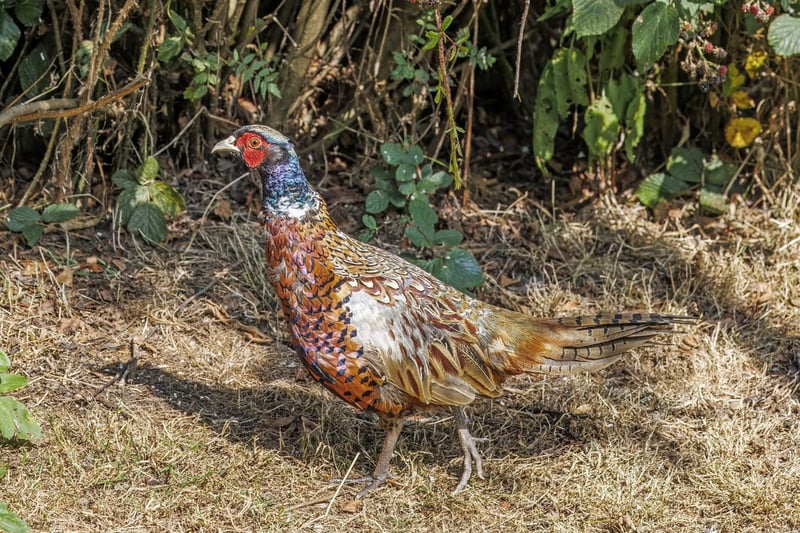
Ring-necked pheasant
An Asian steppe bird that became the signature game bird of the American grain belt — a runner first, a flusher second, and the loudest cackle in the uplands.
Phasianus colchicus
- Weight
- 2–3 lb roosters, 1.75–2.5 lb hens
- Length
- 20–35 in including tail
- Lifespan
- 1–2 yr wild (very high turnover)
- Rooster ID
- White neck ring, iridescent green head, red face wattle
- Flush speed
- 35–45 mph, top-end 55 mph in a tailwind
- Habitat
- CRP grass, cattail sloughs, shelterbelts, standing corn
- Clutch
- 10–12 eggs on the ground, hatch late May–June
- Native range
- Caucasus to China; introduced to N. America in 1881
Regulations by region
Ring-necked pheasant rules where you're headed
Seasons, tags, limits, and legal methods for ring-necked pheasant are set jurisdiction by jurisdiction. Pick your state or province and we'll point you at the agency that writes the rules.
Jump to another species
A steppe bird in the corn belt
Ring-necked pheasants are not native to North America. The first successful release was in Oregon's Willamette Valley in 1881, using birds shipped from China, and by the 1930s pheasants had saturated the grain-and-grassland mosaic of the Dakotas, Nebraska, Kansas, Iowa, and Minnesota. The reason is simple: the American grain belt accidentally recreated the mixed steppe-and-agriculture landscape the bird evolved in — waste grain for winter calories, tall grass for nesting, and wetland edges for thermal cover.
Habitat and the CRP connection
Pheasant numbers track Conservation Reserve Program grassland acreage almost one-for-one. Where CRP contracts expire and grass is plowed back into row crop, bird counts fall inside two seasons; where enrollment rises, they rebound just as fast. Winter cover matters as much as nesting cover — a cattail slough or a dense shelterbelt is what carries a population through a Dakota blizzard, and counties without it hold birds in mild years only.
Behavior — why they run
A pheasant's first defence is its legs, not its wings. A pressured rooster will sprint the length of a quarter-mile field ahead of dogs and hunters, weaving through grass, and only flush when it hits an edge or is pinned. That single behavior explains almost everything about how they are hunted: cover is worked toward a hard edge, and someone stands at that edge.
Breeding and brood season
Roosters are harem breeders. In April and May a dominant bird holds a crowing territory and breeds several hens; the hens nest alone on the ground, usually 10–12 eggs, and raise the brood without the male. That polygyny is why rooster-only harvest is biologically sustainable — a population can lose most of its roosters and still be fully bred. Cold wet Junes, not hunting pressure, drive the biggest year-to-year swings.
Predators and turnover
Nearly everything on the prairie eats pheasant: red fox, coyote, raccoon, skunk, badger, feral cat, northern harrier, great horned owl. Average adult lifespan is under a year. Nest predation and hail-and-flood loss on ground nests, not adult mortality, set the ceiling on most populations.
How to hunt ring-necked pheasant
Hunt them as a running bird. The classic method is a walking line pushing a strip of CRP, cattail, or standing corn toward blockers posted at the far end — the drivers move the birds, the blockers turn the run into a flush. Zigzag rather than walking straight lines, and pause every 30–40 yards: a holding rooster that has watched you pass steadily will often break when you stop. Work the last 100 yards of any strip slowly, because that is where the running birds pile up. A flushing dog (springer, lab) is worth more than a pointer in heavy grass, though a close-working pointer shines in thin early-season cover. Start late morning rather than at first light in most states, hunt edges and food-to-cover travel lanes at dusk, and after a snow work only the heaviest cattail and shelterbelt cover — birds abandon thin grass entirely. Shoot a 12- or 20-gauge with an improved-cylinder or modified choke and 5 or 6 shot; flushes are close and fast, and a tight waterfowl choke costs you more birds than it saves. Identify before you shoot: roosters only, and a cackling flush plus a long tail and white ring is your confirmation. Full state-by-state tactics, dog work, and access notes are in the Wild10 pheasant hunting guide at /hunting/small-game/pheasant.
On the table
Pheasant is white, very lean breast meat with darker legs and thighs, and it dries out faster than any other common upland bird. Brine the breast, cook it hot and fast to just-done, and braise the legs separately — they carry tendons that never go tender under a quick sear. Wild birds are milder than the farmed birds sold in markets, and an old rooster shot in January is best treated as braising meat, not a pan-sear.
Male vs. female
How to tell a male from a female
Male
Roosters are unmistakable: iridescent bronze-and-copper body, a bottle-green head with bare scarlet face wattles, small ear tufts, a bold white neck ring, and a barred tail 20+ inches long. Legs carry a sharp spur that lengthens with age.
Female
Hens are cryptic mottled sandy-brown and buff, noticeably smaller, with a shorter pointed tail and no ring, wattle, or green head. A hen on a ground nest is effectively invisible at ten feet.
At a distance
At a flush the call decides it: roosters cackle loudly, hens flush silently or with a soft chirp. In flight the rooster's long tail and dark head against the sky are visible well past shotgun range — if you cannot confirm both, do not shoot.
Field notes
- Three-toed tracks and long drag lines in fresh snow along a shelterbelt mean birds walked to grain and will walk back at dusk.
- A rooster that cackles on the flush has already been pressured — a silent flush usually means an undisturbed bird you walked up on.
- Long, coiled white-tipped droppings under cattails are the fingerprint of a winter roost. Come back at last light, not at dawn.
- After a hard snow, ignore short grass entirely: the whole population moves into cattail sloughs and dense shelterbelts.