


Reader rating
Rate it and you move it. Community ratings re-rank this product inside its Top 10 list.
Expert-picked, reader-ranked. Our editors choose the products and the launch order; member star ratings move picks up or down over time.
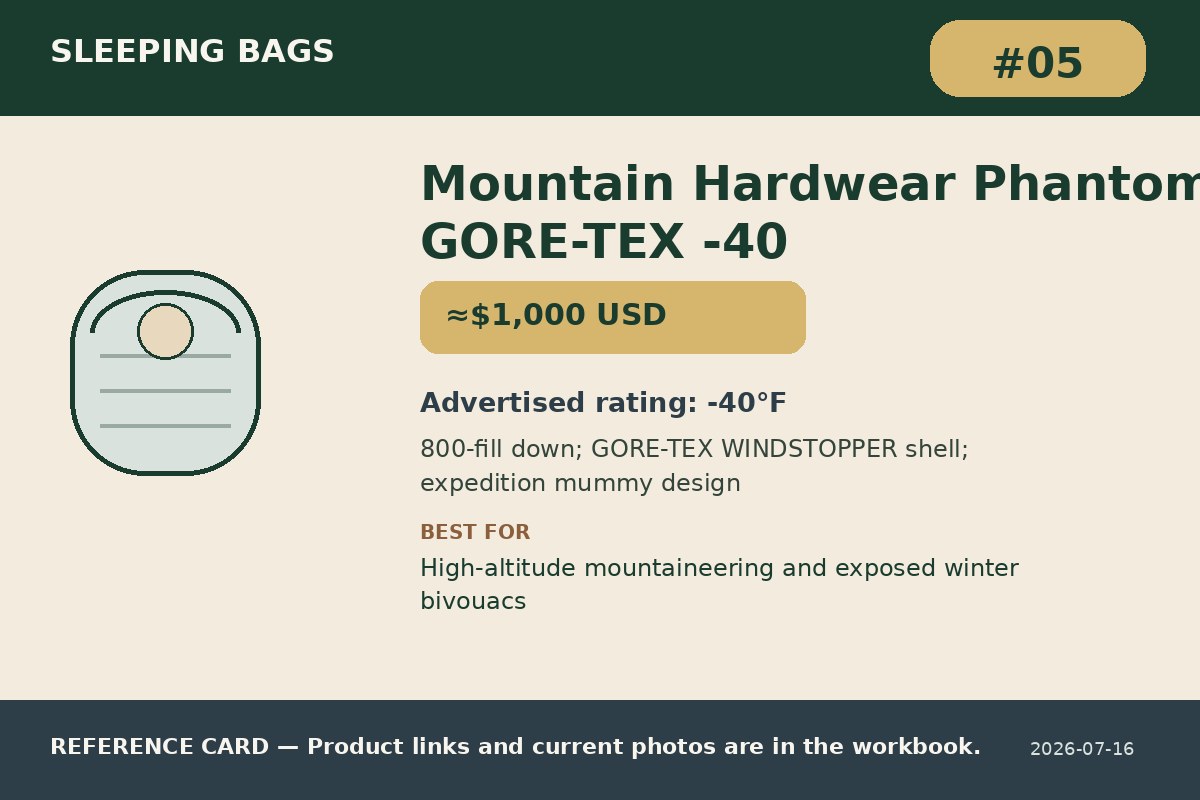
The Mountain Hardwear Phantom is an alpine-tested classic engineered for serious shoulder-season ventures, high-altitude trips, and cold-weather wilderness routes. It is constructed to bridge the gap between ultralight three-season bags and full-blown winter expedition gear, making it a reliable choice for variable alpine conditions. Insulated with high-loft 800-fill down, the Phantom focuses on thermal efficiency and moisture defense. The shell fabric features a durable water-repellent finish that handles shelter condensation and damp morning frost effectively. Independent reviewers frequently highlight its well-padded, ergonomic draft collar and insulated face gasket, both of which seal out cold air and cinch down tightly during bitter overnight drops. The Phantom's performance cut is distinctly alpine-oriented: snug around the shoulders and body to reduce dead air space that your body has to heat. Backpackers looking for a lounge-like, spacious fit might feel confined. Furthermore, the robust fabrics and heavy-duty thermal architecture push the cost upward, making it overbuilt for casual summer weekenders. **Highlights** * Reliable 800-fill down insulation built for colder environments * Well-designed draft collar and face gasket seal out severe drafts * Snug, thermally optimized mummy cut reduces air volume * Weather-resistant outer shell fabric combats frost and condensation * Contoured footbox allows natural, uncompressed foot placement **Watch-outs** * Premium pricing places it beyond casual camping budgets * Snug performance mummy cut restricts movement for larger builds * Overly warm and heavy for dedicated midsummer use
Pros
- High-efficiency 800-fill down offers excellent warmth-to-weight ratio
- Substantial draft collar and insulated face gasket seal in vital heat
- Snug alpine mummy cut eliminates cold dead air pockets
- Compresses down small relative to its high thermal rating
Cons
- Steep $780 investment limits appeal for non-winter backpackers
- Trim alpine silhouette restricts restless sleepers and broader frames
- Overbuilt and excessively hot for standard three-season trips
Best uses
- Winter backpacking expeditions
- High-altitude alpine mountaineering
- Shoulder-season cold weather routes
- Sub-zero wilderness traverses
Specifications
- Insulation
- 800-fill power down
- Target Use
- Winter and alpine backpacking
- Fit Profile
- Performance alpine mummy
- Draft Protection
- Insulated collar and face gasket
- Estimated Retail
- Approximately $780
- Key Advantage
- Maximum warmth retention per ounce
Pricing
We don't publish a price we haven't verified. The retailer links below open the live listing for this exact model.
Full catalog listing & offersBest for
Winter backpacking expeditions, High-altitude alpine mountaineering, Shoulder-season cold weather routes, Sub-zero wilderness traverses
Where to buy the Phantom
Prices and stock change often, so check the current Amazon offer before you buy.
Some links are affiliate links. Buying through them supports our testing at no extra cost to you.
The Mountain Hardwear Phantom sits in a specialized tier of alpine and sub-zero sleep systems. While conventional backpacking bags prioritize minimal weight for balmy three-season trails, the Phantom is engineered for serious cold-weather routes, mountaineering approaches, and late-season expeditions. It relies on premium 800-fill down insulation packed into a tightly engineered mummy profile, creating an aggressive warmth-to-weight balance that caters directly to cold-weather backpackers. Independent reviews across outlets like CleverHiker, GearJunkie, and Switchback Travel consistently single out the Phantom series for severe conditions. The bag pairs high-loft down with robust draft management, including an insulated face gasket and a substantial neck baffle designed to lock in core heat. It bridges the difficult divide between a packable wilderness sack and a bulky winter cocoon. That focused alpine utility comes with distinct boundaries. At approximately $780, it represents a major financial commitment, and its trim mummy cut prioritizes thermal efficiency over room to stretch. For casual summer overnighters, it is both excessive and overly restrictive, but for sustained freeze conditions, it serves as a dependable workhorse.
Who It Truly Serves
The Mountain Hardwear Phantom is not built for the casual summer trail hiker. Instead, it targets mountaineers, shoulder-season backpackers, and winter trekkers who routinely face freezing or sub-freezing temperatures. In these environments, dead air inside a sleeping bag is a liability that demands precious body heat to warm. The Phantom serves users who prioritize pure thermal safety and compactness when night falls in exposed, high-altitude camps. If your calendar revolves around balmy July outings along the Appalachian Trail, the insulation and cost will be massive overkill. However, for guides, alpine climbers, and committed four-season adventurers traversing snowfields or windy ridgelines, the bag provides a reliable buffer against volatile mountain weather without overwhelming an internal frame pack.
Materials and Down Quality
At the core of the Phantom is 800-fill power down, selected to maximize loft while remaining compressible inside a haul pack. Mountain Hardwear wraps this insulation in a lightweight, tightly woven shell fabric treated with a durable water-repellent finish. In alpine environments, moisture often threatens down from two sides: condensation dripping from single-wall tent ceilings and body vapor accumulating within the lining. The Phantom’s shell provides enough resistance to shed frost and minor tent drips before moisture can compromise the down clusters beneath. The baffling structure is engineered to prevent down migration across key zones like the chest and lower back, ensuring that cold spots do not develop when sleepers shift positions over uneven, frozen ground.
Thermal Architecture and Draft Control
What separates serious cold-weather bags from standard three-season models is their ability to trap air around the neck and face. The Phantom incorporates a heavily filled, contoured draft collar alongside an integrated face gasket. When the thermometer plunges, cinching the hood creates an enclosed microclimate that prevents the bellows effect—the accidental flushing out of warm air when shifting inside the bag. The zipper is backed by a full-length insulated draft tube, mitigating heat loss along the bag’s side seam and preventing fabric snags during middle-of-the-night adjustments. Reviewers consistently note that these comprehensive draft barriers allow the bag to maintain warmth efficiently, even in sustained freezing conditions that overwhelm lesser designs.
Fit and Interior Space
The cut of the Phantom is explicitly tailored for alpine efficiency, meaning it features an aggressive mummy silhouette. The internal dimensions stay close to the body through the torso and thighs, minimizing the volume of empty space your core needs to heat. At the lower end, an anatomically shaped footbox provides enough volume for feet to rest naturally upright without pressing against the shell, which prevents compression of the down in a vulnerable extremity zone. However, broad-shouldered individuals or active side-sleepers who roll aggressively may find the fit somewhat confining. There is minimal surplus space to store bulky boot liners or water filters inside the bag without creating uncomfortable tension against the zipper and baffles.
Alternatives and Market Context
Priced around $780, the Phantom operates in a premium bracket alongside cold-weather flagships from Western Mountaineering and Feathered Friends. Offerings like the Western Mountaineering Antelope or Kodiak are legendary benchmarks in this price class, often praised for exceptional craftsmanship and continuous baffling. The Phantom differentiates itself with a modern, technical cut and Mountain Hardwear’s specialized alpine pedigree. Against more mass-market competitors like the Marmot Never Summer, the Phantom commands a notable price premium but delivers a much higher warmth-to-weight ratio and superior packability via its 800-fill down. If budget is paramount, heavier duck-down bags exist, but for weight-sensitive winter pursuits, the Phantom remains a potent contender.
Longevity and Real-World Trade-Offs
Relying on high-loft down and lightweight technical fabrics requires disciplined maintenance in the field and at home. While the Phantom's shell handles frost and incidental friction well, ultralight face fabrics remain susceptible to abrasion from sharp gear, crampons, or rough bivy platforms. Proper storage in an uncompressed cotton sack is mandatory to maintain the 800-fill power's structural resilience over multiple seasons. The primary trade-off is versatility: this is an uncompromising cold-weather tool. It cannot be easily unzipped into a flat quilt for mild evenings, and using it in temperate weather guarantees sweat-soaked misery. For its intended winter remit, however, the construction offers proven longevity when treated with the care high-end alpine equipment demands.
How we picked
We started with a long list of backpacking sleeping bags that people actually buy, cut anything that could not clear our baseline for durability and field performance, then ranked the 10 that were left against the same criteria. Rankings are editorial. No brand pays for placement, and affiliate links never move a pick up or down.
- Load carriage
- How the suspension handles the loads the pack is actually rated for, over long days.
- Real-world durability
- How the material, stitching, or steel holds up after a season of hard use — not how it looks new.
- Performance in bad conditions
- Wind, rain, cold, and grit are the test. Anything that only works on a nice day gets marked down.
- Weight and packability
- Every ounce has to earn its place in the pack, but not at the cost of something that fails in the field.
- Ease of use
- Setup, adjustment, and maintenance with cold hands, in the dark, without the manual.
- Value at its price point
- Compared against the closest competitors in the same tier, not against cheaper gear in a different class.
Phantom — frequently asked questions
- Is the Phantom worth it?
- We rank it #6 in Backpacking Sleeping Bags. The Mountain Hardwear Phantom is an alpine-tested classic engineered for serious shoulder-season ventures, high-altitude trips, and cold-weather wilderness routes. It is constructed to bridge the gap between ultralight three-season bags and full-blown winter expedition gear, making it a reliable choice for variable…
- What is the Phantom best for?
- Best for winter backpacking expeditions, high-altitude alpine mountaineering, shoulder-season cold weather routes and sub-zero wilderness traverses. Standouts: high-efficiency 800-fill down offers excellent warmth-to-weight ratio and substantial draft collar and insulated face gasket seal in vital heat.
- What are the downsides of the Phantom?
- Steep $780 investment limits appeal for non-winter backpackers, Trim alpine silhouette restricts restless sleepers and broader frames and Overbuilt and excessively hot for standard three-season trips.
- What are the key specs of the Phantom?
- Insulation: 800-fill power down · Target Use: Winter and alpine backpacking · Fit Profile: Performance alpine mummy · Draft Protection: Insulated collar and face gasket · Estimated Retail: Approximately $780
- Who It Truly Serves?
- The Mountain Hardwear Phantom is not built for the casual summer trail hiker. Instead, it targets mountaineers, shoulder-season backpackers, and winter trekkers who routinely face freezing or sub-freezing temperatures.
- Materials and Down Quality — what should I know about the Phantom?
- At the core of the Phantom is 800-fill power down, selected to maximize loft while remaining compressible inside a haul pack. Mountain Hardwear wraps this insulation in a lightweight, tightly woven shell fabric treated with a durable water-repellent finish.
Compare side by side
Put the Phantom against any other pick on this list — specs, price, pros, cons and reader ratings.