


Reader rating
Rate it and you move it. Community ratings re-rank this product inside its Top 10 list.
Expert-picked, reader-ranked. Our editors choose the products and the launch order; member star ratings move picks up or down over time.
Heat-resistant pick: 100% Kevlar braid that won't melt near a fire.
Pros
- Will not melt, soften, or fuse when rigged near flames or flying embers
- Extreme tensile capacity in an ultra-thin, low-pack-volume diameter
- Near-zero elongation keeps tarps drum-tight throughout wet storms
- Polyurethane navy coating shields internal fibers from rapid UV decay
Cons
- Quickly dulls plain-edge camp knives unless cut with serrations or shears
- Slick surface requires deliberate, multi-wrap knots to prevent slippage
- Lacks elasticity to absorb sudden heavy shock loads without stressing anchors
Best uses
- Campfire Dutch Oven Rigging
- Zero-Stretch Tarp Ridgelines
- Bear Bag Food Suspensions
- High-Heat Emergency Lashing
Specifications
- Fiber Type
- 100% Braided Kevlar Aramid
- Heat Tolerance
- Resists melting up to ~800°F decomposition point
- Stretch Rating
- Near-zero elongation under static load
- Protective Finish
- Navy blue UV- and abrasion-resistant coating
- Structure
- Dense hollow braid without inner core strands
Pricing
We don't publish a price we haven't verified. The retailer links below open the live listing for this exact model.
Best for
Campfire Dutch Oven Rigging, Zero-Stretch Tarp Ridgelines, Bear Bag Food Suspensions, High-Heat Emergency Lashing
Where to buy the Navy Blue Kevlar Cord
We don't have a direct Amazon listing on file yet — this opens an Amazon search for the exact make and model.
Some links are affiliate links. Buying through them supports our testing at no extra cost to you.
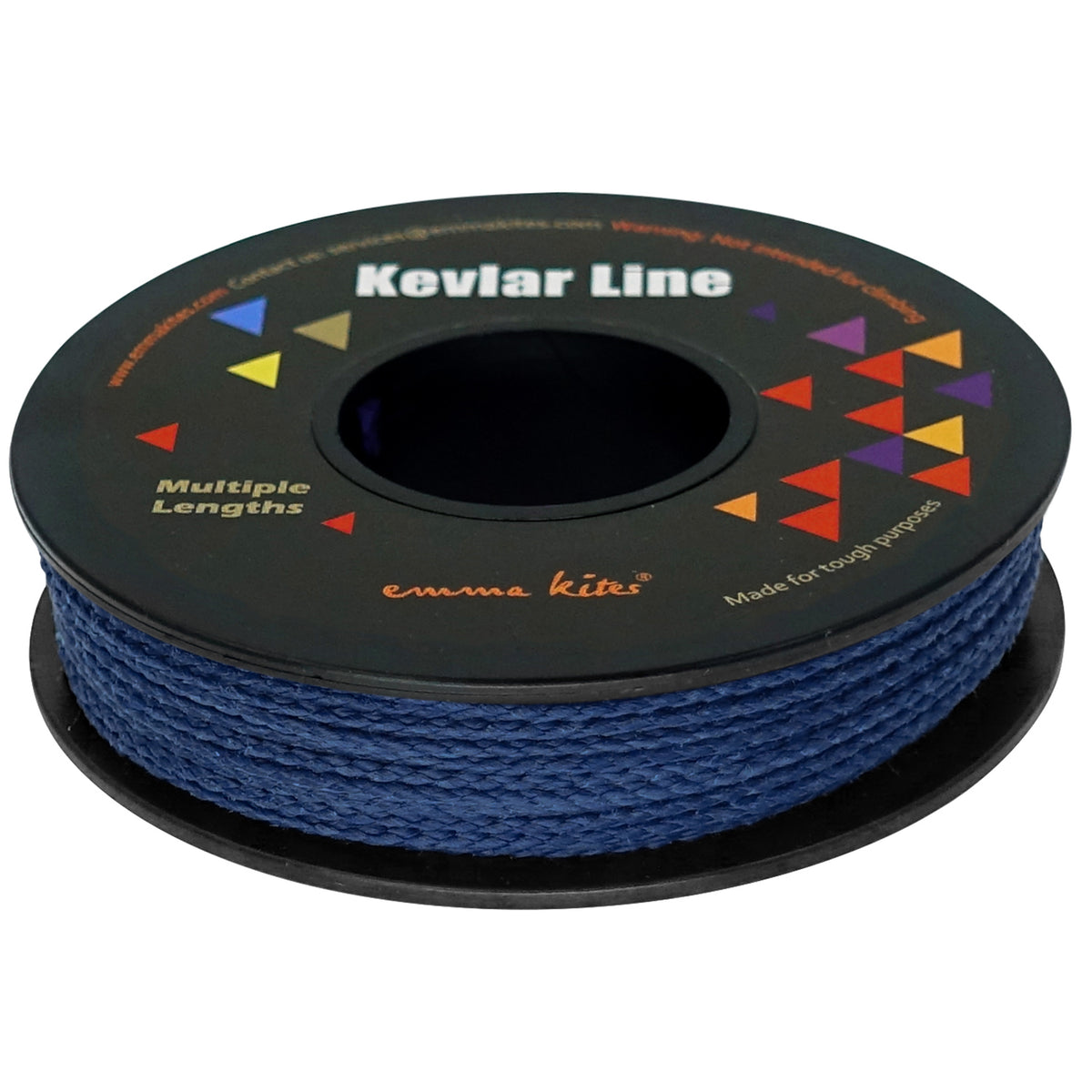
Synthetic cordage dominates modern camp kits, but standard nylon paracord and polyester utility lines share a critical flaw: they soften, stretch, and liquefy when exposed to heat. Braided aramid line solves that specific vulnerability cleanly. Built entirely from continuous-filament Kevlar fiber, this cord will not melt, drip, or fuse under sparks or high radiant heat, charring only when temperatures climb past eight hundred degrees Fahrenheit. That makes it the premier choice for pot hangers, grill-suspension lines, and fire-pit tarp tie-outs where conventional cords fail catastrophically. EMMA KITES treatments add a dark navy blue polyurethane bath to the raw golden aramid, which serves two practical field purposes. It tames the frayed, fibrous texture of bare braided Kevlar to improve knot handling, and it shields the underlying fibers from ultraviolet light, which notoriously degrades natural aramid. The line offers astronomical tensile strength for a cord thinner than a stick of standard pencil lead, packing flat spools into the smallest kit pockets with negligible weight. Living with aramid requires adjusting field habits. It provides virtually zero elongation, transferring shock directly to stakes and anchor points rather than absorbing it. Slicing it cleanly in the woods also ruins common pocketknife edges in short order without a serrated blade or dedicated shears. For dedicated backcountry crafters who understand its mechanical quirks, however, it remains an indispensable specialized tool.
Thermal Performance at the Fire
Suspending cooking gear or stringing windbreaks near an open fire pit routinely destroys standard nylon cordage, which weakens at temperatures as low as two hundred degrees and melts into molten beads shortly after. This braided aramid behaves entirely differently. When hit by drifting embers or placed directly above a cooking fire to hang a titanium pot, the fiber maintains structural integrity without softening or stretching. It will eventually decompose and char into inert carbon dust once exposed to temperatures beyond eight hundred degrees Fahrenheit, but it never forms the dangerous, sticky liquid drops characteristic of polyester and nylon. That thermal threshold allows you to rig closer to heat sources, utilize greenwood tripods over open flames without wire, and secure reflective fire tarps without fear of radiant heat collapsing your shelter in the middle of the night.
Tensile Muscle in Micro Diameters
The strength-to-diameter ratio of aramid cordage changes how you pack a repair and rigging kit. At diameters where common bank line or paracord might hold fifty to one hundred pounds, braided Kevlar safely manages multiple times that load with virtually zero noticeable bulk. The compact footprint means a fifty-foot spool occupies less pocket space than a box of stormproof matches, yet it can haul heavy dry bags into bear hangs without breaking a strand. Because the braid is dense and uniform, it runs smoothly over branch forks with minimal surface friction, resisting the internal friction burn that often compromises nylon when pulled hard over rough bark. It also shrugs off pinch points in hardware, holding form under high tension where softer sheath-and-core utility cords flatten, slip, and jam inside tight tensioners.
Handling, Cutting, and Knots
Working with aramid cordage in the field exposes its distinct mechanical trade-offs. The ultra-high-tenacity fibers are notoriously tough on plain-edge knives; sawing through this braid with a standard carbon or stainless pocket blade will dull the edge quickly and leave a frayed, messy tail. A micro-serrated blade, trauma shears, or a dedicated line cutter is essential for clean work. Knotting also requires careful selection. The stiff, slick surface does not grip against itself as cooperatively as tarred twine, meaning casual square knots or single half-hitches will creep and pull free under load. To lock tension reliably, you must lean on multi-turn friction hitches, such as the Blake's hitch, taut-line hitch with an extra wrap, or a carefully dressed figure-eight on a bight, which lock down cleanly without jamming irreparably under extreme load.
UV Defense and Environmental Durability
Natural, untreated Kevlar carries an Achilles' heel: ultraviolet radiation rapidly breaks down its chemical bonds, turning the bright yellow fibers brittle and weak after extended exposure to direct sunlight. EMMA KITES counters this vulnerability by saturating the braid in a dark navy blue polyurethane pigment. The dark coating creates a physical barrier against sunlight, vastly extending the operational lifespan of semi-permanent shelter tie-outs and drying lines left pitched for weeks. The coating also seals the exterior against moisture ingress, preventing the line from absorbing water, freezing stiff in sub-zero winter camps, or holding grit that could grind down the core. While still less UV-stable over multi-year setups than premium marine-grade polyester, the colored barrier turns an otherwise fragile aerospace fiber into a dependable, weather-hardy outdoor supply.
Comparative Trade-offs and Value
At this price bracket, outdoor cordage choices generally split between tarred nylon bank line, traditional 550 paracord, and ultra-high-molecular-weight polyethylene lines like Dyneema. Dyneema matches or exceeds Kevlar for raw strength-to-weight and boasts superior chemical slickness, but it shares nylon's fatal weakness of melting at low temperatures, making it useless around campfires. Tarred bank line handles knots more intuitively and costs less, but it weighs considerably more, bulks up quickly on a spool, and burns readily. The navy braided Kevlar sits in a distinct operational sweet spot: lighter and thinner than paracord, tougher and more heat-tolerant than Dyneema, and cleaner to handle than oily bank line. If campfire safety and zero-stretch performance matter more than casual knife-cutting convenience, it justifies its specialized spot in your pack.
How we chose
We compared widely available cordage by type using maker specifications, retailer listings and published reviews, then ranked 10 against the same criteria below. This is desk research unless a pick is marked field tested. Rankings are editorial. No brand pays for placement, and affiliate links never move a pick up or down.
- Real-world durability
- How the material, stitching, or steel holds up after a season of hard use — not how it looks new.
- Performance in bad conditions
- Wind, rain, cold, and grit are the test. Anything that only works on a nice day gets marked down.
- Weight and packability
- Every ounce has to earn its place in the pack, but not at the cost of something that fails in the field.
- Ease of use
- Setup, adjustment, and maintenance with cold hands, in the dark, without the manual.
- Value at its price point
- Compared against the closest competitors in the same tier, not against cheaper gear in a different class.
- Repairability and support
- Field-fixable design, available parts, and a warranty the maker actually honors.
Navy Blue Kevlar Cord — frequently asked questions
- Is the Navy Blue Kevlar Cord worth it?
- We rank it #6 in Cordage by Type. Heat-resistant pick: 100% Kevlar braid that won't melt near a fire.
- What is the Navy Blue Kevlar Cord best for?
- Best for campfire dutch oven rigging, zero-stretch tarp ridgelines, bear bag food suspensions and high-heat emergency lashing. Standouts: will not melt, soften, or fuse when rigged near flames or flying embers and extreme tensile capacity in an ultra-thin, low-pack-volume diameter.
- What are the downsides of the Navy Blue Kevlar Cord?
- Quickly dulls plain-edge camp knives unless cut with serrations or shears, Slick surface requires deliberate, multi-wrap knots to prevent slippage and Lacks elasticity to absorb sudden heavy shock loads without stressing anchors.
- What are the key specs of the Navy Blue Kevlar Cord?
- Fiber Type: 100% Braided Kevlar Aramid · Heat Tolerance: Resists melting up to ~800°F decomposition point · Stretch Rating: Near-zero elongation under static load · Protective Finish: Navy blue UV- and abrasion-resistant coating · Structure: Dense hollow braid without inner core strands
- Thermal Performance at the Fire — what should I know about the Navy Blue Kevlar Cord?
- Suspending cooking gear or stringing windbreaks near an open fire pit routinely destroys standard nylon cordage, which weakens at temperatures as low as two hundred degrees and melts into molten beads shortly after. This braided aramid behaves entirely differently.
- Tensile Muscle in Micro Diameters — what should I know about the Navy Blue Kevlar Cord?
- The strength-to-diameter ratio of aramid cordage changes how you pack a repair and rigging kit. At diameters where common bank line or paracord might hold fifty to one hundred pounds, braided Kevlar safely manages multiple times that load with virtually zero noticeable bulk.
Compare side by side
Put the Navy Blue Kevlar Cord against any other pick on this list — specs, price, pros, cons and reader ratings.