


Reader rating
Rate it and you move it. Community ratings re-rank this product inside its Top 10 list.
Expert-picked, reader-ranked. Our editors choose the products and the launch order; member star ratings move picks up or down over time.
Best for cold, wet walking hunts: fleece-lined neoprene with a mud-shedding tread.
Pros
- Anatomical heel pocket prevents slippage and blisters during long hikes
- Wide-spaced lug pattern drops sticky clay rather than packing out
- High vulcanized rubber rand defends against thorns and sharp stumps
- Fleece-lined interior provides reliable warmth in freezing water
Cons
- Tight ankle construction makes pulling the boot off difficult
- Heavier and bulkier to pack than unreinforced rubber boots
- Lacks an adjustable calf gusset for very thick hunting bibs
Best uses
- Flooded timber deer stalks
- Freezing marsh waterfowl retrieves
- Cold weather creek crossings
- Navigating slick clay gumbo
Specifications
- Primary Material
- Vulcanized rubber over insulated neoprene
- Lining
- High-loft microfleece interior
- Outsole
- Self-cleaning multidirectional mud lugs
- Shaft Height
- Over-the-calf knee height
- Heel Structure
- Locked anatomical ankle pocket
- Intended Season
- Mid to late season cold and wet
Pricing
We don't publish a price we haven't verified. The retailer links below open the live listing for this exact model.
Best for
Flooded timber deer stalks, Freezing marsh waterfowl retrieves, Cold weather creek crossings, Navigating slick clay gumbo
Where to buy the KUIU HD Mud Boot
We don't have a direct Amazon listing on file yet — this opens an Amazon search for the exact make and model.
Some links are affiliate links. Buying through them supports our testing at no extra cost to you.
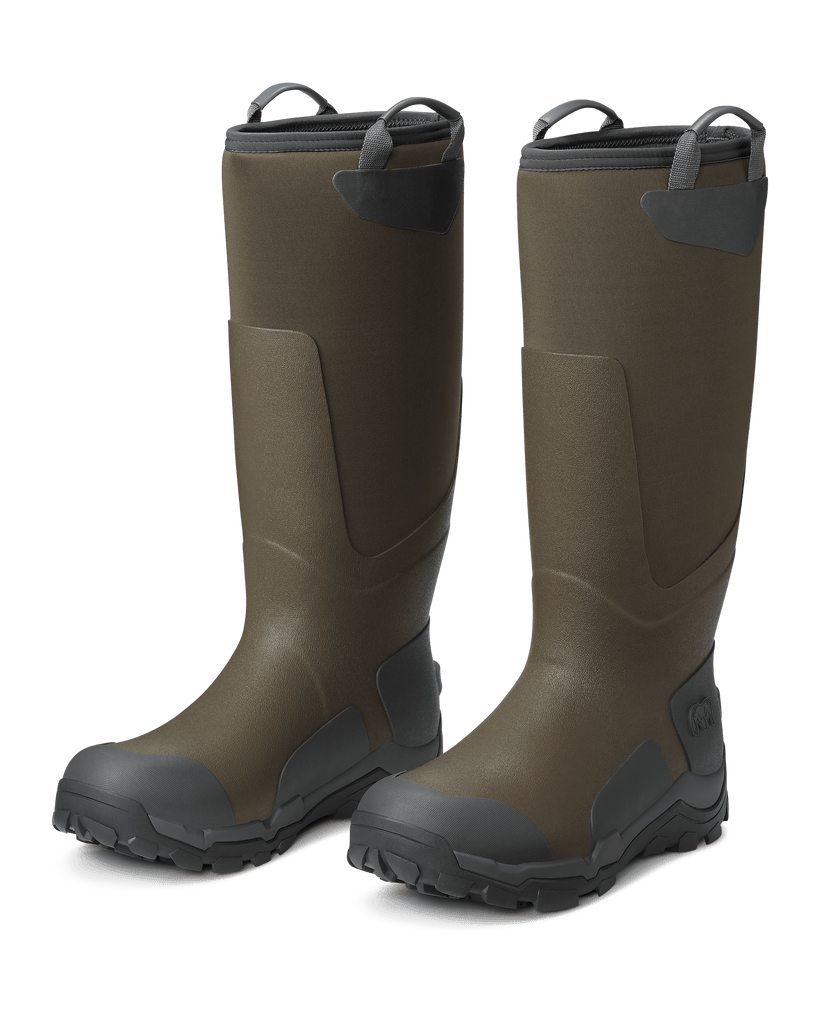
Rubber boots have a well-earned reputation for sloppy fits and blistered heels the moment a hunter moves past a flat farm track. KUIU designed this boot to counter that exact problem, creating a vulcanized rubber and neoprene slip-on that behaves more like an athletic hunting boot than a floppy muck shoe. By tapering the ankle and carving out a precise heel pocket, it eliminates the slop that typically exhausts leg muscles when navigating deep tidal flats, flooded river bottoms, and greasy clay hillsides. The boot pairs an insulating neoprene core with a high-pile fleece lining that buffers against icy water, sleet, and freezing mud. While not built for all-day stationary sits in sub-zero late seasons, it handles active cold-weather wading with composure. It provides high-traction mobility for hunters who refuse to trade dry legs for poor foot control.
Anatomical Fit and Stride
Traditional pull-on rubber boots leave excess volume around the instep and heel, causing your foot to slide forward on descents and lift with every step. Here, the internal last mirrors a supportive mountain boot. The ankle is pinched tightly to secure the calcaneus, which prevents your heel from rubbing raw during multi-mile hikes across saturated river flats. The toe box still allows enough wiggle room for blood circulation and heavy merino socks. Because the ankle pocket is deliberately tight, getting the boot on and off requires a dedicated yank on the pull loops, but that snug construction pays immediate dividends in technical terrain by preventing the suction of deep bogs from stealing your footwear mid-stride.
Thermal Performance in Motion
A fleece-lined neoprene upper provides immediate warmth when breaking skin ice on flooded timber edges or wading beaver runs. For dynamic hunts, where walking comprises half the day, the insulation package hits a sweet spot from freezing up to roughly forty-five degrees Fahrenheit. The fleece interior wicks vapor away from thin base socks, preventing cold sweat accumulation during hard pushes. That said, it is not a heavy-insulation stationary pac boot. Sit in a frozen treestand in November for four hours without moving, and the chill from the soil will eventually seep through the rubber sole. It excels when your legs are pumping and generating internal heat.
Outsole and Mud Clearance
Traction in saturated, heavy clay makes or breaks a rubber boot. Instead of narrow, shallow siping that traps soil, the outsole features widely spaced, perimeter-wrapped lugs with aggressive bevels. Heavy gumbo and sod release naturally as the rubber flexes across each step rather than building into five-pound mud bricks underfoot. A reinforced shank provides torsional stability, letting you dig edges into steep river cutbanks without the boot twisting out from underneath your foot. On slick wet logs and submerged river rocks, the rubber compound grips reliably without feeling overly hard or skating like plastic.
Durability and Armor
Punctures from hidden beaver puncheons, barbwire, and greenbrier vines are the death of standard neoprene boots. Heavy vulcanized rubber cladding wraps high up the shaft, covering vulnerable lower-leg areas before transitioning to bare neoprene near the calf collar. The toe cap and heel counter receive double-layered overlays to fend off abrasion from sharp river gravel and flint shards. After extensive miles through brushy river bottoms, the external seams hold tight without delaminating at the flex points. The pull loops are reinforced into the collar hem, showing no signs of tearing loose even after hard yanks with wet, muddy hands.
Weight and Field Realities
This is a substantial boot built with heavy protective foxing, meaning it carries real mass. You will feel that weight on four-mile marsh treks, though the balanced, locked-in fit distributes the burden far better than lighter, sloppy boots that flap against your shins. Packing these into a spike camp requires dedicated planning; the rigid sole and structured rubber lower cannot be compressed, folded, or rolled down like flimsy farm gumboots. They occupy significant volume in a gear duffel and are best worn on your feet during transit rather than stuffed inside a pack.
Market Context and Alternatives
In the premium rubber hunting category, the primary comparison is the classic LaCrosse AlphaBurly Pro. The LaCrosse offers an adjustable gusset that accommodates larger calves more readily, making it easier to vent or tuck bulky insulated bibs. However, KUIU delivers a noticeably stiffer chassis and far better lateral stability on sidehills. If your hunts consist of flat strolls to a deer stand, cheaper options from Muck Boot or generic farm brands will suffice. If you regularly hunt saturated bottomlands where slipping, ankle rolling, or boot suction is a constant hazard, the athletic stability here justifies the steeper investment.
How we chose
We compared widely available rubber hunting boots using maker specifications, retailer listings and published reviews, then ranked 10 against the same criteria below. This is desk research unless a pick is marked field tested. Rankings are editorial. No brand pays for placement, and affiliate links never move a pick up or down.
- Fabric behavior over time
- Breathability, DWR life, loft retention, and how the piece performs after repeated washing.
- Real-world durability
- How the material, stitching, or steel holds up after a season of hard use — not how it looks new.
- Performance in bad conditions
- Wind, rain, cold, and grit are the test. Anything that only works on a nice day gets marked down.
- Weight and packability
- Every ounce has to earn its place in the pack, but not at the cost of something that fails in the field.
- Ease of use
- Setup, adjustment, and maintenance with cold hands, in the dark, without the manual.
- Value at its price point
- Compared against the closest competitors in the same tier, not against cheaper gear in a different class.
KUIU HD Mud Boot — frequently asked questions
- Is the KUIU HD Mud Boot worth it?
- We rank it #3 in Rubber Hunting Boots. Best for cold, wet walking hunts: fleece-lined neoprene with a mud-shedding tread.
- What is the KUIU HD Mud Boot best for?
- Best for flooded timber deer stalks, freezing marsh waterfowl retrieves, cold weather creek crossings and navigating slick clay gumbo. Standouts: anatomical heel pocket prevents slippage and blisters during long hikes and wide-spaced lug pattern drops sticky clay rather than packing out.
- What are the downsides of the KUIU HD Mud Boot?
- Tight ankle construction makes pulling the boot off difficult, Heavier and bulkier to pack than unreinforced rubber boots and Lacks an adjustable calf gusset for very thick hunting bibs.
- What are the key specs of the KUIU HD Mud Boot?
- Primary Material: Vulcanized rubber over insulated neoprene · Lining: High-loft microfleece interior · Outsole: Self-cleaning multidirectional mud lugs · Shaft Height: Over-the-calf knee height · Heel Structure: Locked anatomical ankle pocket
- Anatomical Fit and Stride — what should I know about the KUIU HD Mud Boot?
- Traditional pull-on rubber boots leave excess volume around the instep and heel, causing your foot to slide forward on descents and lift with every step. Here, the internal last mirrors a supportive mountain boot.
- Thermal Performance in Motion — what should I know about the KUIU HD Mud Boot?
- A fleece-lined neoprene upper provides immediate warmth when breaking skin ice on flooded timber edges or wading beaver runs. For dynamic hunts, where walking comprises half the day, the insulation package hits a sweet spot from freezing up to roughly forty-five degrees Fahrenheit.
Compare side by side
Put the KUIU HD Mud Boot against any other pick on this list — specs, price, pros, cons and reader ratings.