Who this is for: hunters, farmers and anyone working marsh, creek bottoms, muddy fields or wet timber, where leather boots soak through. We compared ten tall men's rubber boots using each brand's own product page: shaft height, insulation, lining, outsole, listed weight and price. This is desk research from manufacturer specifications, not a field test. Prices were checked November 10, 2026 and stock varies by size. Pick insulation by how much you move: heavy gram ratings or thick neoprene suit cold stands and blinds, while thinner neoprene suits walking hunts and early season.
Quick picks
Shop links open Wild10 checkout products. External affiliate links may earn us a commission, at no extra cost to you.
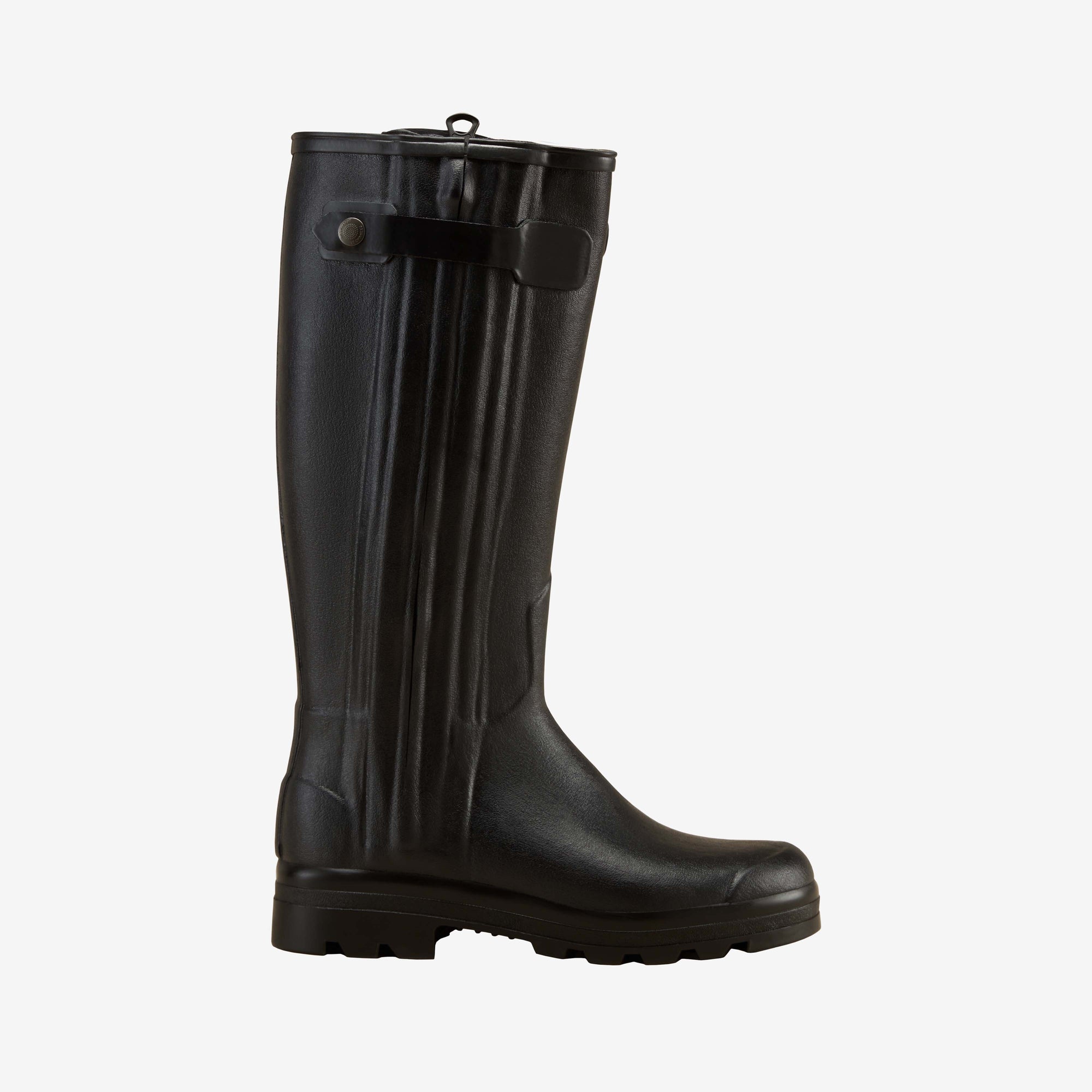
Rubber boots usually force a cruel compromise in freezing conditions: sweat out your socks during the hike in, then suffer through numbing cold thirty minutes into a treestand vigil. This heavy-duty build solves that exact dilemma for late-season hunters who require complete scent suppression alongside uncompromising warmth. It is engineered specifically for sub-freezing temperatures where lighter rubber options fail completely, providing an impenetrable shield against wind, slush, and standing swamp water.
LaCrosse achieves this level of warmth by encasing a dense 3.5-millimeter neoprene core inside premium hand-laid rubber, then backing it with a massive 1600-gram layer of Thinsulate Ultra. The package feels substantial on the foot, but it delivers on its promise. Instead of brittle, stiff rubber that cracks when the mercury drops, the exterior compound stays pliable enough to walk naturally, while the embossed interior lining helps circulate air to manage interior sweat.
If your hunting style involves active still-hunting across steep ridges or trekking three miles over dry prairie, look elsewhere. But for stationary vigils in snow, muck, and biting northern winds, it provides a fortress-like barrier that lets you sit longer when mature bucks are finally on their feet.
Where it fits
Late-season treestand deer hunting
Stationary waterfowl blind vigils
Sub-zero winter predator calling
Midwestern late-muzzleloader sits
Pros
Uncompromising thermal warmth for motionless sits in deep sub-freezing temperatures
Ankle-Fit design locks the heel down to minimize blisters on long approaches
Adjustable rear gusset easily accommodates heavy winter bibs and muscular calves
Supple natural rubber exterior stays flexible and quiet in sub-zero conditions
Cons
Heavy build creates noticeable leg fatigue on walks exceeding one mile
Generates excessive internal moisture if worn in temperatures above freezing
Dense insulation takes significant time to dry out without a dedicated boot dryer
The centerpiece here is the 1600-gram Thinsulate Ultra package, which positions this boot at the far extreme of cold-weather protection. Unlike uninsulated rubber boots that pull heat straight out through the sole, the thick footbed and wrapped insulation isolate your foot from frozen metal treestand platforms. The interior neoprene sleeve adds an auxiliary layer of dead-air insulation while remaining soft against the shin. The challenge with this much thermal mass is moisture management during transit. If you walk fast to your stand, your feet will sweat, and that dampness can chill you later regardless of insulation. Savvy hunters hike in at a slow pace, pull their heavy wool socks up only at the base of the ladder, and let the boot's moisture-wicking liner move minor condensation away from the skin. For sits under twenty degrees Fahrenheit, this thermal package is tough to beat.
Ankle Fit and Mobility
Classic rubber boots are notorious for the dreaded heel slip, which chews through socks and causes blisters on the approach hike. LaCrosse counters this with their signature contoured Ankle-Fit design, narrowing the throat just above the heel to lock the back of your foot in place. This secure heel pocket makes the boot feel far more responsive than traditional chore-style footwear, preventing your foot from sliding forward when descending muddy creek banks. Around the calf, an adjustable rear neoprene gusset accommodates bulky insulated bibs without pinching or binding. The cam-buckle strap stays cinched once pulled tight, preventing cold drafts and swamp water from spilling in. While the boot is tall and substantial, the natural flex in the ankle prevents the clunky, wooden-leg gait common to heavily insulated winter footwear.
Traction and Mud Shedding
The Burly Pro outsole utilizes a distinct lug pattern engineered specifically for mixed hunting terrain rather than flat barnyards. Sharper, angled perimeter lugs dig into slick mud and frost-covered leaf litter, giving you steady footing when climbing greasy timber hillsides or navigating uneven marsh hummocks. The center tread features broader contact pads designed to shed sticky clay and wet snow before it clumps into heavy, traction-robbing platforms. On wet wood and slick treestand rungs, the rubber compound grips reliably without making loud squeaking noises that could alert nearby game. The sole also incorporates a fiberglass shank through the midfoot, offering enough torsional rigidity to keep your arches from aching when standing for hours on narrow metal bars or uneven frozen ground.
Weight and Walking Penalty
No boot carrying 1600 grams of insulation and heavy-gauge vulcanized rubber comes light. Tipping the scales at well over five pounds for the pair, these boots make their presence known with every step. You will feel that mass after a mile of slogging through deep mud, marsh muck, or drifted snow. This is not the footwear for run-and-gun turkey hunting or covering endless terrain on western upland hunts. The sheer bulk also limits pedal feel if you are driving an ATV or truck to your hunting location. However, that heft is a deliberate, necessary tradeoff for the extreme warmth provided. If your routine consists of a half-mile trek through wet bottomland followed by four motionless hours in an open blind, the weight is an acceptable tax for all-day comfort.
Field Durability and Care
Hand-laid natural rubber coats the exterior, shielding the inner neoprene from puncture hazards like greenbrier, blackberry thorns, and sharp submerged stubble. Natural rubber remains supple in bitter cold, meaning it resists the flex-point cracking that routinely ruins cheap PVC or synthetic boots after a single hard winter. The seams are vulcanized and reinforced at high-stress junctions around the toe cap and heel counter. To maximize lifespan, these boots demand basic routine maintenance. Storing them in a hot garage or leaving them caked in dry dirt accelerates rubber oxidation. Rinsing off mud with clean water and applying a silicone-based rubber conditioner once or twice a season keeps the outer shell supple. If you sweat heavily, putting them on a non-heated boot dryer overnight ensures the thick lining dries fully between sits.
The Competitive Landscape
Against direct rivals like the Muck Arctic Pro, this boot holds a distinct advantage in ankle security and calf adjustability. Muck relies entirely on a stretch-to-fit neoprene collar that can feel overly tight on thick calves or wear down quickly at the seams. LaCrosse's buckled rear gusset handles layering over heavy winter pants far better. On the other hand, hunters operating mostly in temperatures hovering around the freezing mark may find the 1600-gram model excessive, making the lighter Alphaburly 800-gram variant a smarter, less fatiguing middle ground. But when evaluated purely as a weapon against true late-season arctic cold, this heavy-hitter easily outclasses lighter competitors by keeping blood flowing to your toes long after other hunters have packed up and headed for the truck.
As an Amazon Associate, Wild10 earns from qualifying purchases.
No ratings yet
Pick 02Research-based review
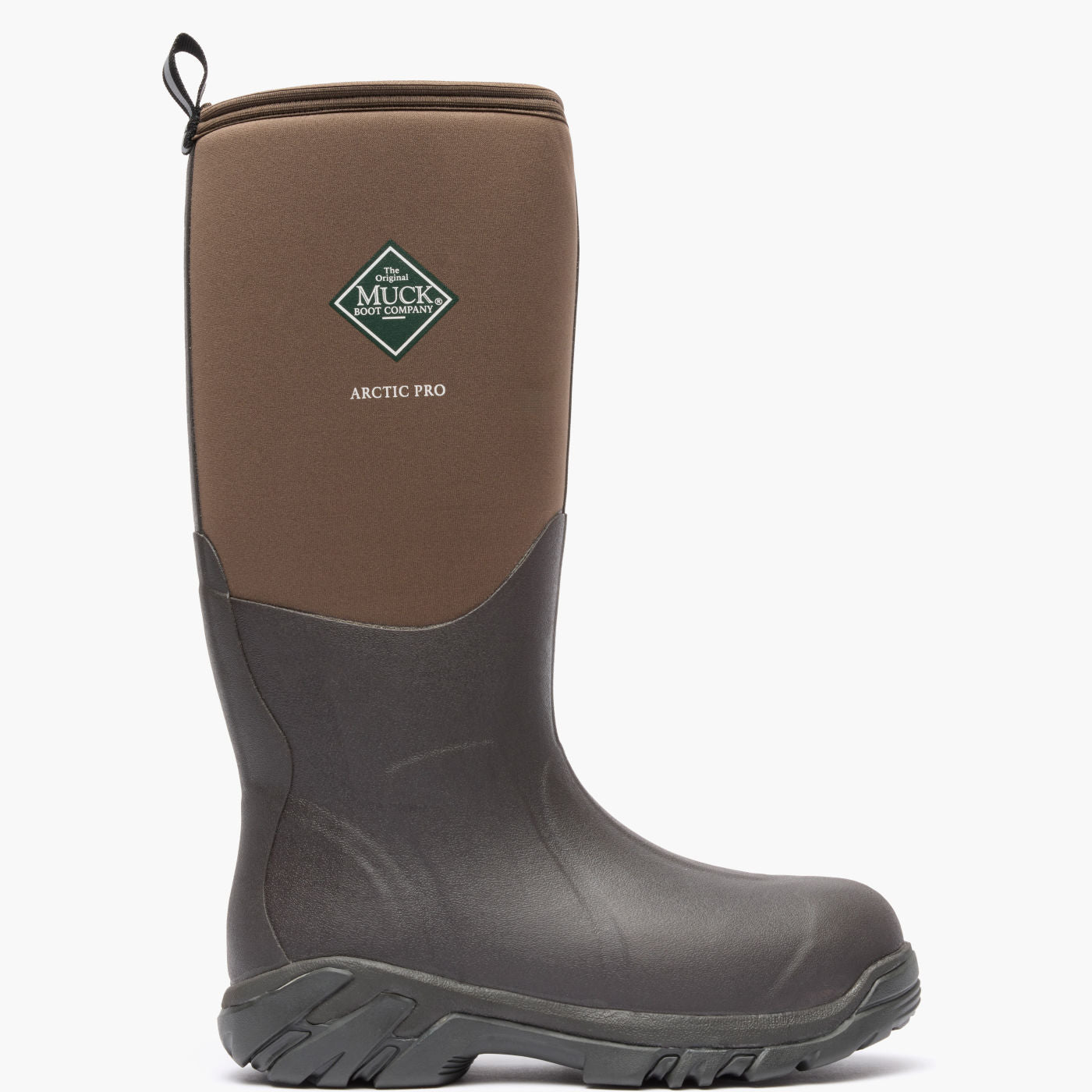
Men's Arctic Pro Insulated Boot
The Original Muck Boot Company
Men's Arctic Pro Insulated Boot
The Original Muck Boot Company
Insulation
8mm neoprene with fleece lining
Footbed Barrier
2mm thermal foam underlay
Outsole
Molded Bob-Tracker lugged rubber
Shaft Material
Extended rubber overlay and flexible neoprene
Collar Style
Snug stretch-fit topline binding
Waterproof Rating
100% waterproof to top of shaft
When mid-November gives way to deep January freezes, standard uninsulated or lightly lined rubber boots become liability traps. Sitting motionless on a frigid metal tree stand platform strips warmth through the soles faster than most hunters anticipate. The Original Muck Boot Company designed the Arctic Pro specifically to solve that dead-stop cold issue, combining high-grade vulcanized rubber with an exceptionally thick insulating core.
At the heart of the design is an 8mm neoprene inner bootie backed by a soft fleece lining and a 2mm thermal foam underlay nestled beneath the footbed. This construction creates an impermeable, heavy-duty barrier that traps body heat while locking out sub-zero slush, standing water, and biting wind. The stretch-fit collar hugs the calf to retain rising warmth and keep falling snow out of the shaft.
While this heavy build makes the boot an absolute powerhouse for stationary vigils, it demands a deliberate compromise on mobility. The generous profile and substantial weight will wear on your legs during long mountain pack-ins. For hunters who prioritize pure thermal defense during sub-zero stakeouts over nimble mountain pacing, this boot remains a benchmark workhorse.
Where it fits
Late-Season Treestand Sits
Hardwater Ice Fishing
Sub-Zero Box Blind Hunts
Winter Farm and Trail Chores
Pros
Uncompromising dead-of-winter warmth built for motionless cold-weather sits
Thick underfoot thermal barrier stops conductive heat loss from frozen steel
Closed-cell neoprene construction resists packing out over repeated seasons
Self-cleaning lug outsole delivers dependable traction in deep muck and slush
Cons
Heavy build causes noticeable leg fatigue on walks exceeding two miles
Exposed upper neoprene remains vulnerable to tears from thorns and wire
Quickly traps foot perspiration if worn during high-exertion hikes
The primary reason hunters reach for this boot is pure thermal mass. Most insulated hunting boots rely on synthetic fills packed around the foot, but here the entire chassis is formed from 8mm neoprene encased in a vulcanized rubber shield. That thick foam wall delivers uniform insulation across the toes, instep, and lower shin, eliminating the cold spots common in multi-seam stitched boots. Crucially, the maker inserted a 2mm thermal barrier under the footbed to cut off conductive heat loss. When standing on frozen soil, snow-packed logs, or bare steel treestand grates for five uninterrupted hours, that underfoot barrier makes the difference between maintaining sensation in your toes and cutting the sit short. The fleece lining accelerates warmth build-up, though it also means managing internal moisture requires disciplined wool sock selection.
Shaft Ergonomics and Calf Fit
Pulling this boot on reveals a distinct contrast between the rigid rubber lower and the pliable neoprene upper. The high rubber coverage runs well up the calf before transitioning to raw neoprene, providing rigid protection against punctures while allowing the shaft to flex with each stride. The topline collar features a heavy stretch binding designed to gather snugly around the calf or over thick base layers. This seal effectively keeps out drifting powder, burs, and freezing drafts without choking circulation. However, hunters with particularly large calves may find the initial squeeze tight, requiring them to roll the neoprene down slightly before stepping into the footbed. The rear pull loop is stout enough to take full body weight when hauling the boot on over thick winter socks.
Traction Across Winter Slush and Mud
The undercarriage features the aggressive Bob-Tracker outsole, a molded lug pattern that uses wide spacing to shed packed mud, snow, and wet clay. In deep snow and muddy logging roads, the perimeter lugs bite into the terrain reliably, preventing the slick, skate-like sensation typical of shallower work boots. The rubber compound stays relatively pliable in sub-freezing temperatures, avoiding the hard plastic feel that causes slips on hidden creek ice or wet rungs of a climbing stick. While the outsole excels in soft, sloppy conditions, it does lack the sharp, biting edge control found on stiff mountain hunting boots. For flat bottomlands, soggy marsh edges, and rolling timber, the grip inspires total confidence, but sidehilling steep, frozen scree is not its native environment.
Weight and Long-Haul Mobility
Carrying an 8mm neoprene boot layered in thick vulcanized rubber incurs an undeniable weight tax. Each step requires lifting noticeable bulk, and over a two-mile hike through rolling cut-overs or knee-deep crust, that mass translates directly to leg fatigue. Rubber boots inevitably exhibit some heel slip because they lack the ankle-locking power of traditional laces, and this boot is no exception. If you hike aggressively in these, your feet will quickly sweat out the fleece lining, creating internal dampness that freezes once you finally climb up into your stand. The boot rewards the hunter who walks in at a measured, deliberate pace to prevent overheating, reserving its heavy thermal payload for the long, motionless hours that follow.
Puncture Resistance and Material Durability
The high rubber overlay does an exceptional job shielding the vulnerable foot and ankle regions from submerged sticks, broken beaver dams, and jagged rocks. The vulcanized rubber holds up against repeated bending without checking or cracking, provided it is kept clean and stored away from direct heat sources. The exposed neoprene shaft on the upper third of the boot, however, represents the predictable weak link. While neoprene provides natural flex and insulation, it is susceptible to snags from dense greenbrier, locust thorns, or barbed wire fences. Tearing the upper neoprene will not compromise the fully waterproof lower foot box, but it will ruin the clean thermal wrap. Sticking to established trails or wearing heavy brush gaiters over the shaft preserves the outer foam.
Market Context and Alternative Builds
Within the realm of sub-zero rubber footwear, the Arctic Pro squares off directly against high-ounce Thinsulate-lined rubber models like the LaCrosse Alphaburly Pro. The primary distinction lies in how the insulation behaves over time. Thinsulate-lined boots generally offer a tighter, more athletic ankle contour that reduces heel slop for longer treks, but their insulation can mat down and lose loft over seasons of hard compression. The 8mm closed-cell neoprene inside this boot cannot pack out or collapse, guaranteeing the exact same dead-air space and thermal performance year after year. For pure, brutal cold where walking is secondary to survival-level warmth during zero-degree sits, the simplicity and unrelenting thermal bulk of this platform consistently edge out narrower athletic designs.
As an Amazon Associate, Wild10 earns from qualifying purchases.
No ratings yet
Pick 03Research-based review
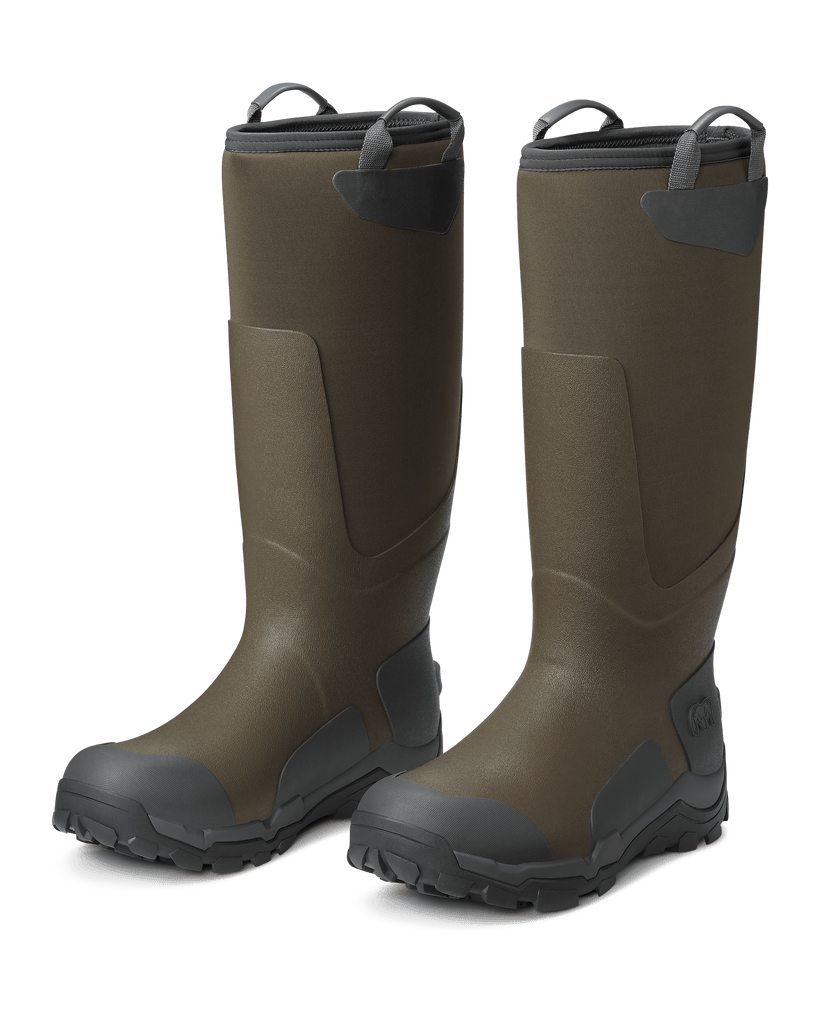
KUIU HD Mud Boot
KUIU HD Mud Boot
Primary Material
Vulcanized rubber over insulated neoprene
Lining
High-loft microfleece interior
Outsole
Self-cleaning multidirectional mud lugs
Shaft Height
Over-the-calf knee height
Heel Structure
Locked anatomical ankle pocket
Intended Season
Mid to late season cold and wet
Rubber boots have a well-earned reputation for sloppy fits and blistered heels the moment a hunter moves past a flat farm track. KUIU designed this boot to counter that exact problem, creating a vulcanized rubber and neoprene slip-on that behaves more like an athletic hunting boot than a floppy muck shoe. By tapering the ankle and carving out a precise heel pocket, it eliminates the slop that typically exhausts leg muscles when navigating deep tidal flats, flooded river bottoms, and greasy clay hillsides.
The boot pairs an insulating neoprene core with a high-pile fleece lining that buffers against icy water, sleet, and freezing mud. While not built for all-day stationary sits in sub-zero late seasons, it handles active cold-weather wading with composure. It provides high-traction mobility for hunters who refuse to trade dry legs for poor foot control.
Where it fits
Flooded timber deer stalks
Freezing marsh waterfowl retrieves
Cold weather creek crossings
Navigating slick clay gumbo
Pros
Anatomical heel pocket prevents slippage and blisters during long hikes
Wide-spaced lug pattern drops sticky clay rather than packing out
High vulcanized rubber rand defends against thorns and sharp stumps
Fleece-lined interior provides reliable warmth in freezing water
Cons
Tight ankle construction makes pulling the boot off difficult
Heavier and bulkier to pack than unreinforced rubber boots
Lacks an adjustable calf gusset for very thick hunting bibs
Traditional pull-on rubber boots leave excess volume around the instep and heel, causing your foot to slide forward on descents and lift with every step. Here, the internal last mirrors a supportive mountain boot. The ankle is pinched tightly to secure the calcaneus, which prevents your heel from rubbing raw during multi-mile hikes across saturated river flats. The toe box still allows enough wiggle room for blood circulation and heavy merino socks. Because the ankle pocket is deliberately tight, getting the boot on and off requires a dedicated yank on the pull loops, but that snug construction pays immediate dividends in technical terrain by preventing the suction of deep bogs from stealing your footwear mid-stride.
Thermal Performance in Motion
A fleece-lined neoprene upper provides immediate warmth when breaking skin ice on flooded timber edges or wading beaver runs. For dynamic hunts, where walking comprises half the day, the insulation package hits a sweet spot from freezing up to roughly forty-five degrees Fahrenheit. The fleece interior wicks vapor away from thin base socks, preventing cold sweat accumulation during hard pushes. That said, it is not a heavy-insulation stationary pac boot. Sit in a frozen treestand in November for four hours without moving, and the chill from the soil will eventually seep through the rubber sole. It excels when your legs are pumping and generating internal heat.
Outsole and Mud Clearance
Traction in saturated, heavy clay makes or breaks a rubber boot. Instead of narrow, shallow siping that traps soil, the outsole features widely spaced, perimeter-wrapped lugs with aggressive bevels. Heavy gumbo and sod release naturally as the rubber flexes across each step rather than building into five-pound mud bricks underfoot. A reinforced shank provides torsional stability, letting you dig edges into steep river cutbanks without the boot twisting out from underneath your foot. On slick wet logs and submerged river rocks, the rubber compound grips reliably without feeling overly hard or skating like plastic.
Durability and Armor
Punctures from hidden beaver puncheons, barbwire, and greenbrier vines are the death of standard neoprene boots. Heavy vulcanized rubber cladding wraps high up the shaft, covering vulnerable lower-leg areas before transitioning to bare neoprene near the calf collar. The toe cap and heel counter receive double-layered overlays to fend off abrasion from sharp river gravel and flint shards. After extensive miles through brushy river bottoms, the external seams hold tight without delaminating at the flex points. The pull loops are reinforced into the collar hem, showing no signs of tearing loose even after hard yanks with wet, muddy hands.
Weight and Field Realities
This is a substantial boot built with heavy protective foxing, meaning it carries real mass. You will feel that weight on four-mile marsh treks, though the balanced, locked-in fit distributes the burden far better than lighter, sloppy boots that flap against your shins. Packing these into a spike camp requires dedicated planning; the rigid sole and structured rubber lower cannot be compressed, folded, or rolled down like flimsy farm gumboots. They occupy significant volume in a gear duffel and are best worn on your feet during transit rather than stuffed inside a pack.
Market Context and Alternatives
In the premium rubber hunting category, the primary comparison is the classic LaCrosse AlphaBurly Pro. The LaCrosse offers an adjustable gusset that accommodates larger calves more readily, making it easier to vent or tuck bulky insulated bibs. However, KUIU delivers a noticeably stiffer chassis and far better lateral stability on sidehills. If your hunts consist of flat strolls to a deer stand, cheaper options from Muck Boot or generic farm brands will suffice. If you regularly hunt saturated bottomlands where slipping, ankle rolling, or boot suction is a constant hazard, the athletic stability here justifies the steeper investment.
As an Amazon Associate, Wild10 earns from qualifying purchases.
No ratings yet
Pick 04Research-based review
Alpha Agility 17" Brown
LaCrosse
Alpha Agility 17" Brown
LaCrosse
Shaft Height
17 inches
Insulation
5mm flexible neoprene core
Weight
Approximately 4.0 lbs per pair
Outsole
Agility multi-lug rubber
Midsole
Lightweight athletic EVA
Lining
Moisture-wicking jersey
Rubber boots have a well-earned reputation for feeling like clumsy buckets strapped to your shins. LaCrosse designed the Alpha Agility to counter that exact complaint by borrowing footbed geometry and rebound cushioning from trail running footwear, layering natural hand-laid rubber over a flexible 5mm neoprene core. The result is a knee-high boot engineered specifically for active foot travel through marshes, creek bottoms, and thick timber without inducing early-afternoon leg fatigue.
At roughly four pounds per pair, the build cuts away excess dead weight that normally drags on your hip flexors over long miles. An intentional taper around the ankle locks the heel securely into the pocket, virtually eliminating the friction slip that causes hot spots and blisters on steep sidehills or in sucking gumbo mud. It hugs the lower leg and calf like an athletic shoe rather than a sloppy barn boot.
This setup shines during early-to-mid season hunts where steady movement generates your warmth. While it lacks the heavy insulation required for all-day sits in sub-freezing treestands, it excels during active scouting, spring turkey hunting, and mobile swamp stalking where waterproof scent control needs to keep pace with your stride.
Where it fits
Spring turkey hunting across wet bottoms
Early-season whitetail scouting and hanging stands
Active swamp stalking where scent control matters
Navigating muddy agricultural fields on foot
Pros
Lightweight construction drastically cuts down on leg fatigue over long walking hunts
Athletic heel pocket locks the foot in place to stop blisters before they start
Flexible EVA midsole provides quiet, shock-absorbing stride mechanics in timber
Aggressive lug design sheds soft mud while gripping greasy creek banks
Cons
Tight ankle taper makes the boot stubborn to pull off without a boot jack
Exposed upper neoprene can snag on dense thorn thickets over time
Not warm enough for stationary sits in true sub-freezing late-season conditions
The defining feature of this boot is its tapered ankle pocket, constructed to keep the heel seated firmly against the insole during forward strides. Traditional rubber boots slosh around the heel, creating friction hot spots within the first mile of walking. Here, the contoured heel counter and form-fitting midfoot cradle the foot like a hiking shoe. That close profile prevents mud from wrenching the footwear off your foot in saturated floodplains. The trade-off for such a secure fit is entry and exit; tugging them off at the tailgate at the end of a long day takes deliberate effort and a reliable boot jack. Hunters with exceptionally high insteps or thick ankles may find the initial break-in period snug around the collar.
Trail Running Sole Architecture
Underfoot, an injected EVA midsole absorbs shock and isolates sharp rocks far better than the hard rubber slabs found on standard muck boots. This midsole flexes naturally at the ball of the foot, promoting a smooth, quiet heel-to-toe roll that helps with stealthy approaches in dry timber. The multi-directional lug pattern on the outsole features varied lug heights that bite into greasy clay, wet grass, and slick logs without packing solid with mud. Because the rubber compound is formulated for flexibility and grip rather than sheer industrial stiffness, the lugs clean out relatively well with every stride, maintaining dependable traction whether scrambling up muddy creek embankments or picking through flooded timber.
Materials and Brush Durability
The upper combines hand-laid natural rubber over insulating neoprene, giving the boot total waterproof integrity from collar to sole. The rubber overlay wraps high enough over the foot and shins to deflect briars, blackberry brambles, and submerged beaver-chewed sticks without puncturing easily. However, because the upper calf relies on exposed neoprene for stretch and venting, hunters pushing through heavy multiflora rose or vicious greenbrier will see surface snagging over time. It holds up well to standard cattails, flooded reeds, and typical agricultural brush, but it is not an armored snake boot or a puncture-proof logging boot. Storing them away from direct sunlight and heat registers is critical to prevent the natural rubber from drying and cracking.
Thermal Range and Moisture
With a 5mm neoprene core, this boot sits comfortably in the moderate temperature window, performing best between thirty and sixty degrees Fahrenheit when on the move. The neoprene traps enough radiant warmth to shrug off morning frosts and cold wading water, while the quick-drying jersey lining pulls interior sweat away from your socks. If you sit motionless in a deer stand once temperatures plunge into the teens, your toes will get cold within a couple of hours. Conversely, high-exertion treks in seventy-degree early fall heat will result in damp socks from sweat buildup, since waterproof rubber cannot breathe like unlined leather. Managing thermal comfort comes down to pairing this model with lightweight merino socks.
Market Context and Alternatives
Priced in the upper-mid tier of hunting rubber boots, this model competes directly against classics like the Muck Wetland and modern athletic options like the Irish Setter MudTrek. Compared to the Muck Wetland, the Agility is significantly less clunky and offers far superior ankle stability on hillsides, though the Wetland is easier to kick off hands-free. The MudTrek matches its weight and walking comfort closely, but the LaCrosse features a slightly narrower heel profile that better prevents interior slippage for average-width feet. If raw thermal warmth is your top priority, heavy vulcanized boots with dense Thinsulate packages are a smarter call, but for dedicated walking in damp terrain, this platform is tough to beat.
As an Amazon Associate, Wild10 earns from qualifying purchases.
No ratings yet
Pick 05Research-based review
Men's Mossy Oak Break-Up Country Woody Max Boot
The Original Muck Boot Company
Men's Mossy Oak Break-Up Country Woody Max Boot
The Original Muck Boot Company
Shaft Height
18 inches
Insulation
5mm neoprene with warm fleece lining
Camo Pattern
Mossy Oak Break-Up Country
Outsole
Rugged molded rubber lug
Waterproofing
100% waterproof to top of collar
Primary Season
Late fall through mid-winter
Cold-weather whitetail hunters who sit for hours on freezing metal platforms understand the specific misery of cold feet. The Original Muck Boot Company designed the Woody Max to solve that exact problem, creating a staple boot found in deer camps across the upper Midwest and Northeast. Built for late fall through mid-winter, this boot relies on heavy thermal layering and total waterproofing to keep stationary hunters comfortable when the mercury drops.
The build relies on a dense five-millimeter neoprene bootie paired with a soft fleece lining and high-grade rubber overlays. While many newer rubber boots chase the running-shoe trend with aggressive heel locks and featherlight outsoles, this model sticks to a classic, accommodating footprint. The roomy interior leaves plenty of dead-air space for thick wool socks, creating an effective thermal barrier against icy mud, slush, and frozen ground.
Sitting comfortably at rank five, it strikes an honest balance between reliable warmth, scent containment, and accessible pricing. It is not an athletic mountain boot, and the insulation makes it stifling during active early-season hikes. But for navigating flooded logging roads to spend four quiet hours in a treestand, it delivers dependable, no-fuss field performance.
Where it fits
Late-season treestand hunting
Soggy timber scouting
Cold marsh approach hikes
Winter farm utility work
Pros
Fleece-lined five-millimeter neoprene offers outstanding warmth for stationary sits
Generous interior volume easily accommodates thick winter socks without pinching
Tall eighteen-inch waterproof shaft keeps out deep muck and traps human scent
Self-cleaning lug outsole sheds sticky mud effectively on saturated trails
Cons
Trap heat too aggressively for early-season hunts or long-distance walking
Relaxed ankle cut allows minor heel lift on steep terrain
Exposed upper neoprene can snag on dense thorn patches
The core appeal of the Woody Max is how well it holds heat when you stop moving. The five-millimeter neoprene chassis serves as an insulating baseline, but the addition of the fleece lining elevates the thermal ceiling above standard unlined rubber boots. This interior traps ambient foot warmth while buffering against freezing air, keeping toes comfortable into low-teens temperatures during static sits, provided you size appropriately to allow blood flow. However, that heavy insulation makes the boot an oven during early archery season or on dry-land walks exceeding a mile. If your feet sweat during an aggressive hike in, the moisture will stay trapped against the waterproof lining, which will rapidly chill your toes once you settle onto your stand for the morning.
Construction and Scent Barrier
High-grade vulcanized rubber armors the lower foot and extends far up the shin before yielding to exposed neoprene, terminating just below the knee at an eighteen-inch height. This tall silhouette serves two crucial jobs in hunting country: wading through muck and sealing in human scent signatures along deer trails. A stretch-fit topline binding snugs cleanly against the calf, preventing leaves, snow, and cold drafts from entering the boot from above while hugging your pant legs securely. The rubber overlay wraps critical wear points like the heel counter and toe box, protecting against briars and hidden deadfall without making the forward flex feel like bending a plastic pipe with every step.
Outsole Traction and Field Handling
Underneath, a rugged molded lug outsole handles wet soil, slick riverbanks, and greasy snow. The lugs are spaced widely enough to shed sticky clay and saturated muck as you walk, preventing the soles from turning into heavy, tractionless cakes of mud. While the compound grips well on organic surfaces and agricultural fields, the relatively soft rubber and flexible internal shank provide limited edge control on steep, rocky sidehills or loose riprap. It behaves like a well-cushioned swamp boot rather than a stiff mountaineering boot. For treestand hunters navigating greasy timber roads and saturated bottoms to reach their tree, the traction profile hits the functional mark without adding unnecessary walking fatigue.
Fit and Walking Dynamics
Tall rubber boots often struggle with heel retention, and this model leans toward a relaxed, forgiving fit rather than an athletic, locked-down wrap. Pulling the boot on and kicking it off is easy thanks to the rear pull tab and pliable upper, and the toe box offers generous vertical volume that prevents cramped toes. However, hunters logging multiple miles over uneven topography will notice modest heel slip due to the absence of a narrowed ankle pocket or cinch strap. It is engineered for low-speed navigation and warmth rather than chasing upland birds across rolling pastures. Paired with a dense wool sock, it provides comfortable, cushioned strides for typical approach distances.
Durability and Maintenance
Rubber boots face natural hazards in the field, primarily thorny brush and dry rot from sun exposure. The vulcanized rubber lower shrugs off corn stubble, barbed wire scrapes, and incidental briars reliably, but the exposed neoprene on the upper calf requires care when cutting through dense blackberry tangles. Storing the boots clean in a cool, dark space away from wood stoves and direct sunlight keeps the natural rubber from checking or cracking prematurely. Rinsing mud off after every hunt preserves the factory flex and prevents seam stress. Treated with basic seasonal maintenance, the materials will easily endure multiple years of hard freeze-and-thaw cycles without leaking or delaminating.
Market Value and Alternatives
Occupying the middle tier of premium rubber hunting boots, this model squares off directly against competitors like the Lacrosse Alphaburly Pro. The Alphaburly provides a tighter, more athletic ankle contour and an adjustable gusset, which suits hunters who log heavy walking miles or have very wide calves. However, the Woody Max wins on pure ease of entry, generous room for heavyweight winter socks, and plush fleece warmth during long, frigid vigils. It skips the steep price tags of specialized side-zip boots while outlasting budget farm-store rubber boots, making it a pragmatic choice for the hunter who prioritizes cold-weather comfort over long-distance hiking speed.
As an Amazon Associate, Wild10 earns from qualifying purchases.
No ratings yet
Pick 06Research-based review
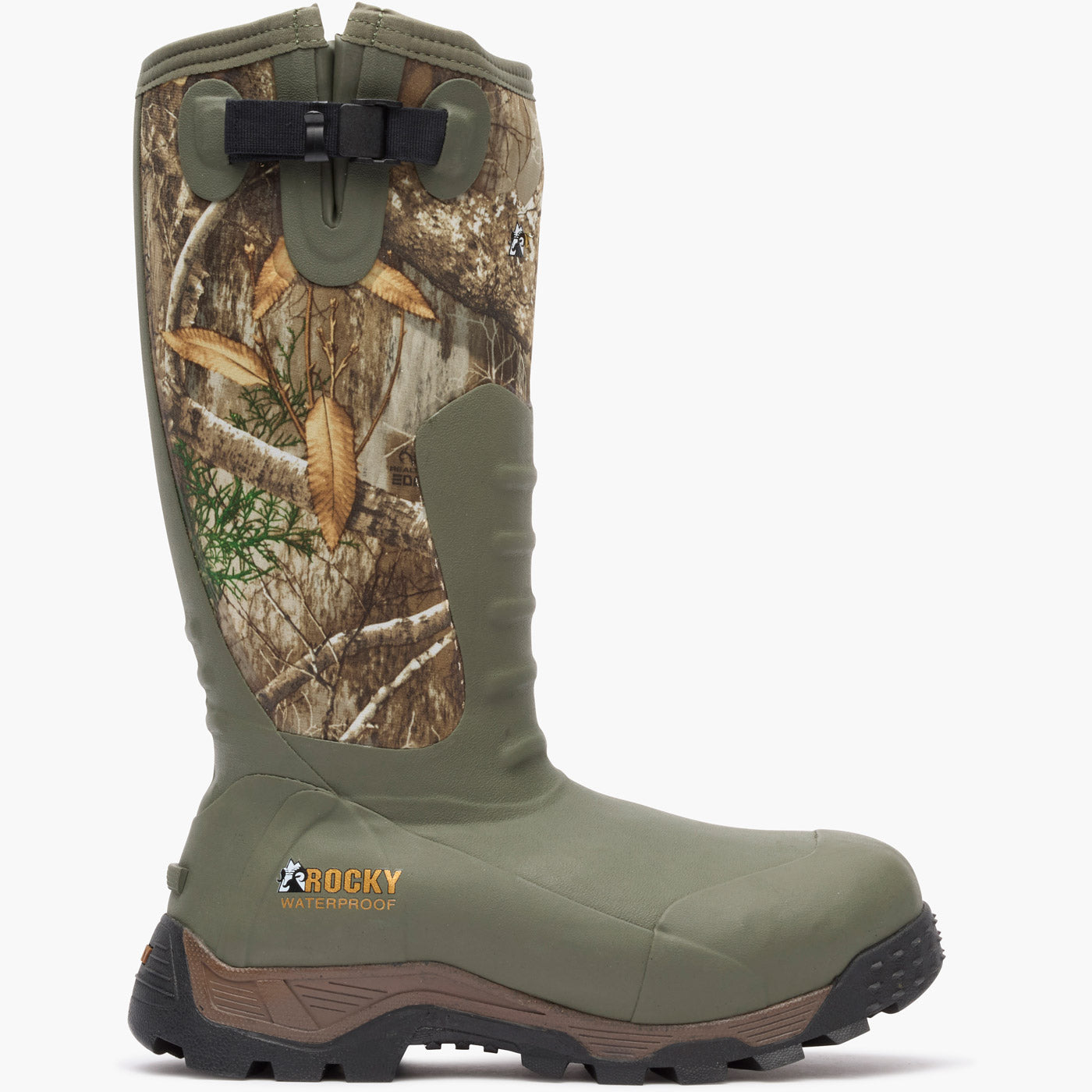
Sport Pro Rubber 1200G Insulated Waterproof Outdoor Boot
Rocky
Sport Pro Rubber 1200G Insulated Waterproof Outdoor Boot
Rocky
Insulation
1200g 3M Thinsulate Ultra
Shaft Height
16 inches
Primary Upper
Vulcanized rubber over 5mm neoprene
Closure Style
Full-length side zipper with internal gusset
Outsole
Aggressive multi-directional rubber tread
Footbed
Removable dual-density polyurethane
Sitting motionless on a late-November treestand when freezing rain turns to crusty slush will expose cut corners faster than any gear review on the internet. Rocky designed this boot specifically for stationary, late-season whitetail hunters who need extreme thermal protection without draining their hunting budget. Packing 1,200 grams of high-density insulation beneath a vulcanized rubber and neoprene exterior, the boot acts like a personal furnace for your feet. It is not built to chase elk up steep timber or sprint across arid sagebrush; it is a heavy-duty, cold-weather shelter intended to keep you in the woods when lesser footwear drives you back to the truck.
The standout structural feature is a full-length side zipper, a component that fundamentally alters the daily experience of using heavy rubber footwear. Anyone who has wrestled with a stubborn, vacuum-sealed neoprene boot after a twelve-hour day in the cold knows the frustration of bruised heels and torn socks. This design allows you to step in over heavyweight merino wool without the usual wrestling match. While purists often view zippers on wet-weather footwear with suspicion, the balance of entry ease, sheer thermal retention, and affordability cements this model as an indispensable tool for sub-freezing sits.
Where it fits
Late-season whitetail treestand hunting
Stationary waterfowl pit blinds
Deep-winter ice fishing expeditions
Cold-weather tractor work and chores
Pros
High thermal retention keeps feet comfortable during freezing, motionless sits
Side zipper eliminates the frustrating struggle of pulling off tight rubber boots
Substantially lower price point than competing premium heavy-insulated models
Rugged outsole lugs bite securely into slick mud, wet leaves, and packed snow
Cons
Considerable weight and bulk cause leg fatigue during extended hikes
Side zipper introduces a mechanical component that requires cleaning and maintenance
Poor breathability causes moisture buildup if worn during high-exertion walks
This boot belongs firmly in the territory of the cold-weather stationary hunter. If your hunting calendar revolves around November and December sits in the Midwest or Northeast, sitting hours on end in sub-freezing timber, this design makes immediate sense. It serves deer hunters waiting over food plots, waterfowl hunters parked in wind-scoured timber blinds, and ice anglers operating out of bucket setups. What it does not handle well is active, high-mileage ground tracking. The thick thermal lining builds up immense interior heat while you are moving, and if you sweat through your sock liners during a long hike, that trapped moisture will chill your toes the minute you settle onto your stand platform.
Shell Construction and Scent Control
The construction centers on a heavy-gauge vulcanized rubber outer layer fused over insulating neoprene. Rubber remains the gold standard for whitetail hunters because non-porous surfaces prevent human foot odors from lingering on vegetation along access trails. Rocky reinforced the high-abrasion zones across the heel counter and the toe cap, giving you solid protection against submerged cypress knees, sharp briars, and jagged ice crusts. The upper calf area remains supple enough to allow natural knee flexion when stepping over deadfall, though the overall rigidity of the lower boot is noticeably stiffer than lightweight athletic rubber models. Seams are vulcanized rather than simply stitched and taped, providing a clean watertight barrier up through the gusset line.
Real-World Thermal Performance
With 1,200 grams of synthetic insulation layered throughout the footbed and lower shell, thermal inertia is the main attraction. In single-digit temperatures, cold air readily leeches warmth through traditional thin-soled rubber boots within ninety minutes. Here, thick composite rubber lugs pair with dense interior insulation to build a massive thermal buffer between your soles and frozen steel treestand grates. Field experience shows that keeping toes warm during five-hour stationary sits requires minimal chemical toe-warmer intervention. The internal fleece lining assists with warmth, though managing personal foot moisture remains critical. Pairing this boot with moisture-wicking synthetic liners under medium-weight wool socks yields the best results, preventing interior dampness from compromising the insulation.
Weight and Trail Manners
There is no dancing around the scale: these are substantial boots that carry real heft on your feet. Expect to feel every ounce during steep approaches or prolonged slogs through deep muck. The heel pocket is sculpted reasonably well to mitigate heel lift, but the sheer mass of the boot generates forward inertia that taxes your shins and calves over long treks. The outsole pattern utilizes wide-spaced, multi-directional perimeter lugs that grip slick clay and frozen creek banks without balling up mud excessively. It behaves less like an agile hiking boot and more like a dependable set of snow-tire chains. For one-mile approaches from the truck, it is entirely manageable, but backcountry trekker types should look elsewhere.
The Side Zipper Trade-Off
Mechanical entry systems on rubber boots provoke endless debate, and for good reason. The side zipper on this boot is shielded by a waterproof internal gusset that keeps mud and standing water from flooding the interior. In practice, the zipper makes getting in and out effortless, particularly when layering multiple thermal pants and bulky hunting bibs. However, zippers require discipline. If you neglect cleaning dried marsh clay and swamp grit from the teeth, you risk jamming the slider or chewing through the zipper tape over time. Occasional washing and dry-lube applications keep it running smoothly. As long as you respect the maintenance requirements, the daily convenience easily outweighs the marginal failure risk.
Price Value and Market Alternatives
In a market where premium cold-weather rubber boots from Lacrosse or Muck frequently command over two hundred and fifty dollars, this model hits an aggressive price-to-performance sweet spot. You will not receive the refined orthotic arch support of an insulated Alphaburly Pro or the precision athletic fit of a high-end French field boot. Instead, you get raw, unapologetic thermal value. When evaluating alternatives in this price bracket, most competing options settle for 800 grams of insulation and lack any entry assistance whatsoever. If you demand bulletproof simplicity, a zipperless standard pull-on boot eliminates a potential mechanical failure point, but you sacrifice the sheer convenience that makes this model so practical during late-season exhaustion.
As an Amazon Associate, Wild10 earns from qualifying purchases.
No ratings yet
Pick 07Research-based review
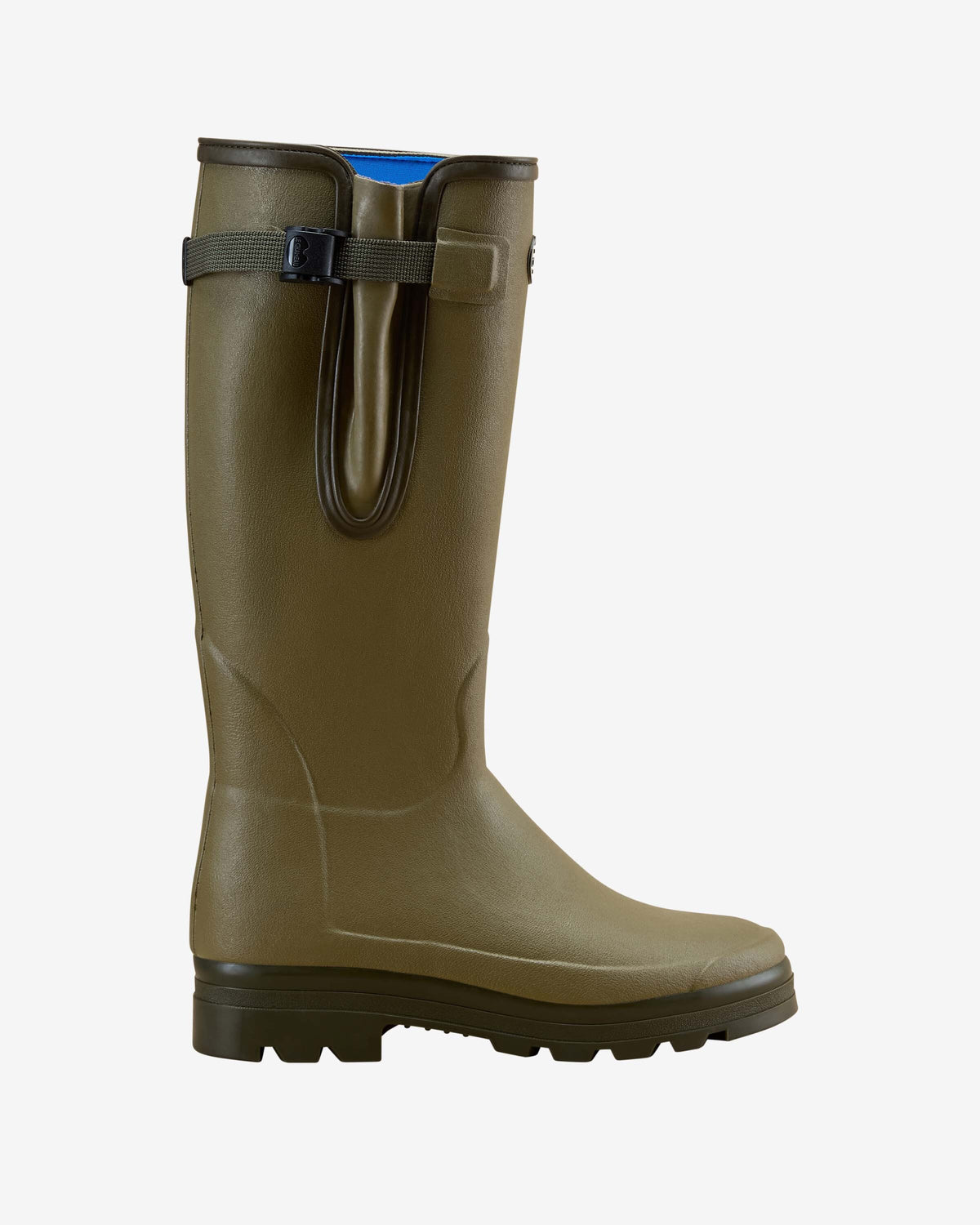
Men's Vierzonord Neoprene Lined Wellington Boot
Le Chameau
Men's Vierzonord Neoprene Lined Wellington Boot
Le Chameau
Upper Material
Handcrafted Chamolux natural rubber
Lining
3mm insulating quick-drying neoprene
Outsole
Dual-density shock-absorbing cross tread
Closure
Side gusset with metal snap tightening strap
Intended Temp Range
Freezing to 60°F (active use)
Shank
Reinforced anti-fatigue arch shank
Rubber hunting boots are notoriously cumbersome. Most feel like stiff plastic buckets bolted to lugged outsoles, designed to keep water out while torturing your shins over any hike longer than half a mile. The Le Chameau Vierzonord operates on an entirely different philosophy. Built around an anatomically sculpted last with supple Chamolux natural rubber, it fits through the instep and ankle like a bespoke walking boot rather than a piece of commercial fishing gear.
First introduced in the 1960s, the Vierzonord pioneered the use of an adjustable waterproof gusset combined with an insulating neoprene lining. It has remained a staple in European hunting circles for decades, specifically tailored for walked-up game and wet pasture work where continuous movement demands foot support and flexibility. It is not an armored muck boot built for mucking stalls or clearing heavy thorn brambles, but a refined piece of field footwear meant for covering ground in wet, chilly weather.
At this price tier, expectations run sky-high. The boot delivers exceptional ride quality, shock absorption, and a tailored silhouette that completely eliminates heel slip. However, natural rubber demands disciplined maintenance, and the boot's delicate balance of suppleness leaves it somewhat vulnerable to catastrophic punctures from barbed wire or heavy briars.
Where it fits
Wet upland bird hunting
Driven game days
Sporting clays in rain
High-mileage pasture walking
Pros
Supple natural rubber eliminates ankle stiffness and blister-causing heel lift
Adjustable waterproof gusset creates a precise fit around wide or narrow calves
Dual-density sole and reinforced shank deliver unmatched all-day walking support
3mm neoprene lining hits the sweet spot for active hunters in cool weather
Cons
High price point requires a serious long-term footwear investment
Soft natural rubber upper is vulnerable to punctures from barbed wire and thorns
Lacks sufficient thermal insulation for stationary sits in sub-freezing temperatures
The primary differentiator between this boot and standard vulcanized rubber footwear is the footbed geometry. Le Chameau shapes the heel pocket and instep tightly to hold the rear foot securely in place. You do not suffer the sloppy, blister-inducing heel lift common to budget rubber boots when walking up steep terrace banks or marshy grades. The calf gusset features an integrated waterproof membrane backed by an adjustable tightening strap with a secure metal snap. This system accommodates larger athletic calves or heavy hunting trousers without pinching or bunching. Pulling them on takes a split second of effort due to the contoured ankle, but once seated, the boot moves in unison with your leg rather than flopping against your tibia with every forward step.
Field Walking Dynamics
Long-distance comfort is where the Vierzonord justifies its reputation. The sole unit integrates a rigid shank reinforcement beneath the midfoot, distributing pressure across the entire sole when standing on rocky ground, ladder rungs, or frozen ruts. Beneath that sits a dual-density all-terrain tread that cushions heel strike while providing surefooted traction in slick loam, wet grass, and sticky mud. Unlike aggressive, deep-cleated swamp boots that accumulate pounds of clinging topsoil, this tread pattern cleans itself out as the rubber flexes with your stride. It walks with the fluid cadence of a traditional leather stalking boot, sparing your lower back and knee joints over a six-hour day chasing upland birds across rolling, sodden agricultural fields.
Thermal Performance Limits
The 3mm neoprene lining provides a sensible middle ground for active fall and winter pursuits. It lines the entire interior, including the footbed, providing an immediate layer of cushioning and thermal barrier against freezing ground. When moving continuously, this lining keeps feet comfortable down to roughly freezing temperatures without causing the clammy, swampy overheating that heavy 5mm or 8mm neoprene boots induce. That said, prospective buyers must understand its limitations. This is an active stalking boot, not a stationary tree-stand pac boot. If you sit motionless for four hours in an open deer stand in late November, cold will eventually creep through the sole. Paired with quality merino wool socks, it handles cold marsh walks and frost-covered fields with ease.
Chamolux Rubber Vulnerabilities
The very characteristic that makes this boot so comfortable to walk in is its greatest durability vulnerability. Chamolux natural rubber is remarkably supple, pliable, and elastic, allowing it to bend repeatedly without premature cracking at the flex points. However, that softness makes the rubber susceptible to punctures from jagged barbed wire fences, sharp cutover saplings, and dense multi-flora rose brambles. If your primary hunting grounds consist of overgrown briar patches and thorny deadfalls, you risk tearing the outer shell. Furthermore, natural rubber requires regular cleaning and periodic conditioning with silicone-based spray to prevent UV oxidation and surface crazing. Neglect them in the back of an unconditioned truck bed all summer, and the rubber will prematurely degrade.
Market Context and Alternatives
Sitting at the high end of the rubber boot market, the Vierzonord competes directly with French rival Aigle's Parcours 2 Iso. The Aigle features a slightly more cushioned wedge-style anti-fatigue heel, but the Le Chameau offers a more refined, tailored ankle fit and superior natural rubber flexibility. When compared to workhorse American options like the Muck Woody Max or Lacrosse Alpha Burly Pro, the Vierzonord is significantly less bulky, lighter on the foot, and far more aesthetically traditional. The tradeoff is simple economics and ruggedness: the American alternatives cost roughly half as much and endure brutal thorn abuse with thicker composite overlays, but they lack the glove-like feel, walking agility, and long-term repairability of the handcrafted Le Chameau.
As an Amazon Associate, Wild10 earns from qualifying purchases.
No ratings yet
Pick 08Research-based review
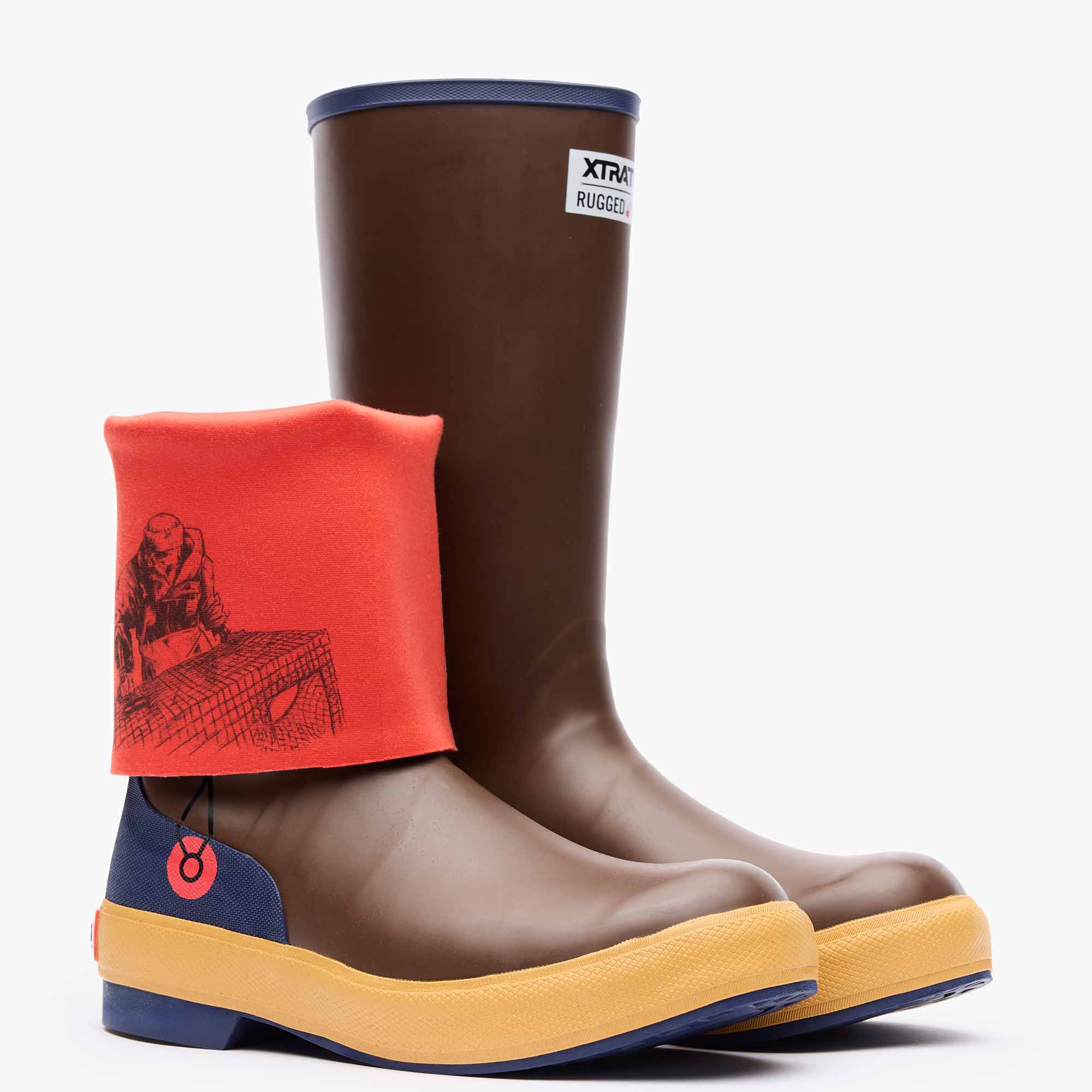
Men's 15" Legacy Boot
XTRATUF
Men's 15" Legacy Boot
XTRATUF
Shaft Height
15 inches
Shell Build
Triple-dipped seamless latex neoprene
Outsole
Non-marking slip-resistant Chevron
Insulation
Uninsulated fabric lining
Pliability
Roll-down calf shaft
Chemical Resistance
Resistant to fuel, fish oil, and acids
Every commercial dock from Bristol Bay to Ketchikan runs on this footwear, but it earned a cult following among coastal and river hunters for identical reasons. When waterfowling out of an aluminum jon boat or working marsh edges where slick decks meet muck, standard heavy hunting pacs feel like concrete blocks. This model provides an exceptionally supple, 100 percent waterproof barrier that moves with your ankle rather than fighting it.
The build relies on seamless triple-dipped latex neoprene, vulcanized to seal out corrosive salt brine, swamp muck, and motor fuel. Unlike stiff multi-layer rubber boots lined with thick foam, the pliable upper rolls down smoothly to the mid-calf when temperatures rise or during warm-weather boat transits. It sits low to the ground and delivers immediate tactile feedback through the footbed.
Taking an Alaskan fishing staple into the timber involves deliberate compromises. Without rigid shanks or aggressive deep-cleat outsoles, it falters on steep, frozen side-hills and offers zero thermal buffer once water temperatures plunge toward freezing. Yet for flat tidelands, boat blinds, and swamp runs where agility and bombproof waterproofing take precedence over rigidity, few boots feel as natural.
Where it fits
Duck boat blind operations
Tidal marsh waterfowl hunting
Coastal river skiff transport
Early-season swamp wading
Pros
Unmatched slip resistance on wet boat decks and smooth surfaces
Highly supple latex shaft rolls down easily to dump excess heat
Completely seamless dipped construction prevents bond delamination
Narrow ankle lock holds heel securely to defeat mud suction
Cons
Shallow Chevron tread packs out rapidly in thick hillside mud
Zero built-in insulation offers poor protection in near-freezing water
Minimal puncture defense against briars, beaver stobs, and thorns
The foundation of this boot is a seamless dipped-latex construction that behaves very differently from standard injection-molded rubber or heavy vulcanized sheets. The latex forms a flexible, elastic skin over a lightweight knit backing, creating a waterproof barrier that stretches easily over the calf and bends naturally at the instep. Because there are no bonded side seams to delaminate, points of mechanical failure are drastically reduced along high-stress flex zones. The rubber compound is specifically formulated to resist corrosive compounds, from marsh tannins and outboard gas spills to fish oils that cause standard boots to crack and degrade prematurely. It feels almost skin-like compared to thick armor-plated deer hunting boots, sacrificing puncture resistance against sharp thorns in exchange for a lighter, softer shell that hugs the lower leg without calf pinch.
Field Traction and Footing
Underfoot, the boot runs the proprietary Chevron outsole: a tightly spaced, grooved pattern originally engineered to evacuate water from wet fiberglass boat decks and steel docks. On slick wet wood, damp aluminum hulls, and hard-packed tidal flats, this sole grips with remarkable tenacity, far outperforming aggressive off-road lugs that slip on wet hard surfaces. However, its hunting limits emerge the moment you climb greasy clay riverbanks or traverse loose, muddy slopes. The shallow grooves lack the tooth to dig into soft loam, and thick muck quickly packs between the sipes, turning the sole into a slick flat surface. Hunters operating in steep river breaks or muddy timber will miss the aggressive biting lugs of dedicated upland or swamp boots, making this pattern strictly optimal for flat bottoms, boats, and tidal mud.
Fit, Flex, and Packability
Sizing runs true but fits narrow through the ankle and across the instep, an intentional design feature that creates a secure hold and prevents mud from suctioning the footwear off your foot. The lack of rigid internal plastic counters means the boot articulates naturally, requiring virtually zero break-in period. You can easily roll the 15-inch shaft down to the ankle to dump heat during warm early-season setup or while running the boat motor. This extreme pliability also makes it far easier to pack into a duffel or stow beneath a skiff thwart than rigid hunting boots. The flat footbed provides minimal built-in arch support, meaning anyone covering significant dry miles will want to drop in aftermarket orthotics to prevent mid-foot fatigue after long days standing in blinds.
Thermal Limits and Comfort
Because this standard model contains no internal insulating foam or neoprene sponge core, thermal performance depends entirely on your sock selection. The thin shell offers zero thermal barrier against ice water; when standing submerged in late-season marsh water, cold conducts through the rubber instantly. In temperatures above freezing, this breathability deficit is manageable, and rolling the shaft down creates immediate ventilation that thick hunting rubber simply cannot match. For sub-freezing timber hunts or late-season goose pit sessions, your feet will quickly become numb unless you step up to an insulated sub-model or size up significantly to accommodate heavy wool loops. Treat this as a three-season, high-moisture tool designed for working wet bottoms in moderate temperatures rather than a cold-weather stationary stand boot.
Durability and Longevity
Longevity depends heavily on how you store and treat the latex. When kept away from continuous direct UV exposure and ozone sources like electric heaters, the supple shell outlasts rigid vulcanized rubbers that dry out and split along the flex line behind the toes. The sole rubber wears down slowly on natural ground, though abrasive gravel bars and concrete launch ramps will gradually round off the shallow sipes over seasons of hard use. The primary structural vulnerability is puncture resistance: the thin latex-neoprene construction does not offer the heavy-gauge barrier needed for walking through black locust, sharp hawthorn, or broken beaver puncheon. Keep it in mud, water, reeds, and boats, and the seamless exterior will remain watertight across years of relentless abuse.
Hunting Suitability and Rivals
Positioning this boot against competitors like the Lacrosse Grange or Muck Wetland highlights its distinct mixed-use specialty. The Lacrosse Grange provides superior calf-locking cinch straps and slightly better hillside traction for still-hunting timber, while the Muck Wetland brings thick insulating neoprene for freezing tree-stand days. However, neither matches this boot for boat-based duck hunting, decoy handling, or coastal wet-work where stepping across slick gunwales and rolling down cuffs is routine. It remains an offbeat choice for the deer woods, but for hunters whose territory centers on skiffs, swamp marshes, coastal estuaries, and wet transport, its combination of tactile grip, effortless flexibility, and proven watertight integrity justifies its presence on any serious waterman's rack.
As an Amazon Associate, Wild10 earns from qualifying purchases.
No ratings yet
Pick 09Research-based review
Parcours 2 ISO Neoprene-Lined Boot
AIGLE
Parcours 2 ISO Neoprene-Lined Boot
AIGLE
Origin
Handcrafted in France
Upper Material
Gomma Plus natural rubber
Lining
4.5mm insulating neoprene
Midsole
Anti-fatigue tri-density rubber
Outsole
Bi-directional self-cleaning lugs
Shaft Fit
Fitted with adjustable side gusset
Most rubber boots behave like rigid plastic buckets, fine for standing beside a tailgate but punishing on a three-mile trek across wet marshland. The French outdoor house Aigle designed this boot around a different premise: build a waterproof rubber shell on top of an athletic walking platform. The result is a dedicated stalking boot built on a supportive hiking last, delivering genuine shock absorption where traditional gumboots usually pound your feet flat.
A supple natural rubber exterior encapsulates a 4.5-millimeter neoprene lining, creating an insulated barrier against freezing slush, sodden peat, and submerged creek crossings. What earns this boot its field reputation, however, is the tri-density rubber outsole. With an integrated dampening cushion in the heel, it flexes cleanly through the midfoot and rebounds on hard-packed fire roads. It is built explicitly for the hunter or land manager who measures cold-weather field days in miles walked rather than hours sat stationary.
Sitting near the tail of our top ten, it remains a specialized piece of kit. It carries significant heft, demands a steep entry price, and fits close through the ankle and instep, which can make pulling it off after a long day a wrestling match. Yet for roaming timber and soggy upland cover when temperatures hover near freezing, few boots match its balance of weather protection and stride comfort.
Where it fits
Cold-weather timber stalking
Wet marshland bird hunting
Winter livestock chores
Long-distance muddy scouting
Pros
Class-leading heel cushion buffers impact across long hiking days
Supple natural rubber stays flexible and quiet in freezing weather
Tailored ankle pocket eliminates heel slip and prevents blisters
Lug pattern clears heavy clay and mud without packing tight
Cons
Substantial overall weight tires unconditioned legs late in the day
Narrow instep makes kicking them off difficult without a boot jack
Requires regular silicone conditioning to prevent rubber oxidation
This boot is engineered for hunters who burn boot leather. If your season involves trailing deer through wet coastal rainforests, following bird dogs across saturated river bottoms, or logging hard morning chores in freezing mud, the footbed geometry pays off immediately. It is not built for sub-zero treestand sits where circulation slows and bulky Pac boots rule. Instead, it serves active pursuits down to roughly twenty degrees Fahrenheit, where your body heat keeps the neoprene charged and the supportive arch structure prevents foot fatigue across uneven ground.
Materials and Construction
Aigle builds these boots by hand in Châtellerault using their proprietary Gomma Plus vulcanized natural rubber mix. Natural rubber retains elasticity in freezing temperatures far better than synthetic PVC or oil-based polymers, resulting in quiet movement through brush and resistance to micro-cracking at flex points. Inside, a four-and-a-half-millimeter neoprene sleeve wraps the entire foot and calf. An adjustable waterproof side gusset accommodates thicker hunting trousers and stouter calves, anchored with a heavy-gauge strap and buckle that resists slipping under brush snag.
Trail and Stalking Performance
The triple-layer sole assembly acts more like an approach shoe than a farm wellington. An internal heel cushion compresses on impact, deadening shock on rocky logging roads and frozen ruts, while an arch shank prevents midfoot torsional twist. Traction is dependable in deep loamy muck because the multi-directional cleats are spaced broadly enough to shed packed clay with every footstep. Because the ankle pocket is tailored narrow, your heel stays locked in place, eliminating the friction and slippage that chew through socks in loose-fitting boots.
Weight and Bulk Trade-Offs
There is no getting around the physical mass of dense vulcanized rubber and thick neoprene insulation. These are substantial boots that make their presence felt when slung into a duffle bag or packed for travel. You cannot roll or compress the shafts without risking permanent creasing in the rubber compound, so they demand their own footprint in your vehicle. On foot, that weight is carried close and balanced well across the sole, but after seven miles of deep mire, you will certainly feel the physical drag.
Long-Term Field Durability
With basic care, natural rubber outlasts bonded polyurethane by years. The outsoles wear down slowly, and the factory vulcanization means delamination between the upper and sole is practically nonexistent. However, natural latex rubber is vulnerable to ultraviolet degradation and ozone drying. If left coated in manure or stored in direct sunlight, the rubber will bloom, oxidize, and eventually split. Applying a silicone-based rubber conditioner every few months is mandatory maintenance if you want to see a decade of service from them.
The Competitive Landscape
In the premium European rubber boot tier, this model squares off directly against the Le Chameau Vierzonord. The Le Chameau offers a slightly softer initial flex and a wider calf cut, but Aigle wins on outright underfoot shock absorption over distance. Domestic staples like the Lacrosse AlphaBurly Pro come in at lower prices and provide easier slip-on convenience, but rely heavily on injected EVA foams that pack out over time. The Aigle delivers a denser, more permanent chassis that justifies its premium for pure mileage.
As an Amazon Associate, Wild10 earns from qualifying purchases.
No ratings yet
Pick 10Research-based review
Men's Chasseur Leather Lined Wellington Boot
Le Chameau
Men's Chasseur Leather Lined Wellington Boot
Le Chameau
Upper Material
Chamolux handcrafted natural rubber
Lining
Full-grain Italian calf leather
Closure
Full-length waterproof side zipper
Outsole
Dual-density shock-absorbing cross sole
Calf Sizing
Up to eight distinct circumference fittings
Shank
Reinforced rigid arch support shank
This is not gear intended for slogging through flooded public-land timber where barbed wire and hidden t-posts threaten to shred your investment. The Chasseur occupies the absolute summit of traditional sporting footwear, pairing handcrafted natural rubber with a glove-soft, full-grain calfskin leather lining. Built for formal shoots, upland field walking, and damp ground where you spend eight hours upright, it addresses the core flaw of standard rubber boots: the miserable internal climate.
Its defining engineering feature is the waterproof full-length side zipper combined with multiple calf-width fittings. Standard pull-on wellingtons must remain sloppy around the ankle and instep just to let your heel clear the turn. By utilizing a heavy-duty sliding closure, this boot cuts close through the ankle and instep, locking the foot into the heel cup more like a traditional leather field boot than a floppy muck shoe.
That bespoke fit and plush lining come with explicit responsibilities. Natural rubber demands routine UV protection and conditioning, while damp leather requires careful, unhurried air drying between outings. Treat it like disposable agricultural rubber and you will ruin it. Maintain it with basic care, and it yields all-day walking comfort that no neoprene boot on the shelf can replicate.
Where it fits
Upland bird walking
Lowland wet field shoots
Cool weather dog handling
Traditional sporting estate pursuits
Pros
Full-grain leather interior regulates foot moisture far better than synthetic linings
Full-length waterproof side zipper eliminates heel slip and eases entry
Calf-specific sizing options deliver an exceptionally tailored athletic fit
Stiff internal shank provides true arch support across broken, rocky ground
Cons
Significantly higher price point than any standard hunting wellington
Requires active maintenance including rubber conditioning and gentle drying
Substantial overall weight can induce fatigue on steep, technical ascents
Every pair is built by a single master bootmaker using Chamolux natural rubber, a proprietary compound formulated to remain supple across shifting temperatures rather than stiffening in early frosts. Crucial friction zones across the front of the shin and ankle are reinforced with an integrated Kevlar blend, adding puncture defense against briars and hidden brambles. Inside, thick full-grain leather lines the entire interior from cuff to toe. Unlike neoprene or brushed poly linings that eventually pill, fray, or retain sour odors, smooth calfskin molds gradually to the contours of your foot. The internal seams are stitched flat and covered to prevent hot spots. It is old-world bench construction applied to waterproof sporting footwear.
Ankle Lock and Zipper Function
The heavy-duty waterproof zipper running down the exterior lateral seam changes how the boot interacts with your stride. In conventional wellies, oversized ankle openings let your heel lift with every step, generating friction and early blister formation on rolling hills. The zipper allows a tailored cut that grips the instep firmly. Supported by a snap-down keeper strap at the top hem, the zip closure remains completely sealed against standing water and muddy ditches. A gusset behind the zipper teeth ensures complete submersion protection to the collar. You step in, zip down, and instantly gain the heel retention of a lace-up leather hunting boot without compromising total waterproofing.
Field Comfort and Climate
Natural leather acts as a biological buffer against sweat buildup. Where closed-cell synthetic foam traps foot moisture until your socks are soaked, full-grain leather naturally breathes and moderates temperature during high-output walking. Paired with a dual-density all-terrain outsole, underfoot fatigue stays low over gravel tracks and furrowed agricultural fields. The integrated shank adds torsional rigidity, preventing your foot from wrapping around rocks or tree roots on uneven terrain. Traction lugs are widely spaced and bi-directional, biting into greasy clay on the push-off while shedding wet sod rather than packing into slick, heavy plates. For cool mornings that turn into mild afternoons, this internal foot climate remains unmatched.
Weight and Transit Realities
Dense natural rubber, substantial outsoles, and thick leather linings result in serious heft. This is among the heaviest rubber boots in its category. On flat pasture and moderate woodlots, that weight provides reassuring ground feel and damping; on steep, muddy sidehills, the mass is noticeable by mile four. Packability is essentially nonexistent. You cannot roll, crush, or compress these shafts into a duffel bag without permanently creasing the rubber and damaging the internal leather structure. They demand their own boot bag or upright floor space in the back of your vehicle, preferably kept away from direct sunlight, engine heat, and ozone-producing electric motors that degrade natural latex.
Ownership Demands and Maintenance
Buying these boots requires committing to an actual maintenance routine. If you leave them caked in acidic farmyard slurry or damp mud next to a hot radiator, the rubber will bloom, craze, and crack prematurely. Field dirt must be rinsed off with clean water. The rubber exterior requires regular wiping with a specialized silicone conditioning spray to keep the natural oils locked in. Inside, damp leather needs cedar shoe trees or gentle room-temperature airflow to dry; forced high-heat dryers will bake the lining brittle. The zipper teeth also require occasional clearing of grit and paraffin waxing to slide smoothly. For hunters willing to do the upkeep, the lifespan easily doubles standard synthetic boots.
Value and Market Context
At several times the price of mass-market neoprene boots from Lacrosse or Muck, this boot does not attempt to compete on raw utility-per-dollar. It sits against high-end European rivals like the Aigle Parcours leather-lined model, distinguishing itself through its zippered entry and granular calf-sizing options. If your hunting involves sub-zero stationary tree stands or crawling through sharp riprap, an insulated technical pack boot is far more practical and durable. But for upland bird hunting behind dogs, wet-grass dog training, and walking shoots where hours of active striding demand absolute comfort, blister-free heel retention, and refined aesthetics, nothing else feels quite like it.
Knee-high rubber and neoprene boots from LaCrosse, KUIU, Muck, Rocky, XTRATUF, Le Chameau and AIGLE, compared on height, insulation, weight and price.
Key takeaways
#1 Alphaburly Pro 18" 1600G — LaCrosse
#2 Men's Arctic Pro Insulated Boot — The Original Muck Boot Company
#3 KUIU HD Mud Boot — KUIU
#4 Alpha Agility 17" Brown — LaCrosse
#5 Men's Mossy Oak Break-Up Country Woody Max Boot — The Original Muck Boot Company
#6 Sport Pro Rubber 1200G Insulated Waterproof Outdoor Boot — Rocky
Intended uses
Gear
Verification notes
Editorial ranked list, 10 entries. Evidence mix — 10 research only. Buy links open the maker or a retailer search.
How we chose
Last updated
Ranked by Wild10 Editorial Team, Research desk
We compared widely available rubber hunting boots using maker specifications, retailer listings and published reviews, then ranked 10 against the same criteria below. This is desk research unless a pick is marked field tested. Rankings are editorial. No brand pays for placement, and affiliate links never move a pick up or down.
Fabric behavior over time
Breathability, DWR life, loft retention, and how the piece performs after repeated washing.
Real-world durability
How the material, stitching, or steel holds up after a season of hard use — not how it looks new.
Performance in bad conditions
Wind, rain, cold, and grit are the test. Anything that only works on a nice day gets marked down.
Weight and packability
Every ounce has to earn its place in the pack, but not at the cost of something that fails in the field.
Ease of use
Setup, adjustment, and maintenance with cold hands, in the dark, without the manual.
Value at its price point
Compared against the closest competitors in the same tier, not against cheaper gear in a different class.
How often we recheck this: Reviewed on a rolling basis and rechecked at least once a year, or sooner if a pick is discontinued, revised, or beaten by something new.
Best rubber hunting boots for a specific job
Skip the ranking — jump to the pick that matches how you actually use it.
Our editors test the gear, pick the ten, and set the order the day a list publishes. After that, the ranking is live: every member star rating feeds the community order, so picks climb or slide as real owners report back. Editorial judgment decides what earns a spot — you help decide where it sits.
Editors set the field
Verified specs, feature and use-case comparison, and outside sources choose the ten and the published order; field-tested picks are labeled.
Readers re-rank it
Your 1–5 star ratings drive the community order on every list.
Rankings keep moving
Picks rise or fall over time — nothing is frozen at launch day.
Award picks
The ranking above is price-blind and judged on merit. These awards call out the pick we'd hand a specific person with a specific need.
For cold stands and late season, the LaCrosse Alphaburly Pro 1600G is the warmest pick. The Muck Arctic Pro and KUIU HD Mud Boot cover most cold hunts, the LaCrosse Alpha Agility is lighter for walking, and the Rocky Sport Pro is the budget choice with a side zip.
How to choose rubber hunting boots
Every pick on this page was judged against the same criteria. If you want the short answer, Alphaburly Pro 18" 1600G by LaCrosse is the one we point most people at. If you want to decide for yourself, here is what actually separates a good rubber hunting boot from an expensive one.
Fabric behavior over time
Breathability, DWR life, loft retention, and how the piece performs after repeated washing.
Real-world durability
How the material, stitching, or steel holds up after a season of hard use — not how it looks new.
Performance in bad conditions
Wind, rain, cold, and grit are the test. Anything that only works on a nice day gets marked down.
Weight and packability
Every ounce has to earn its place in the pack, but not at the cost of something that fails in the field.
Ease of use
Setup, adjustment, and maintenance with cold hands, in the dark, without the manual.
Value at its price point
Compared against the closest competitors in the same tier, not against cheaper gear in a different class.
Match the pick to your use
The right rubber hunting boots depends on what you are actually doing with it: Late-season treestand deer hunting; Stationary waterfowl blind vigils; Sub-zero winter predator calling; Midwestern late-muzzleloader sits; Late-Season Treestand Sits; Hardwater Ice Fishing. Start from the use case, then work down the ranking until you hit the first pick that covers it.
Common mistakes
Buying the lightest rubber hunting boots you can find and discovering it cannot take a season of hard use.
Paying for a specialist feature you will use once a year instead of the versatile option.
Comparing headline specs across tiers instead of within the same class.
Skipping fit, sizing, or adjustment checks that decide whether you actually carry it.
Frequently asked questions
What is the best rubber hunting boots?
Alphaburly Pro 18" 1600G by LaCrosse takes the top spot. Warmest pick for cold stands: 1600G Thinsulate Ultra under hand-laid rubber.
How did The Wild10 choose and rank these rubber hunting boots?
We judged every pick against the same criteria — fabric behavior over time, real-world durability, performance in bad conditions, weight and packability — and ranked them on merit regardless of price. Knee-high rubber and neoprene boots from LaCrosse, KUIU, Muck, Rocky, XTRATUF, Le Chameau and AIGLE, compared on height, insulation, weight and price.
What is the best budget rubber hunting boots?
Sport Pro Rubber 1200G Insulated Waterproof Outdoor Boot by Rocky — Best budget pick: 1200G insulation and a side zipper for under $160.
Alphaburly Pro 18" 1600G vs Men's Arctic Pro Insulated Boot — which should I pick?
Alphaburly Pro 18" 1600G ranks first: Warmest pick for cold stands: 1600G Thinsulate Ultra under hand-laid rubber. Men's Arctic Pro Insulated Boot is the close second: Best all-round cold boot: 8mm neoprene bootie, fleece lining and thermal foam underfoot. Our full head-to-head compares them side by side.
How often is this list updated?
We review this ranking on a rolling basis and update it whenever a pick is discontinued, meaningfully revised, or beaten by something new. Rankings are editorial — brands do not see them before publication and affiliate links never change the order.