


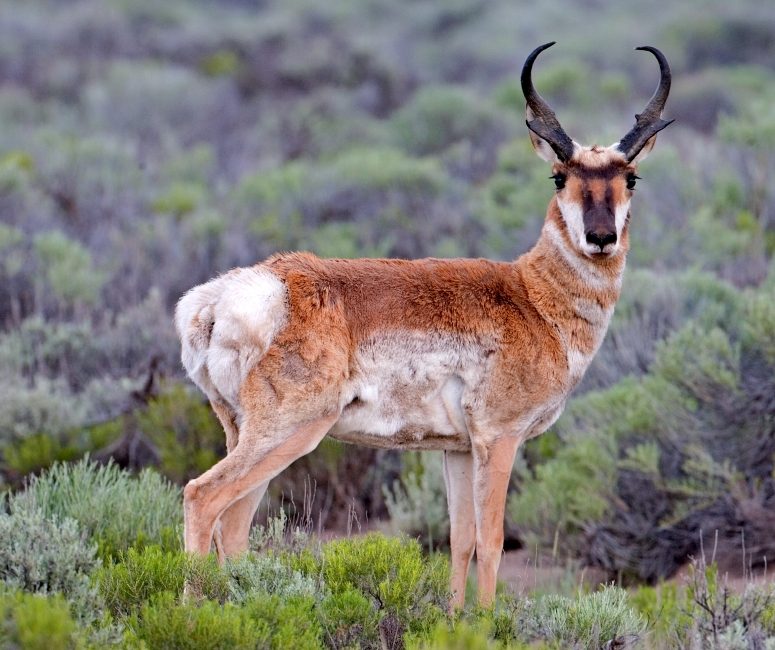
From the north · Wildlife
Pronghorn Antelope
The fastest land animal in the hemisphere, the easiest western tag to draw, and the best first do-it-yourself western hunt there is.
Antilocapra americana
- Range
- Wyoming, MT, NM, CO, NV
- Peak season
- Aug archery – Oct rifle
- Tag access
- Easy draw, often 0–2 points
- Live weight
- 90–140 lb
Regulations by region
Pronghorn Antelope rules where you're headed
Seasons, tags, limits, and legal methods for pronghorn antelope are set jurisdiction by jurisdiction. Pick your state or province and we'll point you at the agency that writes the rules.
Jump to another species
About the pronghorn antelope
Pronghorn are not antelope and not deer — they are the only surviving member of their family, built to outrun a predator that has been extinct for 10,000 years. They can hold 45 mph for minutes and see roughly as well as you do through 8x binoculars. They also live in wide-open sagebrush country where you can see for miles, and Wyoming alone issues tens of thousands of tags a year. For a hunter who wants a genuine western DIY hunt without a decade of points, pronghorn is the answer. The hunt trades physical difficulty for tactical difficulty. The walking is flat and easy; the challenge is closing the last 400 yards across country with no cover on an animal that never stops watching.
Range and habitat
Wyoming holds roughly half the world's pronghorn and issues more tags than every other state combined. Montana, New Mexico, Colorado, and Nevada round out the options. Wyoming: About half the global population; tens of thousands of tags. Montana: Excellent eastern-plains hunting and large blocks of public and block-management land. New Mexico: Biggest-horned bucks in the country on private and state land. Colorado: Strong eastern-plains and northwest herds. Nevada & Oregon: Lower density, high quality, and big country. Texas & South Dakota: Panhandle and prairie populations.
Behavior and field method
Pronghorn are found from a truck window with binoculars and killed with a careful, low-crawl stalk or a patient wait at water — this is the most beginner-friendly spot-and-stalk method in the West. Drive two-tracks and glass open basins from a vehicle or high point to inventory bucks before committing to a stalk. Use terrain folds, dry washes, and any available cover to close distance, dropping to a crawl for the last hundred yards since pronghorn vision is extraordinary. Keep the wind in your favor throughout, though pronghorn rely far more on eyesight than scent — movement and silhouette are what bust a stalk. Alternatively, in hot August/September weather, set a brushed-in ground blind on an isolated waterhole or stock tank that pronghorn are using daily, and sit it for a full day. Range the animal and set up on a bipod, tripod, or shooting sticks — flat, open country rarely offers a natural rest. Take the shot broadside inside your verified range (typically 200–350 yards with a rifle, inside 40 yards from a blind with a bow), aiming behind the shoulder. Skin and quarter immediately in the heat, and get the meat on ice within an hour or two to avoid the fat and hide souring it.
Tracks, droppings, and sign
Pronghorn live on open prairie where you find them with a spotting scope, not by tracking. But their sign tells you where the animals water and where the fences funnel them. Tracks — Heart-shaped and pointed with no dewclaws — the only North American hoofed game with none, so the rear of the track is always clean. Concave, cushioned hooves leave a shallow print on hardpan. Droppings — Small, dry, tapered pellets in tight clusters, usually near water or on a bedding rise. Bucks defecate on territorial scrapes, so piles at fence corners are marking behavior. Scrapes & marking — Pawed dirt patches with dung and urine, plus cheek-gland rubbing on sagebrush. In August and September a buck refreshes a circuit of these across his territory daily. Fence crossings — Pronghorn go under fences, not over. Look for hair on the bottom wire and worn dirt beneath it — those crossings are the best ambush points on the prairie. Water sign — Churned mud and heavy track concentrations at stock tanks and guzzlers. In an arid unit, one tank can be the entire hunt.
In the field
You hunt pronghorn from a truck window and a pair of binoculars first. Drive two-tracks, glass every basin, and inventory bucks until you find one worth stalking. That part feels almost too easy. The stalk is the hunt. Pronghorn vision is extraordinary, and the country is often ankle-high sage. You use folds in the ground, dry washes, and windmills, you crawl the last hundred yards, and you get busted more than half the time. The other classic method is a waterhole sit in hot early-season weather. In August and September, pronghorn must drink daily, so a blind on an isolated stock tank or spring can produce a 20-yard archery shot on animals you could never stalk. Rifle shots are typically 200–350 yards. This is the hunt where a rangefinder, a bipod or shooting sticks, and honest practice at distance pay off most directly. It is hot, dry, and windy. September on the high plains is 80°F at midday with 25 mph wind, and there is no shade. Water, sun protection, and a cooler full of ice in the truck are as important as the rifle.
Regulations, tags, and seasons
Pronghorn is the single most achievable western draw. Two to four applications a year across Wyoming, Montana, and New Mexico gives most hunters a tag in their first or second season. Start with Wyoming. Apply by the late-May deadline for a buck antelope tag in a unit with high public-land percentage and low point requirements — the state publishes both figures. Add a New Mexico application (March deadline). It is a pure random draw, so your first year has the same odds as anyone else's twentieth. Add Montana (June deadline) as a third line. Doe/fawn tags in many districts are essentially unlimited and cheap — a great way to hunt and fill a freezer while waiting on a buck tag. Verify public access. Use BLM, state trust land, and Montana's Block Management or Wyoming's Hunter Management Area programs; the checkerboard land pattern in Wyoming makes 'corner crossing' a real legal issue you must understand. Expect roughly $300–$500 for a nonresident buck tag and license, well under most other western species. If you strike out, buy a leftover tag — Wyoming and Montana both release unclaimed antelope licenses in summer.
Harvest and processing
Antelope are usually shot in 80°F heat on open ground. The clock on the meat starts immediately and runs faster than you think. Watch the pronghorn after the shot instead of running to the spot. Mark the exact stance with a landmark, note the direction of travel, and listen — a crash you hear is worth more than a blood trail you guess at. Give a body-hit animal 30–45 minutes before you take up the trail, and a gut-hit animal 6–8 hours. Pushing a wounded animal is the single most common way hunters lose one. Trail with flagging tape at each blood spot so you can see the line of travel and back up to the last sign if you lose it. Bright blood with bubbles is lungs; dark blood with green flecks is paunch. Confirm the animal is dead by touching an open eye with a stick or the muzzle before you set the gun down and start handling it. Tag the animal immediately if your state requires it, and photograph it where it fell before you move anything — that photo is also your proof of legal harvest in most jurisdictions. Roll the animal onto its back or downhill on its side. Ring the anus with a knife and tie it off with a zip tie or twine so nothing spills into the body cavity. Get the hide off and the quarters into a cooler with ice as fast as your hands can move.
Meat care and what you take home
A pronghorn yields 30–45 pounds of boneless meat. Its reputation for being 'gamey' comes almost entirely from hunters leaving hide and hair on a warm carcass for hours. Skin it immediately, quarter it, get it into breathable bags, and get it on ice within a couple of hours. Handled that way it is one of the finest wild meats in North America — mild, fine-grained, and excellent on the grill.
Field notes
- Flat-shooting rifle: Pronghorn are small and thin-skinned. A .243, 6mm Creedmoor, .25-06, or 6.5 Creedmoor with a match-hunting bullet is ideal — flat trajectory matters more than energy.
- Binoculars & spotting scope: 10x binoculars for finding, a spotter for judging horn length and prong. Most bucks look bigger at a mile than they do at 40 yards.
- Rangefinder + shooting support: Bipod, tripod, or sticks. There is rarely a rest in open sage, and prone is often blocked by brush.
- Ground blind (archery): A dark, brushed-in blind left up for a day or two before you hunt. Bring a chair, water, and a book — sits run twelve hours.
- Coolers and ice: This is a hot-weather hunt. Get the hide off within an hour, quarter, and get it on ice the same day or the meat will sour.
- Mapping app with land ownership: Wyoming's alternating public/private sections make legal access a map problem. Know where you stand at all times.
Pronghorn Antelope questions, answered
- Is pronghorn a good first western hunt?
- It is the best one. Tags are drawable, the terrain is walkable, public land is abundant in Wyoming and Montana, and the tactics teach you glassing and stalking skills that transfer directly to mule deer and elk.
- How close can I get to a pronghorn?
- With a rifle, plan on 200–350 yards. Successful bow stalks inside 40 yards happen, but the reliable archery method is a waterhole blind rather than a spot-and-stalk.
- What is corner crossing?
- In checkerboard land, public and private sections meet at a single point. Stepping from one public corner to the diagonal public corner has been litigated in Wyoming and remains legally sensitive. Know the current law and, when in doubt, find a legal access route.
- Does pronghorn taste bad?
- No — mishandled pronghorn tastes bad. The animal is taken in hot weather and the fat and hide hold heat. Get it skinned, quartered, and cold fast and it is superb.
- Buck or doe tag?
- Doe/fawn tags are cheap, plentiful, and often available over the counter or as leftovers. They are an outstanding way to hunt every year, fill a freezer, and learn a unit while you accumulate points for a buck tag.
Official sources and further reading
- Wyoming Game & Fish — antelope
Draw application, unit maps, and published draw odds for the largest pronghorn herd.
- Montana FWP hunting
Antelope districts, Block Management public access, and license deadlines.
- New Mexico Department of Game & Fish
Pure random draw — the best zero-point pronghorn opportunity in the West.
- BLM recreation & hunting
Locating the public land that most pronghorn hunting happens on.