


Reader rating
Rate it and you move it. Community ratings re-rank this product inside its Top 10 list.
Expert-picked, reader-ranked. Our editors choose the products and the launch order; member star ratings move picks up or down over time.
Best value Silky
Pros
- Class-leading cutting speed and efficiency for its price bracket
- Noticeably lighter than metal-framed folding saws of similar capacity
- Dual-angle blade lock keeps knuckles clear of the ground during cuts
- Tacky overmolded handle maintains secure grip in cold, wet weather
Cons
- Plastic handle exhibits slight flex under heavy torsional strain
- Thin Japanese blade stock bends if forced carelessly on the push stroke
- Impulse-hardened teeth cannot be sharpened with field files
Best uses
- Processing backcountry campfire wood
- Solo and tandem wilderness backpacking
- Clearing trail deadfall and brush
- Lightweight canoe and packraft camping
Specifications
- Blade Length
- 180mm (approx. 7.1 inches)
- Blade Material
- SK4 high-carbon Japanese steel
- Tooth Configuration
- Large (approx. 6.4 teeth per 30mm)
- Cutting Stroke
- Pull stroke only
- Handle Construction
- Fiberglass polypropylene with rubber grip
- Locking Mechanism
- Two-position spring-loaded lock
Pricing
We don't publish a price we haven't verified. The retailer links below open the live listing for this exact model.
Best for
Processing backcountry campfire wood, Solo and tandem wilderness backpacking, Clearing trail deadfall and brush, Lightweight canoe and packraft camping
Where to buy the F180 Large Teeth
We don't have a direct Amazon listing on file yet — this opens an Amazon search for the exact make and model.
Some links are affiliate links. Buying through them supports our testing at no extra cost to you.
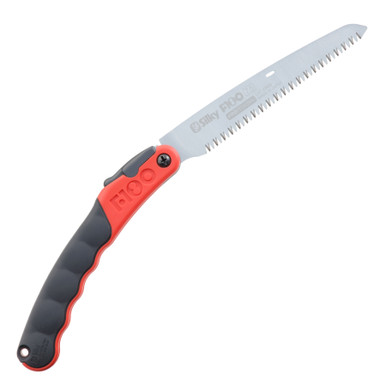
Silky folding saws like the Pocketboy and Gomboy earn most of the fanfare in trail and bushcraft communities, but the F180 quietly offers nearly identical cutting performance for a fraction of the cost. By swapping the full metal internal frame for a molded fiberglass-reinforced composite chassis, Silky cut both production costs and pack weight without downgrading the Japanese high-carbon pull-stroke steel that sets their cutting tools apart. For backcountry travelers who regularly process wrist- to forearm-thick deadfall rather than clearing heavy logging blowdowns, this 180mm blade hits the practical sweet spot. It packs flat against an internal frame stay or slides easily into an exterior water bottle pocket, unfolding with an authoritative click into two distinct locking angles to handle both waist-height bucking and awkward, ground-level flush cuts.
Target User and Scope
This saw is built for backpackers, packrafters, and hunters who value fast, clean wood processing on trail but refuse to pay premium prices for an arborist-grade aluminum folder. It caters directly to hikers who rely on small campfires for warmth or cooking and regularly cut dead, downed branches up to five inches in diameter. If you demand a featherweight pack load yet still want genuine firewood-processing capability beyond what a pocketknife or multitool saw can offer, this hits the exact intersection of low carry weight and legitimate cutting utility.
Blade Dynamics and Cutting Speed
The impulse-hardened, non-set teeth are taper-ground so that only the tooth edge contacts the wood, drastically reducing friction and binding in fresh or seasoned deadfall. Cutting occurs solely on the pull stroke, using the natural mechanics of your arm to sink the teeth deep into the grain with minimal downward pressure. Clearing wood chips is exceptionally fast on softwoods and dry birch, producing clean cuts in seconds. Attempting to force the blade forward under pressure is unnecessary and counterproductive, as the blade relies on smooth, rhythmic draw strokes to do the work.
Materials and Handle Construction
To keep the price accessible and shave ounces, the chassis abandons the full aluminum liner seen on the Gomboy in favor of rigid fiberglass-reinforced polypropylene. An overmolded rubber grip wraps the handle, delivering dependable traction when your hands are slick with rain or sweat. The spine houses a straightforward rocker-arm locking plate that seats the blade solidly in either a standard straight position or a slightly upward-angled orientation that protects your knuckles when sawing close to the dirt or against a log pile.
Packability and Trail Weight
Weighing roughly six ounces, the tool rides unnoticed in an outer pack sleeve or under top-lid compression straps. Fused plastic construction means there are no sharp metal corners on the frame to abrade lightweight nylon pack bags. Folded closed, the teeth sit entirely recessed within the composite handle, eliminating the strict necessity of carrying a bulky separate plastic sheath into the backcountry. It delivers full-size bucking authority without occupying the volume or weight of traditional camp bow saws.
Durability and Field Limits
The high-carbon steel edge holds sharpness through cords of campfire prep, but impulse hardening means the individual teeth cannot be touched up with a standard saw file once worn out. When the edge eventually dulls, replacing the blade is the only option. Furthermore, the thinner blade profile demands disciplined cutting technique. If you bind the blade and aggressively shove the handle forward, you risk bending or snapping the steel. Treating it strictly as a tension-based pull saw is vital for long-term field reliability.
Price Point and Alternatives
At roughly half the cost of premium Japanese folders, this saw easily outcuts hardware-store pruning saws and generic camp tools. Its primary rival at this price is the venerable Bahco Laplander. The Laplander features a thicker blade that cuts in both directions and tolerates abusive, sloppy technique far better, making it more forgiving for beginners. However, for users with proper pull-stroke discipline, this model cuts nearly twice as fast while weighing noticeably less, cementing its status as the performance-per-dollar benchmark.
How we chose
We compared widely available ultralight backpacking saws using maker specifications, retailer listings and published reviews, then ranked 10 against the same criteria below. This is desk research unless a pick is marked field tested. Rankings are editorial. No brand pays for placement, and affiliate links never move a pick up or down.
- Edge geometry and steel
- Grind, stock thickness, and how the steel behaves between sharpenings in real camp tasks.
- Load carriage
- How the suspension handles the loads the pack is actually rated for, over long days.
- Real-world durability
- How the material, stitching, or steel holds up after a season of hard use — not how it looks new.
- Performance in bad conditions
- Wind, rain, cold, and grit are the test. Anything that only works on a nice day gets marked down.
- Weight and packability
- Every ounce has to earn its place in the pack, but not at the cost of something that fails in the field.
- Ease of use
- Setup, adjustment, and maintenance with cold hands, in the dark, without the manual.
F180 Large Teeth — frequently asked questions
- Is the F180 Large Teeth worth it?
- We rank it #3 in Ultralight Backpacking Saws. Best value Silky
- What is the F180 Large Teeth best for?
- Best for processing backcountry campfire wood, solo and tandem wilderness backpacking, clearing trail deadfall and brush and lightweight canoe and packraft camping. Standouts: class-leading cutting speed and efficiency for its price bracket and noticeably lighter than metal-framed folding saws of similar capacity.
- What are the downsides of the F180 Large Teeth?
- Plastic handle exhibits slight flex under heavy torsional strain, Thin Japanese blade stock bends if forced carelessly on the push stroke and Impulse-hardened teeth cannot be sharpened with field files.
- What are the key specs of the F180 Large Teeth?
- Blade Length: 180mm (approx. 7.1 inches) · Blade Material: SK4 high-carbon Japanese steel · Tooth Configuration: Large (approx. 6.4 teeth per 30mm) · Cutting Stroke: Pull stroke only · Handle Construction: Fiberglass polypropylene with rubber grip
- Target User and Scope — what should I know about the F180 Large Teeth?
- This saw is built for backpackers, packrafters, and hunters who value fast, clean wood processing on trail but refuse to pay premium prices for an arborist-grade aluminum folder. It caters directly to hikers who rely on small campfires for warmth or cooking and regularly cut dead, downed branches up to five inches in…
- Blade Dynamics and Cutting Speed — what should I know about the F180 Large Teeth?
- The impulse-hardened, non-set teeth are taper-ground so that only the tooth edge contacts the wood, drastically reducing friction and binding in fresh or seasoned deadfall. Cutting occurs solely on the pull stroke, using the natural mechanics of your arm to sink the teeth deep into the grain with minimal downward…
Compare side by side
Put the F180 Large Teeth against any other pick on this list — specs, price, pros, cons and reader ratings.