


Reader rating
Rate it and you move it. Community ratings re-rank this product inside its Top 10 list.
Expert-picked, reader-ranked. Our editors choose the products and the launch order; member star ratings move picks up or down over time.
Best compact Silky
Pros
- Remarkable cutting speed through hardwood and softwood up to three inches thick
- Impulse-hardened teeth hold a sharp edge far longer than stamped carbon blades
- Two-position locking spine enables clean flush cuts near ground level
- Compact folded footprint slips effortlessly into pants or hip-belt pockets
Cons
- Short five-inch blade limits efficient timber diameter to roughly wrist-size
- Thin high-carbon steel will bind and bend if forced on the push stroke
- Hardened teeth cannot be sharpened with field files and require blade replacement
Best uses
- Ultralight solo backpacking
- Twig stove fuel preparation
- Bikepacking trail maintenance
- Emergency daypack fire kit
Specifications
- Blade Length
- 130 mm (5.1 inches)
- Tooth Pitch
- Medium (10 teeth per 30 mm / 8.5 TPI)
- Blade Material
- SK4 high carbon Japanese steel
- Action
- Pull stroke only
- Locking Mechanism
- Spring-loaded thumb lock with two positions
- Tool Weight
- Approximately 5.8 oz (165 g)
Pricing
We don't publish a price we haven't verified. The retailer links below open the live listing for this exact model.
Best for
Ultralight solo backpacking, Twig stove fuel preparation, Bikepacking trail maintenance, Emergency daypack fire kit
Where to buy the PocketBoy 130 Medium Teeth
We don't have a direct Amazon listing on file yet — this opens an Amazon search for the exact make and model.
Some links are affiliate links. Buying through them supports our testing at no extra cost to you.
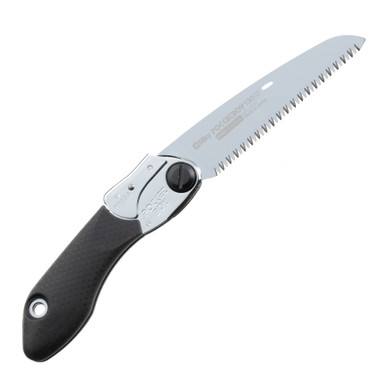
The appeal of this compact folder lies in its refusal to compromise cutting geometry simply because it fits inside a hip-belt pocket. When weight-conscious backpackers need reliable wood-processing capability for small-diameter fuel, downsizing usually means settling for flimsy stamped blades or flexible sheet steel. This model sidesteps those compromises by packing the manufacturer's renowned non-set, impulse-hardened teeth into a rigid five-inch blade that out-cuts tools twice its size. Operating strictly on the pull stroke, the blade tracks true and bites deep into green and seasoned wood alike. It is not designed to fell standing deadwood or process winter wall-tent logs, but for solo hikers feeding a titanium twig stove or maintaining a modest three-season campfire, it eliminates the bulk and heft of traditional pack saws. The chassis feels solid in hand, thanks to a steel backbone clad in grooved rubber that stays secure even when working in freezing rain.
Materials and Construction
The foundation of this saw is a taper-ground, SK4 high carbon steel blade featuring teeth that undergo an impulse-hardening process. This localized electrical heating makes the cutting edge exceptionally hard while keeping the spine ductile enough to absorb working stress. Unlike conventional Western blades with offset teeth, the profile is thicker at the edge and narrows toward the spine, creating a naturally clean kerf without wasted friction. The handle is built around a rigid metal frame enveloped in a vulcanized rubber compound that isolates hand shock and provides positive traction in wet conditions. A stout brass pivot pin maintains lateral rigidity and allows easy disassembly for cleaning sap and debris, while the spring-actuated lock engages with a firm, audible click in two open configurations.
Real-World Cutting Performance
On the trail, the tool behaves like a precision surgical instrument rather than a blunt-force chopping implement. It clears three-inch hardwood branches in fewer than a dozen relaxed pull strokes, self-clearing sawdust rapidly thanks to the mirrored tooth geometry. The medium tooth configuration proves to be the sweet spot for mixed backcountry timber, tearing cleanly through damp softwood without catching and chewing through dry oak without skipping. Because the cutting happens purely on the draw, users must unlearn Western sawing habits; attempting to force the blade forward under downward pressure is an invitation to bind or buckle the relatively thin steel. Letting the weight of the tool do the work yields effortless, square cuts that simplify camp building and fire prep.
Weight and Trail Packability
Tipping the scales just shy of six ounces, the folder sits in an enviable weight bracket for backpackers who normally carry only a fixed blade knife. It folds down to roughly six and a half inches, sliding seamlessly into an exterior mesh pocket, a cook-kit pouch, or an ultralight fanny pack without creating an awkward pressure point against your body. The included hard plastic flip case adds roughly an ounce and a half; while durable and equipped with a functional belt clip, most minimalist hikers leave it at home and slip the folded tool directly into their pack. The rounded edges of the folded rubber handle prevent it from snagging on fragile silnylon shelters or merino layers, making it exceptionally safe to stow loosely inside a pack liner.
Durability and Field Upkeep
The impulse-hardened teeth remain razor sharp through multiple seasons of regular trail maintenance and firewood gathering. The trade-off is that these teeth cannot be touched up in the field with a standard triangular file; once dull, the blade must be replaced as a modular unit. Fortunately, single replacement blades are readily available and swap out with a flathead screwdriver or coin. Because the carbon steel lacks chromium, sap and moisture will induce surface rust if the saw is packed away damp. A quick wipe with mineral oil or camp stove fuel after heavy pine processing keeps the flank slick and clean. The pivot mechanism handles fine dirt well, though a seasonal wash and drop of lubricant prevents the lock button from feeling gritty.
Field Trade-Offs
The primary restriction is physical stroke length. With only five inches of usable cutting edge, tackling timber wider than three or four inches requires sawing around the circumference in stages, which wastes time and tires out the wrist. Working in cramped brush or close to ground level can also be tricky; if the short tip catches on an errant root mid-stroke, the backward momentum can bend the blade. Users who frequently encounter thick downfall across remote pack trails will find the stroke too truncated for sustained labor. Additionally, the aggressive bite can feel grabby on flexible, springy green saplings, which vibrate intensely unless firmly stabilized with an off-hand well clear of the cutting line.
Comparable Alternatives
Hikers weighing options at this price point frequently cross-shop the Bahco Laplander. The Bahco offers a longer blade and cuts on both the push and pull strokes with softer, resharpenable steel, making it far more forgiving of sloppy technique or accidental bending. However, the Laplander weighs nearly two ounces more, cuts significantly slower, and lacks the clinical precision of Japanese tooth geometry. Another in-house alternative is the larger 170mm or 210mm variants from the same brand; while those provide a longer draw that handles wrist-thick logs with far less effort, they push weight past eight ounces and cannot slip discreetly into a pants pocket. For true ounce-counters, this 130mm format remains the benchmark for size-to-speed efficiency.
How we chose
We compared widely available ultralight backpacking saws using maker specifications, retailer listings and published reviews, then ranked 10 against the same criteria below. This is desk research unless a pick is marked field tested. Rankings are editorial. No brand pays for placement, and affiliate links never move a pick up or down.
- Edge geometry and steel
- Grind, stock thickness, and how the steel behaves between sharpenings in real camp tasks.
- Load carriage
- How the suspension handles the loads the pack is actually rated for, over long days.
- Real-world durability
- How the material, stitching, or steel holds up after a season of hard use — not how it looks new.
- Performance in bad conditions
- Wind, rain, cold, and grit are the test. Anything that only works on a nice day gets marked down.
- Weight and packability
- Every ounce has to earn its place in the pack, but not at the cost of something that fails in the field.
- Ease of use
- Setup, adjustment, and maintenance with cold hands, in the dark, without the manual.
PocketBoy 130 Medium Teeth — frequently asked questions
- Is the PocketBoy 130 Medium Teeth worth it?
- We rank it #2 in Ultralight Backpacking Saws. Best compact Silky
- What is the PocketBoy 130 Medium Teeth best for?
- Best for ultralight solo backpacking, twig stove fuel preparation, bikepacking trail maintenance and emergency daypack fire kit. Standouts: remarkable cutting speed through hardwood and softwood up to three inches thick and impulse-hardened teeth hold a sharp edge far longer than stamped carbon blades.
- What are the downsides of the PocketBoy 130 Medium Teeth?
- Short five-inch blade limits efficient timber diameter to roughly wrist-size, Thin high-carbon steel will bind and bend if forced on the push stroke and Hardened teeth cannot be sharpened with field files and require blade replacement.
- What are the key specs of the PocketBoy 130 Medium Teeth?
- Blade Length: 130 mm (5.1 inches) · Tooth Pitch: Medium (10 teeth per 30 mm / 8.5 TPI) · Blade Material: SK4 high carbon Japanese steel · Action: Pull stroke only · Locking Mechanism: Spring-loaded thumb lock with two positions
- Materials and Construction — what should I know about the PocketBoy 130 Medium Teeth?
- The foundation of this saw is a taper-ground, SK4 high carbon steel blade featuring teeth that undergo an impulse-hardening process. This localized electrical heating makes the cutting edge exceptionally hard while keeping the spine ductile enough to absorb working stress.
- Real-World Cutting Performance — what should I know about the PocketBoy 130 Medium Teeth?
- On the trail, the tool behaves like a precision surgical instrument rather than a blunt-force chopping implement. It clears three-inch hardwood branches in fewer than a dozen relaxed pull strokes, self-clearing sawdust rapidly thanks to the mirrored tooth geometry.
Compare side by side
Put the PocketBoy 130 Medium Teeth against any other pick on this list — specs, price, pros, cons and reader ratings.