


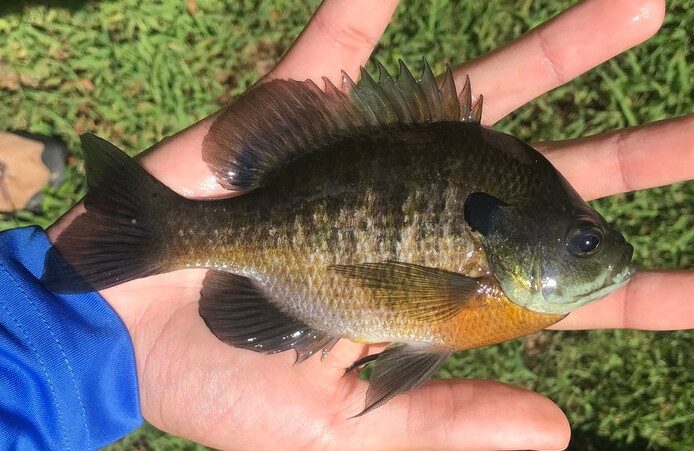
From the north · Wildlife
Bluegill
The fish that teaches everyone to fish, and still the best afternoon on the water for most families.
Lepomis macrochirus
- Range
- Every state but Alaska
- Prime season
- May–August, peaking on the beds
- Access
- Basic license; bank fishing everywhere
- Table quality
- Excellent — sweet and firm
Regulations by region
Bluegill rules where you're headed
Seasons, tags, limits, and legal methods for bluegill are set jurisdiction by jurisdiction. Pick your state or province and we'll point you at the agency that writes the rules.
Jump to another species
About the bluegill
Bluegill are the most-caught gamefish in America and the reason most people own a tackle box. They live in nearly every warm-water pond, lake, and slow river on the continent. They also reward doing it properly. A nine-inch bluegill on a 4-weight fly rod or an ultralight spinning rod fights harder for its size than any other freshwater fish. The bedding period — full moons from late May through July — is the peak, when hundreds of fish fan visible saucer-shaped nests in shallow water and defend them aggressively.
Range, water, and where they live
You can find bluegill almost anywhere. These are places where they get big. Farm ponds: Least pressured, often the biggest fish. Florida lakes: Year-round growth and huge bull bluegill. Great Lakes bays and drowned rivermouths: Big, healthy panfish on weed edges. Southern reservoirs: Long season, heavy spawning colonies. Urban fishing program lakes: Stocked and open to everyone.
Behavior and how they feed
Find shallow cover in warm water, present something small, and keep it still enough for them to eat. Look for beds: light-colored saucer-shaped depressions in two to five feet of water, often in colonies, near shoreline cover. If you can't see beds, fish weed edges, docks, laydowns, and any shade line in shallow water. Use a small bait — a piece of nightcrawler, a cricket, a 1/32 oz jig, or a small popper — on a light hook. Suspend it under a small float 12 to 24 inches deep and let it sit; bluegill inspect before they commit. Downsize the hook before you do anything else if they're nipping and missing — a #8 or #10 hook doubles hookups. On a fly rod, cast a small foam popper or a sponge spider to the bank and let it sit motionless for several seconds before twitching. Move along the bank steadily; a bed colony gives up a lot of fish quickly, and then you find the next one. Keep the bigger bulls only if you plan to eat them, and release the biggest breeders on small ponds.
Where they hold
Bluegill live where the cover is and go shallow to spawn repeatedly through the summer, which makes them the most predictable fish there is. Spawning colonies — Dinner-plate beds clustered on hard bottom in 1–4 feet; find one bed and you have found forty fish. Weed pockets and edges — Openings inside cabbage and lily pads hold fish out of the sun with instant escape cover. Docks and swim platforms — Shade plus barnacle and insect growth on the posts makes docks a permanent food source. Deep weed line — The largest bluegill in a lake spend most of their time on the deep grass edge in 10–18 feet, not in the shallows.
What they eat and what they hit
These are the presentations that consistently produce bluegill, with the conditions each one is actually for — not a tackle-shop wall. Worm under a bobber — A piece of nightcrawler on a #8 hook eighteen inches under a small float. Nothing catches more bluegill. 1/32 oz jig + wax worm — Lets you hold a bait at an exact depth over a bed or a weed pocket. Small foam popper — A #10 popper on a 4-weight over a bed in the evening is the best hour in panfish fishing. Beadhead nymph — Deep, slow-sinking nymphs on the outside weed line take the biggest fish in the lake. Tiny inline spinner — A #0 spinner covers water quickly to locate a school on unfamiliar water.
In the field
This is the most enjoyable low-stakes fishing there is. A summer evening, a bucket of crickets, and a shoreline is a complete outing. It's also the best possible way to teach a child to fish: constant action, no casting distance required, and immediate feedback. The fly-rod version is genuinely fun for experienced anglers — a bull bluegill on a 3-weight turns sideways and refuses to come in.
Licenses, stamps, and limits
The lowest-barrier fishing in the country — but panfish limits are getting tighter as agencies protect big fish. Buy the basic state license; most states exempt anglers under 16. Check the panfish daily limit; several states have reduced it to 10–15 to protect size structure. Confirm whether the water has a combined panfish limit including crappie and perch. Note any live-bait restrictions on the specific water. For private ponds, confirm your state's rules — some require a license even on private water.
Landing, release, and cleaning
What happens between the hookset and the cooler decides whether you land the fish and whether it is worth eating. Use small hooks — #8 to #10. Bluegill swallow big baits and get gut-hooked on oversized hooks. Carry hemostats. A gut-hooked panfish you plan to release should have the line cut at the mouth, not the hook dug out. To keep the fish, dispatch it immediately — a firm rap with a priest or knife spine at the top of the skull, just behind and above the eyes. A bluegill killed instantly tastes better than one that suffocates in a bucket. Bleed it right away: cut the two gill arches on one side, or make a single cut behind the pectoral fin to the artery, and hold it in the water for thirty seconds while it pumps out. Get it on ice — slurry ice (ice plus water plus a little salt) if you have it — within minutes, not at the end of the day. Cold, bled fish is the entire difference between good and muddy-tasting fillets. Harvest the 6–8 inch fish freely; most lakes are overpopulated with small bluegill and thinning them improves the fishery. Cleaning a bluegill the right way takes about four minutes once you know the sequence.
On the table
Bluegill are outstanding eating — sweet, firm, and among the cleanest-tasting freshwater fish. Fillets are small; many people scale and pan-fry the whole fish instead, which is faster and better. On small ponds, harvesting numbers of small bluegill actually improves the fishery, while removing the big bulls hurts it. Ice immediately and eat fresh — panfish do not improve in the freezer.
Field notes
- 5'6" ultralight spinning rod: Makes a half-pound fish feel like a real one; 4 lb line is plenty.
- 8' 3-weight fly rod: The most fun way to fish bedding bluegill with poppers.
- #8–#10 long-shank hooks: Small hooks are the single biggest fix for missed bites.
- Small floats: A pencil float shows the light take that a round bobber hides.
- Crickets, worms, or 1/32 oz jigs: Live bait outfishes everything; jigs keep you fishing when bait runs out.
- Foam poppers and sponge spiders: Sizes 8–12, black and yellow, cover the whole summer.
Bluegill questions, answered
- What's the best bait for bluegill?
- A piece of nightcrawler or a live cricket on a small hook under a float. Nothing else is as consistently effective, and both are cheap and easy to find.
- When do bluegill bed?
- Around the full moons from late May through July in most of the country, when water reaches the upper 60s. Look for colonies of pale, saucer-shaped nests in shallow water.
- Why do I keep missing bites?
- Your hook is too big. Bluegill have small mouths — drop to a #8 or #10 and use a smaller piece of bait, and hookups improve immediately.
- How big does a bluegill get?
- Eight inches is a nice fish, nine to ten is excellent, and anything over eleven is a genuine trophy anywhere in the country.
Official sources and further reading
- Wisconsin DNR — Panfish Regulations
Reduced panfish bag limits and the reasoning behind them.
- Florida FWC — Panfish
Site forecasts for bluegill and shellcracker.