


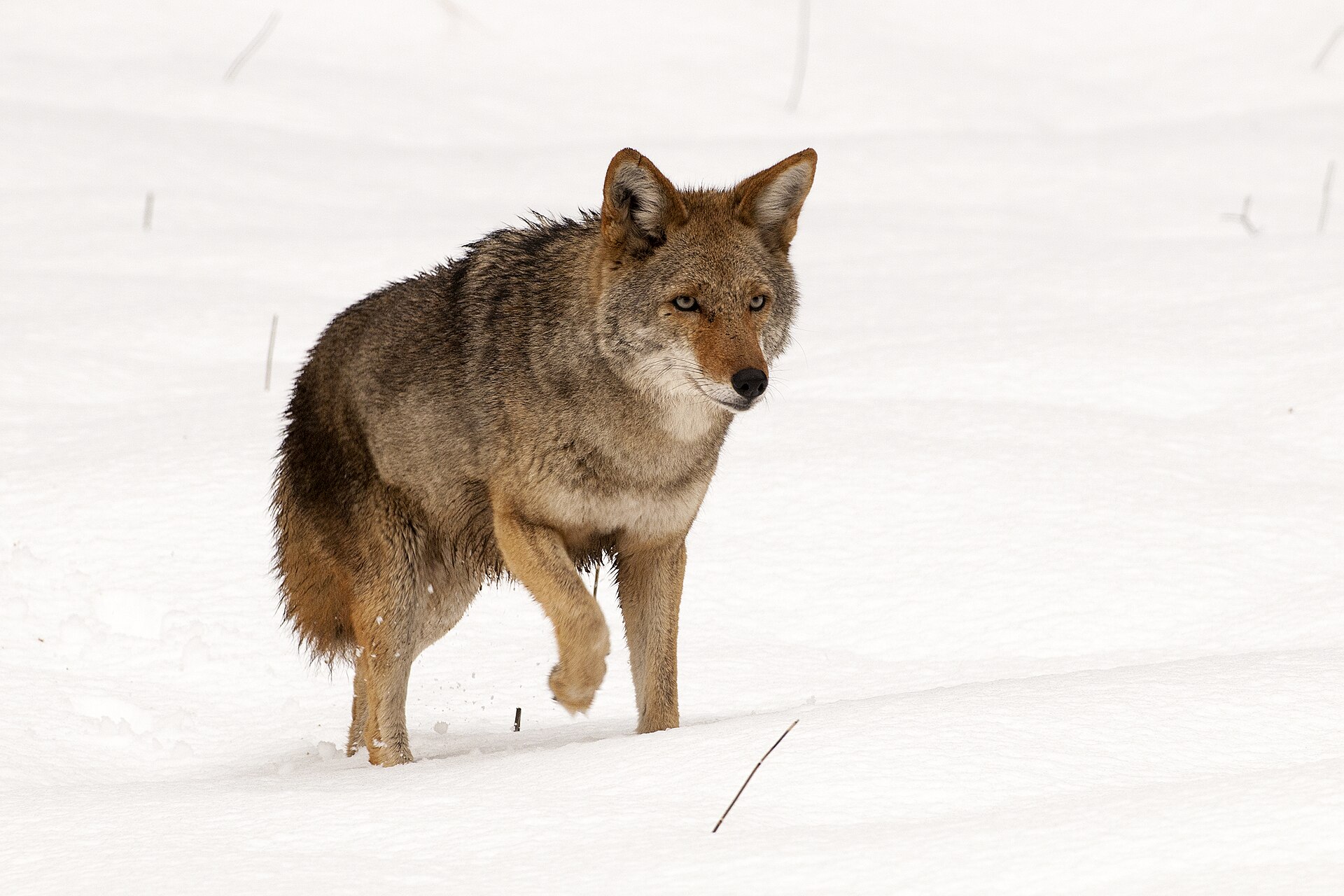
From the north · Wildlife
Coyote
A wary, intelligent predator hunted almost entirely by calling — mimicking a wounded rabbit or a fighting pack to pull a coyote into rifle range.
Canis latrans
- Range
- Continent-wide
- Peak season
- Year-round in most states; winter fur prime
- Tag access
- Over-the-counter
- Live weight
- 20–45 lb
Regulations by region
Coyote rules where you're headed
Seasons, tags, limits, and legal methods for coyote are set jurisdiction by jurisdiction. Pick your state or province and we'll point you at the agency that writes the rules.
Jump to another species
About the coyote
Coyotes are found in every U.S. state except Hawaii, thriving in habitats ranging from western prairie to eastern forest to suburban fringe, and most states classify them as a predator or non-game species with year-round hunting seasons and minimal licensing requirements. Coyote hunting is fundamentally a calling game — using electronic callers or mouth calls to mimic a distressed rabbit, a fawn, or fighting coyotes to trigger a hungry or territorial animal's instinct to investigate, since actively still-hunting or tracking coyotes rarely produces a shot. It's a highly technical hunt built around wind, concealment, and patience against an animal with excellent hearing, sharp eyesight, and a fast-learning wariness toward calls and setups that get used too often in the same area.
Range and habitat
Coyote hunting is available almost everywhere, but open country with good visibility for calling setups — western prairie, agricultural edges, and cutover forest — tends to produce the most consistent action. Kansas & Nebraska: Open agricultural country with excellent visibility for calling setups. Texas: Huge coyote population and largely unrestricted year-round hunting on private land. Wyoming & Montana: Vast open prairie ideal for long-range calling and spotting. New York & Pennsylvania: Strong eastern coyote population in forested and farmland mix. Midwest farm belt: Dense coyote populations near agricultural edges and woodlots.
Behavior and field method
Coyote hunting revolves around setting up in good wind and concealment, then calling to trigger a predator response from an animal you often never see approach. Choose a setup location with good visibility, the wind in your favor, and natural concealment like brush or a slight rise in terrain. Position with the wind blowing from the calling area toward you, since coyotes will often circle downwind to scent-check a call before committing. Begin with quieter, closer-range sounds and build to louder distress calls, mimicking a wounded rabbit or fawn in distress. Stay still and alert for the first ten minutes especially, since coyotes often approach silently and quickly if they're already close when the calling starts. Watch downwind and to the sides as much as straight ahead, since a cautious coyote frequently circles to approach from an unexpected angle. Call for 15-20 minutes per setup before moving to a new location if nothing responds, then relocate at least a half-mile to avoid re-calling an educated animal. Use decoys or a subtle movement device paired with calling to give an approaching coyote a visual focal point away from your position. Hunt at dawn, dusk, or at night with legal lighting or thermal optics where permitted, since coyotes are most active during low-light hours.
Tracks, droppings, and sign
Coyote sign is dog sign with discipline. Learning to separate coyote from domestic dog and fox is what makes the rest of it useful. Tracks — Oval, longer than wide, with four toes and visible claw marks. The two front toes sit ahead of the outer two and the whole print is symmetric — you can draw a straight line between the front toes without touching the outer ones, which you cannot do on a dog track. Coyote trails run straight and purposeful; dog trails wander. Droppings — Twisted, tapered, rope-like scat full of hair, bone chips, and berry seeds, usually deposited conspicuously in the middle of a trail, road, or on a rise. Fox scat is thinner; dog scat is smoother and food-pellet based. Scent posts — Urine marks and scat on prominent objects — rocks, tufts, fence posts, trail intersections — refreshed on a patrol circuit. Dirt-hole and flat sets in trapping exploit exactly this behavior. Kills & caches — Scattered bone, hair, and feathers with crushed rather than sheared bone ends; shallow scratched-over caches of leftover food. Howling — Group yip-howls at dusk and after sirens locate a pack. A stand set 300 yards downwind of last night's howl is a high-percentage setup.
In the field
A coyote hunt is a game of stillness and anticipation — you set up in good cover, start calling, and then simply wait, scanning the terrain in every direction for a shape that might appear silently from any angle. Success often comes fast when it comes at all — a coyote that's already within earshot can close 300 yards in under a minute, meaning a hunter has to be ready to shoot within seconds of starting a call. It's a hunt of many blank setups rewarded by occasional intense action, and serious predator hunters treat every unsuccessful stand as data — refining wind reading, sound selection, and setup choice for the next try.
Regulations, tags, and seasons
Coyote hunting requires only a basic hunting license in most states, with minimal restrictions given their classification as a predator or non-game species in many areas. Buy a general hunting license online from the state wildlife agency — coyotes are often covered under a basic small-game or predator designation. Confirm whether your state has any closed season for coyotes; many have none, allowing hunting year-round. Check night-hunting regulations specifically, since many states restrict or require special permits for hunting coyotes after dark with lights or thermal optics. Verify electronic caller legality, which is allowed in most but not all states for predator hunting. Secure landowner permission on private agricultural land, since much of the best calling terrain is privately owned farmland.
Harvest and processing
Coyotes come to a call fast and downwind. Everything about the harvest depends on where you set up before you ever call. Set up with the wind in your face and something at your back, and watch the downwind side — 80% of coyotes circle downwind before committing. Take a broadside or quartering shot in the shoulder pocket. A .223 or .22-250 with a soft-point drops them; for fur, a smaller frangible bullet reduces exit-hole damage. If you plan to sell or tan the pelt, avoid shoulder shots that blow out the hide — a neck or head shot keeps the fur intact. Watch a hit coyote all the way down and be ready for a second shot; they are tough and run hard on a marginal hit. Wear gloves. Coyotes carry mange mites, fleas, ticks, and occasionally rabies. Get the animal cool and out of the sun immediately if you intend to keep the fur — hair slips fast on a warm carcass. Coyotes are taken for fur and for predator management. Handle the pelt like it is worth money, because in a good year it is.
Meat care and what you take home
Coyotes are not typically hunted for meat; most hunters pursue them for predator management, fur value, or the calling and marksmanship challenge itself. Fur is prime in the coldest winter months, and pelts can have real value depending on the regional fur market and coat quality. Where population management is the goal, many hunters and landowners view coyote hunting as a tool to reduce predation on livestock, poultry, and game bird nests rather than a food-focused pursuit.
Field notes
- Flat-shooting rifle (.223 to .243): A fast, flat-shooting rifle with a good scope handles the typical 50-300 yard predator-calling shot with minimal pelt damage for fur hunters.
- Electronic predator call: A remote electronic caller with a variety of distress and coyote vocalization sounds lets hunters place the sound source away from their own position.
- Camouflage matched to terrain: Coyotes have sharp eyesight; full camouflage matched to the season and habitat, including face coverage, meaningfully improves success.
- Decoy (motion or static): A small decoy near the call speaker gives an approaching coyote something to focus on, buying the shooter time to get into position.
- Thermal or night-vision optics (where legal): In states permitting night predator hunting, thermal optics dramatically improve the ability to spot approaching coyotes in low light.
Coyote questions, answered
- Is coyote hunting legal year-round?
- In most states, yes — coyotes are classified as a predator or non-game species without a closed season, though some states have specific restrictions, especially around night hunting. Confirm current state rules before heading out.
- Do I need an electronic caller?
- No, mouth calls and hand calls work well and are how most predator hunters started, but electronic callers offer more realistic and varied sounds and let hunters place the sound source away from their position.
- What's the best time of day to call coyotes?
- Dawn and dusk generally produce the most action, since coyotes are most active during low-light hours, though calling can work at any time, especially in areas with less hunting pressure.
- How close will a coyote come to a call?
- It varies enormously — some rush in aggressively to within 20 yards, while wary or previously called coyotes may hang up at 200+ yards and never fully commit, requiring a longer-range shot.
- Is night hunting for coyotes legal?
- It depends heavily on the state — some allow night hunting with lights or thermal optics for coyotes specifically, while others restrict or prohibit it. Check current state-specific regulations carefully.
- Why do landowners want coyotes managed?
- Coyotes can prey on livestock, poultry, and ground-nesting game birds, so many farmers and wildlife managers view targeted coyote hunting as a useful population and predation management tool.
Official sources and further reading
- USDA Wildlife Services
Federal predator management resources and coyote population information.
- Find state wildlife agencies
Directory of every state wildlife agency for current predator hunting regulations.
- National Trappers Association
Fur-bearer harvest information and fur market resources relevant to coyote hunting.
- USFWS — Hunting
Federal hunting resources and public land access information.