


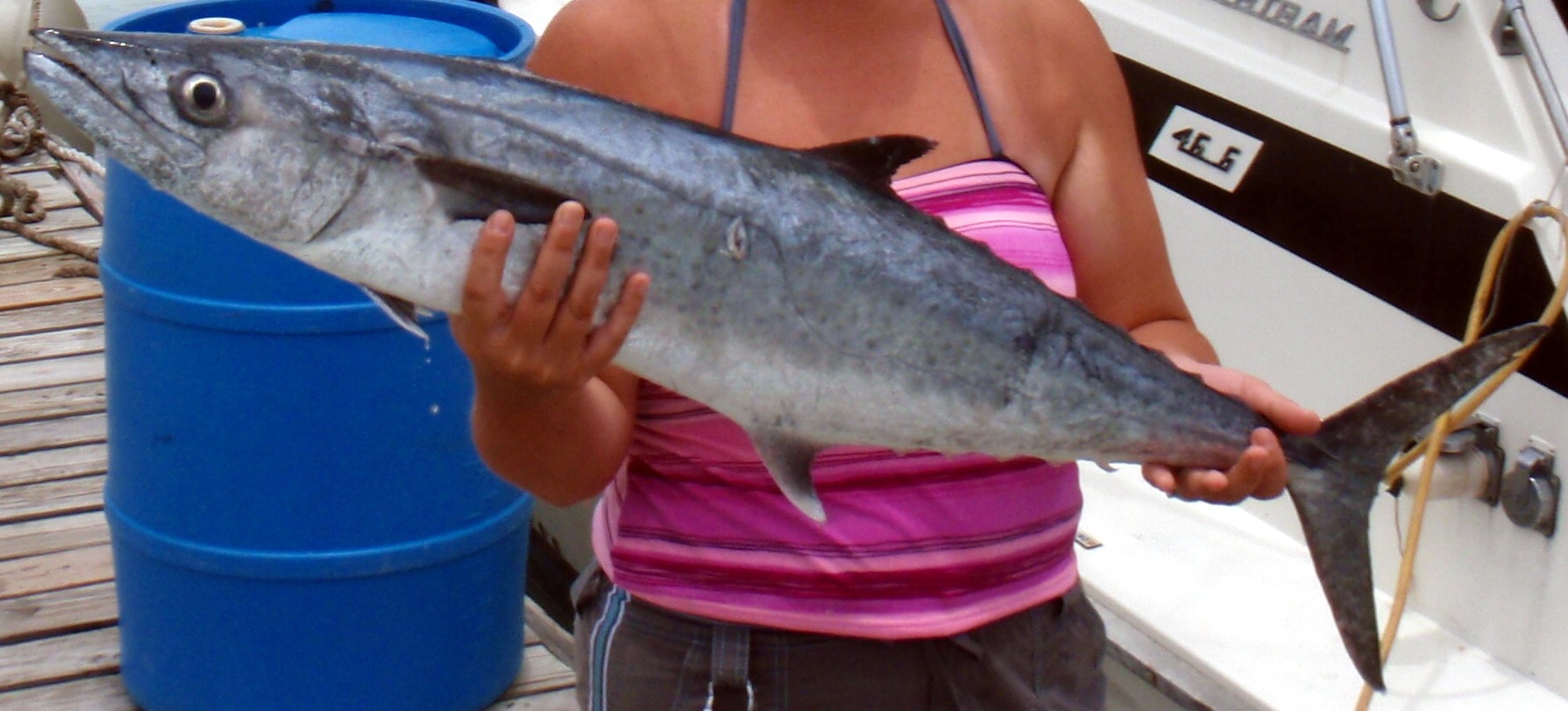
From the north · Wildlife
King Mackerel
A high-speed pelagic predator that skyrockets on live bait and strips a hundred yards of line before you get the rod out of the holder.
Scomberomorus cavalla
- Range
- Gulf of Mexico and Atlantic, NC to Texas
- Prime season
- Spring and fall migrations
- Access
- State saltwater license; federal permit for some
- Table quality
- Good smoked; strong fresh from big fish
Regulations by region
King Mackerel rules where you're headed
Seasons, tags, limits, and legal methods for king mackerel are set jurisdiction by jurisdiction. Pick your state or province and we'll point you at the agency that writes the rules.
Jump to another species
About the king mackerel
King mackerel are speed. They cruise nearshore reefs, wrecks, and bait schools in the Gulf and along the Atlantic coast, and when one eats a slow-trolled bait it does so at a dead sprint — often clearing the water with the bait crossways in its jaws. The fishery is built around that. Slow-trolled live bait on a two-hook stinger rig with a wire leader is the standard, because kings routinely bite a bait in half without touching the front hook. They are also the most accessible offshore-feeling fish for a small boat. Plenty of kings are caught within a few miles of the beach, and the pier fishery for them is a tradition of its own along the Carolinas and the Gulf.
Range, water, and where they live
Kings follow bait and temperature. Find the bait schools over nearshore structure and you have found the fish. North Carolina nearshore reefs: Strong fall run within a few miles of the beach. Florida Panhandle and Gulf reefs: Spring and fall migrations over artificial reefs. Texas jetties and nearshore rigs: Summer fish around platforms and passes. South Florida wrecks: Winter concentration on the deep edge. Gulf and Atlantic fishing piers: Live-bait pier fishery with kite and float rigs.
Behavior and how they feed
Slow-troll live bait over structure with bait present. Everything else is refinement. Catch live bait first — menhaden, blue runners, cigar minnows, or ribbonfish — with a cast net or sabiki over nearshore schools. Locate structure with bait on it: an artificial reef, a wreck, a ledge, or a color change with obvious life. Rig a stinger: a 4/0 nose hook and a trailing treble on single-strand wire, with a short fluorocarbon top leader. Slow-troll at 1.5–3 knots so baits swim naturally, staggering depths with a downrigger or a small trolling weight. Run a flat line, a deep line, and a bait behind a planer to cover the water column. Leave the drag light on the strike. Kings run hard and fast, and a locked drag pulls hooks or breaks off. Do not chase the fish with the boat immediately; let the first run finish, then apply steady pressure. Gaff at the shoulder and control the fish on deck — a green king with those teeth is dangerous.
Where they hold
Kings follow bait along the coast and around structure. Find the bait pods and the temperature break, and the fish are with them. Nearshore wrecks and reefs — Hard bottom in 50–120 feet that holds bait attracts kings on every tide. Bait pods — Menhaden and cigar minnow schools on the surface; kings work the deep side of the pod. Piers — The end of a long pier during the fall run is genuine king mackerel water from land. Color and temperature breaks — A clean water edge with bait on it in 70–75°F water is the classic smoker king setup. Channel markers and buoys — Isolated structure inshore concentrates fish, especially early and late in the run.
What they eat and what they hit
These are the presentations that consistently produce king mackerel, with the conditions each one is actually for — not a tackle-shop wall. Slow-trolled live bait on a stinger rig — A live menhaden or blue runner on a two-hook wire stinger at 1.5–2.5 knots is the tournament method. Trolled spoon behind a planer — A #3.5 silver spoon on a #1 planer at 6–7 knots finds fish fast. Dead bait ribbonfish — A rigged ribbonfish swimming behind the boat is deadly on large fish. Casting jig / spoon — Heavy metal thrown into a skyrocketing king; retrieve as fast as you can crank. Wire leader — Kings shear mono instantly; single-strand #4 or #5 wire is the standard bite trace.
In the field
The strike is the best part of the day. A skyrocketing king clearing the water with a bait is one of the great sights in nearshore fishing. Live bait is the bottleneck. Plan the first hour of the trip around catching it and the day works; skip it and it usually doesn't. Handle them carefully. Kings have razor teeth and thrash violently, and most injuries in this fishery happen at the boat.
Licenses, stamps, and limits
Kings are federally managed with separate Gulf and Atlantic zones, and the rules diverge on size and bag. Buy the state saltwater fishing license; some piers hold a blanket license that covers anglers on the deck. Check the current minimum size — commonly 24 inches fork length — and the daily bag, typically three fish. Verify whether your trip requires a federal Gulf reef fish or HMS permit based on the other species targeted. Confirm circle-hook and dehooking-device requirements in federal waters. Watch for annual catch limit closures, which can shut the fishery mid-season.
Landing, release, and cleaning
What happens between the hookset and the cooler decides whether you land the fish and whether it is worth eating. Kings make blistering first runs. Let the drag work, do not lock down, and keep the rod tip low. Expect a second run at the boat. Do not gaff until the fish is truly done and on its side. Gaff in the shoulder, never the body, and get the fish into the box immediately — the teeth are dangerous on deck. On a keeper, ike jime is worth learning: drive a spike into the brain (a soft spot above and slightly behind the eye) so the king mackerel dies instantly, then bleed and chill it. Bleed by cutting the gill arches or the artery behind the pectoral, and let it drain into the water or a bucket for a full minute before icing. Bury the fish in a slurry of ice and seawater. Warm fish on a deck in the sun loses quality by the minute, especially in the belly meat. Cleaning a king mackerel the right way takes about four minutes once you know the sequence.
On the table
King mackerel is a strong, oily, dark-fleshed fish. Small 'snake' kings eaten fresh are perfectly good; large fish are best smoked. Bleed immediately and ice hard. Trim every bit of the dark bloodline — it holds most of the strong flavor. Large king mackerel carry elevated mercury. Health agencies advise limiting or avoiding consumption of big fish, especially for children and pregnant women.
Field notes
- 7' medium-heavy trolling rod: Moderate action that cushions a screaming first run.
- Conventional reel with 250+ yd of 20–30 lb: Capacity matters; a big king takes a lot of line quickly.
- Single-strand wire stinger rigs: Kings shear mono instantly and often bite baits in half.
- Live menhaden, blue runners, cigar minnows: The most effective baits, in that order, where available.
- Downrigger or trolling weights: Puts a second bait in the strike zone below the surface.
- Long gaff and heavy gloves: Safe boarding of a thrashing, toothy fish.
King Mackerel questions, answered
- What is the best way to catch king mackerel?
- Slow-trolling live bait at 1.5 to 3 knots over nearshore structure that holds bait, using a two-hook stinger rig on single-strand wire. The trailing treble is what converts the short strikes kings are famous for.
- Why do I need a wire leader?
- King mackerel teeth cut monofilament and fluorocarbon instantly. Single-strand wire in the 30–45 lb range is standard and does not noticeably reduce strikes when it is kept short and clean.
- When is king mackerel season?
- Kings follow water temperature, so the fishing peaks during the spring and fall migrations in most of their range, with a winter concentration in south Florida and summer fish off Texas and the Panhandle.
- Can you catch kings from a pier?
- Yes — the Carolina and Gulf pier king fishery is a long-running tradition, using live bait floated out on a balloon or kite from a specialized pier cart rig.
- Is king mackerel good to eat?
- Smaller fish are good, especially smoked or grilled fresh. Larger kings are strong-flavored and carry higher mercury levels, so agencies recommend limiting consumption of big fish.
Official sources and further reading
- NOAA Fisheries — King Mackerel
Federal management zones, stock status, and annual catch limits.
- Florida FWC — King Mackerel Regulations
Size and bag limits, and gear requirements.
- FDA/EPA — Fish Consumption Advice
Mercury guidance covering large king mackerel.