


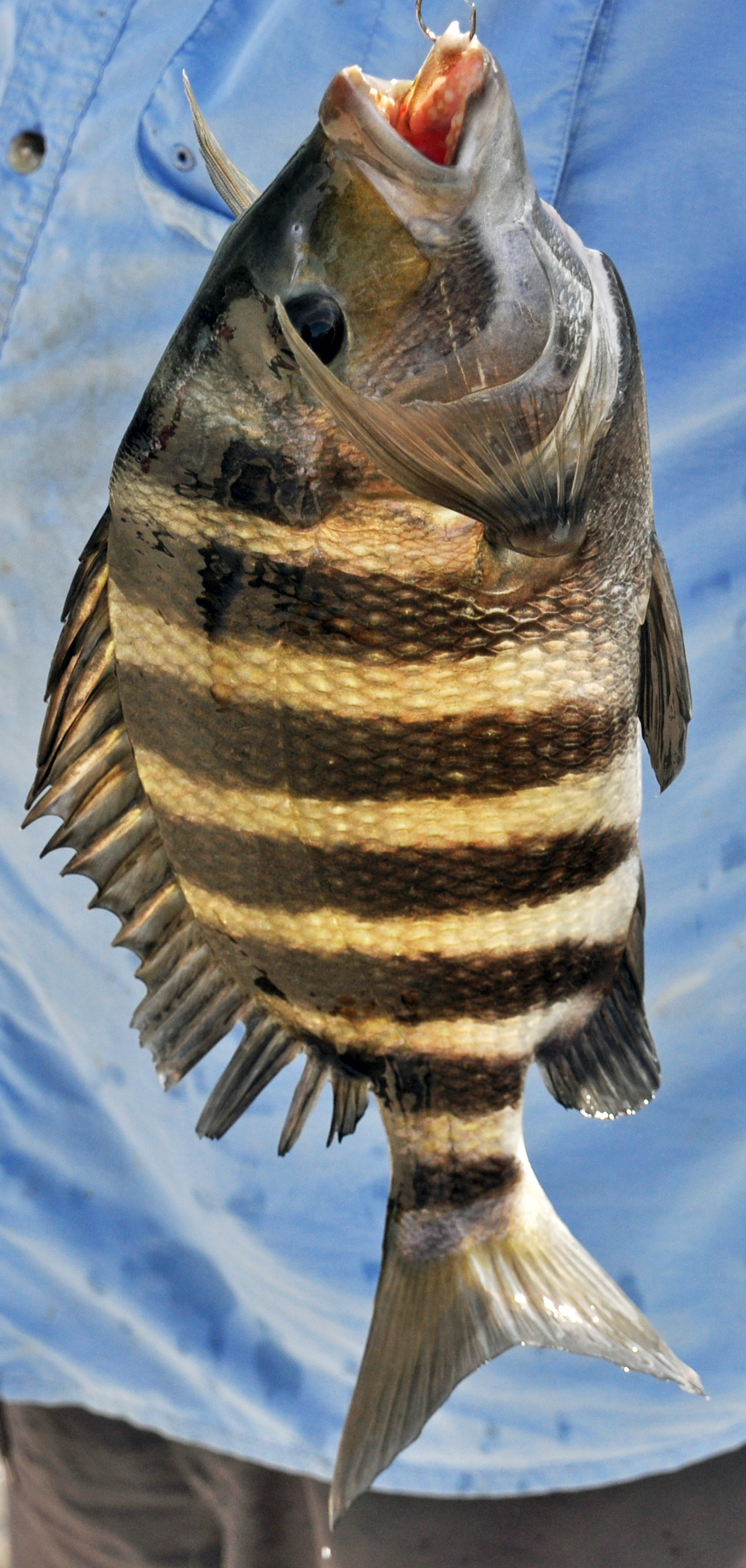
From the north · Wildlife
Sheepshead
A structure-hugging convict-striped bait thief with human-like teeth — the hardest inshore fish to hook and one of the best to eat.
Archosargus probatocephalus
- Range
- Mid-Atlantic through Gulf of Mexico
- Prime season
- December–April spawning concentration
- Access
- State license; excellent from docks and jetties
- Table quality
- Excellent — sweet, firm, crab-like
Regulations by region
Sheepshead rules where you're headed
Seasons, tags, limits, and legal methods for sheepshead are set jurisdiction by jurisdiction. Pick your state or province and we'll point you at the agency that writes the rules.
Jump to another species
About the sheepshead
Sheepshead are a bait thief with a professional reputation. They eat barnacles, oysters, crabs, and shrimp off hard structure using a mouth full of flat, human-looking molars, and they can remove a shrimp from a hook without moving your rod tip. The species rewards a completely different skill set from most inshore fishing. Instead of casting and covering water, you tie up to a piling, drop a small bait vertically against it, and learn to detect a bite that feels like nothing at all. Winter is their season. From December through April, sheepshead move to nearshore structure to spawn and concentrate in numbers around bridges, jetties, reefs, and dock pilings, exactly when most other inshore species are slow.
Range, water, and where they live
Anywhere there is hard structure with growth on it in the Gulf or South Atlantic, there are sheepshead. Gulf Coast bridges and piers: Dense winter concentrations on piling growth. Louisiana nearshore rigs and reefs: Very large fish on platform legs. Florida jetties and inlets: Year-round fish with a strong winter peak. Chesapeake Bay bridge-tunnel: Northern-range fish on rock and pilings. Texas jetties and bay docks: Consistent winter and spring fishery.
Behavior and how they feed
Get tight to structure, use small hooks and natural bait, and learn to set on pressure rather than on a strike. Find structure with visible barnacle or oyster growth — pilings, bridge fenders, jetty rock, reef edges, and dock ladders. Scrape the growth with a hoe or a paint scraper to chum the area; this genuinely brings fish in. Anchor or tie off so the boat sits within a rod's length of the structure. Rig small: a 1/0 to 2/0 short-shank hook, a split shot or knocker rig, and 20 lb fluorocarbon. Bait with fiddler crabs, small blue crab pieces, oysters, or fresh shrimp — fiddlers first where you can get them. Drop straight down, keep the bait within inches of the piling, and hold the line lightly between your fingers. Set on weight, not on a tap. The bite feels like the bait suddenly got heavier or the line went slack. Once hooked, lift immediately and get the fish away from the barnacles before it cuts you off.
Where they hold
Sheepshead live on hard, fouled structure and eat what grows on it. If there are barnacles, there are sheepshead. Barnacle-covered pilings — Bridge and dock pilings with growth on them; fish sit vertically against the piling, not out from it. Jetties and rock groins — The rock face and the sand pocket at its base, especially on moving water. Oyster bars and reefs — Fish work the edges on the last of the incoming tide. Nearshore wrecks — Big sheepshead move offshore to hard bottom in late winter to spawn — the trophy season. Marina structure — Any marina with growth on the pilings holds fish and is fishable from shore.
What they eat and what they hit
These are the presentations that consistently produce sheepshead, with the conditions each one is actually for — not a tackle-shop wall. Fiddler crab — Hooked once through the shell from the back; nothing else comes close. Live or fresh shrimp — Small pieces on a small, strong hook fished tight to the piling. Oyster or barnacle scrape — Scrape the pilings with a hoe to chum and use the same growth as bait. Sand fleas — The best bait on a rock jetty and free if you dig them in the wash. Small, strong hook (#1–1/0) — Sheepshead have a small mouth and human-like teeth; a big hook does not fit and a weak hook straightens. Knocker or split-shot rig — Just enough weight to keep the bait against the piling in current, with nothing to snag on.
In the field
The learning curve is the bite detection. Expect to lose a lot of bait before you start recognizing the pressure change. Cold, windy winter days on a bridge are the productive ones. Dress for it, because the best fishing is in the least pleasant weather. Sheepshead have real teeth and sharp dorsal spines. Handle them with a towel and grip behind the head.
Licenses, stamps, and limits
Simple licensing, but size and bag limits differ meaningfully between Gulf states and have tightened in recent years. Buy the state saltwater license or fish from a pier that holds a blanket license. Check the current minimum size — commonly 12 to 15 inches depending on the state. Confirm the daily bag; several Gulf states have reduced sheepshead limits recently. Note that some states now have a spawning-season vessel limit in addition to the personal bag. Verify access rules for bridges and jetties, which are frequently regulated separately from open water.
Landing, release, and cleaning
What happens between the hookset and the cooler decides whether you land the fish and whether it is worth eating. Sheepshead bite is famously subtle — the old advice is to set the hook right before they bite. Watch the line, not the rod tip, and set on any hesitation. Keep the fish out of the piling immediately; they cut leaders on barnacles as fast as any toothy fish. Handle carefully: the dorsal and anal spines are sharp and stiff. Grip across the back behind the spines with a glove. To keep the fish, dispatch it immediately — a firm rap with a priest or knife spine at the top of the skull, just behind and above the eyes. A sheepshead killed instantly tastes better than one that suffocates in a bucket. Bleed it right away: cut the two gill arches on one side, or make a single cut behind the pectoral fin to the artery, and hold it in the water for thirty seconds while it pumps out. Get it on ice — slurry ice (ice plus water plus a little salt) if you have it — within minutes, not at the end of the day. Cold, bled fish is the entire difference between good and muddy-tasting fillets. Cleaning a sheepshead the right way takes about four minutes once you know the sequence.
On the table
Sheepshead is superb eating — firm, white, sweet, and often described as tasting faintly of crab because of what it eats. They are difficult to clean. The scales are heavy, the rib bones are thick, and a sharp, stiff fillet knife is required. Fillet, skin, and cook simply — pan-seared or fried. The meat is good enough that it needs almost nothing.
Field notes
- 7' medium spinning or casting rod, fast tip: Sensitive tip to feel the bite, backbone to lift a fish off structure.
- 3000 reel with 20 lb braid: Braid transmits the subtle weight change that is the bite.
- 20–25 lb fluorocarbon leader: Abrasion resistance against barnacles and low visibility in clear water.
- 1/0–2/0 short-shank hooks: Fit a sheepshead's small mouth; big hooks simply do not get eaten.
- Fiddler crabs or fresh shrimp: Fiddlers are the premium bait and stay on the hook better.
- Barnacle scraper or garden hoe: Scraping growth off a piling pulls fish to your spot within minutes.
Sheepshead questions, answered
- What is the best bait for sheepshead?
- Fiddler crabs, by a clear margin. Small pieces of blue crab, oysters, barnacles scraped from the piling, and fresh shrimp all work, but fiddlers stay on the hook and are the bait sheepshead eat naturally.
- Why can't I hook sheepshead?
- Because they crush and mouth the bait rather than striking it. Use a small short-shank hook, keep the line barely tight, and set the hook when you feel the bait get heavy — not when you feel a tap.
- When is the best time to catch sheepshead?
- December through April, when they gather on nearshore structure to spawn. Winter concentrations around bridges, jetties, and reefs are the peak of the year.
- Does sheepshead taste good?
- Very. The flesh is firm, white, and sweet with a mild shellfish note that comes from a diet of crabs and barnacles. Cleaning is the only hard part.
- How do you clean a sheepshead?
- Use a stiff, sharp fillet knife and expect resistance. Cut behind the head, ride the rib cage carefully, then skin the fillet. Many anglers use an electric knife purely because of how heavy the scales and ribs are.
Official sources and further reading
- Florida FWC — Sheepshead
Size limits, bag limits, and vessel limits by season.
- Louisiana Department of Wildlife and Fisheries
Regulations and nearshore structure access.
- Texas Parks & Wildlife — Saltwater Fishing
Jetty and bay regulations and current limits.