


From the north · Wildlife
Moose
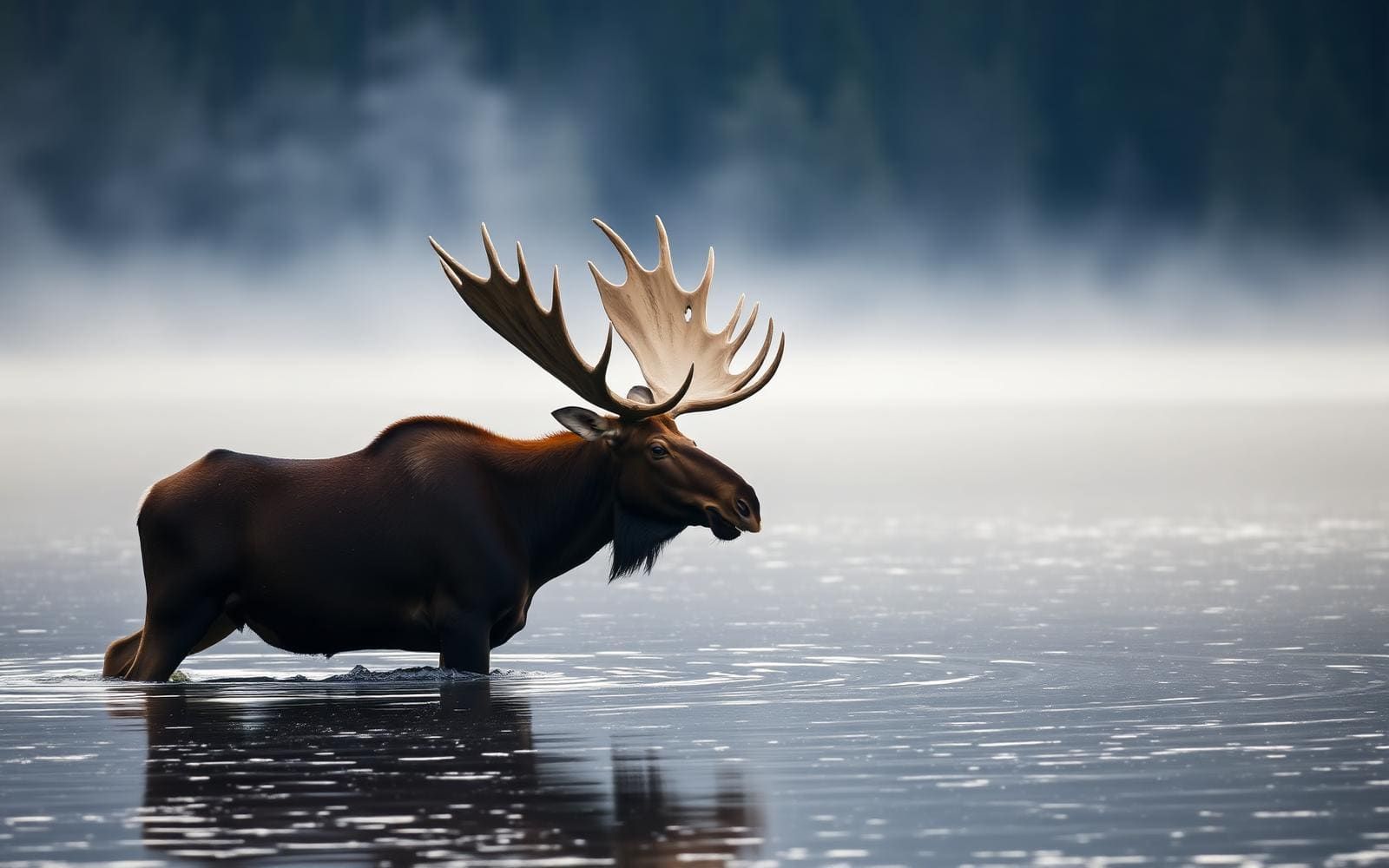
The largest deer on Earth — a 1,000-pound answer to every question about protein, danger, and river crossings in the boreal.
Alces alces
- Weight
- 800–1,600 lb (360–725 kg)
- Shoulder height
- 5.5–7 ft
- Antler spread
- Bulls: 4–6 ft palmated
- Lifespan
- 15–20 yr wild
- Diet
- Willow, aspen, aquatic plants, birch
- Home range
- 5–50 sq mi
- Calves
- 1–2 per yr, born late May
- Range
- Boreal & sub-arctic across N. America and Eurasia
- Peak season
- Late Sept – Oct rut
- Tag access
- Once-in-a-lifetime draw
- Live weight
- 800–1,600 lb
Regulations by region
Moose rules where you're headed
Seasons, tags, limits, and legal methods for moose are set jurisdiction by jurisdiction. Pick your state or province and we'll point you at the agency that writes the rules.
Jump to another species
The most dangerous animal in the woods
A moose injures more people in the North than bears and wolves combined. They are unpredictable, extremely fast off the mark, and will absolutely defend calves, rut territory, or personal space with a front-hoof strike that shatters bone. A cow with a calf in June, or a rutting bull in September–October, should be treated with more caution than any predator you may meet on the same trip.
Country to expect them
Willow flats along river oxbows, beaver flowages, burn-regeneration in a 5–15-year window, alder-choked creek bottoms, and shallow lakeshores where they feed on aquatic vegetation. In winter they yard up in mature conifer with a browsable understory. Fresh sign is unmistakable: dinner-plate hoof prints, chin-height stripped willow, and piles of moist oval pellets like small chocolate footballs.
Rut behavior
Bulls rut from mid-September to mid-October. A rutting bull grunts, thrashes willows, digs urine wallows, and will charge anything — moose, human, canoe, ATV — that comes between him and a cow. The 'wallow' is a mud pit soaked with urine that cows roll in; if you smell strong urine along a game trail in fall, back out. Cow calls answered by a grunting bull crashing toward you are how most rut-related injuries start.
As food and calories
A downed adult moose is 400–800 lb of edible meat and organs — the single largest calorie source available in the boreal. It is also a magnet: wolves, bears, wolverines, and ravens locate a kill within hours. If you take one (legal harvest only), quarter and hang immediately, cache under bear-resistant cover, and expect night visitors. Never sleep next to a kill.
Winter yards
In deep snow, moose gather in yards — dense conifer stands where the canopy intercepts snow and browse is reachable. A yard cut off from spring green-up by early logging or roads becomes a starvation trap. Reading a fresh yard in February is reading who survived the last two months, and predicting who the wolves will pressure next.
About the moose
A bull moose stands seven feet at the shoulder and can exceed 1,400 pounds. There is no other animal in North America where the hunt is easy relative to the recovery — you can shoot a moose 400 yards from the truck and still spend two full days getting it out. In the Lower 48, moose tags are the scarcest big-game permits there are. Most states issue them as once-in-a-lifetime licenses, meaning that if you draw and fill one, you can never apply again in that state. Alaska, the Yukon, Newfoundland, and much of Canada are the realistic destinations for someone who wants to hunt moose in this decade rather than in retirement.
Range and habitat
Split your thinking into Lower 48 lottery states, Alaska (where a nonresident can buy a tag but needs logistics), and Canadian provinces where an outfitter books you a guaranteed hunt. Alaska: Highest densities and the biggest bulls; huge public land. Maine: Best moose hunting in the eastern U.S.; strong success rates. Wyoming, Montana & Idaho: Shiras moose in classic mountain willow country. Utah, Colorado & New Hampshire: Small but stable Shiras and eastern herds. Newfoundland: Introduced population at extremely high density; affordable outfitted hunts. British Columbia, Yukon & Ontario: Big Canada and Alaska–Yukon moose in remote country.
Behavior and field method
Moose are hunted almost entirely by calling them out of thick willow and timber during the rut, then solving the very real problem of getting a half-ton animal out of the country. Scout lake edges, willow flats, and river bottoms for fresh tracks, rubs, and wallows in the weeks leading into the late-September/October rut. Set up on a ridge or lake edge at first light with good sightlines into willow flats, and stay downwind of where you expect a bull to approach. Make long, mournful cow calls and rake brush with a paddle or shed antler to imitate a rival bull thrashing — then go silent and wait; a bull may take an hour to respond and show. Let the bull commit fully into range before moving; moose in the open often come surprisingly close and calm. Confirm you can physically work the kill site — never shoot a bull in deep water or a bog you can't get into, no matter how good the shot looks. Place the shot into the shoulder crease with a heavy, deep-penetrating bullet, and wait before approaching to confirm the animal is down. Immediately begin quartering with the gutless method, bag every piece, and stage a multi-trip haul plan (pack, canoe, cart, or outfitter) before you're exhausted — the packout is the real second half of the hunt.
Tracks, droppings, and sign
Moose leave the biggest sign in North America and they leave it in swamps, willows, and burns. If you find fresh moose sign you are usually within a mile of the moose, because they do not travel far. Tracks — Enormous, pointed, deeply cloven, and often sunk 6 inches into muskeg with dewclaws printing behind. No other North American track is this large and this pointed — caribou tracks are equally big but round and crescent-shaped. Droppings — Winter browse produces oval pellets the size of a large olive in piles the size of a dinner plate. Summer aquatic feeding produces a loose brown pat. Volume alone identifies moose — nothing else in the woods produces this much. Rubs & thrashing — Willow and aspen stands torn apart at shoulder height, whole saplings snapped, and bark scraped in wide swaths. Fresh thrashing during the September–October rut means a bull is working that patch. Wallows — Pawed-out, urine-soaked pits about the size of a bathtub, usually in a willow flat opening. They stink strongly enough to smell from downwind at a hundred yards. Browse line — Willow and birch clipped off cleanly at 6–8 feet — far above deer height — plus stripped bark on aspen. Cropped aquatic vegetation and churned mud at a pond edge means a summer or early-fall feeding pattern.
In the field
Moose hunting in the rut is a calling hunt. You sit on a ridge over a willow flat or paddle a lake edge at first light, make long mournful cow calls, and rake a shoulder blade against brush to imitate a bull thrashing. A responding bull may grunt back for an hour before he appears. The animals seem improbably calm and enormous when they arrive. Shots are usually inside 200 yards, often much closer, and the challenge is not marksmanship but choosing a spot where you can physically deal with the animal afterwards. Never shoot a moose in water or deep in a bog you cannot work in. Experienced hunters will pass a bull rather than kill one on the wrong side of a beaver pond. After the shot, the real hunt begins. Two people with sharp knives will spend six to ten hours quartering and bagging, and then move 400–600 pounds of meat — often multiple miles, sometimes by canoe, raft, or bush plane. Weather in prime moose country in October is cold, wet, and buggy earlier in the season. It is a hunt where your camp system and your ability to keep working in the rain matter more than your rifle.
Regulations, tags, and seasons
Moose applications are cheap and the odds are long, which makes them the ideal 'lottery ticket' line item in a western application budget. Put in every year and forget about it. Apply in every once-in-a-lifetime state you can afford: Wyoming, Montana, Idaho, Utah, Colorado, New Hampshire, and Maine each cost $10–$50 in application and point fees. Understand the once-in-a-lifetime rule. Filling a tag usually ends your eligibility in that state permanently, so treat a draw as the trip of a lifetime. For a hunt you can actually book, look at Newfoundland or a Canadian guide-outfitter — licenses come with the hunt and success rates are commonly 80%+. In Alaska, a nonresident can hunt moose unguided if accompanied by an Alaska resident relative or hunting on their own with the right tag; check the current guide-required species list before you plan. Budget for transport. A drop-camp fly-in Alaska moose hunt runs $6,000–$12,000; a fully guided Canadian hunt is $10,000–$20,000. Plan the meat before the shot. Alaska has strict salvage laws requiring all edible meat to come out, and bush planes charge by the pound for extra flights.
Harvest and processing
A moose is a thousand pounds of meat that will spoil in twelve hours if you leave it in the hide. Shoot one only where you can physically get it out. Watch the moose after the shot instead of running to the spot. Mark the exact stance with a landmark, note the direction of travel, and listen — a crash you hear is worth more than a blood trail you guess at. Give a body-hit animal 30–45 minutes before you take up the trail, and a gut-hit animal 6–8 hours. Pushing a wounded animal is the single most common way hunters lose one. Trail with flagging tape at each blood spot so you can see the line of travel and back up to the last sign if you lose it. Bright blood with bubbles is lungs; dark blood with green flecks is paunch. Confirm the animal is dead by touching an open eye with a stick or the muzzle before you set the gun down and start handling it. Tag the animal immediately if your state requires it, and photograph it where it fell before you move anything — that photo is also your proof of legal harvest in most jurisdictions. Roll the animal onto its back or downhill on its side. Ring the anus with a knife and tie it off with a zip tie or twine so nothing spills into the body cavity. Nobody hangs a moose. You break it down where it lies, in the water or the muskeg, and you do it fast.
Meat care and what you take home
A mature bull produces 400–600 pounds of boneless meat — one animal can fill two chest freezers and feed a family for a year. Cool it aggressively. Break the animal into quarters, get every piece into a breathable bag off the ground, and separate the pieces so air can circulate. Moose is lean, mild, and slightly sweeter than elk. Loins and hindquarters as steaks and roasts; the rest into grind, stew, and sausage.
Male vs. female
How to tell a male from a female
Male
Bulls carry massive palmated antlers from May (velvet) through November (drop), plus a heavy dewlap ('bell') hanging under the chin. In rut they develop swollen necks and dark, urine-stained shoulders. Boy moose average 200–400 lb heavier than cows.
Female
Cows are antlerless year-round, with a slimmer face and no dewlap. From May onward a cow with a red-brown calf trailing behind is the typical summer sight. Cows defend calves more aggressively than any bear.
At a distance
Any moose carrying antlers from June through October is a bull. Any moose with a small red-brown calf close by is a cow — and the most dangerous single animal in the woods that day.
Field notes
- Ears flat back, hackles up, tongue licking the muzzle — the bull has decided to charge. Get a tree between you now.
- A cow snorting and stomping between you and a hidden calf is a warning. Retreat exactly the way you came, do not circle.
- A fresh urine wallow smelling strongly of ammonia in September means a rutting bull is inside 200 yards.
- Adequate rifle: .30-06, .300 Win Mag, .338 Win Mag, or .35 Whelen with heavy, deeply penetrating bullets. Shot placement into the shoulder crease; a moose can absorb a poor hit and walk into cover you cannot follow into.
- Cow call & birch-bark megaphone: Long, drawn-out cow calls carry a mile in still morning air. Add brush raking with a paddle or shed antler to imitate a rival bull.
- Two sharp knives, a saw, and 6+ large game bags: You are butchering the largest animal you will ever break down in the field. Bring twice the blades and bags you think you need.
- Meat pack plus haul system: Frame pack, game cart if terrain allows, canoe or raft on water routes, or a pre-arranged plane or outfitter with stock.
- Waders or serious waterproof boots: Moose live in willow bogs and lake edges. Wet feet on day one ruins a ten-day hunt.
- Cooler / cooling plan: In warm early-season weather a moose spoils quickly. A hanging pole, shade, and airflow immediately; ice or a processor within a day or two.
Where you'll find it
Filming locations with moose
On screen
Alone seasons where contestants encountered moose
Moose questions, answered
- What are my odds of drawing a moose tag?
- In most Lower 48 states, well under 1% per year for nonresidents even with maximum points. Maine's nonresident lottery runs around 1–2%. Apply every year because the cost is small, but plan any moose hunt you actually intend to take around Alaska or Canada.
- Do I need a guide to hunt moose?
- In Canada, nonresident aliens must hunt with a licensed guide-outfitter. In Alaska, moose is generally not on the guide-required list, so a self-sufficient DIY or drop-camp hunt is legal — but the logistics are serious. In the Lower 48, no guide is required.
- How do you get a moose out of the backcountry?
- In pieces, repeatedly. Plan on four to eight loads of 80–100 pounds per person, or a boat, raft, game cart, packhorse, or bush plane. Decide your recovery plan before you pull the trigger — that decision is the hunt.
- When is the moose rut?
- Late September through mid-October across most of the range, peaking earlier in the far north. Bulls are most responsive to calling in the seven to ten days before peak breeding.
- Is a moose dangerous?
- A rutting bull or a cow with a calf will absolutely charge, and a moose kills and injures more people annually in Alaska than bears do. Keep an escape route and a tree between you and any moose that pins its ears and raises its hackles.
Official sources and further reading
- Alaska Department of Fish & Game — moose
Unit regulations, salvage law, and guide-required species list.
- Maine IFW moose permit lottery
The largest eastern moose lottery — rules, odds, and deadlines.
- Wyoming Game & Fish moose
Once-in-a-lifetime Shiras moose application and point rules.
- Boone and Crockett — moose categories
Distinguishing Canada, Alaska–Yukon, and Shiras moose for records and regulations.