


From the north · Wildlife
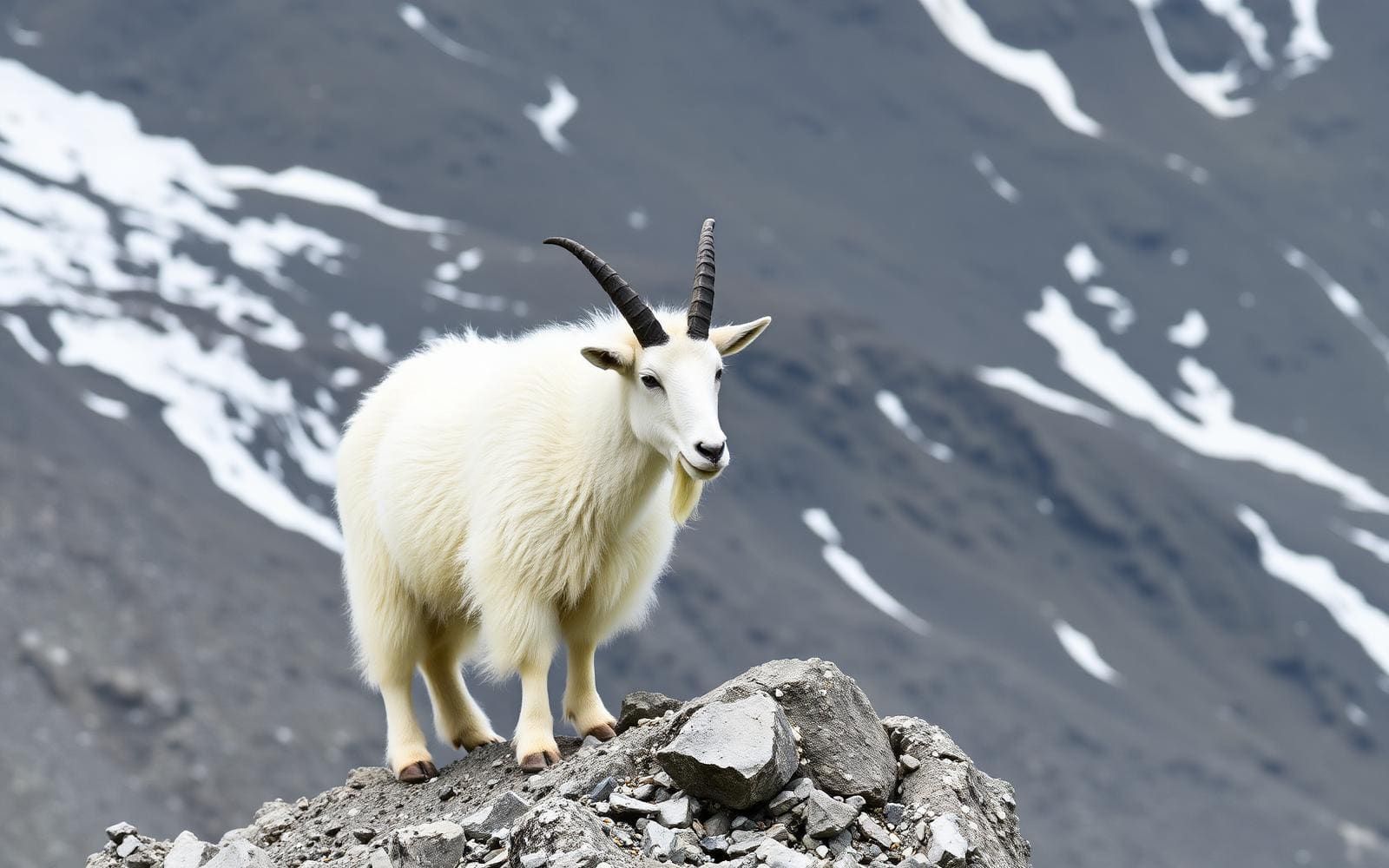
Mountain goat
A cliff-adapted alpine specialist — not a true goat, and one of the few large mammals more sure-footed than a cougar on wet rock.
Oreamnos americanus
- Weight
- 125–250 lb (billy); 100–180 lb (nanny)
- Shoulder height
- 3–3.5 ft
- Horns
- 9–12 in, black, dagger-shaped, both sexes
- Lifespan
- 12–15 yr wild
- Habitat
- Alpine cliff, scree, mineral licks
- Group size
- Nannies + kids in bands of 4–20; billies mostly solitary
- Kids
- 1–2 per yr, born late May on cliff ledges
- Range
- BC Coast & Interior, SE Alaska, Rockies, N. Cascades
- Peak season
- Sept – Nov, unit specific
- Tag access
- Once-in-a-lifetime draw
- Live weight
- 100–300 lb
Regulations by region
Mountain goat rules where you're headed
Seasons, tags, limits, and legal methods for mountain goat are set jurisdiction by jurisdiction. Pick your state or province and we'll point you at the agency that writes the rules.
Jump to another species
Why cliff country
Mountain goats trade grass biomass for absolute predator security. No wolf, cougar, or bear willingly follows a goat onto 55-degree exposed rock, so the animal spends its life on ledges that would kill any other ungulate. The hoof is soft-padded inside and hard-shelled outside, giving the traction a climbing shoe imitates. Where you see them is almost never where you can safely go.
Country in the Chilko region
In the interior BC ranges around Chilko Lake, goats hold high on the granite headwalls above treeline all summer, drop to mineral licks in mid-summer, and winter on wind-scoured south-facing cliffs where snow blows clear. Look for white specks on grey rock at 6,000–8,000 ft, and for tufts of white belly hair caught on krummholz or ice-glazed shrubs at treeline.
Nannies vs. billies
Nannies (females) and their kids form bands that dominate the best cliff terrain year-round. Billies (males) live largely alone or in loose bachelor groups from spring through summer and only rejoin the females for the November rut. In any mixed group, the animal being avoided by the others is usually a nanny — nannies dominate billies on the mountain, an unusual pattern among ungulates.
As game and as danger
Where legal, mountain goat is a demanding backcountry hunt with very high risk of a fatal fall on the recovery. As a wildlife hazard: a mountain goat is generally indifferent to humans, but goats habituated to salt (sweat, urine) in high-use trail corridors will follow hikers and have gored people at Olympic National Park and elsewhere. Do not urinate on trail — urinate off-trail on rock — in goat country to avoid training them onto the tread.
Winter survival
Goats winter high, not low. On the coldest days they cluster on wind-scoured cliffs where the snow blows clear enough to reach lichen and cured grass. A late spring storm that ices the cliffs is a bigger mortality event than any winter, because it seals off the last forage. Long spring die-offs on inaccessible ledges are the reason ravens work certain faces every May.
About the mountain goat
Mountain goats live on the steepest, most exposed terrain of any North American big game — sheer cliff bands, scree chutes, and knife-edge ridgelines well above treeline, often in country where a mule deer or elk simply couldn't survive. Nearly every state and province issues mountain goat tags as extremely limited or once-in-a-lifetime licenses, and several require a mandatory hunter-education or orientation course specific to goat terrain before you can even hunt. This is as much a mountaineering skill test as a hunting skill test. More goat hunters are injured or killed by falls than by any other cause in North American big-game hunting, and terrain assessment matters more than marksmanship.
Range and habitat
The best goat hunting splits between Rocky Mountain interior populations (Montana, Colorado, Wyoming) and coastal populations in Alaska, British Columbia, and the Cascades that live in even steeper, wetter terrain. Alaska: Largest goat population and the most accessible nonresident hunting. British Columbia: Excellent interior and coastal goat hunting. Montana & Wyoming: Strong Rocky Mountain herds in classic high alpine terrain. Colorado & Utah: Transplanted, well-managed herds with limited units. Washington (Cascades): Wet, steep, brushy coastal-style terrain close to the Lower 48 population centers.
Behavior and field method
Goat hunting is glassing distant cliff bands from a stable position, then executing a careful, terrain-first stalk that never puts you in a position you can't safely climb back out of. Glass basins and cliff faces from across a drainage using a spotting scope, looking for the white coat against dark rock, which stands out even at long range. Study a billy for several minutes to judge horn mass and confirm sex — nannies and billies look similar at a distance, but a nanny is often paired with a kid. Plan a stalk route that approaches from above or level with the animal along stable ground, avoiding loose scree and wet rock wherever possible. Move deliberately and test footing before committing weight, since a fall in goat country is often unrecoverable — speed is never worth the risk here. Close to a range you can shoot confidently from a solid rest, since a wounded goat that falls or runs into a cliff band may be unrecoverable. Take a broadside shot into the vitals only when your own footing and follow-up position are secure, not just when the shot angle looks good. After the shot, approach cautiously from above if possible, and plan the cape, meat, and horn recovery around the safest available route rather than the shortest one.
Tracks, droppings, and sign
Goat sign sits above the sheep sign, on the worst terrain in the range. White hair on rock is often the first confirmation you get. Tracks — Nearly square with a soft, spreading pad and blunt tips — the toes splay wide for grip. Squarer and blockier than sheep tracks, which are more rectangular and hard-rimmed. Droppings — Small hard pellets accumulated in heaps on narrow ledges and in shallow caves used as bedding sites. Hair — White wool snagged on rock edges, krummholz, and cliff-side brush. Goats shed heavily in summer and leave hair everywhere they travel. Dust beds — Scraped, dusty depressions on ledges and at the base of cliffs, usually with dung and hair together. Mineral licks — Eroded mineral seeps with heavy track concentration, often the only predictable place goats appear on schedule.
In the field
A goat hunt is largely a spotting-scope game played across a canyon: you find a billy on a cliff band and then spend hours studying the terrain between you and him before you ever move. The stalk is deliberate and slow. Every step is tested, loose rock is avoided, and hunters frequently back off a route that looked fine from a distance but proves unsafe up close. Weather changes fast at treeline and above, and wet rock turns a manageable slope into a genuine hazard — many experienced goat hunters simply wait out bad weather rather than push through it. Shots are often at moderate range but at extreme up- or down-angles, and the true test is finding a stance stable enough to shoot from safely. Recovery can be the hardest part of the entire hunt: goats often die where they stand or tumble into terrain that takes hours to safely access, and hunters must sometimes leave part of the animal if the ground is too dangerous to retrieve it.
Regulations, tags, and seasons
Outside Alaska and British Columbia, a mountain goat tag is a lottery ticket you apply for every year and may never draw. If you actually want to hunt goats this decade, plan on a guided Alaska or BC hunt. Apply annually in every once-in-a-lifetime state you're eligible for; fees are modest and this is a pure long-odds lottery for nonresidents. Complete any state-mandated goat hunter orientation course — several states require one before you can hunt, covering terrain safety and judging nannies versus billies. If you want a bookable hunt, look at Alaska or British Columbia, both of which require a registered guide-outfitter for nonresidents but have realistic tag availability. Budget $12,000–$20,000+ for a guided Alaska or BC coastal goat hunt, reflecting the remote access (often boat or helicopter) and the terrain-management skill required of the guide. Study nanny-versus-billy identification before you hunt — many states discourage or restrict harvesting nannies, since losing a nanny can remove a kid's only source of survival skills. Confirm horn-plugging or check-in requirements; most goat units require the horns to be sealed by an officer within a set window after harvest.
Harvest and processing
Goats die in places you cannot safely reach. Where the animal will fall matters more than whether you can hit it. Watch the mountain goat after the shot instead of running to the spot. Mark the exact stance with a landmark, note the direction of travel, and listen — a crash you hear is worth more than a blood trail you guess at. Give a body-hit animal 30–45 minutes before you take up the trail, and a gut-hit animal 6–8 hours. Pushing a wounded animal is the single most common way hunters lose one. Trail with flagging tape at each blood spot so you can see the line of travel and back up to the last sign if you lose it. Bright blood with bubbles is lungs; dark blood with green flecks is paunch. Confirm the animal is dead by touching an open eye with a stick or the muzzle before you set the gun down and start handling it. Tag the animal immediately if your state requires it, and photograph it where it fell before you move anything — that photo is also your proof of legal harvest in most jurisdictions. Roll the animal onto its back or downhill on its side. Ring the anus with a knife and tie it off with a zip tie or twine so nothing spills into the body cavity. Goat meat is better than its reputation and the hide is exceptional. Both are worth the extra care.
Meat care and what you take home
A goat yields 60–90 pounds of boneless meat. Older billies, especially in the rut, can be strong-flavored and tough; nannies and younger animals are noticeably better eating. Bone the animal out where it falls and get the meat cooling in shade and airflow quickly — high-alpine temperatures are cool but direct sun on a dark hide can still warm meat fast. Slow, moist cooking methods (braises, stews, sausage) suit goat well, especially from an older billy; younger animals can be treated more like venison steaks and roasts.
Male vs. female
How to tell a male from a female
Male
Billies are slightly heavier and blockier, with a broader nose bridge, thicker neck, and horns that curve more gradually with a heavier base. Long chaps (leg hair) get more pronounced in mature males. In rut, billies dig urine pits and rub the urine into their belly hair — the resulting yellow stain is a reliable rut ID.
Female
Nannies are slimmer through the shoulder, with a more slender face and horns that rise straighter before hooking sharply. Nearly always accompanied by a kid (spring–fall) or a yearling. Nannies are the dominant sex on the mountain — an animal that displaces others from a bed or feeding site is a nanny.
At a distance
Sexing goats at distance is hard — both sexes are white with black horns. Company is the tell: an adult with a small white kid trailing on the ledge is a nanny; a solitary large white goat traveling alone in summer is almost always a billy.
Field notes
- A white speck on 55° rock is a goat; anything below the cliff foot is almost never a goat — cross-check with binoculars.
- Tufts of white hair caught on subalpine fir at treeline in July mark a summer travel route from lick to bed.
- Never urinate on trail in goat country; salt training is how goats get habituated and dangerous.
- Accurate mountain rifle: A light, precise rifle you can shoot well from awkward, angled positions; goats are tough for their size and a marginal hit can send one into unrecoverable terrain.
- Spotting scope & tripod: You'll spend far more time glassing than moving. A quality spotter is what lets you judge a billy and plan a route before committing to a stalk.
- Mountaineering boots with real edging: Stiff-soled boots that hold an edge on rock and scree; approach shoes or trekking poles help on lower-angle terrain but boots do the real work up high.
- Helmet: Increasingly standard on serious goat hunts — loose rock is a real hazard both from your own footing and from animals above you.
- Angle-compensating rangefinder: Extreme up- and down-angle shots are the norm; true horizontal distance must be calculated correctly or you'll miss high or low.
- Cape and meat-care kit: Sharp knives for caping the distinctive long-haired hide, salt, and a plan for a difficult pack-out over broken terrain.
Where you'll find it
Filming locations with mountain goat

On screen
Alone seasons where contestants encountered mountain goat
Mountain goat questions, answered
- Is mountain goat hunting really that dangerous?
- Yes — falls in steep terrain are the leading cause of injury and death in North American goat hunting, more than any firearm-related incident. Terrain judgment matters more than any other skill in this hunt.
- Should I shoot a nanny or a billy?
- Most guides and agencies strongly recommend billies only. Nannies are harder to visually distinguish, and removing one can leave a dependent kid without its main source of survival knowledge. Study identification materials before you hunt.
- How do I actually get a tag?
- Apply every year in once-in-a-lifetime lottery states for a very small chance, or book a guided hunt in Alaska or British Columbia, where nonresident tags are realistically available through a licensed outfitter.
- What does a guided goat hunt cost?
- Commonly $12,000–$20,000+ for a coastal Alaska or BC hunt, reflecting boat or helicopter access and the specialized guiding skill required in that terrain.
- How far do goat shots typically run?
- Often 150–350 yards, but at extreme angles. The shot distance is rarely the hard part — getting into a stable, safe position to take it is.
- What's the best time of year to hunt goats?
- September through November depending on the unit; early-season hunts avoid the worst weather, while late-season hunts can catch goats lower and more visible against early snow.
Official sources and further reading
- Alaska Department of Fish & Game — mountain goat
Guide requirements, unit quotas, and sex-identification guidance.
- British Columbia hunting regulations
Guide-outfitter requirements and mountain goat management units.
- Boone and Crockett Club
Official scoring and fair-chase standards for mountain goat.
- Wild Sheep Foundation
Mountain goat and wild sheep habitat and conservation funding across shared alpine range.