


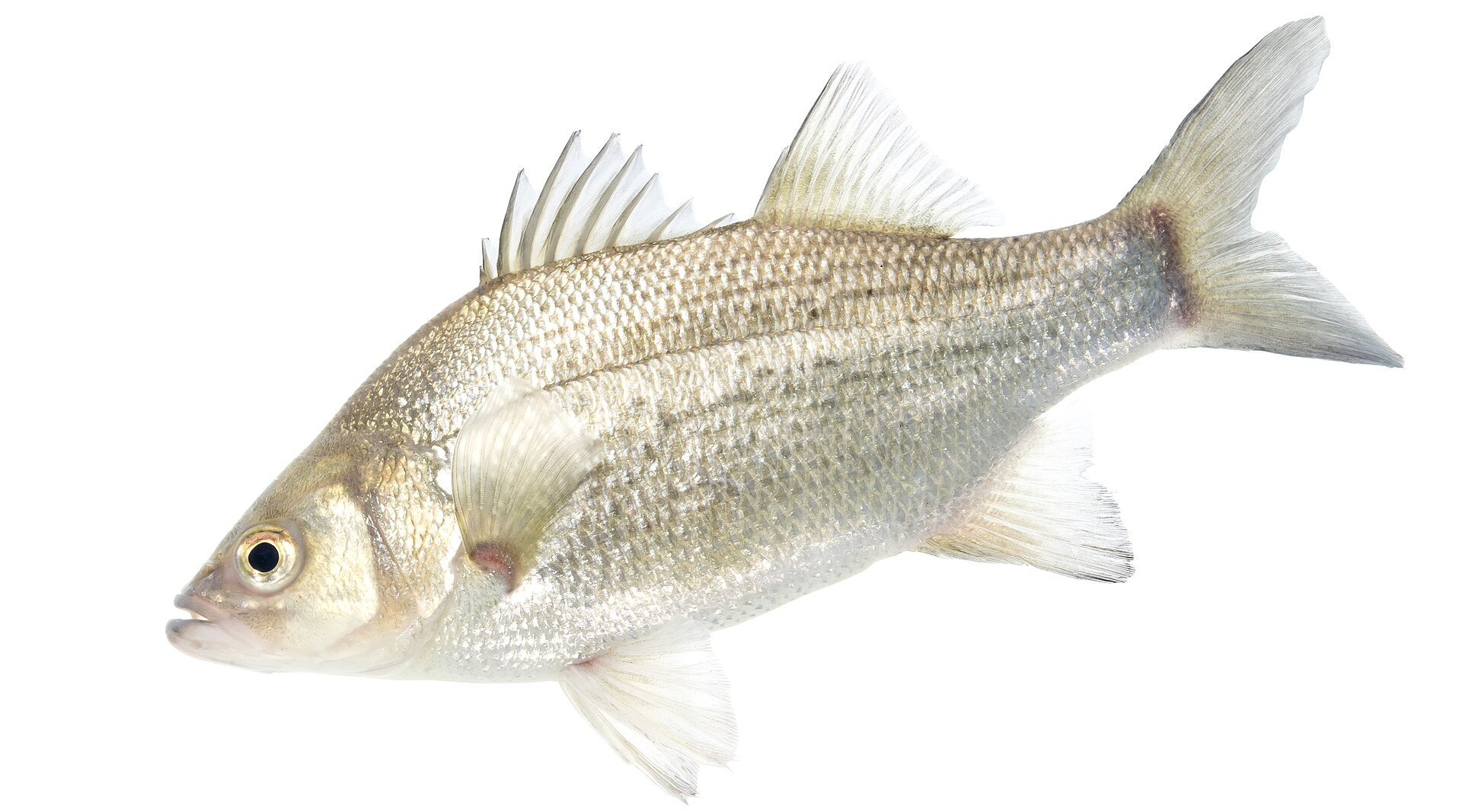
From the north · Wildlife
White Bass
A schooling shad-chaser that runs up rivers by the thousand every spring — the fastest fishing of the year for anyone who times it right.
Morone chrysops
- Range
- Reservoirs and rivers across the central U.S.
- Prime season
- March–April run; June–September boils
- Access
- Basic state license; wade the run from shore
- Table quality
- Very good if bled and trimmed
Regulations by region
White Bass rules where you're headed
Seasons, tags, limits, and legal methods for white bass are set jurisdiction by jurisdiction. Pick your state or province and we'll point you at the agency that writes the rules.
Jump to another species
About the white bass
White bass live by the school. They spend the year following shad around a reservoir, then in early spring they push up the feeder rivers to spawn in current, and for two to three weeks a wading angler can catch fish on nearly every cast. The rest of the year they are a surface fishery. When shad get corralled against the top on a summer evening, whole acres of water erupt, and a jigging spoon dropped into the boil catches fish until the school sounds. They are also a legitimately underrated table fish. Bled immediately, iced, and trimmed of the red line, white bass fry as well as crappie.
Range, water, and where they live
Anywhere there is a reservoir with a shad forage base and a feeder creek, there is a white bass run. These systems are the best known. Lake Texoma tributaries, OK/TX: Enormous spring run up the Red and Washita. Lake Erie western basin: Big summer schools and heavy average size. Arkansas River system: Reliable March run into every feeder creek. Kansas reservoirs (Milford, Wilson): Wadeable spring runs within a short walk of parking. Tennessee River reservoirs: Year-round schooling and strong fall surface bite.
Behavior and how they feed
Timing is nearly everything. Find water temperature and current, and the fish will already be stacked before you arrive. Watch water temperature in the feeder creeks; the run starts as the river hits the mid-50s and peaks in the upper 50s. Fish the first current break above a reservoir — the gravel bar, the riffle tail, the outside bend below a shoal. Wade upstream and cast across and down, letting a 1/8 to 1/4 oz jig swing through the seam. When the males show up first, expect smaller fish; the bigger females push through in the following week. In summer, run the main-lake points and flats at dawn and dusk and look for birds and surface boils. Cast past a boil, not into it, and burn a small swimbait or blade back through the edge. When the school sounds, drop a 3/4 oz jigging spoon straight down and rip it — they are still there, just deeper. Once you find the depth the fish are holding at, replicate it on every similar point on the lake.
Where they hold
White bass are open-water schoolers that chase shad. They are either there in numbers or gone entirely — there is no in-between. River spawning runs — Massive runs up tributaries and into tailwaters when water reaches the mid-50s; a hundred-fish day is normal. Surface jumps — Schools push shad to the top in open water; look for gulls and boils, and stay off the school with the trolling motor. Main-lake points — Wind-blown points and humps in 10–25 feet hold schools between feeding pushes. Dam tailraces — Whites stack in the eddies below generation and feed hard when water is running.
What they eat and what they hit
These are the presentations that consistently produce white bass, with the conditions each one is actually for — not a tackle-shop wall. 1/4 oz white jig or grub — A white or chartreuse grub on a jig head matches shad and fishes at any depth. Casting spoon / slab — A 1/2–1 oz slab dropped into a marked school and jigged vertically. Small topwater — A popper or walking bait thrown to the edge of a jump — never into the middle of it. Inline spinner or Rooster Tail — The classic spring tributary bait, cast up and swung across current. Blade bait — Vertical snap-jigged over wintering schools on deep structure.
In the field
A good run day is genuinely nonstop. Bring more jigs than you expect to need; you will lose them on rock all day. The run is short. Two weeks late and the fish are gone back to the lake, which is why local reports matter more than a calendar. Summer surface fishing is a chase. Keep the trolling motor down, stay off the school, and let them come up in front of you.
Licenses, stamps, and limits
White bass are managed simply. The details worth checking are creel limits and whether the water has hybrid striped bass in the mix. Buy the state license online; a one-day or three-day option is often enough for a run trip. Check the creel — 15 to 25 fish per day is common, sometimes with a combined limit including hybrids and stripers. Learn the hybrid identification rules; hybrids usually carry a smaller limit and a length minimum. Verify tailwater closures during spawning periods, which shift by a couple weeks each year. Confirm wading access and whether a parking permit is required at the creek crossings.
Landing, release, and cleaning
What happens between the hookset and the cooler decides whether you land the fish and whether it is worth eating. White bass fight hard for their size and often hook themselves. Keep the rod loaded and swing eaters straight into the boat. To keep the fish, dispatch it immediately — a firm rap with a priest or knife spine at the top of the skull, just behind and above the eyes. A white bass killed instantly tastes better than one that suffocates in a bucket. Bleed it right away: cut the two gill arches on one side, or make a single cut behind the pectoral fin to the artery, and hold it in the water for thirty seconds while it pumps out. Get it on ice — slurry ice (ice plus water plus a little salt) if you have it — within minutes, not at the end of the day. Cold, bled fish is the entire difference between good and muddy-tasting fillets. Bleed and ice white bass immediately — they are the species most improved by proper handling and the most ruined by neglect. Cleaning a white bass the right way takes about four minutes once you know the sequence.
On the table
White bass have a reputation for strong flavor that is almost entirely a handling problem. Bleed them at the bank and ice them immediately and the fillets are mild and white. Trim every trace of the red lateral meat — that tissue holds the flavor people complain about. They fry beautifully, hold up in fish tacos, and are a good candidate for smoking when you have a cooler full.
Field notes
- 6'6" medium-light spinning rod: Enough tip to cast light jigs and enough backbone for current.
- 2500-size spinning reel, 10 lb braid: Braid transmits the tick of a jig bouncing through gravel.
- 1/8–1/4 oz marabou or curly-tail jigs: White, chartreuse, and smoke — the whole spring lure selection.
- 3/4 oz jigging spoon: The answer when a summer school sounds under the boat.
- 2.5" paddle-tail swimbait: Matches shad size and burns through surface boils.
- Chest waders and studded boots: Spring creeks are cold and the gravel is slick.
White Bass questions, answered
- When exactly does the white bass run start?
- When feeder-creek water temperature reaches the mid-50s, which is typically March in the southern plains and April farther north. Watch a local river gauge and temperature reading rather than a date — the run shifts two to three weeks year to year.
- How do I tell white bass from hybrid stripers?
- White bass have one tooth patch on the tongue, faint broken stripes, and rarely exceed three pounds. Hybrids have two tooth patches, bolder stripes, and grow much larger. Limits usually differ, so check before you keep.
- What is the best white bass lure?
- A 1/8 oz white marabou jig in the spring run and a 3/4 oz jigging spoon for summer schools. Between the two you can cover the entire year.
- Can you catch white bass from shore?
- Yes — the spring run is one of the best bank and wading fisheries in the country, since the fish push into knee-deep gravel current within a short walk of most creek crossings.
- Do white bass taste good?
- Yes, when handled correctly. Bleed and ice immediately, remove the red line, and they compare favorably to crappie. Fish left on a stringer in warm water are the source of the bad reputation.
Official sources and further reading
- Texas Parks & Wildlife — White Bass
Run timing, identification, and statewide limits.
- Kansas Department of Wildlife & Parks
Reservoir reports and spring run access information.
- Ohio DNR — Lake Erie Fishing Reports
Weekly reports covering white bass schooling activity.