Skip to content
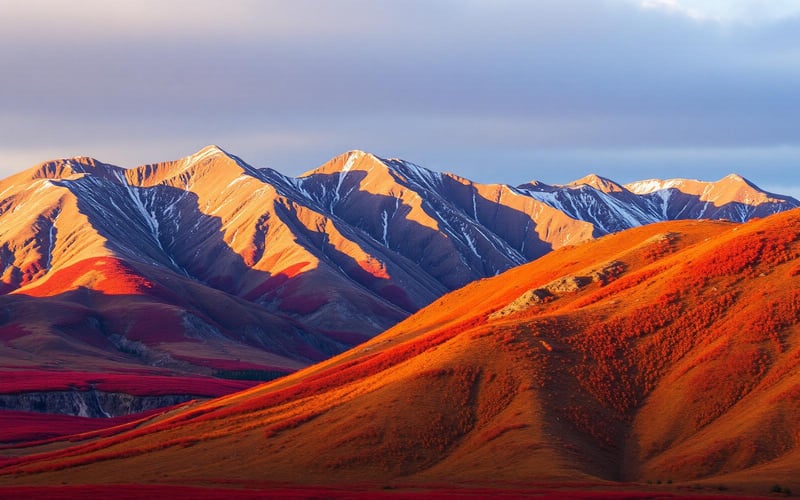
Autumn-colored tundra slopes below the Richardson Mountains at sunset

Alone Show

Alone Season 13 Filming Location

The Richardson Mountains, Northwest Territories — Arctic tundra above tree line, and the hardest environment the show has used.

Alone Season 13 was filmed in the Richardson Mountains, a range that runs north above tree line along the Yukon–Northwest Territories border in Arctic Canada, near 67° N.

It is the first season set in genuine tundra: no usable timber, relentless wind, a short autumn window of red-and-gold color, and a winter that arrives fast and hard.

01

Where exactly is the Season 13 location?

The Richardson Mountains straddle the Yukon–Northwest Territories border, north of the Arctic Circle and inland from the Mackenzie Delta. The Dempster Highway skirts the range on its way to Inuvik, which is what makes a remote production logistically possible at all.

Vegetation stops at dwarf birch, willow, lichen, and moss. Ridge lines are rock and wind-scoured tundra. Sightlines are long — you can watch weather arrive for an hour before it reaches you.

02

Season 13 location quick facts

FactDetail
LocationRichardson Mountains, Northwest Territories, Canada
Latitude~67° N (above the Arctic Circle)
BiomeArctic tundra / subarctic transition
Winter lows-35 °C to -45 °C
Key foodPtarmigan, Arctic hare, caribou, char
Big predatorsGrizzly, wolf, wolverine
SeasonAlone (US) Season 13

03

Why the show chose it

Every previous Alone location gave participants timber. Timber means a log shelter, a sustained fire, bow-drill stock, and tool handles. Above tree line, all of that disappears at once.

The result is a season decided by shelter thermodynamics and food caching rather than construction ambition. Small, hot, wind-sheltered fires replace the big burn; snow becomes the primary building material rather than an obstacle.

04

What the location demands

Three survival constraints define the Season 13 location more than anything else.

Shelter

Snow, not logs

Quinzhee and snow-block shelters are the winter home, not a stopgap. A well-built snow shelter can hold near 0 °C interior while the outside sits at -40 °C.

  • Plan the winter shelter before freeze-up
  • Insulate the sleeping platform off the floor
  • Keep a marked ventilation port

Fuel

Measured in twigs

Willow and dwarf birch burn fast and small. A stone-lined, wind-shielded pit conserves fuel dramatically compared with an open fire on tundra.

  • Gather far more than feels necessary
  • Store fuel dry and inside the shelter footprint

Food

Cache early

Ptarmigan flocks are the fastest tundra protein and typically require close shots. Fish and any large-animal windfall must be cached before freeze-up and protected from wolverines.

  • Cache inside the shelter footprint
  • Dry or freeze surplus immediately

05

Visiting the region

The Richardson Mountains are accessible in summer via the Dempster Highway between Dawson City and Inuvik, with tundra hiking straight off the road at Wright Pass. There are no services in the range itself.

Autumn color peaks in late August and early September; by October the country is in winter conditions. Anyone travelling here should be self-sufficient for weather, wind, and bear encounters.

Questions

Frequently asked

Where was Alone Season 13 filmed?
Alone Season 13 was filmed in the Richardson Mountains, straddling the Yukon–Northwest Territories border in Arctic Canada, at roughly 67° N — above tree line on open tundra.
What is the terrain like at the Alone Season 13 location?
Tundra ridges, rock, dwarf birch, willow, lichen, and moss. There is almost no usable timber, so shelter is built from snow, stone, and salvaged brush rather than logs.
How cold does the Alone Season 13 location get?
Winter lows in the Richardson Mountains run from about -35 °C to -45 °C (-31 °F to -49 °F), and constant wind makes wind chill the real frostbite risk long before ambient temperature does.
What food sources are available at the Season 13 location?
Ptarmigan, Arctic hare, caribou, and char are the primary protein. The productive window is short, so pre-freeze-up caching matters far more than it does in forested seasons.
What predators live in the Richardson Mountains?
Grizzly bear, wolf, and wolverine. Wolverines in particular will find any food cache left outside a shelter footprint.
Is the Alone Season 13 location harder than previous seasons?
By most measures yes. It is the first true above-tree-line tundra season, combining no reliable firewood, extreme wind, and a filming window that pushes participants into deep winter.