An all-mountain snowboard is the quintessential one-board solution for riders who refuse to be boxed into a single zone on the mountain. Rather than specializing exclusively in deep powder, technical rails, or high-speed carving corduroy, these decks are designed to bridge disciplines. To achieve that balance, manufacturers blend directional profiles, nuanced sidecuts, and adaptable flex patterns, creating platforms that provide stability at speed without sacrificing agility in tight trees or playful pop off side hits.
To build this ranking, The Wild10 synthesized cross-outlet evaluations from independent gear reviewers alongside dedicated editorial weighting for durability, build materials, and overall versatility. We placed heavy emphasis on how well these decks perform when surface conditions transition from morning corduroy to afternoon chop, assessing their dampening characteristics and edge control.
Every snowboard on this list balances responsiveness and forgiveness differently. Whether your priority is aggressive freeride descending, value-driven daily driving, or surfy agility through natural features, this lineup highlights the most capable decks across the all-mountain spectrum.
The Stranda Descender is an all-mountain snowboard built specifically for riders who want high-speed confidence and precision across the entire resort. Emerging as a standout premium deck in independent testing, it pairs traditional edge hold with modern freeride shaping. Rather than aiming for middle-of-the-road neutrality, the Descender prioritizes aggressive carving, clean powder float, and damp composure when conditions turn rough.
Underfoot, the board utilizes traditional camber to maintain reliable contact on hardpack, while a subtle early-rise nose keeps the deck riding above deep or inconsistent snow. Unlike many stiff freeride planks that feel cumbersome at moderate speeds, the Descender retains enough agility through its sidecut and flex pattern to navigate tight glades and steep chutes without fighting the rider. Available in dedicated men's and women's builds, the platform scales its flex and dimensions appropriately rather than merely altering graphic treatments.
This specialized performance profile means it is not intended for casual cruising or park laps. The directional stance and firm tail require focused input from an experienced pilot. For riders who favor fall-line charging and technical control over playful buttering, the Descender represents a purpose-built platform that justifies its top-tier positioning through uncompromising build quality and downhill execution.
Where it fits
Steep off-piste freeriding
High-speed groomer carving
Technical tree runs
Deep powder bowls
Pros
Exceptional edge hold on hardpack and icy resort snow
Damp construction absorbs chatter in choppy afternoon crud
Nimble handling in tight glades despite its aggressive nature
Strong float in powder thanks to the early-rise nose profile
Cons
Demanding flex punishes sloppy technique or backseat riding
Stiff directional tail limits park utility and switch riding
Boutique pricing is significantly higher than mass-market decks
The Descender is designed for advanced and expert riders who spend the majority of their time driving clean carves on groomers, navigating technical off-piste lines, or searching for untracked snow in the trees. Because it relies on an assertive camber profile and a sturdy directional flex, it demands deliberate edge transitions and proper body positioning. Intermediate riders or those who tend to steer passively from the back foot may find the board fatiguing or prone to catching an edge when initiating turns casually. Conversely, riders with a strong technical foundation will appreciate the direct power transfer from bindings to edge. It suits snowboarders who view the entire mountain as a terrain park of natural hits, steep pitches, and variable bowls, yet want a single deck capable of locking into high-speed arcs on morning corduroy without skittering.
Shape and Profile Architecture
Stranda builds the Descender around a directional geometry that emphasizes forward drive and clean float. Camber extends through the center of the board and past the rear contact point, generating positive rebound out of turns and maximizing effective edge contact along firm snow surfaces. Toward the tip, the profile transitions into an early-rise rocker that prevents the nose from submerging in deep snow and smooths out turn entry. The tail remains firm and supportive, providing a stable platform when landing drops or powering through chopped powder. Stranda also accounts for anatomical differences by offering distinct men's and women's specifications, adjusting width profiles and internal laminates to ensure that riders of various weights and foot sizes achieve proper leverage without wrestling an overly stiff core.
Trail and Off-Piste Handling
In mixed conditions, the Descender exhibits notable dampness, absorbing high-frequency vibrations when cutting across tracked-out snow and afternoon refreeze. Rather than deflecting off firm ruts, the chassis stays composed, helping the rider maintain an athletic stance without joint fatigue. In open bowls and fresh snow, the combination of nose rocker and directional taper provides natural lift without forcing the rider to lean excessively over the rear binding. In tight timber, the board reacts promptly to subtle weight shifts; while it is undeniably a charging deck, its sidecut allows for quick edge disengagements when dodging obstacles. It performs best when pushed with speed, transforming kinetic energy into responsive pop when springing between turns or launching off natural terrain features.
Edge Grip and Carving Dynamics
Edge retention is a defining characteristic of the Descender. The pronounced camber profile creates sustained pressure across the entire effective edge, allowing the board to grip tenaciously on boilerplate ice and firm winter pack where rocker-dominant boards often wash out. Entering a carve, the tip engages predictably, pulling the board smoothly into the turn radius before the stiff midsection takes over to resist twisting under high centrifugal forces. Exiting the arc, the energetic tail snaps back, providing clear acceleration into the next transition. This behavior delivers immense satisfaction to riders who enjoy laying down aggressive, deep carves, but it also necessitates commitment. Slicing across hardpack on this board requires confidence, as half-hearted edge sets can result in sudden, unintended tracking down the fall line.
Practical Limitations and Trade-offs
While the Descender ranks highly for all-mountain versatility, that versatility sits firmly on the freeride spectrum. The directional shape, setback stance, and stiff tail significantly hinder switch riding; landing backwards or executing cab tricks requires far more precision than on a true twin or twin-leaning directional deck. It is fundamentally ill-suited for rails, boxes, or low-speed jibbing, where a softer, catch-free profile is preferable. Furthermore, the board offers very little forgiveness for lapses in form. On lazy run-outs or cat tracks, failing to stay centered over the working edge can lead to abrupt hook-ups. Its premium positioning also carries a boutique price tag that demands careful consideration, especially for riders who do not regularly encounter terrain steep or fast enough to unlock its performance potential.
Market Context and Alternatives
In the premium all-mountain category, the Stranda Descender competes alongside well-regarded benchmarks like the Jones Flagship and the Burton Custom X. Compared to the Jones Flagship, which shares an aggressive freeride pedigree, the Descender provides a slightly nimbler feel at moderate speeds, making it easier to maneuver through tight North American tree lines. Against the ultra-stiff Burton Custom X, the Descender trades away a fraction of raw groomer velocity in exchange for superior powder buoyancy and a more compliant tip in off-piste bumps. For riders seeking a softer, more playful daily driver, models such as the Rome Ravine offer significantly more torsional forgiveness at a lower price point. However, riders prioritizing damp high-speed stability paired with genuine glade agility will find the Descender's balance difficult to match.
As an Amazon Associate, Wild10 earns from qualifying purchases.
No ratings yet
Pick 02Research-based review
Ravine — Men’s & Women’s
Rome
Profile
Directional hybrid camber with rockered nose
Shape
Tapered directional
Flex Rating
Medium flex
Riding Level
Intermediate to advanced
Category
All-mountain freeride
Listed Price
Approximately $348
The Rome Ravine occupies an appealing middle ground in the all-mountain snowboard category, providing legitimate directional freeride performance without the unforgiving stiffness common to aggressive alpine decks. Engineered to navigate deep powder, tight trees, and open resort groomers with equal fluency, it delivers an energetic, surf-inspired ride that prioritizes maneuverability and fun. At a price point that frequently undercuts top-tier boutique boards, it has earned widespread recognition among gear analysts as one of the best value propositions available for everyday resort riding.
Rather than locking the rider into a rigid, rail-like carve, the board relies on a directional camber footprint matched with a rockered, 3D-shaped nose. This design promotes effortless float in untracked snow and easy turn initiation across chopped-up terrain. Carbon and fiberglass reinforcements provide snap for popping off natural rollers, while the medium torsional flex keeps the deck friendly and forgiving when fatigue sets in toward the end of the day.
While the Ravine thrives on flow and agility, its softer temperament does introduce realistic limitations. Riders who regularly straight-line hard-packed groomers or charge through refrozen debris will discover that it lacks the dampening mass of heavier, metal-infused freeride decks. For intermediate and advanced riders seeking a nimble, playful daily driver, however, the balance struck between float, edge hold, and affordability is difficult to beat.
Where it fits
Resort powder days
Glade and tree navigation
All-mountain cruising
Natural side-hit riding
Pros
Effortless powder float delivered by the rockered, contoured nose
Agile, low-fatigue turn initiation ideal for tight tree runs
Playful medium flex that remains forgiving across choppy snow
Outstanding performance-to-price ratio within the directional category
Cons
Transmits noticeable chatter when carving over bulletproof ice
Lacks the high-speed dampening stability of heavier, stiff decks
Shorter tail reduces support when stomping deep drop landings
The Ravine is designed primarily for intermediate and advanced riders who favor a dynamic, three-dimensional approach to the mountain over sheer terminal velocity. It appeals directly to snowboarders who hunt out powder stashes in the morning, weave through tight timber lines by midday, and spend afternoons launching off side hits and natural trail features. Because its flex pattern is forgiving rather than punishing, progressing riders moving away from true-twin park decks will find the transition into directional riding natural and encouraging. Conversely, it is not built for hyper-aggressive freeriders who demand maximum stiffness for fifty-degree icy couloirs or massive cliff drops where a rigid tail is critical to landing survival.
Materials and Core Construction
Rome builds the Ravine around a full wood core reinforced with structural fiberglass and targeted carbon additives designed to amplify pop without creating an overly rigid platform. The hybrid profile places traditional camber beneath and between the bindings, generating reliable edge hold and spring when initiating carves on firm snow. Forward of the front foot, the profile transitions into an elongated rockered nose equipped with subtle three-dimensional contouring. This rockered scoop dramatically reduces drag in deep powder, allowing riders to maintain a centered, neutral stance rather than leaning back heavily. The tail remains shorter and moderately firm, retaining enough substance to finish carved turns with authority.
Real-World Performance
On groomed terrain, the Ravine rolls smoothly from edge to edge with minimal physical exertion. The sidecut engages quickly, allowing riders to lay down clean, stylish arcs across packed snow at moderate to high speeds. In tight glades, the board feels extraordinarily nimble; quick adjustments and reflexive pivot turns require very little muscle, which significantly cuts down on leg fatigue over consecutive laps. In powder, the combination of setback, directional taper, and a scooped nose creates intuitive buoyancy that makes traversing flat sections far less stressful. However, when pushed through chunky, refrozen chunder or icy wind crust, the lightweight construction transmits noticeable chatter through the boots.
Durability and Longevity
The materials and build quality of the Ravine align well with expectations for a dedicated seasonal workhorse. The topsheet holds up respectably against binding rash and cosmetic scuffs, though the extended nose can show standard wear if consistently bumped in crowded lift lines. Its extruded or mid-density sintered running surface strikes a practical balance between gliding speed and impact resilience, proving relatively easy to wax, scrape, and repair with standard P-tex after encounters with shallow early-season rocks. Steel edges are cleanly wrapped and provide dependable longevity, provided owners maintain regular tuning schedules to eliminate burrs after navigating abrasive man-made resort snow.
Stance and Tuning Notes
To extract the best performance from the Ravine, riders should adhere closely to the factory reference stance, which already accounts for the directional setback and taper. Setting bindings too far forward diminishes the float advantages of the 3D rockered nose, while pushing the stance too far back shortens an already compact tail and compromises carving exit drive. Pairing this board with a medium-flexing all-mountain binding preserves its playful responsiveness, whereas an ultra-stiff carbon binding can overpower the deck's torsional flex. A progressive edge bevel with slightly detuned contact points at the widest tip and tail zones prevents hookiness when navigating crusty snow.
Comparative Value and Trade-Offs
Positioned around the mid-three-hundred-dollar threshold, the Ravine delivers an exceptional performance-to-cost ratio compared to premium freeride models like the Stranda Descender, which cost significantly more. It sacrifices the heavy vibration damping and supreme high-speed stability found in those boutique boards in exchange for a lighter, more agile, and substantially more affordable build. While it cannot match the sheer edge bite of stiff, carbon-dampened alternatives on bulletproof morning ice, its approachable character and versatile powder manners make it a far more sensible choice for riders who prioritize playful versatility over uncompromising, high-speed aggression.
As an Amazon Associate, Wild10 earns from qualifying purchases.
No ratings yet
Pick 03Research-based review
Howler — Men’s & Women’s
Jones
Riding Style
Aggressive all-mountain freestyle
Ability Level
Advanced to expert
Profile
Camber-dominant with rockered tips
Flex Rating
Stiff (approx. 8 out of 10)
Shape
Directional twin
Core Matrix
Hardwood blend with targeted stringers
The Jones Howler sits firmly in the aggressive all-mountain freestyle category, designed for riders who look at natural terrain as a series of launch points and steep run-outs. Rather than catering to casual cruisers or surfy powder specialists, Jones engineered this deck to bridge high-speed directional carving with full-throttle freestyle utility. It prioritizes stability, energy transfer, and unyielding edge control over forgiveness or relaxed handling.
At the core of the Howler's design is a powerful, camber-dominant architecture supported by stout torsional reinforcement. This gives the board exceptional spring off natural rollers and lip transitions, alongside a firm platform for stomping heavy landings in variable snow. Refined sidecut profiling adds dependable mechanical bite across firm slopes, ensuring the board stays locked on line when charging through wind-scoured bowls and icy resort mornings.
Because of its uncompromising stiffness and direct power transfer, the Howler demands an active, athletic pilot. It will not bail a rider out of sloppy weight distribution or hesitant turn initiation. For advanced riders who carry speed everywhere and want an energetic deck that will not buckle under pressure, it offers a level of precision and pop that few standard all-mountain shapes can match.
Where it fits
Aggressive all-mountain freestyle
High-speed resort carving
Launching natural terrain features
Firm and steep freeride runs
Pros
Explosive pop and massive energy return out of loaded turns
Exceptional edge hold on firm resort corduroy and windblown ice
Rock-solid landing stability when stomping drops at speed
Durable construction built to withstand heavy all-mountain impacts
Cons
Punishes lazy technique and imprecise edge awareness immediately
Stiff longitudinal flex makes slow-speed flat buttering difficult
Requires constant physical input that can tire legs over a full day
The Howler is expressly crafted for riders who find standard all-mountain resort boards too soft or skittish when charging hard. It suits snowboarders with a freestyle background who spend their time outside the terrain park, sending natural drops, gapping cat tracks, and carving trenches on steep corduroy. To extract the board's benefits, a rider must possess sound fundamentals and strong legs. Hesitant inputs or passive riding will quickly lead to hooked edges, as the board does not wash out turns smoothly when unweighted carelessly. Intermediate snowboarders looking to build confidence or riders who prefer loose, surfy, low-speed buttering should look elsewhere in the Jones lineup, such as the Frontier or Mountain Twin. For the hard-charging rider who stays over their edges and demands instant response at speed, the Howler provides an uncompromising platform.
Materials and Core Architecture
Jones built the Howler with a durable wood core reinforced by strategically placed stringers to control torsional twist and maximize longitudinal pop. By combining lighter woods with dense hardwood laminates near the edges and binding inserts, the core balances swing-weight efficiency with resilience against blunt landings. Fiberglass laminates wrap the core to create a rigid torsional box, which eliminates chatter when slicing through chundered snow or crossing frozen tracks. The exterior finish uses durable, bio-based resin and a hardened topsheet designed to shrug off scuffs from lift lines and stray branches. Underneath, a high-density sintered base retains wax well and generates rapid acceleration out of flat run-outs, provided it receives regular hot scrapes and waxing.
Carving and Edge Response
Edge grip is where the Howler separates itself from softer freestyle twins. The camber-dominant profile creates extensive contact along the effective edge, forcing the sidecut deep into hardpack the moment the board is tipped onto its side. Subtle edge traction profiling along the perimeter introduces secondary contact points that slice through slick morning ice and wind-blown crust. Entering a turn requires deliberate leverage, but once established, the sidecut locks in and tracks without skipping or washing out. Rebound out of deep carves is pronounced; the stiff tail loads up under pressure and launches the rider into the next transition with serious snap. It holds its line exceptionally well through choppy snow, though the sheer rigidity can transmit significant vibration into your knees on extended frozen groomers.
Freestyle Power and Landings
In freestyle applications, the Howler acts less like a playful park jibber and more like a high-velocity launchpad. The board's pop is explosive, but it requires solid ollie technique to bend the stiff tail and release the energy. On booters and natural wind lips, it delivers predictable trajectory and clean departures. Its true strength lies in stability on touchdown. When landing in compressed bomb holes, steep transitions, or heavy run-outs, the deck resists wheelieing out and keeps the rider centered over the snow. Switch riding feels natural thanks to the directional twin geometry, though the board's aggressive flex means switch landings demand just as much precision as regular ones. It handles rails and urban features adequately, but the stiff profile makes pressing an exhausting chore.
Stance Setup and Tuning
Getting the most out of the Howler requires pairing it with responsive equipment. Soft freestyle bindings with flexible highbacks will mute the board's edge-to-edge speed and cause leg fatigue; a medium-stiff to stiff binding is necessary to transmit direct steering inputs. Stance-wise, the centered reference marks cater well to all-mountain freestyle, offering balanced swing weight for spins and switch maneuvers. Riders taking the deck into deeper storm snow will want to set the bindings back a couple of centimeters to counteract the camber profile and keep the nose floating without burning out the rear quad. Out of the wrapper, the factory edge bevel is sharp and aggressive. Riders who plan to hit natural logs or occasionally slide boxes will benefit from lightly detuning the contact points near the tips to minimize grab.
Competing Decks and Value
At this performance tier, the Howler contends against heavy hitters like the Burton Custom X and the Capita Mega Merc. The Custom X offers a legendary, hyper-focused carving pedigree but leans more traditional in its directional feel and can feel clinically stiff. The Mega Merc provides similar high-end composite power with slightly more low-speed versatility, though often at a steeper price tag. Compared to these peers, the Howler strikes a distinct middle ground: it retains the raw power and edge bite of an aggressive camber deck while incorporating a directional twin silhouette that feels right at home in natural freestyle terrain. Its rugged construction and premium base material justify the upper-echelon pricing for riders who actually ride fast enough to tap into its structural limits.
As an Amazon Associate, Wild10 earns from qualifying purchases.
No ratings yet
Pick 04Research-based review
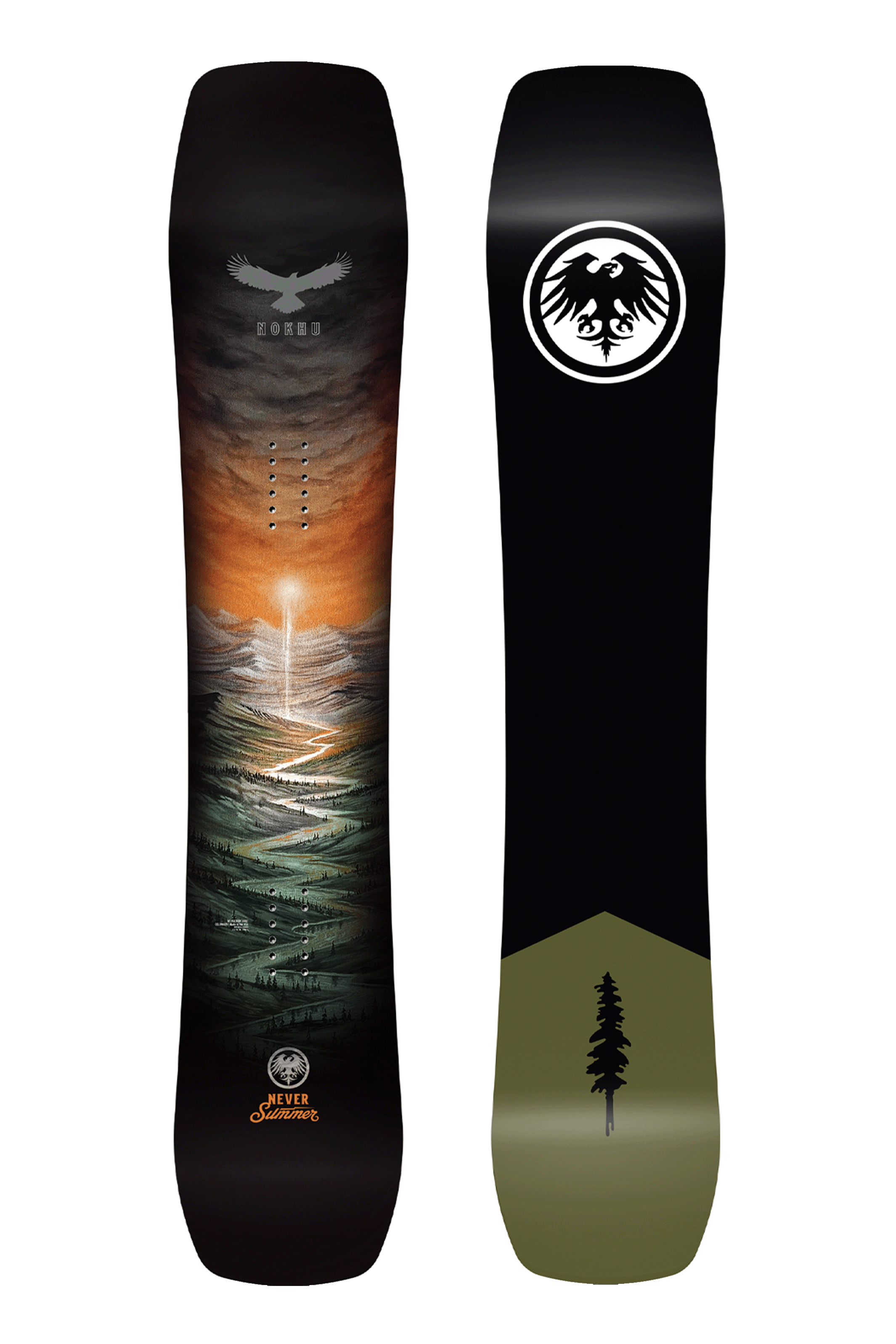
Summer Nokhu 161 DF
Never
Profile
Directional Hybrid Rocker Camber
Width Class
Drag Free (DF) Extra Wide
Shape
Tapered Directional
Dampening
Full Elastomeric Stabilization
Riding Style
All-Mountain, Carving, Powder
Target Boot Size
US Men's 11.5 and larger
The Never Summer Nokhu 161 DF is an unapologetic, ultra-wide directional deck engineered specifically for deep-trench carving and untracked powder. Built on Never Summer's 'Drag Free' platform, this model addresses a persistent problem for aggressive carvers and riders with larger boot sizes: boot out. By pushing the waist width well beyond standard wide dimensions, the board allows riders to drop low into high-angle turns without toes or heels catching the snow surface.
Beneath the hood, the Nokhu utilizes Never Summer's multi-camber hybrid profile. With rocker situated between the feet and distinct camber sections under each binding, the deck remains surprisingly maneuverable when pivoting at lower speeds while still securing firm edge engagement through the apex of a turn. Extensive elastomeric dampening runs through the internal laminate, delivering the quiet, chatter-resistant ride quality that the Colorado factory is known for when plowing through midday chop.
This specialized geometry brings distinct limitations. Because of its massive surface area and wide waist, the Nokhu demands deliberate leverage and strong lower-body input from the rider. It excels on sweeping groomers and wide-open powder bowls, but it is noticeably cumbersome in steep, condensed moguls and tight forest lines.
Where it fits
High-angle groomer carving
Deep powder bowl riding
Large-boot freeride cruising
High-speed chop busting
Pros
Eliminates toe and heel overhang entirely during high-angle carves
Massive surface area delivers effortless flotation in deep snow
Elastomeric core dampening effectively deadens rough resort chop
Impact-resistant sidewalls and topsheet offer exceptional durability
Cons
Noticeably slow edge-to-edge transition for average boot sizes
High physical exertion required to maneuver through tight moguls
Significant swing weight reduces agility for aerial rotations
The Nokhu 161 DF serves two specific profiles: riders with boot sizes of US 11.5 or larger who constantly fight boot drag on standard wide decks, and dedicated euro-carvers seeking extreme edge angles. Standard wide snowboards often top out around a 265-millimeter waist, which still leaves size 12 or 13 boots vulnerable to dragging on steep corduroy. The DF footprint gives these riders the clearance necessary to lean their hips to the snow safely. Conversely, lightweight riders or anyone with boot sizes under US 10.5 will find this board exhausting to steer. It lacks the nimble reactivity needed for park laps or casual side-hit hopping, requiring an assertive pilot who prefers high-speed, open-terrain descending.
Materials and Core Construction
Never Summer builds the Nokhu around a lightweight wood core reinforced with custom fiberglass matrices and carbon load-spreaders. The hallmark of the brand's construction, however, is its multi-layer elastomeric dampening system. Rubber-infused laminates run through key stress points and along the perimeter, soaking up high-frequency vibrations before they transfer to your knees. The base is an ultra-high-molecular-weight sintered material designed for high wax retention and impact resistance. Textured topsheet material resists chipping from lift lines and sheds accumulated snow, while full-wrap steel edges provide structural protection against occasional hidden rocks.
Carving and Powder Performance
On firm corduroy, the Nokhu delivers an incredibly secure platform once you tip it past its wide flat zone. The camber pockets underfoot provide positive grip through the turn, while the center rocker allows you to roll out of one carve and set the opposite edge smoothly. In deep snow, the board's massive surface area acts like an oversized floatation plate. Combined with a directional taper and a rockered nose, the Nokhu glides over powder with minimal rear-leg burn. The trade-off is edge-to-edge transition time. Shifting from heel to toe requires more physical travel and ankle drive than on narrower freeride boards, making sudden evasive maneuvers much harder.
Durability and Longevity
Never Summer operates its own manufacturing facility in Denver, Colorado, and the Nokhu reflects that hands-on production quality. The proprietary P-Tex sidewalls are significantly more impact-resistant than conventional ABS plastic, resisting cracking when clipped against frozen debris or early-season trail hazards. The textured polymer topsheet conceals cosmetic scuffs and resists delamination far better than glossy finishes. Sintered bases from Never Summer are notably dense, holding up well across seasons of regular grinding and waxing. As long as you keep the base saturated and properly detune the tip and tail contact points, this chassis is built for multiple seasons of aggressive riding.
Sizing and Stance Tuning
Dialing in the Nokhu requires close attention to binding setup and leverage. Riders should not size down solely to compensate for the width, as the board's flex pattern depends on adequate rider weight over the camber zones. Binding angles between positive fifteen and positive twenty-one degrees on the front foot, with a neutral to slightly positive rear angle, help maximize forward-facing leverage across the expansive waist. If you ride with wide duck stances, be prepared to exert extra heel pressure. Additionally, pair this deck with medium-to-stiff bindings; soft, flexible bindings will fold under pressure before transferring enough force to cleanly tip the board onto its edge.
Comparable Market Alternatives
Riders looking for wide-platform carving and powder performance typically cross-shop the Nokhu against models like the Lib Tech Skunk Ape and the Korua Shapes Cafe Racer. The Skunk Ape is another classic big-boot board featuring hybrid rocker-camber and serrated edges, offering a bit more freestyle versatility and a twin-ish demeanor, but less high-speed dampness than the Nokhu. Korua's Cafe Racer provides a pure, ultra-wide full-camber carving experience with faster edge-to-edge snap, though it is far more punishing in chopped powder and uneven snow. The Nokhu sits comfortably in the middle, prioritizing maximum vibration absorption and directional float over aggressive camber snap.
As an Amazon Associate, Wild10 earns from qualifying purchases.
No ratings yet
Pick 05Research-based review
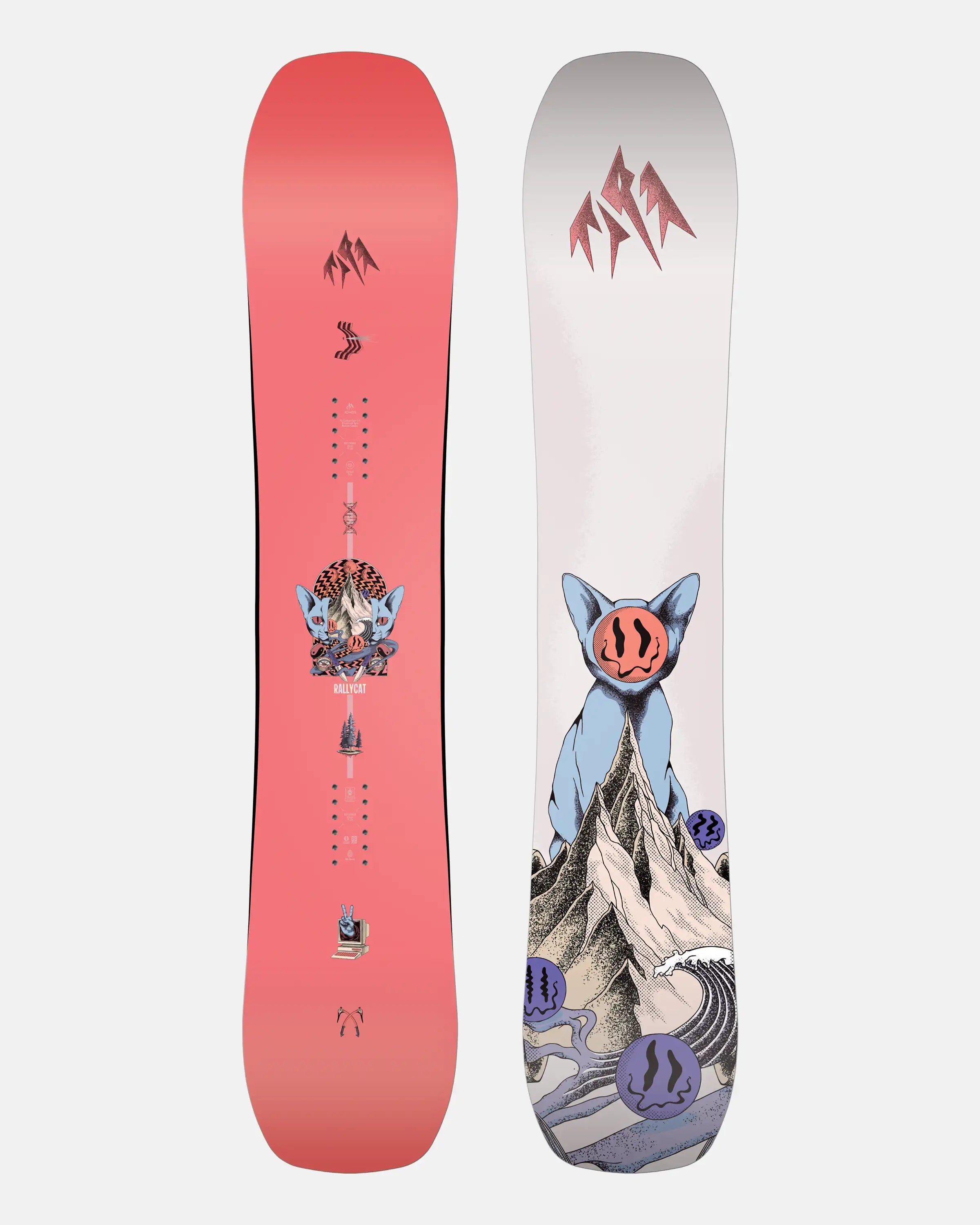
Rally Cat — Men’s & Women’s
Jones
Flex Rating
Medium flex
Board Profile
Central camber with rockered tips
Shape
Directional twin
Riding Level
Intermediate to advanced
Primary Category
All-mountain freestyle
Gender Sizing
Dedicated men's and women's models
While Jones built its brand reputation on burly freeride planks and technical big-mountain splitboards, the Jones Rally Cat leans in a distinctly playful direction. Engineered as a crossover between a lively freestyle deck and an all-mountain resort carver, the Rally Cat approaches groomers and side hits with a loose, skate-inspired attitude. It caters to riders who view natural resort contours as launch pads rather than terrain to straight-line.
The board blends a balanced, switch-friendly outline with a forgiving medium flex and an edge-friendly contour. This configuration lowers the physical effort required to initiate carves, slide rails, or execute ground-level flat-ground buttering maneuvers. Rather than demanding flawless technique, the platform provides immediate compliance and a high degree of underfoot articulation that encourages experimentation across various resort features.
Riders seeking an uncompromising freeride machine to blast through frozen crud at high speeds will quickly reach this board's mechanical limits. The Rally Cat prioritizes accessible flex, butterability, and pop over vibration damping and brute-force stability, finding its home with intermediate and advanced riders who want an agile, creative daily driver across the entire resort footprint.
Where it fits
Resort Freestyle and Side Hits
Intermediate All-Mountain Progression
Park Rails and Medium Jumps
Groomer Carving and Buttering
Pros
Forgiving medium flex excels at presses, butters, and flatground tricks
Nimble edge-to-edge quickness makes tree navigation and side hits intuitive
Hybrid profile reduces hang-ups without sacrificing underfoot pop
The Jones Rally Cat targets riders who want an agile, skate-influenced resort experience rather than a stiff, high-speed charging board. It specifically benefits intermediate snowboarders aiming to progress into park tricks, side hits, and buttering without being punished by an aggressive edge hook. Advanced riders looking for an effortless secondary board to lap the resort with friends will also appreciate its low physical tax. Because it maintains a balanced directional twin geometry, switch riding feels intuitive, making it a great pick for riders who spend significant time spinning off natural features or riding opposite-stance down packed groomers. Those who measure their days by descent speed, straight-line stability, or extreme vertical drops will quickly overwhelm this platform, but freestyle-minded all-terrain cruisers will find its responsive, friendly temperament right on the mark.
Profile and Camber Dynamics
Jones balances user-friendly engagement with sufficient pop by pairing a central camber section with subtle early-rise rocker toward the tips. This profile lifts the contact points slightly off the snow, significantly reducing catchiness during transitions, edge-to-edge rolling, and awkward landings. Despite the softer entry into turns, the underfoot camber provides reliable edge grip when tilted into clean carves on standard hardpack. The directional twin layout positions the stance centrally along the effective edge, allowing the board to behave predictably whether traveling forward or switch. Additionally, the rockered extremities make buttering, tail presses, and nose rolls feel natural, requiring far less core effort and weight transfer than traditional full-camber boards. It gives the board a fluid, loose dynamic at low and moderate speeds without feeling dead or sluggish underfoot.
Groomer and Resort Performance
On groomed corduroy and mellow resort slopes, the Rally Cat shines through its quick turn initiation and high maneuverability. The medium flex pattern allows the board to bend smoothly through short-radius carves, responding rapidly to slight toe and heel inputs. This agility translates directly to tree runs and crowded trails, where darting around obstacles requires instant line adjustments. Energy return between carves is springy and accessible, generating consistent rebound without requiring heavy, aggressive pilot input. While it grips reliably on typical winter hardpack, pure ice reveals the boundaries of its edge hold compared to stiffer, dedicated carving weapons. For everyday resort cruising where the emphasis is on linking turns, popping off rollers, and weaving between trail margins, the board feels exceptionally lively, giving the rider a tactile, communicative connection to the snow surface beneath them.
Park and Freestyle Dynamics
Freestyle performance is the foundation of the Rally Cat's personality. In the terrain park and on natural side hits, the medium flex makes pressing boxes, locking into rails, and landing slightly off-axis far less punishing. The energetic core produces crisp pop off jumps and lip transitions, giving riders ample lift without having to preload the tail with extreme force. Its low swing weight and symmetrical feel facilitate clean spins and steady switch takeoffs. While heavier riders or those sending massive pro-line kickers might find the landings a bit soft, small- to medium-sized jumps feel balanced and forgiving. The tips flex enough to absorb imperfect landings without washing out catastrophically, while the central camber stabilizes the platform through the transition. It effectively turns every undulation along the piste into an opportunity to jump, ollie, or press.
Rough Snow and Speed Limits
The trade-off for the Rally Cat's approachable flex is a noticeable lack of high-speed dampening in rough snow. When encountering frozen afternoon chunder, heavy tracked powder, or rough debris, the tips tend to chatter and deflect rather than power through the obstacles. This feedback transfers directly through the bindings, demanding increased leg tension from the rider to maintain a clean line. In steep, firm terrain where edge hold must be absolute and chatter can compromise control, the board can feel somewhat loose and jittery. Riders pushing past moderate speeds on bumpy descents will find that the board lacks the mass and structural stiffness needed to plow through uneven textures. To maximize safety and enjoyment, the board demands a calculated reduction in velocity when snow conditions turn choppy, frozen, and unforgiving.
Setup Recommendations and Alternatives
Dialing in the Rally Cat requires bindings that complement its lively, articulate nature without overpowering the deck. A medium-flex binding offering plenty of lateral ankle mobility will optimize its freestyle capabilities, preserving natural board feel for presses and short carves. Stiff, carbon-laden freeride bindings will feel mismatched, creating an abrupt transfer of power that overpowers the board's compliant core. For riders considering alternatives, decks like the Rome Ravine lean slightly more directional and powder-oriented while retaining a fun-loving feel, whereas boards like the Never Summer Proto Type 3 provide a dual-camber true twin setup with a slightly different carving signature. The Rally Cat fits squarely in the middle: a genuinely versatile, switch-capable twin hybrid that trades heavy big-mountain dampening for pure, unadulterated resort agility and freestyle fun.
As an Amazon Associate, Wild10 earns from qualifying purchases.
No ratings yet
Pick 06Research-based review
Passport
K2
Profile
Directional camber with rocker nose
Shape
Directional
Flex Rating
Medium-stiff
Core Material
Wood core with carbon reinforcement
Base Type
Sintered 4000
Riding Level
Intermediate to advanced
The K2 Passport occupies a sweet spot in the all-mountain category, blending dedicated freeride capabilities with daily resort comfort. Rather than mimicking the punishing, board-stiff rigidity often found on specialized big-mountain decks, the Passport is engineered for practical mountain versatility. It serves riders who prioritize hunting through tree stashes, dropping into steep bowls, and carving up morning corduroy with dependable edge control.
At its core, the board utilizes a directional baseline that pairs an elongated, early-rise rocker nose with traditional camber running underfoot and through the tail. This geometry delivers immediate lift in untracked powder while preserving the crisp rebound, stability, and edge hold required on firm or wind-buffed terrain. With a predictable sidecut designed for medium to long-radius turns, the board tracks cleanly without hooking unexpectedly.
While remarkably capable across natural terrain, the Passport maintains an accessible flex that will not overly fatigue your legs over a full day of resort laps. It consciously trades symmetrical freestyle balance for superior forward-facing performance, cementing its place as a reliable quiver-killer for riders whose focus remains aimed directly downhill.
Where it fits
Resort freeride exploration
Tree runs and glades
Groomer carving
Powder bowl riding
Pros
Early-rise rocker nose provides effortless float in powder
Underfoot camber delivers crisp edge hold and energetic carves
Forgiving flex reduces leg burn during full-day resort sessions
Nimble and responsive handling through tight trees and bumps
Cons
Directional layout is not optimized for sustained switch riding
Lacks the extreme dampness demanded by high-speed chargers
Not designed for dedicated freestyle or park rail features
The K2 Passport is tuned specifically for intermediate to advanced riders who want an assertive, directional board without the uncompromising stiffness of an aggressive freeride charger. If your typical day consists of seeking out natural side hits, navigating glades, and charging open bowls, this board fits that terrain profile naturally. It favors riders who spend the vast majority of their time traveling forward and desire a fluid, intuitive feel rather than something that requires absolute muscle to bend into a turn. Park-focused riders or those wanting to practice complex switch tricks will likely find its directional bias limiting. However, for the rider seeking a reliable all-terrain daily driver that handles fresh snow as smoothly as morning corduroy, the Passport provides a stable, confidence-inspiring platform that rewards clean line choices.
Edge Hold and Carving Dynamics
On hardpack and groomers, the Passport relies on its underfoot camber to establish firm contact along the effective edge. Because the camber extends well into the tail, the board generates clean energy out of turns, allowing you to lock into medium and long-radius carves with reassuring predictability. The tip rocker does not compromise turn initiation; instead, it provides a smooth, catch-free transition as you roll from edge to edge. While it lacks aggressive mechanical serrations or specialized traction edges found on some competitor boards, the Passport’s edge bite is completely dependable in typical resort conditions. Only on bulletproof ice or severely scoured summits does the board show minor limits in outright grip, where a stiffer torsional flex would otherwise provide an absolute lock on the snow surface.
Powder and Tree Maneuverability
Where the Passport truly excels is in soft snow and variable off-piste conditions. The elongated rocker profile in the nose allows the deck to plane effortlessly through deep snow, minimizing the need to lean back and strain your rear leg during heavy powder days. This lift, combined with a subtle directional setback, keeps the front contact point high over chop and crust. In the trees, the board’s accessible flex profile allows for fast, low-effort steering adjustments. You can quickly dump speed or pivot the tail to duck through narrow glade corridors without feeling like the board is fighting your inputs. It offers the float and agility of a freeride deck while retaining enough mid-body composure to skip through tracked-out late-afternoon powder.
Construction and Flex Balance
K2 builds the Passport around a resilient wood core reinforced with targeted carbon stringers to deliver snap and stability without excessive weight. The flex is medium-stiff—sturdy enough underfoot to resist buckling through choppy snow, yet forgiving enough in the tips to absorb terrain transitions cleanly. The carbon integration enhances torsional response, giving the board immediate feedback when initiating turns without turning the chassis into a bone-rattling plank. Underneath, a high-density sintered base offers high-velocity glide and good wax retention, holding speed through flat runouts and cat tracks. The overall construction prioritizes an optimal balance between vibration damping and energetic rebound, ensuring the board stays lively across varied surface conditions rather than feeling dead or overly muted.
Setup and Stance Considerations
To get the best performance from the Passport, riders should pay close attention to binding placement and stance angles. The board comes with a factory-marked reference stance that works well for mixed resort riding, offering a stable midpoint between carving drive and float. For powder days, setting your bindings back one notch further unlocks even greater surface area in the nose, making deep snow navigation virtually effortless. Pairing this deck with a medium to medium-stiff binding helps translate micro-adjustments directly to the edges, matching the board’s natural responsiveness. While riders can set up a centered duck stance, the board clearly performs best with a forward-angled directional configuration, which naturally complements its tapered geometry and camber-to-rocker profile.
Trade-offs and Comparable Boards
The Passport's directional bias means it is not an ideal fit for dedicated park riders or those who prioritize regular switch riding. Boards like the Never Summer Proto Type 3 offer far better twin-tip balance for switch landings and jibbing. On the other end of the freeride spectrum, boards like the Stranda Descender or Jones Flagship provide superior high-speed dampness and brute stability for charging steep, icy faces, albeit at the cost of being far more demanding on rider fatigue. The Rome Ravine shares a similar approachable freeride ethos, but the Passport offers a bit more traditional camber snap off the tail. The primary trade-off with the Passport is outright dampness at terminal velocity in exchange for all-day agility and low-fatigue cruising.
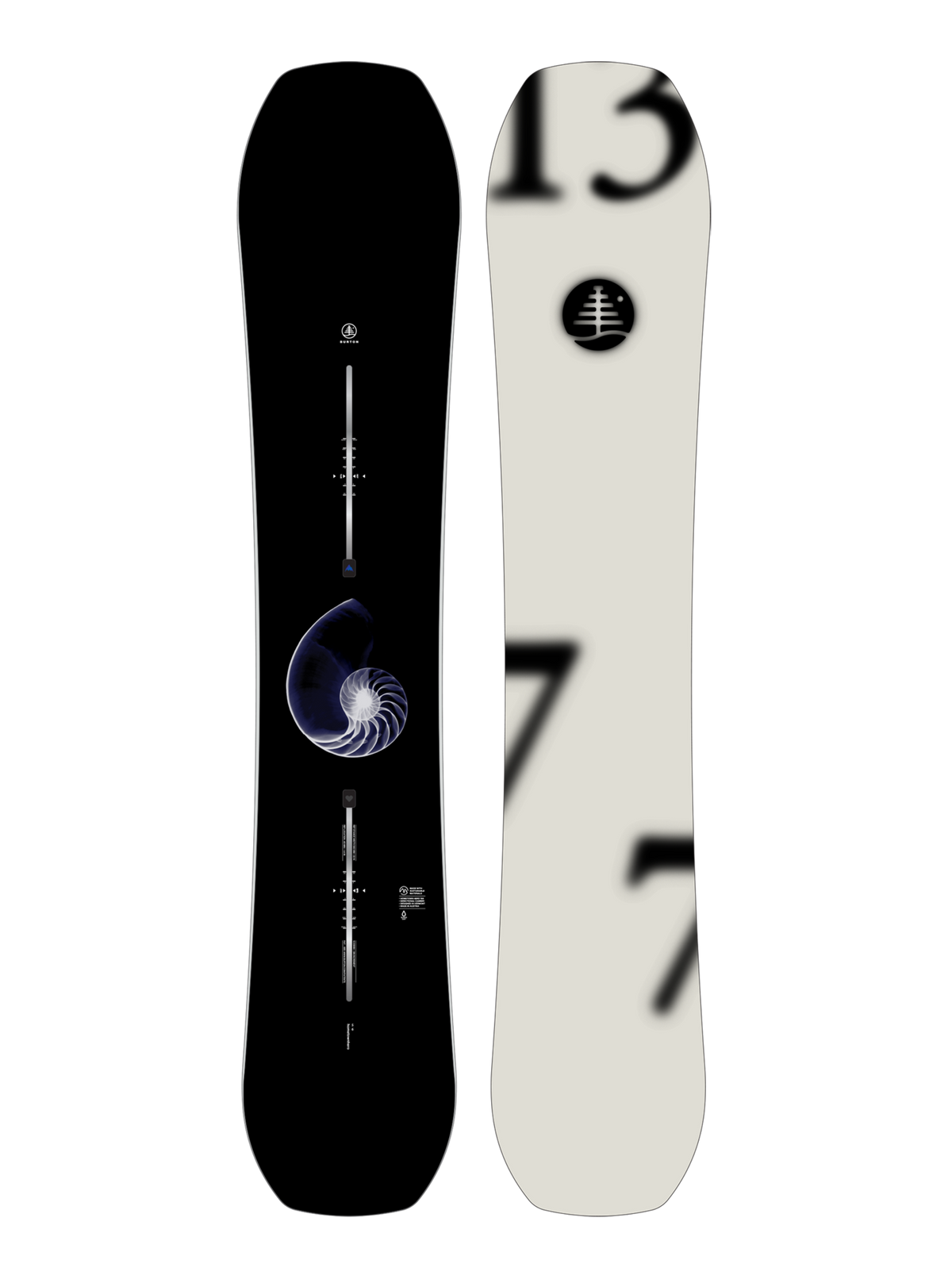
Conceived to handle the unpredictable terrain and mixed snow conditions of Northern Vermont, the Burton Family Tree Hometown Hero Camber is an aggressive all-mountain deck built for technical riding. It targets experienced snowboarders who require dependable edge hold on firm snow, agile handling through dense glades, and enough float to manage sudden storms without swapping boards mid-day.
The platform relies on a directional camber bend, pairing an early-rise rockered nose with solid camber running beneath the feet and back through a reinforced tail. Burton integrates its Balanced Freeride Geometry here, which aligns the sidecut radius directly around the rider's stance. This configuration allows the tapered, directional shape to carve and track like a twin on groomers, while retaining the deep-snow float and straight-line stability inherent to a directional freeride shape.
The result is a dedicated, performance-oriented board that favors high speeds and assertive body mechanics over casual, skidded cruising. It handles chop and heavy tracking exceptionally well, but its firm flex pattern and reactive tail demand focused input from the rider across every run.
Where it fits
Technical Tree and Glade Riding
Variable All-Mountain Freeride
Steep Hardpack Carving
Resort Powder and Chop
Pros
Tenacious edge hold on ice, hardpack, and steep technical lines
Balanced sidecut provides an intuitive, centered feel when carving
Stiff tail provides explosive pop and unwavering stability at speed
Channel mounting allows infinite stance width and micro-angle tuning
Cons
Unforgiving tail can catch if ridden defensively or off the back foot
Harsh, demanding ride feel through low-speed bumps and frozen moguls
Proprietary Channel system requires compatible binding hardware
The Hometown Hero suits intermediate to expert snowboarders who prefer an aggressive, forward-driving technique. It is specifically designed for riders who spend equal time charging hardpack groomers, navigating tight tree lines, and exploring technical off-piste terrain. Because the board features an intentionally stiff tail and full camber underfoot, it does not suit beginners or casual cruisers who rely on slurred, skidded turns. If you consistently ride with your weight centered or driving through the front foot, the deck responds with precision and energy. Conversely, defensive or backseated riders will find the stiff rear edge hooky and unforgiving when initiating rapid edge-to-edge transitions. It is a tool for focused, all-day mountain exploration.
Materials and Shape Architecture
Built around Burton’s Super Fly II 700G core, the Hometown Hero integrates dual-species woods designed to shed weight while maximizing structural resilience. Carbon highlights woven into the fiberglass layup supply torsional rigidity, ensuring that edge angle transfers directly to the snow under heavy load. The silhouette pairs a subtle taper with an elongated, rockered nose and a truncated, firm tail. Crucially, Burton utilizes its Balanced Freeride Geometry, centering the sidecut radius between the feet. This clever design lets the board feel centered and natural when riding flat-based or railing clean carves, while the setback shape and rockered tip work in concert to lift the nose over crust and powder with minimal rear-leg fatigue.
Performance in Variable Conditions
Where conventional all-mountain boards often chatter or fold when transitioning from soft snow to wind-scoured crust, the Hometown Hero excels. The robust camber platform beneath both feet bites hard into firm eastern hardpack and icy steeps, offering uninterrupted edge purchase throughout high-speed turns. In dense forests and narrow gullies, the slightly rockered nose and tapered tail allow for quick, decisive pivots when pushed assertively. When tracking through heavy, chopped-up resort snow, the deck's torsional stiffness and damp core absorb vibrational chop, preventing deflected lines. The board requires consistent physical commitment to work through slow-speed bumps, but at speed, its stability and plow-through capability remain thoroughly dependable across mixed snow types.
Mounting and Binding Tuning
Outfitted with Burton’s proprietary Channel system, mounting bindings to the Hometown Hero offers near-infinite stance width and angle adjustments. Riders running Burton EST bindings will experience maximum board feel and direct underfoot flexing, though standard disc bindings compatible with channel sliders work equally well with supplied mounting hardware. To unlock the board’s full versatility, setting bindings at the factory-marked reference point balances flotation with sidecut engagement. Riders tackling dedicated deep-powder days can shift the stance backward along the channel for effortless float. Detuning the contact points slightly around the wide nose profile helps prevent grabby transitions on hardpack, while keeping the tail edge razor-sharp ensures reliable hold on firm traverses and icy runouts.
Competitive Field and Alternatives
The Hometown Hero sits in a competitive category alongside freeride staples like the Jones Flagship and the Capita Mega Merc. Compared to the Jones Flagship, the Hometown Hero features a slightly more playful, nimble feel in tight trees due to its balanced freeride sidecut, whereas the Flagship offers more raw dampness and stability down wide-open, high-speed faces. Against the Capita Mega Merc, which leans toward a lightweight, freestyle-oriented all-mountain feel, the Hometown Hero provides a stiffer, more grounded tail that excels in unpredictable, crusty conditions. If you prioritize buttery freestyle flexibility, options like the Rome Ravine offer a more forgiving ride, but few boards match the Hometown Hero’s blend of glade agility and variable-snow security.
Durability and Honest Limitations
Burton constructs the Hometown Hero with durable sidewalls and a fast, high-density sintered base that holds wax well and resists light rock impacts encountered in early-season conditions. However, the board carries distinct functional trade-offs. Its stiff flex profile and unyielding tail require active leg work; in low-speed, frozen mogul fields, it can feel harsh, jarring, and fatiguing on the knees. Furthermore, riding switch requires conscious attention, as the directional taper and rockered nose make switch transitions feel noticeably different than riding regular. Lastly, while The Channel offers micro-adjustability, riders using non-Burton bindings must ensure they have compatible channel discs and proper M6 hardware, as improper screw lengths can dimple or damage the base.
As an Amazon Associate, Wild10 earns from qualifying purchases.
No ratings yet
Pick 08Research-based review
Mosquito
Nidecker
Profile
Directional Camber with Rockered Nose
Shape
Volume-Shifted Tapered Swallowtail
Flex
Medium-Stiff
Riding Style
Directional Powder and Freeride
Sizing Recommendation
Downsize 6 to 10 cm from standard length
Core Construction
Multi-wood core with carbon reinforcement
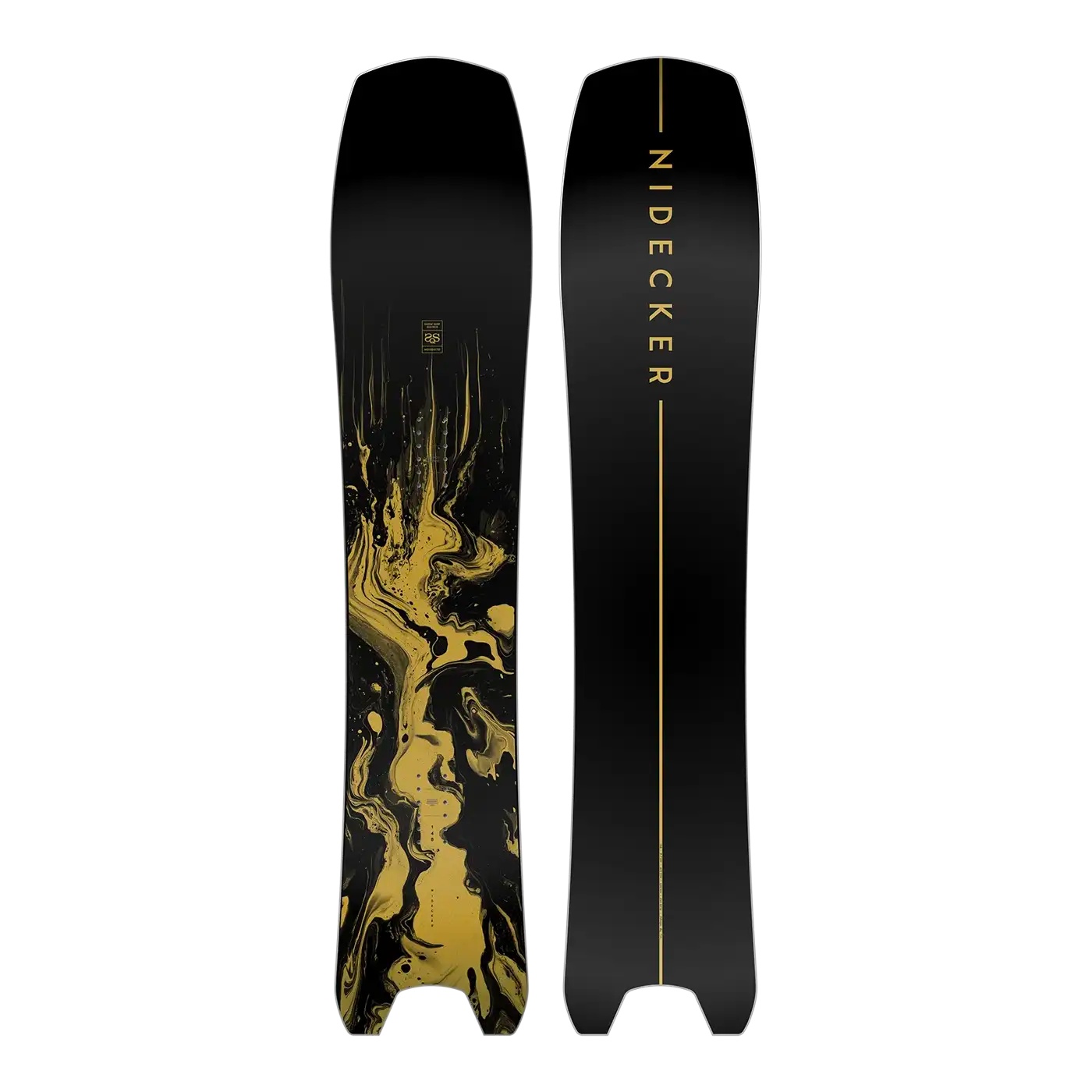
The Nidecker Mosquito stands out as an unapologetically radical, volume-shifted freeride board engineered to extract maximum agility and float from an ultra-compact footprint. Rather than relying on traditional length to generate surface area, the Mosquito expands width across the chassis, combining a bulbous, rockered nose with a deeply notched swallowtail. This design allows riders to downsize significantly compared to their standard all-mountain decks, resulting in a stubby, surf-inspired silhouette that pivots through tight terrain with minimal physical effort.
Beneath its unconventional profile lies a responsive core construction and traditional camber between the feet, giving the board surprising bite on hardpack. In deep snow, the swallowtail drops naturally, allowing the wide nose to stay above the surface without requiring excessive rear-leg weight. On groomed terrain, the tight sidecut lets riders rail energetic, low-angle carves, provided the snow surface is relatively clean and predictable.
While marketed within the broader all-mountain freeride sphere, the Mosquito is deliberately specialized. Its truncated tail offers negligible forgiveness on heavy flat landings, and riding switch is functionally off the table. It thrives in the hands of an experienced rider who views the entire resort through a surf-inspired lens, prioritizing tree runs, gullies, and fresh powder stashes over park laps or high-speed straight-lining.
Where it fits
Dense tree glade exploration
Deep powder bowl riding
Tight-radius groomer carving
Natural gully surfing
Pros
Effortless powder float with virtually zero rear-leg muscle burn
Lightning-fast pivot speed through dense tree glades and chutes
Extra-wide waist eliminates boot overhang on aggressive carves
Lively snap out of tight-radius turns on smooth corduroy
Cons
Functionally directional design makes switch riding impractical
Minimal tail provides little forgiveness on heavy landing impacts
Short effective edge feels nervous in fast, chopped-up hardpack
The Nidecker Mosquito is built specifically for intermediate to expert riders who prioritize turning agility, powder flotation, and natural terrain navigation. It is not an entry-level platform, nor is it aimed at riders who spend their mornings working on switch tricks or lapping the terrain park. Instead, it serves the freerider who hunts tight glades, banked slaloms, and fresh snow off the beaten path. Because of its volume-shifted geometry, the board requires an active, front-foot-driving riding style to engage its nose and initiate turns cleanly. Casual cruisers or back-seat riders will find the board grabby or unforgiving on firmer snow. However, for a pilot who understands how to load camber and exploit a setback stance, the Mosquito acts as a nimble, specialized tool that transforms dense forests and technical gullies into natural playgrounds.
Materials and Core Construction
Nidecker builds the Mosquito using a high-density wood core engineered with alternating stringers of lighter woods to keep swing weight low despite the expansive waist width. Triaxial fiberglass laminates provide torsional rigidity, ensuring that edge hold remains dependable when the board is tipped high onto its sidecut. Strategic carbon reinforcement runs through critical flex zones to enhance snap and rebound out of turns, compensating for the lack of a traditional, elongated tail. The running surface utilizes a fast, dense sintered base that absorbs wax well and maintains speed across flat runouts and deep snow. The sidewalls are rugged, protective ABS, though the delicate tips of the swallowtail require sensible care when navigating lift lines or rocky drop-ins. Overall, the fit and finish reflect high manufacturing tolerances, delivering a damp yet energetic feel underfoot.
Groomer and Carving Performance
On corduroy, the Mosquito behaves like a high-performance carving board squeezed into a sports-car chassis. The generous waist width virtually eliminates toe and heel drag, permitting aggressive edge angles without boot out. Combined with a tight sidecut and positive camber between the bindings, the board grips tenaciously into clean snow and whips through rapid, tight-radius carves with notable spring. However, this agility comes with clear limits. Because the effective edge is condensed and the tail is short, the board lacks the directional stability of longer, traditional freeride decks when pointed straight down choppy slopes. In late-day refrozen rutting or uneven tracked snow, the stubby running length feels skittish, transmitting vibrations directly into the bindings. It demands active edge management and clean technique rather than passive, flat-based coasting.
Powder and Tree Dynamics
Deep snow is the environment where the Mosquito justifies its radical shape. The broad, spooned nose creates enormous surface area up front, while the tapered waist and recessed swallowtail allow the back of the board to sink effortlessly. This mechanical displacement keeps the rider centered, eliminating the fatiguing back-thigh burn typical of standard directional boards in deep powder. In dense, technical tree glades, the short overall length allows for instantaneous pivoting and rapid directional adjustments. Where a standard 160-centimeter powder board feels sluggish between tight pine trunks, the downsized Mosquito darts through narrow gaps and around obstacles with minimal rider input. It manages wind-affected crust and wet maritime snow with equal competence, driving through heavy accumulations without submerging its nose.
Durability and Tuning Considerations
Operating a volume-shifted swallowtail requires specific setup and maintenance adjustments. Riders must adhere to Nidecker sizing charts and downsize substantially, usually six to ten centimeters shorter than their standard board length, to match rider weight to the board flex profile. Stance width should remain moderate; stretching out too far compromises the mechanical advantage of the camber pocket and short tail. For edge tuning, keeping a sharp 90-degree or slightly beveled edge along the main running surface preserves carving precision, but slightly detuning the transition zones near the wide shoulders of the nose helps prevent twitchy hookups on hardpack. The swallowtail tips represent the most structurally vulnerable area of the deck; riders should avoid resting the board tails-down on hard concrete or letting chairlift gates impact the rear cutout.
Comparable Market Alternatives
Riders considering the Mosquito will naturally cross-shop other volume-shifted freeride models. The Lib Tech Orca offers a similarly wide platform with a rockered center and serrated edges, providing superior grip on icy hardpack and slightly more tail for landings, though it lacks the Mosquito’s pure, locked-in carving snap out of turns. The K2 Excavator is another prominent competitor, retaining a slightly more conventional tail shape that handles high-speed chatter and chopped-up resort snow with better dampness, albeit with slightly less surf-style pivot in tight trees. Meanwhile, boards like the Ride Warpig deliver volume-shifted agility in a tapered twin package, which suits riders who still want to land switch or hit side hits. The Mosquito remains the most directional and powder-purist option of the group.
As an Amazon Associate, Wild10 earns from qualifying purchases.
No ratings yet
Pick 09Research-based review
Custom Flying V Snowboard
Burton
Profile
Hybrid rocker-camber (Flying V)
Shape
Directional twin
Flex
Medium flex
Mounting System
The Channel mounting system
Base
Sintered WFO base
Core
FSC-certified dual-zone wood core
The Burton Custom is an established benchmark in snowboarding history, but the Flying V variation takes that familiar platform in a decidedly more relaxed direction. Instead of the aggressive, locked-in edge bite associated with traditional camber, the Flying V introduces rocker between your feet and outside the bindings, balanced by subtle camber pockets underfoot. This geometry yields a fluid, pivot-friendly personality that focuses on maneuverability rather than sheer high-speed carving precision.
On the hill, this design creates an accessible ride suited to mixed terrain, tree glades, and modest powder stashes. The rocker in the center makes initiations easy and reduces the risk of catching an edge in chopped-up snow or slush, while the core remains energetic enough to pop off rollers and side hits. It functions as an approachable all-mountain platform for intermediate to advanced riders who prefer a surfy feel over relentless edge pressure.
The trade-off is edge hold on bulletproof surfaces. Because the profile pulls contact points slightly off the snow until weighted, it cannot generate the reliable hardpack grip of a full-camber board. For riders seeking a forgiving, everyday deck across soft resort snow, it hits a reliable middle ground.
Where it fits
Resort cruising on soft groomers
Tight tree runs and glades
All-mountain freestyle and side hits
Moderate resort powder days
Pros
Forgiving rocker profile significantly reduces edge catches in slush and crud
Effortless low-speed pivotability in tight trees and mogul lines
Generates natural float in fresh powder without severe setback
Infinite stance adjustments available through The Channel system
Cons
Compromised edge hold and stability on bulletproof ice and hardpack
Prone to high-speed tip chatter when railing aggressive carves
Requires Channel-compatible mounting discs for non-Burton bindings
The Burton Custom Flying V is tailored for intermediate to advanced snowboarders who want the heritage of the Custom line without the demanding edge control of full camber. It suits resort riders who spend their days tracking across varied terrain, dipping into tree lines, and hitting natural side features rather than racing down icy groomers. Because the rocker between the feet significantly reduces edge catch, it also accommodates progressing riders seeking an intuitive feel in variable conditions. It is not built for high-speed carving purists, dedicated halfpipe riders, or anyone who primarily tackles hard-frozen slopes. Those riders will find the hybrid profile lacks the immediate rebound and unwavering stability under aggressive forward pressure that traditional camber offers.
Materials and Construction
Burton utilizes a lightweight multi-species wood core designed to optimize strength in critical areas while reducing swing weight at the tips. The core profiling alternates wood grain directions under the bindings and along the edges to bolster edge transfer despite the central rocker bend. Carbon stringers integrated into the fiberglass laminate inject longitudinal snap, helping the board pop off lips without stiffening its torsional flex to an unmanageable degree. The running surface features a fast, dense sintered base that absorbs wax efficiently, which aids in maintaining speed across flat runouts and slushy spring traverses. Together, these elements deliver a resilient platform that feels lightweight underfoot without sacrificing overall structural integrity.
Resort Handling and Feel
On the snow, the Flying V feels loose, lively, and quick to swivel. The central rocker zone creates a natural pivot point, allowing rapid turn adjustments in tight mogul fields or dense glades where an edge catch could result in a fall. In fresh snow, the upturned tip and tail provide natural float without requiring an extreme setback stance, reducing back-leg fatigue on powder days. However, when pushed into high-speed arcs on firm corduroy or boilerplate ice, the profile reveals its limits. The edge contacts can feel slightly disconnected from the snowpack, leading to unwanted chatter or slippage during hard lateral loads. In soft groomers and chopped powder, however, the ride remains composed and playful.
Durability and Wear
Long-term reliability on the Custom Flying V aligns with industry standards for premium resort decks. The topsheet holds up well against edge dings from lift lines, though high-impact impacts can cause cosmetic chipping on the upper perimeter. The sintered base requires periodic waxing to maintain its glide, but its high-density composition resists gouges from hidden rocks better than entry-level extruded alternatives. Over extended seasons, the hybrid camber arcs will gradually settle, slightly reducing the spring between the feet, though the deck retains its forgiving character throughout its working life. Routine base grinds and edge de-tuning near the contact zones will help preserve consistent sliding dynamics year after year.
Mounting and Binding Tuning
Like all modern Burton models, the Custom Flying V features The Channel mounting track rather than traditional four-hole insert packs. This setup allows micro-adjustments in stance width, setback, and angles, but it demands specific hardware. Burton EST bindings mount directly to the channel rails with minimal hardware, while non-EST bindings from other brands require Channel-compatible baseplate discs. Proper torque on the channel screws is essential, as hardware can occasionally loosen if not checked during the first few days of the season. For optimal response, pairing this deck with a medium-flex all-mountain binding matches the board's balanced flex profile without overpowering its torsional flexibility.
Competitive Context and Value
At its price point, the Custom Flying V competes directly with other hybrid-rocker all-mountain staples such as the Never Summer Proto series and hybrid-camber designs from Lib Tech. While Lib Tech's C2 profile relies on serrated edges to counter the edge-hold deficit of central rocker on ice, Burton opts for traditional smooth steel edges, meaning the Custom Flying V forfeits raw ice security in exchange for cleaner glide and a smoother flat-base slide. Compared to the standard full-camber Burton Custom, the Flying V trades aggressive edge lock and energy for superior float and low-speed forgiveness. It represents fair value for riders who prioritize comfort across mixed snow over rigid carving performance.
As an Amazon Associate, Wild10 earns from qualifying purchases.
No ratings yet
Pick 10Research-based review
Merc
Nidecker
Profile
Hybrid camber with rockered tip and tail
Shape
Directional twin with subtle setback
Flex
Medium (around 5 to 6 out of 10)
Riding Level
Beginner-intermediate to advanced-casual
Core Material
Multi-species poplar and paulownia wood core
Terrain Bias
All-mountain resort, groomers, and light powder
The Nidecker Merc is an accessible, high-utility all-mountain snowboard engineered to deliver consistent performance without demanding elite technical skill or command of a premium budget. Shaped as a directional twin with an approachable character, the Merc bypasses ultra-stiff freeride construction in favor of a balanced, user-friendly platform. It serves primarily as a versatile single-board solution for resort riding across varied terrain.
The core of the Merc's ride feel lies in its hybrid profile, which pairs traditional camber between the bindings with rocker through the nose and tail. This arrangement establishes dependable edge hold along groomed runs while lifting contact points to prevent sudden edge catches during flat transitions or slow maneuvers. A modest stance setback enhances lift in fresh snow without compromising switch riding or natural balance on side hits.
While the Merc intentionally foregoes the dampening laminates and rigid backbone required for high-velocity charging in heavy chop, it excels in predictable, day-long ease. For riders seeking a forgiving, durable deck that transitions smoothly between groomers, low-angle powder, and casual resort exploration, the Merc delivers exceptional utility for its class.
Where it fits
Resort all-mountain cruising
Intermediate skill progression
Occasional shallow powder
Casual side-hit riding
Pros
Forgiving hybrid profile resists edge catches while keeping solid edge hold
Balanced directional twin shape transitions smoothly between forward and switch
Low-fatigue medium flex makes turn initiation easy for progressing riders
High overall durability and low-maintenance base offer solid long-term value
Cons
Tips vibrate and chatter when pushed at high speeds through hard chop
Lacks the explosive pop and energy of stiffer, carbon-loaded boards
The Nidecker Merc is tailored specifically for riders moving beyond rental gear and intermediates seeking a predictable board to refine their skills. Rather than punishing slight balance errors, its medium flex and gentle torsional compliance allow for relaxed body positioning and easy turn initiation. It also appeals to veteran resort cruisers who prefer an easy-bending, low-fatigue platform over a punishing, ultra-stiff carve stick. True beginners with a few days under their belts will find it confidence-inspiring, while advanced riders hunting for a relaxed backup deck can appreciate its playful, catch-free manners. Conversely, aggressive freeriders who live on steep chutes, icy faces, or high-speed fall lines will find the board lacking the muscular backbone needed for extreme terrain.
Materials and Build Quality
Nidecker builds the Merc around a dual-density wood core that integrates lighter wood species to reduce swing weight alongside sturdier stringers for longitudinal durability. The core is reinforced with standard fiberglass weaves that provide a smooth, progressive flex rather than the snappy, abrupt response typical of high-tension carbon stringers. The topsheet is designed to resist standard lift-line scuffs, while an extruded or dense standard base ensures reliable glide with minimal maintenance requirements. This base structure holds wax reasonably well and withstands direct contact with debris or shallow obstacles far better than fragile, high-speed competition bases. Overall, the construction reflects an emphasis on structural durability and dependable longevity rather than costly weight-saving novelties.
All-Mountain Handling Dynamics
On resort corduroy, the camber section underfoot engages cleanly, giving the rider secure traction throughout moderate-speed carves and skidded turns. The rockered tips keep transitions intuitive, allowing you to feather edges into turns without worrying about sudden grab on cat tracks or tracked-out slopes. Off-piste, the slight directional setback and rockered nose provide adequate flotation in modest powder stashes, keeping the nose above the snow without demanding excessive back-leg pressure. In tighter tree lines and mogul fields, the Merc swivels quickly due to its forgiving torsional flex, letting you alter lines quickly without muscle strain. While it does not deliver radical pop off large features, it launches predictably off natural rollers and lands softly.
Speed and Terrain Limits
The compromises of the Merc become obvious once terrain steepens and descents speed up. Without advanced elastomeric dampening or dense carbon layups, the nose begins to chatter when plowing through refrozen afternoon chop or hard-packed ruts at full throttle. This vibration transfers directly into the rider's legs, requiring more active shock absorption to maintain an edge. Similarly, on genuine boilerplate ice, the edge grip is competent but cannot rival the tenacious bite of boards with aggressive serrated edges or stiff camber profiles. The board is intentionally tuned for broad versatility rather than specialized high-speed stability, meaning aggressive riders will quickly discover its upper velocity boundaries in unyielding snow conditions.
Stance Setup and Tuning
To get the best all-around performance from the Merc, mounting bindings at the reference stance yields a balanced platform suitable for riding switch, popping side hits, and cruising groomers. For deeper storm cycles, sliding the bindings back to the rearward insert pack unlocks extra nose length and float, significantly reducing leg burn in soft snow without disrupting turn initiation. Pair this board with a soft-to-medium flex all-mountain binding; overly stiff bindings can overpower the board's chassis and compromise its forgiving nature. Maintaining a factory base bevel of roughly one degree keeps the contact points smooth and predictable, while regular recreational hot waxing preserves smooth glide across mid-winter and spring temperatures.
Value and Comparable Alternatives
Within its price bracket, the Merc competes directly against established resort workhorses like the Yes Basic and the Salomon Sight. The Yes Basic offers slightly firmer edge grip on firm pack due to its specialized outline, making it a stronger choice for dedicated park and ice riders. The Salomon Sight shares a similar rocker-camber-rocker profile and approachable price point, though the Merc typically offers a slightly more damp feel in rough snow. Where the Merc wins out is its pure balance: it does not heavily bias either freestyle or freeride, offering a dependable middle ground for riders who want one board to explore the whole boundary without overpaying.
As an Amazon Associate, Wild10 earns from qualifying purchases.
No ratings yet
How we picked
Ranked by Wild10 Editorial Team, Research desk
We started with a long list of all-mountain snowboards that people actually buy, cut anything that could not clear our baseline for durability and field performance, then ranked the 10 that were left against the same criteria. Rankings are editorial. No brand pays for placement, and affiliate links never move a pick up or down.
Edge hold and stability
Grip on firm snow and composure at speed for the intended skier level.
Versatility across conditions
How the ski or board handles groomers, crud and fresh snow in one day.
Real-world durability
How the material, stitching, or steel holds up after a season of hard use — not how it looks new.
Performance in bad conditions
Wind, rain, cold, and grit are the test. Anything that only works on a nice day gets marked down.
Weight and packability
Every ounce has to earn its place in the pack, but not at the cost of something that fails in the field.
Ease of use
Setup, adjustment, and maintenance with cold hands, in the dark, without the manual.
How often we recheck this: Reviewed on a rolling basis and rechecked at least once a year, or sooner if a pick is discontinued, revised, or beaten by something new.
Best all-mountain snowboards for a specific job
Skip the ranking — jump to the pick that matches how you actually use it.
Best for steep off-piste freeriding
#1 Descender Snowboard — Men’s & Women’s — StrandaThe Stranda Descender is engineered for experienced riders who view the entire mountain as an open freeride canvas. Known for delivering exceptional edge hold on firm snow while remaining remarkably nimble in tight glades, this deck bridges the gap between high-speed stability and quick, reactive maneuvering. If your typical day involves hunting steep lines, blasting through variable chop, and carving clean arcs on morning groomers, the Descender provides the precise backbone needed for demanding terrain.
At the core of the Descender's design is a calculated directional shape that prioritizes forward drive without feeling overly cumbersome or plank-like. The board’s profile features traditional camber underfoot to generate powerful rebound out of turns and reliable bite on hardpack, blended with a subtle nose rise that effortlessly surfaces in fresh snow. High-end composite layering keeps the ride damp, filtering out excessive chatter when pushing through uneven afternoon snowpacks.
That level of performance comes with clear operational compromises. The Descender is distinctly a directional deck with premium freeride intentions; riders seeking a forgiving platform for learning spins or spending half their day riding switch through the terrain park will find it overly stiff and locked-in. It demands an active, attentive pilot who drives turns through their boots, but it rewards good technique with supreme control across all snow conditions.
**Highlights**
- Directional freeride geometry optimized for high-speed charging
- Powerful camber underfoot for dependable hardpack edge hold
- Damp construction that absorbs vibration in tracked-out snow
- Progressive nose profile designed for natural powder flotation
- Dedicated men’s and women’s models tailored to diverse rider weights
**Watch-outs**
- Demands an assertive riding style that can punish lazy footwork
- Premium pricing places it out of reach for budget-conscious riders
- Stiff, directional tail limits park utility and switch ridingRead the full profile
Best for resort powder days
#2 Ravine — Men’s & Women’s — RomeThe Rome Ravine sits in a sweet spot for intermediate to advanced riders who want directional freeride capability without losing a playful, energetic disposition. Designed to tackle deep powder stashes, natural side hits, and resort groomers with equal composure, it is widely recognized as an outstanding value for riders seeking a single board to tackle unpredictable winter conditions across North America.
The board pairs a directional shape with a softer torsional flex and a responsive camber profile between the feet, transitioning to a rockered, rock-solid nose. This construction allows riders to lean back into deep snow without suffering burning quads, while also enabling surfy, low-effort slashes along tree lines. Rome’s internal structural glass and carbon additives provide plenty of pop when popping off cat tracks, yet the flex remains forgiving enough that catching an edge is far less common than on rigid freeride planks.
The trade-off for this lively, forgiving character is a modest loss of dampness at terminal velocity. When navigating bulletproof early-morning ice or hauling through heavy, frozen refrozen crud, the Ravine can feel a bit lively and chatter underfoot compared to ultra-stiff, metal-laminated alternatives. It shines brightest under riders who prefer a nimble, dynamic flow down the mountain rather than absolute freight-train charging.
**Highlights**
- Hybrid directional camber with rockered nose for effortless float
- Playful medium flex that balances pop with turn initiation
- Agile sidecut well-suited for tight tree navigation
- Approachable learning curve for progressing intermediate riders
- High performance-to-cost ratio relative to premium competitors
**Watch-outs**
- Can chatter and transmit feedback on hard, refrozen ice
- Shorter tail profile reduces landing support on deep drops
- Less dampening stability at ultra-high downhill speedsRead the full profile
Best for aggressive all-mountain freestyle
#3 Howler — Men’s & Women’s — JonesThe Jones Howler caters specifically to aggressive all-mountain riders who approach natural terrain with a freestyle mindset. While traditional all-mountain boards often lean heavily toward directional cruising, the Howler is tuned for launching off natural rollers, stomping steep landings, and laying down deep trenches on corduroy. It is an unapologetic, firm-charging platform built for riders who carry speed into every feature.
Jones built the Howler with a stout flex profile and a responsive camber-dominant base, delivering immense snap and instantaneous edge response. The refined sidecut utilizes subtle edge-traction zones to dig into slick snow and windblown ridges, giving the rider confidence when setting up for drops in firm conditions. Inside, targeted stringers reduce torsional wash, ensuring the board stays planted and tracks true when landing heavily or carving at maximum lean angles.
Because of its aggressive build, the Howler offers very little forgiveness for casual resort lapping. Relaxing over the center of the board or engaging turns tentatively will quickly lead to unexpected edge grabs. It is not built for slow-speed buttering or cruising flat run-outs; it requires strong leg input and constant rider engagement, making it best suited for seasoned riders with established board control.
**Highlights**
- Aggressive camber-dominant profile engineered for maximum energy return
- Substantial torsional stiffness for stability on high-speed landings
- Strategic edge-grip profiling for dependable bite on firm snow
- Robust core construction built to endure blunt freestyle impacts
- Distinct platform suited for both technical carving and natural air
**Watch-outs**
- Uncompromising flex pattern punishes technique errors
- Requires significant leg drive to bend and maneuver at low speeds
- Not suited for novice or casual intermediate resort cruisingRead the full profile
Best for high-angle groomer carving
#4 Summer Nokhu 161 DF — NeverThe Never Summer Nokhu 161 DF is a specialized tool tailored for larger riders, boot sizes that frequently suffer toe drag, and aggressive carvers who want maximum platform width. Built around Never Summer’s ultra-wide "Drag Free" footprint, this deck allows riders to lay down extreme, armpit-dragging carves without the toe or heel of their boots snagging the snow surface and blowing out the turn.
Beyond its substantial waist width, the Nokhu incorporates Never Summer's distinct multi-camber profile, which places rocker between the feet flanked by powerful camber zones directly beneath the bindings. This blend delivers exceptionally smooth turn transitions and remarkable deep-snow flotation despite the board’s sheer surface area. The internal construction includes robust elastomeric dampening systems, which deaden vibrational feedback when crossing through choppy, frozen snow and uneven resort surfaces.
Naturally, such a broad waist introduces specific compromises. Transferring edge-to-edge on the Nokhu requires deliberate leverage and strong ankle articulation; riders with average or smaller boot sizes will find the board slow to initiate tight, snappy turns. It is an absolute powerhouse for trenching wide groomers and floating deep backbowls, but it demands patience and effort in cramped moguls.
**Highlights**
- Drag Free waist width prevents boot overhang on extreme carve angles
- Multi-camber design offers a balance of foot grip and pivot ease
- Heavy-duty vibration dampening layers for chunder reduction
- Immense surface area delivers effortless flotation in powder
- Durable top sheet and impact-resistant sidewall construction
**Watch-outs**
- Slow edge-to-edge response for riders with average or smaller boot sizes
- Noticeable swing weight requires extra physical effort in the air
- Cumbersome to pilot through tight, technical bump runsRead the full profile
Best for resort freestyle and side hits
#5 Rally Cat — Men’s & Women’s — JonesThe Jones Rally Cat is oriented toward riders who want to turn the whole resort into a skatepark without being confined to the terrain park rope line. Bridging freestyle agility and all-mountain capability, this board delivers a forgiving, energetic feel that excels at buttering, pressing rollers, and weaving through crowded side runs. It is tailored for intermediate to advanced riders who prioritize fun and maneuverability over brute force.
The board features a friendlier, medium flex coupled with a versatile hybrid profile that softens edge catch at the contact points. This design encourages quick, intuitive turn initiation and permits low-stress switch riding, whether landing spins or practicing opposite-stance carves down green and blue cruisers. Despite its approachable flex, the board retains enough structural backbone through the center to hold an edge when you decide to pick up speed down steeper groomers.
However, riders who spend their days charging high-alpine bowls or dropping into frozen, tracked-out chutes will reach the Rally Cat’s ceiling fairly quickly. In heavy, chunky snow at high velocities, the nose can deflect and chatter, requiring you to dial back the throttle. It prioritizes flex and expression over sheer dampness, making it an excellent daily cruiser rather than a big-mountain bruiser.
**Highlights**
- User-friendly medium flex optimized for buttering and presses
- Forgiving edge profile helps minimize unexpected hangups
- Balanced geometry accommodates regular and switch riding with ease
- Nimble handling through trees, park jumps, and side features
- High degree of board feel and underfoot articulation
**Watch-outs**
- Tends to deflect when plowing through heavy, frozen chunder
- Lacks the high-speed dampening needed for steep, icy freeride runs
- Less supportive for stomping high-consequence dropsRead the full profile
Best for resort freeride exploration
#6 Passport — K2The K2 Passport is an understated freeride-leaning all-mountain board designed for riders who prioritize clean line choice, dependable edge control, and deep powder competence. Blending a functional directional shape with an accessible flex, it acts as a dependable vehicle for exploring off-piste bowls, diving through steep forest corridors, and laying down structured turns on groomed trails without beating up the rider's legs.
K2 utilizes a directional camber baseline that runs traditional camber through the tail and midsection, tapering into a gradual, elongated rocker in the nose. This geometry ensures solid edge hold and turn completion while keeping the tip raised above deep, untracked snow. The board’s sidecut is dialed for medium to long-radius turns, offering a stable, predictable track when opening up your lines on open faces, while composite reinforcements provide just enough pop to hop natural obstacles without turning the deck into a stiff plank.
The trade-off is that the Passport has a dedicated directional bias. While it can be ridden switch for basic transitions and quick utility maneuvers, it is clearly not designed for regular backward riding or park rail progression. It is a directional resort utility knife for riders who keep their nose pointed downhill and value consistency across changing mountain conditions.
**Highlights**
- Directional camber profile balances edge security with powder float
- Predictable sidecut geometry ensures clean, stable arcs
- Accessible flex pattern reduces fatigue over full-day sessions
- Snappy tail construction provides reliable pop and turn completion
- Excellent tracking across varied, mixed-snow conditions
**Watch-outs**
- Directional layout makes sustained switch riding awkward
- Not intended for dedicated freestyle park or jib features
- Lacks the extreme dampness demanded by elite-level speed chargersRead the full profile
Best for technical tree and glade riding
#7 Family Tree Hometown Hero Camber Snowboard — BurtonThe Burton Family Tree Hometown Hero Camber is engineered for all-conditions freeride reliability, particularly when conditions turn steep, tight, and unpredictable. Conceived in the variable snow and dense hardwoods of Vermont, this board is built to power through frozen ruts, float over unexpected powder stashes, and hold a tenacious line through tight, technical glades where precision is non-negotiable.
The Hometown Hero uses a directional camber profile with an intentionally stiffened tail and a slightly softer, rockered nose. This layout gives the deck tremendous snap off lips and unyielding edge stability when traversing hardpack, yet lets the front end absorb undulations and plane easily over fresh snow. Burton's balanced freeride geometry sets the sidecut centered relative to your stance, giving the board a surprisingly centered feel when flat-basing or carving, despite its directional silhouette.
With its stout tail and camber-rich platform, the Hometown Hero does not tolerate passive technique. If you get back on your heels or fail to drive through the front foot during turn initiation, the tail can feel grabby and unforgiving. It also requires Burton’s proprietary Channel binding system, which limits hardware choices if you are running non-compatible baseplates without conversion discs.
**Highlights**
- Directional camber provides resolute hold on steep and firm terrain
- Stiff, responsive tail for stability and explosive ollie pop
- Rockered nose geometry helps surface through heavy snow and powder
- Centered sidecut feel provides natural balance when carving
- Burton Channel mounting system allows micro-adjustable stance width
**Watch-outs**
- Demands an assertive, forward-weighted riding stance to avoid tail-catch
- Proprietary Channel system requires compatible binding hardware
- Stiff platform can feel jarring through slow-speed mogul fieldsRead the full profile
Best for dense tree glade exploration
#8 Mosquito — NideckerThe Nidecker Mosquito is an unconventional, volume-shifted freeride board designed to maximize agility and powder float in a compact, stubby frame. Built to be downsized significantly from your standard board length, it relies on an ultra-wide waist and an exaggerated swallowtail to provide the float of a much larger deck while delivering sports-car-like handling through dense trees and tight gullies.
The board’s radical geometry places a massive, rockered nose upfront, pulling down to a short, responsive camber profile and terminating in a functional fish-style cutout tail. In fresh snow, the tail sinks automatically, keeping the tip elevated with virtually zero back-leg strain. On groomers, the tight sidecut grips firmly, allowing riders to lay into surprisingly deep, banked turns, provided they keep their weight properly balanced over the short running surface.
However, the Mosquito is undeniably specialized compared to standard all-mountain shapes. Its ultra-short tail makes landing significant drops challenging, as there is minimal surface area behind the back binding to catch your weight. Riding switch is functionally off the table, and in hard, uneven chop, the short effective edge can feel nervous and skittish compared to a traditionally sized freeride stick.
**Highlights**
- Volume-shifted geometry allows for significant downsizing in length
- Deep swallowtail design sinks naturally for effortless powder flotation
- Broad nose shape prevents submarining in deep or heavy snowpacks
- Ultra-quick pivoting through tight forest glades and natural gullies
- Capable of aggressive, tight-radius carves on smooth groomers
**Watch-outs**
- Short tail provides minimal support on large landing impacts
- Functionally directional; practically unusable for switch riding
- Effective edge can feel unstable in high-speed, choppy hardpackRead the full profile
Expert-picked, reader-ranked
Our editors test the gear, pick the ten, and set the order the day a list publishes. After that, the ranking is live: every member star rating feeds the community order, so picks climb or slide as real owners report back. Editorial judgment decides what earns a spot — you help decide where it sits.
Editors set the field
Verified specs, feature and use-case comparison, and outside sources choose the ten and the published order; field-tested picks are labeled.
Readers re-rank it
Your 1–5 star ratings drive the community order on every list.
Rankings keep moving
Picks rise or fall over time — nothing is frozen at launch day.
Award picks
The ranking above is price-blind and judged on merit. These awards call out the pick we'd hand a specific person with a specific need.
For riders demanding top-tier directional control and precision edge hold, the Stranda Descender stands as the premier choice, while the Rome Ravine delivers exceptional versatile freeride value, and the Jones Howler provides high-speed aggression for freestyle-oriented mountain charging.
How to choose all-mountain snowboards
Every pick on this page was judged against the same criteria. If you want the short answer, Descender Snowboard — Men’s & Women’s by Stranda is the one we point most people at. If you want to decide for yourself, here is what actually separates a good all-mountain snowboard from an expensive one.
Edge hold and stability
Grip on firm snow and composure at speed for the intended skier level.
Versatility across conditions
How the ski or board handles groomers, crud and fresh snow in one day.
Real-world durability
How the material, stitching, or steel holds up after a season of hard use — not how it looks new.
Performance in bad conditions
Wind, rain, cold, and grit are the test. Anything that only works on a nice day gets marked down.
Weight and packability
Every ounce has to earn its place in the pack, but not at the cost of something that fails in the field.
Ease of use
Setup, adjustment, and maintenance with cold hands, in the dark, without the manual.
Match the pick to your use
The right all-mountain snowboards depends on what you are actually doing with it: Steep off-piste freeriding; High-speed groomer carving; Technical tree runs; Deep powder bowls; Resort powder days; Glade and tree navigation. Start from the use case, then work down the ranking until you hit the first pick that covers it.
Common mistakes
Buying the lightest all-mountain snowboards you can find and discovering it cannot take a season of hard use.
Paying for a specialist feature you will use once a year instead of the versatile option.
Comparing headline specs across tiers instead of within the same class.
Skipping fit, sizing, or adjustment checks that decide whether you actually carry it.
Frequently asked questions
What is the best all-mountain snowboards?
Descender Snowboard — Men’s & Women’s by Stranda takes the top spot. The Stranda Descender is engineered for experienced riders who view the entire mountain as an open freeride canvas.
How did The Wild10 choose and rank these all-mountain snowboards?
We judged every pick against the same criteria — edge hold and stability, versatility across conditions, real-world durability, performance in bad conditions — and ranked them on merit regardless of price. Expertly ranked all-mountain snowboards built to handle resort groomers, deep tree lines, and variable terrain.
What is the best budget all-mountain snowboards?
Ravine — Men’s & Women’s by Rome — The Rome Ravine sits in a sweet spot for intermediate to advanced riders who want directional freeride capability without losing a playful, energetic disposition.
Descender Snowboard — Men’s & Women’s vs Ravine — Men’s & Women’s — which should I pick?
Descender Snowboard — Men’s & Women’s ranks first: The Stranda Descender is engineered for experienced riders who view the entire mountain as an open freeride canvas. Ravine — Men’s & Women’s is the close second: The Rome Ravine sits in a sweet spot for intermediate to advanced riders who want directional freeride capability without losing a playful, energetic… Our full head-to-head compares them side by side.
How often is this list updated?
We review this ranking on a rolling basis and update it whenever a pick is discontinued, meaningfully revised, or beaten by something new. Rankings are editorial — brands do not see them before publication and affiliate links never change the order.