


From the north · Wildlife
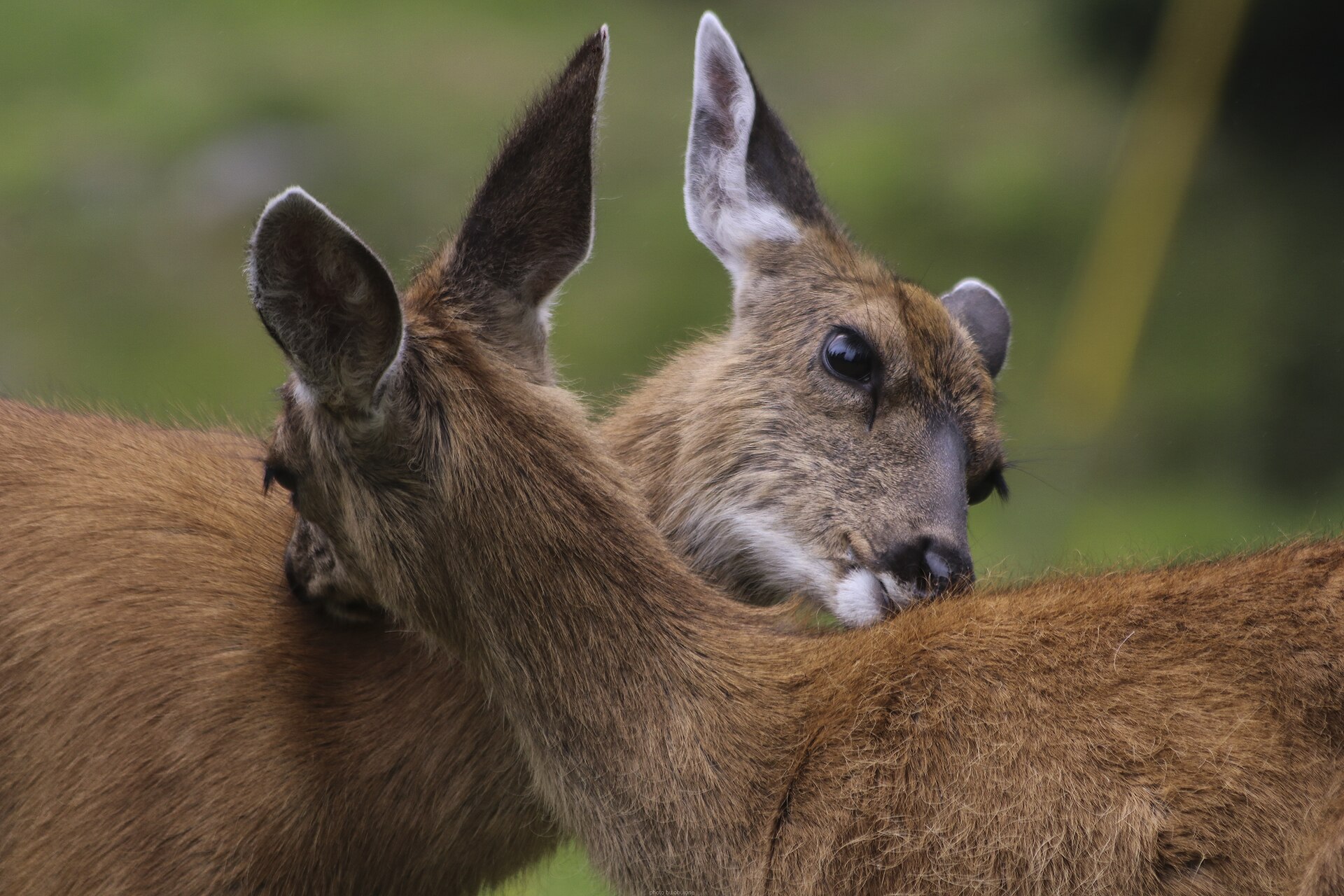
Blacktail Deer
A secretive coastal deer hunted in dense rainforest and coastal brush where visibility is measured in yards, not miles.
Odocoileus hemionus columbianus
- Range
- Coastal OR, WA, CA & BC
- Peak season
- Nov rut
- Tag access
- Mostly over-the-counter
- Live weight
- 100–200 lb
Regulations by region
Blacktail Deer rules where you're headed
Seasons, tags, limits, and legal methods for blacktail deer are set jurisdiction by jurisdiction. Pick your state or province and we'll point you at the agency that writes the rules.
Jump to another species
About the blacktail deer
Columbian blacktail deer are a coastal subspecies of mule deer that live in the dense, wet timber of the Pacific coast from central California through British Columbia — a habitat that rewards completely different skills than the open-country mule deer hunt. Where mule deer are found by glassing across open basins, blacktail are found at 20 to 60 yards in thick salal, fern, and second-growth timber, and a hunter who tries to still-hunt too fast will simply never see them. Tags are affordable and widely available over the counter across most of the range, making blacktail one of the most accessible western deer hunts — the challenge is entirely about hunting skill in difficult, wet, brushy terrain rather than tag access.
Range and habitat
The best blacktail hunting runs along the coastal timber belt of Oregon, Washington, Northern California, and Vancouver Island, with quality and access varying by land ownership as much as by state. Western Oregon: Excellent public national forest and BLM land with strong blacktail densities. Western Washington: Dense coastal and Olympic Peninsula populations. Northern California coast: Strong herds in coastal timber and brush country. Vancouver Island, BC: Renowned for mature bucks in classic coastal rainforest. Industrial timberland (OR/WA): Clear-cuts and regenerating timber concentrate deer on browse.
Behavior and field method
Blacktail are hunted at close range in thick cover — still-hunting slowly into the wind, working clear-cut edges at dawn and dusk, and rattling or grunting during the November rut, rather than glassing distant hillsides. Scout clear-cuts, regenerating timber edges, and old logging roads for browse lines, rubs, and beds — blacktail concentrate on the fresh green growth found in cutover coastal timberland. Still-hunt into the wind at a genuinely slow pace, taking a few steps and then glassing the brush ahead for a flicking ear, a horizontal back line, or a patch of hide rather than a whole deer. Hunt clear-cut edges and old roads at first and last light, when deer move out of dense bedding cover into openings to feed. During the November rut, rattle antlers together and use a grunt call from a stationary position in thick cover — blacktail bucks respond aggressively to rattling in a way that can pull them in close. Keep shots realistic given the terrain — most blacktail are taken inside 100 yards, and many well inside 50, given the density of coastal cover. Place the shot behind the shoulder on a clear, close broadside or quartering-away angle; dense brush makes marginal-angle shots more likely to be deflected, so wait for a clean lane. Track carefully in wet coastal conditions, where rain can wash out a blood trail quickly — mark the last known blood location and work a widening spiral if the trail goes cold.
Tracks, droppings, and sign
Blacktail sign is the same alphabet as whitetail sign, written in a rainforest. Everything is smaller, wetter, and hidden in brush you cannot see through, so you read sign at arm's length rather than across a field. Tracks — Slightly smaller and rounder than a whitetail's, and almost always in mud, moss, or wet duff. In old-growth timber, look for tracks pressed into rotting logs and mossy banks — the forest floor is too spongy to hold a clean print. Droppings — Small dark pellets that often clump because of the soft, wet browse blacktails eat. Piles in clearcuts and along old logging grades are the most reliable indicator of a bedding-to-feeding route. Rubs — Shredded hemlock and fir saplings, usually lower and less dramatic than whitetail rubs. Concentrated rubs along the edge of a five-to-fifteen-year-old clearcut mark a buck's core area. Trails in brush — Blacktails create low tunnels through salal, vine maple, and salmonberry. Get on your knees to see them. A tunnel with fresh hair on the twigs at 30 inches is an active runway. Beds — Mossy depressions under blowdowns, root wads, and low fir boughs — always with an escape route straight downhill into cover.
In the field
Blacktail hunting means slow, deliberate walking through wet, thick coastal brush — fern, salal, and second-growth timber that limits visibility to a few dozen yards at best. You spend as much time listening as looking, since a snapping twig or a startled bird often gives away a bedded deer before you see it directly. Rain and fog are simply part of the hunt on the coast — expect to hunt in steady drizzle for days at a time, and treat dry gear and good rain protection as core equipment rather than optional extras. The November rut brings a real change in behavior: bucks that are normally almost invisible start cruising more openly and respond to rattling and grunting, giving hunters their best realistic window at a mature buck. Shots come fast and close. There's rarely time for a long, deliberate rest — practicing quick, accurate shooting at close range under real field conditions matters more here than distance shooting.
Regulations, tags, and seasons
Blacktail tags are cheap and widely available over the counter, which puts nearly all the challenge on hunting skill and land access rather than the draw system. Buy a resident or nonresident hunting license and a general deer tag online from Oregon, Washington, or California's wildlife agency — most units are sold over the counter. Check weapon-season splits (archery, muzzleloader, rifle), which often carry separate tags and season windows, similar to whitetail hunting. Research industrial timberland access rules in Oregon and Washington — many large private timber companies require a free recreational access permit or charge a fee; confirm current requirements before you plan to hunt there. For Vancouver Island or other BC hunts, book a licensed guide-outfitter, since nonresident aliens cannot hunt big game unguided in British Columbia. Note antler-point or buck-only restrictions, which vary significantly by unit on the West Coast. Read the current regulations for road-hunting and off-highway-vehicle restrictions, since they vary widely by forest and by unit on the coast.
Harvest and processing
Blacktails die in the nastiest cover on the continent. Assume the recovery will be harder than the shot. Watch the blacktail after the shot instead of running to the spot. Mark the exact stance with a landmark, note the direction of travel, and listen — a crash you hear is worth more than a blood trail you guess at. Give a body-hit animal 30–45 minutes before you take up the trail, and a gut-hit animal 6–8 hours. Pushing a wounded animal is the single most common way hunters lose one. Trail with flagging tape at each blood spot so you can see the line of travel and back up to the last sign if you lose it. Bright blood with bubbles is lungs; dark blood with green flecks is paunch. Confirm the animal is dead by touching an open eye with a stick or the muzzle before you set the gun down and start handling it. Tag the animal immediately if your state requires it, and photograph it where it fell before you move anything — that photo is also your proof of legal harvest in most jurisdictions. Roll the animal onto its back or downhill on its side. Ring the anus with a knife and tie it off with a zip tie or twine so nothing spills into the body cavity. Coastal humidity is the enemy. Speed and airflow matter more here than anywhere else in deer country.
Meat care and what you take home
A blacktail yields roughly 30–50 pounds of boneless meat. Cool coastal fall temperatures generally allow more time before spoilage than warm-weather hunts, but get the hide off and the carcass hung promptly regardless. Blacktail is mild and tender, similar to mule deer, and the animal's smaller size makes it easy to fully process at home without special equipment. Wet field conditions make keeping meat dry and clean a real challenge — use game bags and avoid dragging a carcass through mud and standing water whenever possible.
Field notes
- Compact rifle or bow: A lighter rifle in .243 to .308, or a bow, both suit the close, quick shot opportunities typical of thick coastal cover.
- Rattling antlers & grunt call: Blacktail respond well to rattling and grunting during November, often more aggressively than whitetail in similar cover.
- Serious rain gear: A genuinely waterproof jacket and pants, not just water-resistant — coastal rain is sustained and heavy for days at a time during the season.
- Quiet, waterproof boots: Soft-soled, quiet boots that stay dry through wet ferns and standing water all day, since noise discipline is critical in thick cover.
- Compact binoculars: Lighter binoculars used at short range to pick a bedded or partially hidden deer out of dense brush, rather than for long-distance glassing.
- Rangefinder: Even at close range, thick brush distorts distance judgment — a rangefinder confirms the shot before you commit.
Blacktail Deer questions, answered
- How is blacktail hunting different from mule deer hunting?
- Almost entirely in terrain and tactics. Mule deer are glassed across open country at long range; blacktail are hunted at close range in dense coastal timber and brush, relying on slow still-hunting and stand or ambush tactics rather than glassing.
- Do I need a boat or special access for Vancouver Island?
- You need a licensed BC guide-outfitter as a nonresident alien, who typically handles the logistics of accessing island hunting areas.
- What's the best rut timing for blacktail?
- Generally mid-to-late November across most of the coastal range, similar to but sometimes slightly later than whitetail rut timing.
- Is industrial timberland worth hunting?
- Yes — regenerating clear-cuts concentrate deer on fresh browse and can be excellent, but many large timber companies require a permit or fee for access. Check current rules before you go.
- How do I deal with the rain?
- Invest in genuinely waterproof (not just water-resistant) outerwear and boots, and accept that you'll be hunting in steady drizzle for much of the season on the coast.
- Are blacktail tags hard to get?
- No — most of the range in Oregon, Washington, and California sells tags over the counter. Access to good private or industrial timberland is a bigger practical hurdle than the tag itself.
Official sources and further reading
- Oregon Department of Fish & Wildlife — deer
Over-the-counter blacktail tag rules and unit-by-unit season structure.
- Washington Dept. of Fish & Wildlife — deer
General season blacktail rules for western Washington units.
- California Dept. of Fish & Wildlife — deer
Coastal zone deer tag and season information for California.
- Boone and Crockett Club
Scoring category and records specific to Columbia blacktail deer.