


From the north · Wildlife
Brook Trout
A native char of cold headwaters — small, spectacular, and the best reason to hike upstream.
Salvelinus fontinalis
- Range
- Appalachians, Northeast, Canada, Labrador
- Prime season
- Late spring and early fall
- Access
- License plus trout stamp; heavy public land
- Table quality
- Excellent; keep sparingly
Regulations by region
Brook Trout rules where you're headed
Seasons, tags, limits, and legal methods for brook trout are set jurisdiction by jurisdiction. Pick your state or province and we'll point you at the agency that writes the rules.
Jump to another species
About the brook trout
Brook trout are technically a char, and they are the only trout native to most of the eastern United States. Where they still exist in numbers, the water is cold, shaded, and usually small enough to step across. That scale is the whole appeal. A day on brook trout water is a hike with a short rod, a handful of flies, and pool-by-pool fishing where a nine-inch fish is a genuine trophy. The northern extremes — Labrador, northern Quebec, parts of Maine — are the exception, holding fish over five pounds in remote lakes and rivers.
Range, water, and where they live
Native brookies survive where water stays cold. That usually means elevation, shade, or latitude. Great Smoky Mountains NP: Southern Appalachian native strain in headwaters. Adirondacks, New York: Ponds and streams with native populations. Rangeley & Moosehead, Maine: Larger river and pond brookies. Labrador (Minipi, Eagle River): Genuine 5 lb-plus brook trout. Appalachian headwaters (VA/WV/PA): Endless small public-land streams.
Behavior and how they feed
Short casts, careful approach, and constant movement upstream. This is the most physical and least technical trout fishing there is. Work upstream. Brook trout face into current, and fishing up means the fish never see you first. Stay low and behind cover; in a stream eight feet wide, your silhouette matters more than your fly pattern. Fish every plunge pool, undercut bank, and pocket behind a boulder — brookies hold in surprisingly small water. Cast short. Ten to twenty feet is normal; a bow-and-arrow cast handles the tightest spots. Use a buoyant attractor dry fly — a Stimulator, Royal Wulff, or Elk Hair Caddis — and add a small dropper nymph if they refuse. Move quickly. Two or three casts per pool tells you everything; if nothing eats, walk to the next one. With spinning gear, a 1/16 oz spinner cast up and across covers a pool in one pass. Handle with wet hands and release quickly — small fish in warm summer water are the least tolerant of handling.
Where they hold
Brookies need cold, clean water and will always be found near it — spring seeps, headwater plunges, and shaded beaver ponds. Plunge pools — Every small waterfall and step in a mountain stream holds fish in the aerated pocket below it. Spring seeps — When a stream warms above 68°F, every fish in the reach stacks where cold groundwater enters. Beaver ponds — Dark, deep, wood-choked ponds grow the biggest brook trout in a small watershed. Undercut sod banks — Narrow meadow creeks hold surprising fish under grass banks a foot from your boots.
What they eat and what they hit
These are the presentations that consistently produce brook trout, with the conditions each one is actually for — not a tackle-shop wall. Dry fly (attractor) — A #12–#16 Royal Wulff, Stimulator, or elk hair caddis — brook trout are opportunists and rarely selective. Small beadhead nymph — Dropped 12–18 inches beneath the dry for a two-fly search rig. Woolly bugger — Black or olive, size 8–10, stripped slowly through beaver ponds and deep pools. Ultralight inline spinner — A #0–#1 spinner in tight brush water; cast upstream and reel just fast enough to turn the blade. Worm on a small hook — Where legal, a garden worm drifted through a plunge pool is still the most effective brook trout method there is.
In the field
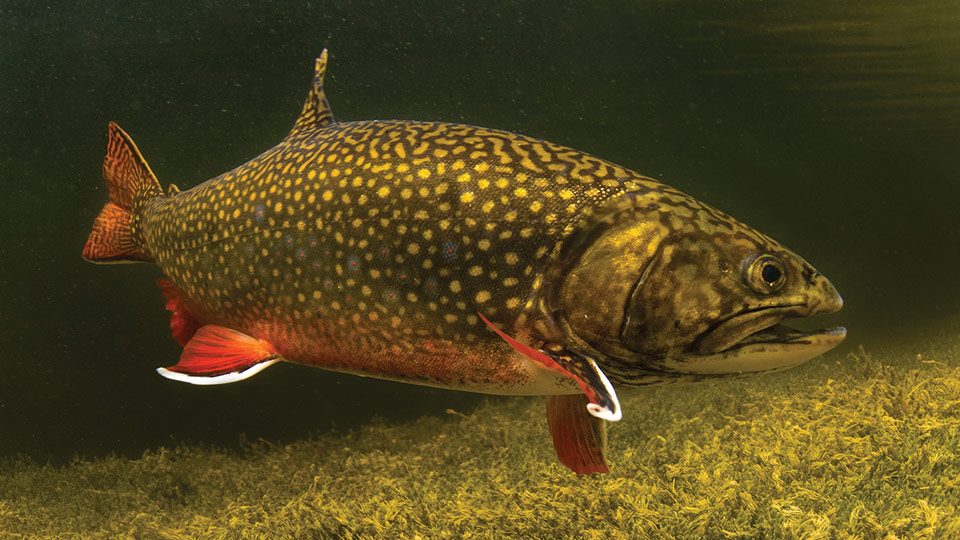
Brook trout days are hikes that happen to include fishing. Expect wet feet, tight quarters, and a lot of walking between pools. The reward is visual: spawning-color brookies in October — orange bellies, blue halos, white fin edges — are the most striking freshwater fish in North America. Solitude is nearly guaranteed. Headwater streams a mile from a trailhead see almost no one.
Licenses, stamps, and limits
Access is easy; the restrictions exist to protect small, fragile populations. Buy the state license and trout stamp. Check whether the stream is designated wild or native trout water with a reduced or zero creel. Note tackle restrictions — artificial-only and single-barbless are common on native water. Check seasonal closures; some headwaters close in fall to protect the spawn. In Canada, book through a lodge or outfitter for remote water and confirm license inclusions.
Landing, release, and cleaning
What happens between the hookset and the cooler decides whether you land the fish and whether it is worth eating. Wild brook trout are small and fragile. Use barbless hooks, keep them wet, and unhook with forceps without squeezing the body. Decide keep or release before you unhook. A brook trout you intend to release should never leave the water for more than the length of one held breath. For release: support the belly, keep the fish horizontal, back the hook out with pliers, and hold it into the current until it kicks off on its own. In hatchery-supported or high-density ponds where a limit is legal and appropriate, keep small fish and release the largest — big brookies are the rare ones. To keep the fish, dispatch it immediately — a firm rap with a priest or knife spine at the top of the skull, just behind and above the eyes. A brook trout killed instantly tastes better than one that suffocates in a bucket. Bleed it right away: cut the two gill arches on one side, or make a single cut behind the pectoral fin to the artery, and hold it in the water for thirty seconds while it pumps out. Cleaning a brook trout the right way takes about four minutes once you know the sequence.
On the table
Brook trout are outstanding on the table — delicate, sweet, and traditionally cooked whole in a pan streamside. Native headwater populations are small and easily overharvested. Keep only where the regulation clearly allows it, and keep few. Northern lake-run brookies from Maine and Labrador are the fish worth keeping a meal from; Appalachian headwater fish are best released.
Field notes
- 7'6" 3-weight fly rod: Short enough for tight canopy, light enough to enjoy an eight-inch fish.
- Ultralight spinning combo, 4 lb line: The simplest effective alternative in brushy water.
- 5X tippet: Plenty fine for fish this size and strong enough for streamside snags.
- Attractor dry flies, sizes 12–16: Brookies are opportunistic; a visible high-floating fly does most of the work.
- 1/16 oz inline spinner: For anglers not fly fishing — deadly in plunge pools.
- Wading boots with studs: Headwater rock is steep and slick; ankle support matters on the hike.
Brook Trout questions, answered
- Are brook trout actually trout?
- They're char, in the same genus as lake trout and Arctic char. That's why they have light spots on a dark body instead of the dark-on-light spotting of true trout.
- How big do brook trout get?
- In Appalachian headwaters, an eight-inch fish is good and a twelve-inch fish is exceptional. In Labrador and northern Quebec, five to seven pounds is genuinely possible.
- What's the best fly?
- A high-floating attractor dry — Royal Wulff, Stimulator, or Elk Hair Caddis in size 14. Brook trout are opportunists and rarely require a match to the hatch.
- Why do brook trout disappear from streams?
- Warming water and sedimentation. They need water under about 68°F, so shade loss, dams, and development push them into ever-smaller headwater refuges.
Official sources and further reading
- Eastern Brook Trout Joint Venture
Range maps, population status, and restoration work.
- Maine DIFW — Fishing Laws
Water-by-water brook trout regulations and special waters.