


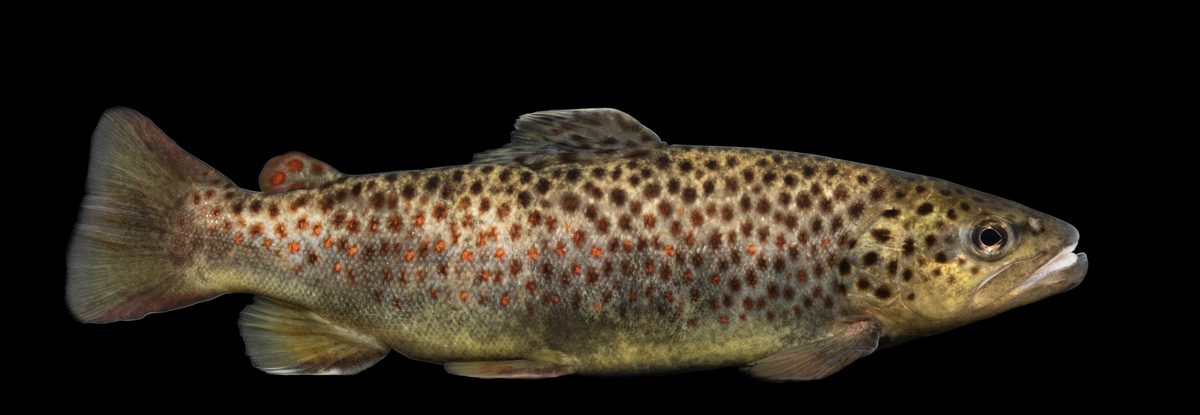
From the north · Wildlife
Brown Trout
The most cautious trout in the river, and the one most likely to be the biggest fish in it.
Salmo trutta
- Range
- Nationwide, strongest in the East and West
- Prime season
- October–November; low light year-round
- Access
- License plus trout stamp
- Table quality
- Good; larger fish often released
Regulations by region
Brown Trout rules where you're headed
Seasons, tags, limits, and legal methods for brown trout are set jurisdiction by jurisdiction. Pick your state or province and we'll point you at the agency that writes the rules.
Jump to another species
About the brown trout
Brown trout tolerate slightly warmer, siltier water than brookies or rainbows, which is why they persist in rivers where native trout have thinned out. They are also the most predatory and the most nocturnal. A big brown feeds at night, in dirty water, and at the edges of light, which is exactly why most anglers never see the biggest fish in their home river. Fish them like a predator — bigger flies, low light, undercut banks and wood — and the size of the average fish changes noticeably.
Range, water, and where they live
Brown trout water rewards knowing a single river well, but these fisheries produce big fish consistently. Missouri River, Montana: Huge wild browns in a rich tailwater. Delaware River system (NY/PA): Wild, selective browns on technical water. Driftless Area (WI/MN/IA): Spring creeks with high wild brown density. White & Norfork Rivers, Arkansas: Trophy browns over 20 lb in tailwater. Lake Michigan tributaries: Fall run of lake-run browns.
Behavior and how they feed
The approach separates brown trout from every other trout: fish low light, fish the edges, and fish bigger than you think. Fish dawn, dusk, night, and dirty water. Bright midday sun pushes the largest browns under cover entirely. Target structure rather than open riffle: undercut banks, log jams, boulder shadows, and deep bank-side slots. Approach quietly from downstream and keep off the skyline; browns spook at movement more than at tippet size. Swing or strip a streamer — a sculpin or baitfish pattern — tight to the bank and let it drop into the shade line. Strip fast and erratically in warm water; slow and deep in cold water with long pauses on the drop. When browns are eating insects, nymph the seams and switch to dries only when a steady rise rhythm is established. After dark, fish a large mouse or waking pattern on heavy tippet across quiet flats — this is how the largest browns are caught. Set on a felt weight, not a visual take, when streamer fishing; strip-set with the line hand rather than lifting the rod.
Where they hold
Brown trout claim the best low-light lies in a river and defend them. They hold tighter to cover and deeper shade than rainbows do. Undercut banks — The single best brown trout address on any river; fish it from downstream with a low profile. Log jams and root wads — Heavy wood in a deep bend holds the largest fish in most trout streams. Deep pool heads — The turbulent water at the top of a pool gives cover and oxygen and delivers a constant food line. Night shallows — Large browns move onto shallow flats and tailouts to hunt after dark — the trophy window in summer.
What they eat and what they hit
These are the presentations that consistently produce brown trout, with the conditions each one is actually for — not a tackle-shop wall. Articulated streamer — Stripped hard on a sink tip along banks and past wood; browns eat streamers out of aggression, not hunger. Mouse pattern — Skated across shallow tailouts on summer nights — the most exciting take in trout fishing. Nymph rig — Two-fly rig with a heavy anchor fly drifted through pool heads and deep seams. Dry fly — Browns key on evening caddis and spinner falls; fish the last hour of light hard. Jerkbait / minnow plug — A 3–4" suspending minnow twitched along undercut banks in stained water. Inline spinner — Silver or gold #2 spinner worked upstream and across in tight brushy water.
In the field
Brown trout fishing gets quieter and more solitary the better it gets. The best hours are before dawn and after dark. Expect fewer, larger fish than a rainbow day. A single 20-inch brown is a successful outing on most rivers. The fall spawn is the ethical line: fish move onto shallow gravel redds and should be left alone there.
Licenses, stamps, and limits
Same permit structure as other trout, with more special-regulation water in the mix. Buy the state license plus the trout stamp or permit. Identify whether your stretch is general regulation, delayed harvest, or catch-and-release only. Check tackle restrictions; many brown trout streams are artificial-only or single-hook barbless. Check the fall closure — some rivers close or restrict fishing over spawning redds in late autumn. On tailwaters, check the dam's generation schedule before wading; releases change the river in minutes.
Landing, release, and cleaning
What happens between the hookset and the cooler decides whether you land the fish and whether it is worth eating. Big browns run for wood. Apply side pressure immediately to steer the fish away from the jam rather than lifting straight up. Keep the rod loaded and the brown trout coming toward you. Most fish are lost in the last ten feet, when an angler high-sticks the rod and gives the fish a straight-line shot at throwing the hook. Have the net in the water before the fish is ready, and lead the fish head-first into it. Never stab at a fish tail-first — it swims away from the frame every time. Wet your hands or your glove before you touch the fish. Dry hands strip the slime coat, and the slime coat is the fish's infection barrier. Decide keep or release before you unhook. A brown trout you intend to release should never leave the water for more than the length of one held breath. For release: support the belly, keep the fish horizontal, back the hook out with pliers, and hold it into the current until it kicks off on its own. Cleaning a brown trout the right way takes about four minutes once you know the sequence.
On the table
Browns eat well, especially fish in the 12–16 inch class from cold water. Big wild browns are slow-growing and disproportionately valuable to the fishery — most anglers release everything over 18 inches. Firm flesh takes smoke, grill, and pan equally well; gut and ice immediately.
Field notes
- 9' 6-weight fly rod: Enough backbone to throw weighted streamers and big terrestrials.
- Sink-tip or full-sink line: Gets the streamer down along banks and through deep slots.
- 0X–3X tippet for streamers: Heavier than nymph tippet — big browns eat hard and hold structure.
- Sculpin and baitfish streamers: Olive and black patterns in 3–5 inches cover most water.
- Mouse pattern: The night fly; unglamorous and shockingly effective on the largest fish.
- Headlamp with red mode: Preserves your night vision and doesn't blow the pool.
Brown Trout questions, answered
- Why are brown trout so hard to catch?
- They're the wariest trout, they feed heavily at night, and larger fish switch from insects to baitfish. Fishing bright midday hours with small flies is the most common reason anglers never see the big ones.
- What's the best streamer color?
- Olive or natural in clear water, black in stained water or at night, and white when they're keyed on baitfish. Movement and depth matter more than color.
- Is night fishing for browns legal?
- In many states yes, but not all — some close trout water at night or during the fall spawn. Check the specific regulation for your river before going.
- How do I identify a brown trout?
- Golden-brown body with large black and red-orange spots ringed by pale halos, and an almost unspotted tail. Rainbows have fine black spotting all over including the tail.
Official sources and further reading
- Wisconsin DNR — Driftless Trout Streams
Stream classifications, easements, and special regulations.
- Arkansas Game & Fish — Trout Waters
Tailwater trout rules and generation schedules.