


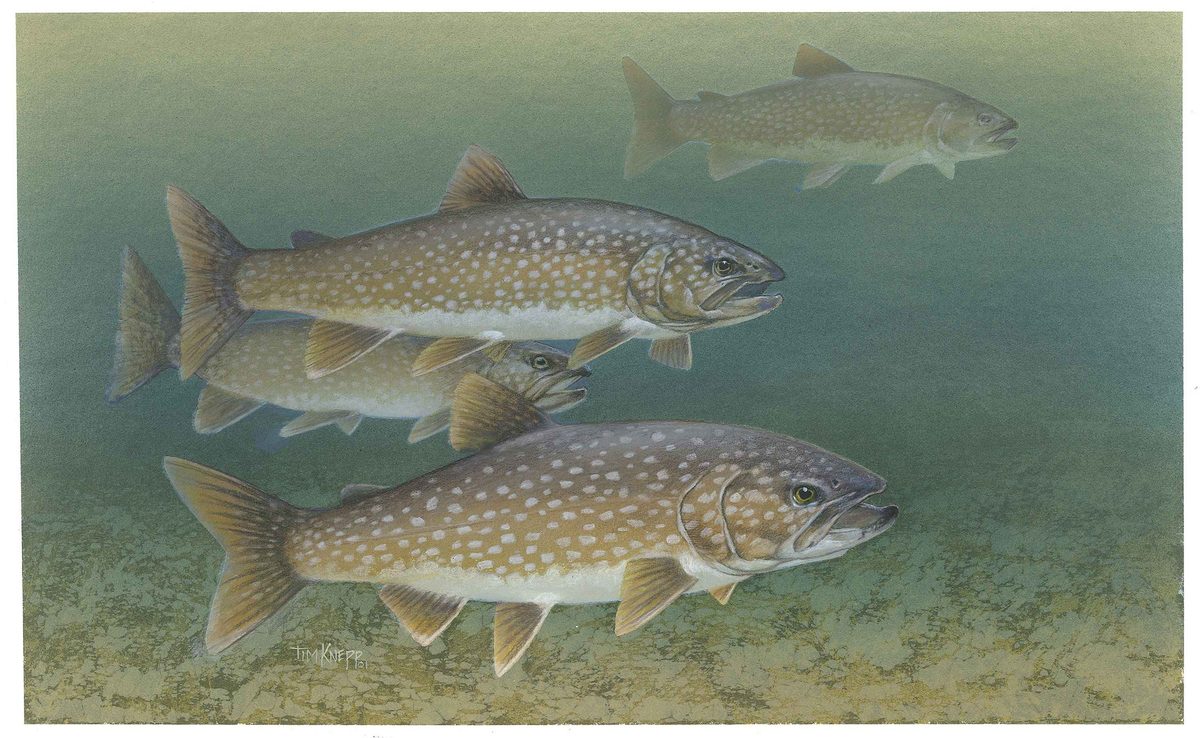
From the north · Wildlife
Lake Trout
A deep, cold-water char that comes within reach twice a year — right after ice-out and through the hardwater season.
Salvelinus namaycush
- Range
- Great Lakes, Canada, northern alpine lakes
- Prime season
- Ice-out May; ice fishing Jan–March
- Access
- State/provincial license; lake-specific limits
- Table quality
- Rich and oily; excellent smoked
Regulations by region
Lake Trout rules where you're headed
Seasons, tags, limits, and legal methods for lake trout are set jurisdiction by jurisdiction. Pick your state or province and we'll point you at the agency that writes the rules.
Jump to another species
About the lake trout
Lake trout live by temperature. They want water in the mid-40s to low 50s, which in summer means 60 to 120 feet down in most lakes and, in far-north lakes, right under the surface all season. That single constraint sets the whole calendar. Right after ice-out the whole lake is cold and lakers are shallow and catchable from a small boat; by July they're a downrigger fishery. They're also long-lived — a 20-pound laker can be 25 years old — which is why limits are conservative and why releasing large fish matters so much.
Range, water, and where they live
Anywhere deep and cold enough. These fisheries combine access with real size. Lake Superior: Restored wild population, big fish near structure. Great Bear & Great Slave, NWT: Genuine 40 lb-plus fish in shallow water. Lake Champlain (VT/NY): Strong put-grow-take fishery, easy access. Flaming Gorge (UT/WY): Trophy lake trout in the West. Canadian Shield lakes (ON/MB/SK): Ice-out shallow fishing at its best.
Behavior and how they feed
Find the temperature band, then choose the delivery method that keeps a bait in it. At ice-out, fish shallow rock — 10 to 30 feet — casting spoons and swimbaits over reefs and points; this is the easiest laker fishing of the year. As water warms, follow them down; use a temperature/depth reading or your electronics to find the 45–52°F band. In summer, troll spoons or flasher-and-fly rigs behind downriggers, lead core, or wire line at that depth over structure. Vertical jig a 1–3 oz tube jig or spoon on structure: drop to bottom, rip it up two feet, and let it flutter back. Lakers commonly follow a jig up; if you mark a fish rising with your bait, keep lifting rather than stopping. In winter, drill over 25–60 feet of water near a break and jig aggressively — lake trout are one of the most active ice species. Use a long, moderate-action rod so a big fish coming up fast doesn't tear free at the hole or the boat. Release deep-caught fish with a descending device if they show barotrauma; from shallow water they release fine.
Where they hold
Lakers follow temperature. They are shallow when the whole lake is cold and deep when it stratifies, and they will always be near open-water forage. Shallow rock — 6–25 feet on main-lake points and reefs when surface temps are under about 50°F. Deep basins — 60–120 feet suspended over the thermocline chasing ciscoes and smelt. Humps and saddles — Isolated structure topping into the fish's preferred temperature band concentrates them predictably. Spawning reefs — Cobble reefs in 10–30 feet draw fish in October and November; many are closed to fishing then.
What they eat and what they hit
These are the presentations that consistently produce lake trout, with the conditions each one is actually for — not a tackle-shop wall. Tube jig — A 3.5–5" white tube on a heavy head, dropped to bottom and hopped hard — the iconic Canadian shield laker bait. Large spoon — Flutter spoons jigged vertically or trolled on downriggers; the flash imitates a fleeing cisco. Downrigger-trolled plug — The only efficient way to cover 80–120 feet of water and find scattered fish. Swimbait on a heavy head — 4–6" paddle tail swum over rock at ice-out when they are up and aggressive. Jigging rap / rattle bait — Snap-jigged over deep structure through the ice, often with a cut-bait tipper.
In the field
Ice-out laker fishing from a small boat is one of the best-value trips in North America: big fish, shallow water, and no crowd. Summer fishing is a gear exercise — riggers, wire, and boat control — and is usually done from a bigger boat or a charter. Ice fishing lake trout is genuinely active. You cover water, drill a lot of holes, and jig hard rather than sit on a bucket.
Licenses, stamps, and limits
Lake trout carry the most conservative limits of any common freshwater fish because of how slowly they grow. Buy the state or provincial license; Ontario also requires the Outdoors Card. Check the daily limit — one or two fish is normal, and some waters are fully catch-and-release. Verify slot limits; many lakes protect fish above a length to preserve the older age classes. Confirm the season; deep lakes often close in fall to protect the shallow-reef spawn. Check whether the lake requires a Great Lakes stamp or trout privilege on top of the base license.
Landing, release, and cleaning
What happens between the hookset and the cooler decides whether you land the fish and whether it is worth eating. Fish pulled from deep water suffer barotrauma. If you are fishing over 60 feet and plan to release, use a descending device or keep the fish you catch within your limit. Keep the rod loaded and the lake trout coming toward you. Most fish are lost in the last ten feet, when an angler high-sticks the rod and gives the fish a straight-line shot at throwing the hook. Have the net in the water before the fish is ready, and lead the fish head-first into it. Never stab at a fish tail-first — it swims away from the frame every time. Wet your hands or your glove before you touch the fish. Dry hands strip the slime coat, and the slime coat is the fish's infection barrier. To keep the fish, dispatch it immediately — a firm rap with a priest or knife spine at the top of the skull, just behind and above the eyes. A lake trout killed instantly tastes better than one that suffocates in a bucket. Bleed it right away: cut the two gill arches on one side, or make a single cut behind the pectoral fin to the artery, and hold it in the water for thirty seconds while it pumps out. Cleaning a lake trout the right way takes about four minutes once you know the sequence.
On the table
Lake trout are rich and oily, closer to salmon than to a walleye fillet. They're outstanding smoked, and very good grilled with the skin on; poor choice for a delicate pan fry. Larger, older fish accumulate contaminants in Great Lakes water — read the state consumption advisory and prefer smaller fish for the table.
Field notes
- 7'6" medium-heavy jigging rod: Handles 2 oz jigs at depth and cushions a big fish at the boat.
- Line-counter reel with 30 lb braid: Depth control is everything in this fishery.
- Downrigger or lead core line: The only practical way to hold a bait at 90 feet at trolling speed.
- Heavy casting/jigging spoons: Flutter on the drop is what triggers strikes; most bites come as it falls.
- 4" white tube jig, 1–2 oz head: The classic laker bait, on the ice and on open water.
- Descending device: Gets deep-water releases back down safely.
Lake Trout questions, answered
- When are lake trout catchable from shore?
- For a few weeks right after ice-out, when they hold on shallow rock. In far-northern lakes that window is longer, and in most of the range shore fishing is otherwise very limited.
- How deep do I need to fish in summer?
- Wherever the water is 45 to 52°F, which is typically 60 to 120 feet in a mid-latitude lake. Find that band first and pick the depth before you pick the lure.
- Are lake trout good eating?
- Yes, if you like an oily fish. They smoke beautifully. Check consumption advisories for large Great Lakes fish.
- Why are limits so low?
- Lake trout grow very slowly and can live decades. A single trophy fish may be twenty-five years old, so harvesting the big ones removes irreplaceable fish from the population.
Official sources and further reading
- Great Lakes Fishery Commission
Lake trout restoration status and lakewide assessments.
- NWT Fishing Regulations
Trophy lake trout limits and license requirements.