


From the north · Wildlife
Red Drum
The best shallow-water sight-fishing target in America — and a fish that will eat almost anything presented well.
Sciaenops ocellatus
- Range
- Texas to Virginia, Gulf and Atlantic
- Prime season
- Fall bull run; flats year-round in the South
- Access
- State saltwater license; strict slot limits
- Table quality
- Excellent within the slot
Regulations by region
Red Drum rules where you're headed
Seasons, tags, limits, and legal methods for red drum are set jurisdiction by jurisdiction. Pick your state or province and we'll point you at the agency that writes the rules.
Jump to another species
About the red drum
Redfish are the reason the flats-boat industry exists on the Gulf Coast. They tail in inches of water, they push visible wakes across a flat, and they eat a fly or a lure while you watch. They're also forgiving. A redfish will eat a shrimp under a popping cork, a gold spoon, a soft plastic, or a crab fly, and it fights with a determined, shouldering run rather than aerobatics. The other side of the fishery is the fall bull run — large adult drum staging at inlets and along the surf from Louisiana to the Outer Banks, fish of 30 to 50 pounds caught from a beach.
Range, water, and where they live
The Gulf marsh and the Atlantic inlets each produce a different kind of redfish fishing. Louisiana marsh (Venice, Delacroix): Highest redfish density in the world. Mosquito Lagoon, Florida: Clear-water sight fishing for big reds. Texas Laguna Madre: Shallow clear flats and tailing fish. Outer Banks, North Carolina: Fall bull drum from the surf at Cape Point. Lowcountry SC/GA marsh: Flood-tide tailing reds in the spartina.
Behavior and how they feed
Look before you cast. Redfish fishing is a hunting exercise more than a casting exercise. Fish shallow on a moving tide. Rising water pushes reds onto flats and into the grass; falling water pulls them into drains and creek mouths. Pole, wade, or drift quietly and scan for signs: tailing fish, pushes, muds, or a copper shape moving against the bottom. Lead the fish by three to six feet and let the bait drop into its path — a cast on top of a red spooks it. In dirty water, use a popping cork with a shrimp or soft plastic; the sound calls fish that can't see the bait. On clear flats, throw a weedless gold spoon, a soft plastic paddle tail, or a crab or shrimp fly. Strip-set on fly and sweep-set on spinning gear; redfish have hard mouths and a trout-set pulls the hook. In the fall surf, fish cut mullet on a fishfinder rig at an inlet or point on the moving tide for bull drum. Support big fish horizontally, keep them wet, and revive fully — oversized drum are the breeders.
Where they hold
Redfish are shallow-water bottom feeders. They follow tide onto flats to eat crabs and shrimp and pull back to deeper edges when it drops. Grass flats on high tide — Flooded spartina and turtle grass in 6–24 inches; look for tails, wakes, and pushes. Oyster bars — Bars break current and hold crabs and shrimp; fish the down-current edge as the tide moves. Marsh drains and creek mouths — Redfish stack at drains eating everything the marsh flushes out. Deep holes and docks — Fish pull into 4–10 foot holes and around dock pilings when the water drops or cools. Beach and surf troughs — Big fish work the first trough and inlet mouths in fall — the trophy season.
What they eat and what they hit
These are the presentations that consistently produce red drum, with the conditions each one is actually for — not a tackle-shop wall. Gold weedless spoon — Comes over grass without fouling and flashes in shallow, off-color water. Paddle tail on a jig head — 1/8–1/4 oz head with a 3–4" tail worked slowly on the bottom in creeks and on flats. Shrimp under a popping cork — The single most productive redfish presentation on the Gulf Coast — the cork's chug imitates a feeding fish. Cut mullet or blue crab — On a fish-finder rig with a circle hook in the surf or an inlet for the big fall fish. Topwater walker — Skinny water at dawn; a red blowing up on a walking bait is the reason people fish the flats. Crab or shrimp fly — 8-weight, a lightly weighted crab pattern, and a lead of two feet in front of a tailing fish.
In the field
A flood tide in the Lowcountry — reds tailing in the spartina grass in a foot of water — is the most anticipated few hours of the month for the anglers who fish it. Louisiana marsh fishing is the numbers version: dozens of shots a day, and a genuine chance at a 20-pound redfish in three feet of water. The fall Outer Banks surf run is a different sport entirely — heavy tackle, cold nights, and 40-pound fish landed and released on the beach.
Licenses, stamps, and limits
Redfish are slot-managed everywhere, and the slot is narrow because large adults are the spawning stock. Buy the state saltwater fishing license (and a saltwater stamp where required, e.g. Texas). Learn the state slot — for example 18–27 inches in Florida, 16–27 in Texas, 18–27 in NC — and measure every fish. Note the daily limit, often one to three fish, and any allowance for one oversized fish. Confirm whether the county or region has a temporary catch-and-release designation (Florida does this after red tide events). Check gear rules for the flat: some areas restrict gigging or netting.
Landing, release, and cleaning
What happens between the hookset and the cooler decides whether you land the fish and whether it is worth eating. Redfish bulldog rather than jump. Keep constant pressure and let them run against a moderate drag; they wear out in open water. Handle with wet hands, support the belly, and keep the fish horizontal — bull reds are heavy and easy to injure on a deck. Decide keep or release before you unhook. A red drum you intend to release should never leave the water for more than the length of one held breath. For release: support the belly, keep the fish horizontal, back the hook out with pliers, and hold it into the current until it kicks off on its own. Slot limits are enforced everywhere and over-slot bull reds must be released in most states. Measure in the water and know the slot before the fish comes aboard. To keep the fish, dispatch it immediately — a firm rap with a priest or knife spine at the top of the skull, just behind and above the eyes. A red drum killed instantly tastes better than one that suffocates in a bucket. Cleaning a red drum the right way takes about four minutes once you know the sequence.
On the table
Slot redfish are excellent — mild, firm, and thick-filleted, ideal for blackening or grilling on the half shell. Remove the dark strip of lateral meat for the cleanest flavor. Oversized bull reds are coarse, strong-flavored, and are the spawning stock — release them. Ice fillets immediately; the meat is dense and holds up well but benefits from cold handling.
Field notes
- 7'6" medium-power spinning rod: Casts light plastics into wind and handles a hard-running slot red.
- 8- or 9-weight fly rod: The standard sight-fishing setup; 9-weight when wind is up.
- 20 lb braid to 20–30 lb fluorocarbon leader: Abrasion resistance for oyster bars and dock pilings.
- Weedless gold spoon: Comes through grass and flashes in stained water — the original redfish lure.
- Popping cork with shrimp or plastic: The most productive redfish rig in murky marsh water.
- Polarized sunglasses: In sight fishing they are literally the most important piece of equipment.
Red Drum questions, answered
- What's the black spot on the tail?
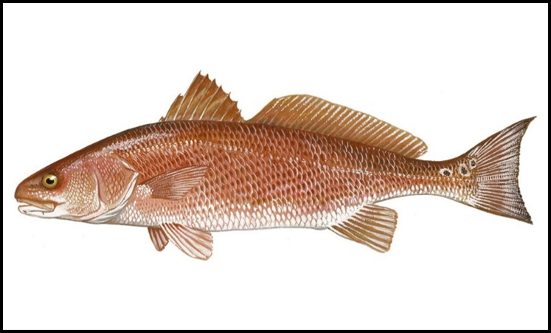
- An eyespot that likely misdirects predators toward the tail. Most redfish have one, some have several, and a few have none — it's the easiest field mark on the fish.
- Best lure for redfish?
- A weedless gold spoon in grass, a soft plastic paddle tail on a jig head on open flats, and a popping cork with shrimp in stained water. All three catch fish everywhere reds live.
- Why can't I keep a big redfish?
- Fish over the slot are mature spawners that support the whole population. Every Gulf and Atlantic state protects them, allowing at most one oversized fish per year in a few places.
- What tide is best?
- Moving water, in either direction. Rising tide puts fish up in the grass; falling tide stacks them at drains and creek mouths where bait is flushed out.
Official sources and further reading
- Florida FWC — Red Drum Regulations
Regional slot limits, closures, and bag limits.
- NOAA Fisheries — Red Drum
Stock biology and federal management background.