


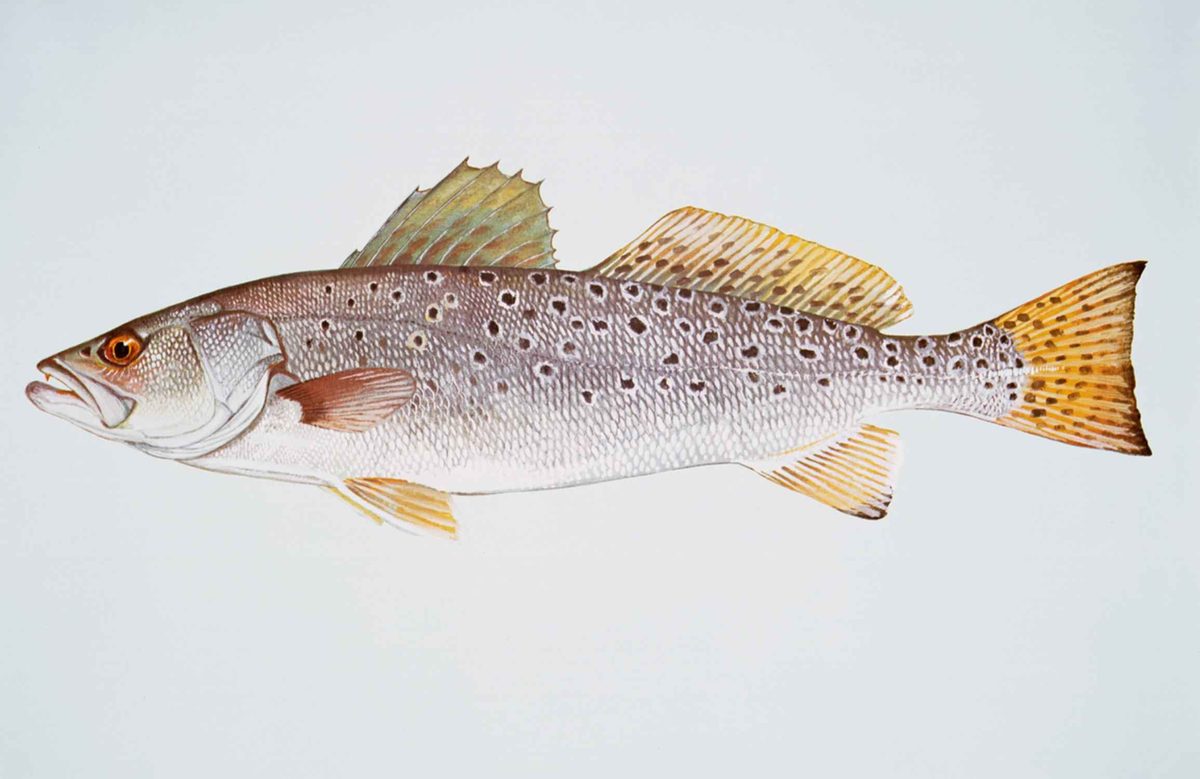
From the north · Wildlife
Spotted Seatrout
The inshore fish that eats a topwater at sunrise and hides in a deep hole by January.
Cynoscion nebulosus
- Range
- Texas to Virginia, inshore
- Prime season
- Spring and fall; winter in deep holes
- Access
- State saltwater license; slot limits
- Table quality
- Very good — delicate, eat fresh
Regulations by region
Spotted Seatrout rules where you're headed
Seasons, tags, limits, and legal methods for spotted seatrout are set jurisdiction by jurisdiction. Pick your state or province and we'll point you at the agency that writes the rules.
Jump to another species
About the spotted seatrout
Speckled trout are the everyday inshore fish of the Gulf and South Atlantic — abundant, willing, and available from a boat, a kayak, or a pair of waders. They live over seagrass and sand, feeding on shrimp and small baitfish, and they hold in a predictable relationship to depth and temperature that changes through the year. The sunrise topwater bite over a grass flat in spring is one of the great American fishing experiences, and it is available to anyone with a rod and access to the flat.
Range, water, and where they live
Trout are everywhere along the Gulf. These are the areas known for both numbers and big fish. Laguna Madre, Texas: Trophy trout over 28 inches in clear grass. Louisiana marsh and bays: Enormous numbers, easy limits. Florida Big Bend (Steinhatchee, Homosassa): Vast shallow grass flats. Mississippi/Alabama Sound: Reliable spring and fall fishing. North Carolina sounds: Fall run of quality specks.
Behavior and how they feed
Match depth to temperature, then work grass edges and potholes methodically. In spring and fall, fish grass flats in two to five feet, focusing on sand potholes and the edges of grass beds. Start at first light with a walk-the-dog topwater over the flat; work it steadily and keep reeling through blowups until the fish connects. When the sun rises, switch to a soft plastic on a 1/8–1/4 oz jig head and bounce it along the bottom of potholes and troughs. Use a popping cork with a shrimp imitation in stained water or when fish are scattered — the noise gathers them. In summer heat, move to deeper cuts, channel edges, and passes where water stays cooler and moves. In winter, fish deep holes and muddy bottoms in the back of bays; slow everything down and fish the warmest hours. Fish moving tide. Trout position on the down-current edge of structure and grass exactly like a river fish. Use a soft sweep to set the hook — trout have papery mouths and a hard set tears out.
Where they hold
Trout relate to grass, potholes, and moving water, and they change depth with temperature more than almost any other inshore fish. Grass flats with potholes — Sand holes inside turtle grass in 2–5 feet; trout sit in the holes and ambush across the grass. Deep channel edges — When it is very cold or very hot, trout drop into 8–20 foot channels and canals adjacent to the flats. Drop-offs and bars — Any depth change with current sweeping over it holds feeding fish. Dock lights — Lit docks concentrate shrimp and glass minnows and are the easiest trout fishing there is after dark. Mud and grass mix — Dark mud bottoms warm fastest on a sunny winter afternoon and hold big trout.
What they eat and what they hit
These are the presentations that consistently produce spotted seatrout, with the conditions each one is actually for — not a tackle-shop wall. Soft plastic on a jig head — 1/8–1/4 oz head, a 3–4" shrimp or paddle tail, hopped across potholes. Popping cork + soft plastic or shrimp — Covers water and calls trout from across a flat; the go-to rig for anyone learning. Suspending twitch bait — A slow-sinking hard bait worked with long pauses over grass is the trophy trout lure. Topwater walker — Walked over a grass flat on a calm morning; expect misses and keep walking the bait. Live shrimp under a cork — The most reliable way to catch trout anywhere on the Gulf and South Atlantic coast. Clouser or shrimp fly — 7-weight and an intermediate line over a flat at first light.
In the field
The dawn topwater window is short and worth setting an alarm for. Once the sun is up, the fishing becomes work. Wade fishing is the underrated approach — quieter than a boat, and it lets you cover a productive flat carefully. Big trout are a separate pursuit: fewer bites, larger baits, and often a slow-sinking twitch bait fished in the coldest months.
Licenses, stamps, and limits
Trout limits have tightened significantly across the Gulf after freeze events and pressure. Buy the state saltwater license (and Texas's saltwater stamp). Check the slot — 15–20 inches with one over is common; Texas and Louisiana have both revised limits recently. Note the daily bag; several states have dropped from 25 to 5 or 6 fish. Watch for cold-stun emergency closures in winter after hard freezes. Confirm any regional differences — Florida manages trout by zone, not statewide.
Landing, release, and cleaning
What happens between the hookset and the cooler decides whether you land the fish and whether it is worth eating. Seatrout have soft, thin mouth tissue. Do not over-set and do not pump the rod hard; keep steady pressure and net them. Use a rubber net and wet hands. Trout are the most slime-sensitive inshore species and handle poorly. Decide keep or release before you unhook. A spotted seatrout you intend to release should never leave the water for more than the length of one held breath. For release: support the belly, keep the fish horizontal, back the hook out with pliers, and hold it into the current until it kicks off on its own. Release the big females — the fish over about 25 inches are almost all breeding females and are inferior eating anyway. To keep the fish, dispatch it immediately — a firm rap with a priest or knife spine at the top of the skull, just behind and above the eyes. A spotted seatrout killed instantly tastes better than one that suffocates in a bucket. Cleaning a spotted seatrout the right way takes about four minutes once you know the sequence.
On the table
Speckled trout are very good but delicate — the flesh is soft and does not hold up to long storage. Ice them immediately and eat them within a day or two; frozen speck fillets deteriorate noticeably. They fry and broil beautifully. Skip the heavy sauces; the flavor is mild and clean. Keep within the slot and release the large females, which are the primary spawners.
Field notes
- 7' medium-light spinning rod: Soft enough for a delicate mouth, long enough to work a cork.
- 15 lb braid to 20 lb fluorocarbon leader: Handles grass and the occasional bycatch redfish.
- Walk-the-dog topwater: The most exciting and one of the most effective trout presentations.
- Soft plastic paddle tail on 1/8–1/4 oz jig: The all-day workhorse over grass and potholes.
- Popping cork rig: Calls fish in from a distance in stained or choppy water.
- Wading belt and stingray guards: Shuffle your feet on Gulf flats — rays bury in the sand.
Spotted Seatrout questions, answered
- Where do speckled trout go in winter?
- Into the deepest, muddiest holes in the back of bays and up coastal rivers, where water holds heat. Fish slowly on the bottom in the warmest part of the afternoon.
- Best lure for speckled trout?
- A soft plastic paddle tail on a light jig head, all day, everywhere. At sunrise a walking topwater over grass is better, and a popping cork wins in murky water.
- Why do I keep losing trout at the boat?
- Their mouths are thin and tear easily. Use a softer rod, keep steady pressure without pumping, and net the fish rather than lifting it.
- How big is a trophy speck?
- Twenty-five inches is a genuine trophy across most of the range; Texas's Laguna Madre and Florida's Indian River produce 28-inch-plus fish, almost all of which are released.
Official sources and further reading
- Texas Parks & Wildlife — Spotted Seatrout
Current bag and slot limits by bay system.
- Louisiana Wildlife & Fisheries
Recent speckled trout limit changes and season rules.