


From the north · Wildlife
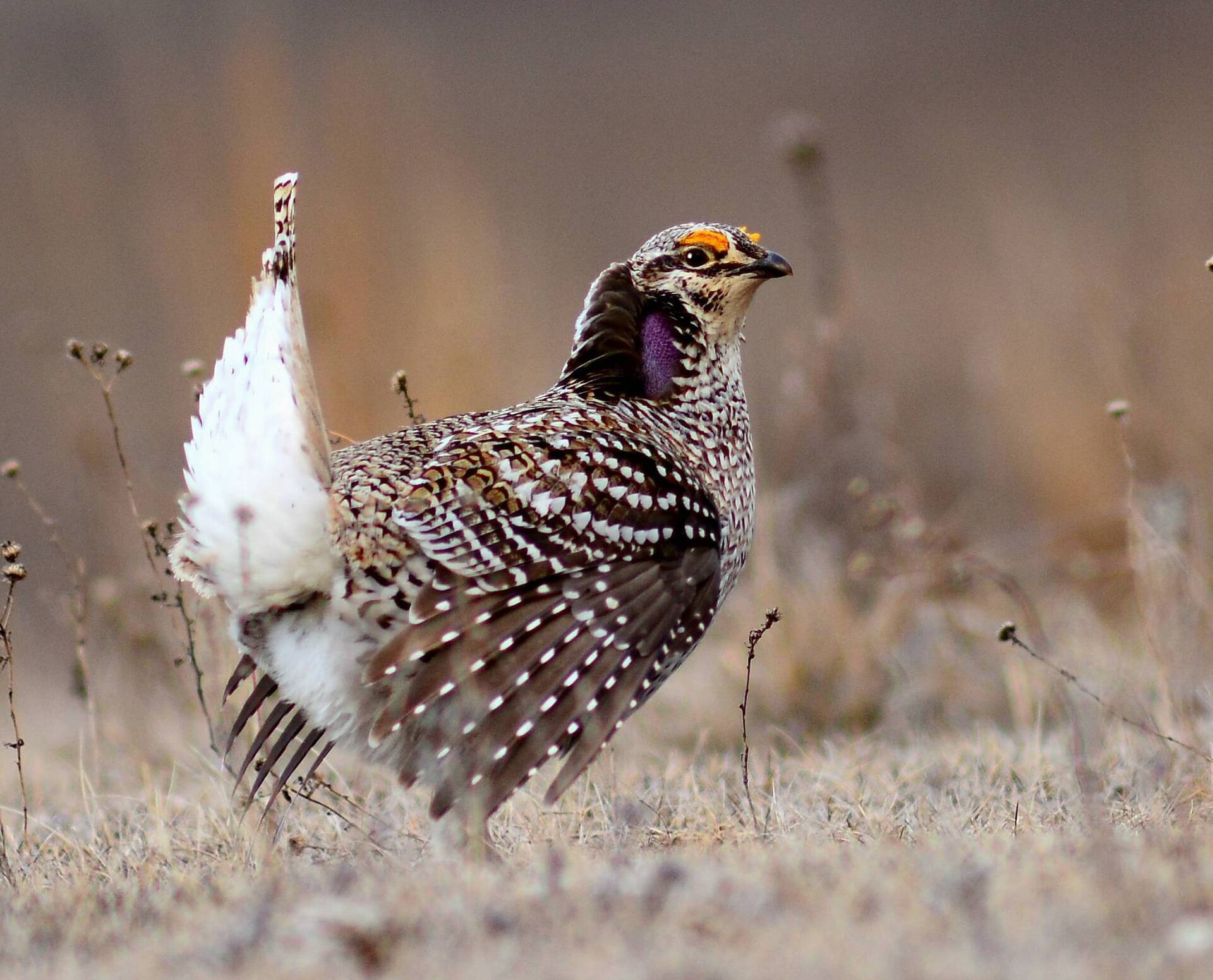
Sharp-Tailed Grouse
A prairie grouse that flushes in loose coveys from mixed grass and rolling hills, made for a long walk and an open-choke shotgun.
Tympanuchus phasianellus
- Range
- Northern Great Plains & prairie Canada
- Peak season
- Sept – Nov
- Tag access
- Over-the-counter
- Live weight
- 1.5–2 lb
Regulations by region
Sharp-Tailed Grouse rules where you're headed
Seasons, tags, limits, and legal methods for sharp-tailed grouse are set jurisdiction by jurisdiction. Pick your state or province and we'll point you at the agency that writes the rules.
Jump to another species
About the sharp-tailed grouse
Sharp-tailed grouse are birds of open mixed-grass prairie, brushy coulees, and grain-field edges across the Dakotas, Montana, and prairie Canada, gathering in loose coveys of 5–15 birds outside of the spring lek-dancing season. They're a walking hunter's bird — no blinds, no calling, just miles of rolling native prairie covered on foot with a dog ranging ahead, flushing coveys that scatter into singles you can work again. Sharptails often share range with pheasants and Hungarian partridge, so a single fall walk through prairie CRP and grain-field edges can produce a genuine mixed bag.
Range and habitat
The best sharptail hunting sits in the transition zone between native mixed-grass prairie and grain agriculture across the northern Plains. South Dakota: Strong native prairie populations in the west-river region. North Dakota: Excellent PLOTS public access through native prairie and CRP. Montana: Huge expanses of native prairie with light hunting pressure. Nebraska (Sandhills): Unique dune-prairie habitat with good sharptail density. Saskatchewan & Alberta: Massive native prairie tracts with strong bird numbers.
Behavior and field method
Sharptail hunting means long walks across open prairie, working coveys that flush at a distance and often re-flush as workable singles. Hunt native mixed-grass prairie, especially rolling hills near grain fields where birds feed morning and evening. Walk into or across the wind so a ranging dog can scent birds well ahead of the gun. Expect covey flushes at longer range than most upland birds — sharptails are wary and often flush at 30–40 yards. Mark where singles scatter after the initial covey flush and work that area methodically for a second and third flush. Focus on coulees, brushy draws, and shelterbelts for midday loafing cover when birds aren't in open feeding areas. Cover ground steadily rather than stopping often — sharptails hold less tightly than grouse and will run or flush wild if pressured slowly. Hunt early morning and late afternoon when birds move between roosting cover and grain-field edges. Carry more shells than you think you'll need — covey flushes often present multiple close-together shot opportunities.
Tracks, droppings, and sign
Sharptail sign concentrates on prairie leks and in the transition between native grass and brushy draws. Tracks — Three-toed prints in dust and snow, usually in loose groups because sharptails move in coveys. Winter foot feathering widens the print. Droppings — Dry fibrous coils with white caps in roosting grass. Concentrations in a single grass pocket mean a covey roost. Leks (dancing grounds) — Bare, cropped, trampled hilltop openings with heavy droppings and feathers where males dance in April. Coveys stay near lek complexes all year. Buffaloberry & bud feeding — Stripped buffaloberry, chokecherry, and rosehip thickets in draws, and clipped birch and aspen buds in trees during hard winter. Loafing cover — Flattened grass and feathers on the leeward side of a draw or a snowberry patch, usually on the sunny side in cold weather.
In the field
A sharptail hunt feels like a pheasant hunt turned up in scale — miles of open, rolling prairie instead of grassy draws, with a dog working hundreds of yards ahead across visible terrain rather than hidden cover. The covey flush is loud and sudden even at distance — a dozen birds cackling up together and scattering across a hillside, several within range and several not. It rewards a hunter who can pick a single bird out of a rising group. The follow-up work on scattered singles is often the best shooting of the day, since individual birds hold tighter after a covey break and offer closer, more deliberate flushes.
Regulations, tags, and seasons
Sharptail tags require only a basic upland bird or small-game license — the effort is in finding native prairie access, not securing permission from a draw system. Buy a small-game or upland bird license online from the state wildlife agency. Check whether it's bundled with a general combination license alongside pheasant and partridge, common in the Dakotas. Use public/PLOTS/walk-in access maps to identify native prairie tracts, since sharptails avoid dense monoculture cropland. Confirm season dates and bag limits — usually 3–4 birds daily, sometimes combined with prairie chicken in overlapping range. If hunting Canada, book with a licensed outfitter or confirm nonresident licensing requirements well in advance of the season.
Harvest and processing
Sharptails flush wild and far, and they land in country where everything looks the same. Marking matters more than shooting. Mark the fall the moment the sharptail folds. Pick a landmark behind the bird — a stump, a color change in the cover — and walk straight to it without taking your eyes off it. Send the dog immediately if you have one; a runner covers a shocking amount of ground in thirty seconds. If you are hunting without a dog, walk a tight grid from the fall and look for feathers, not the whole bird. Dispatch a cripple immediately by pressing your thumb behind the head and firmly extending the neck, or by cervical dislocation with a quick pull. Do not wring wings or crush the breast. Check your bird against the daily limit and, where required, leave a fully feathered wing or head attached for species identification during transport. Field dress hot birds right away: open the vent, hook two fingers in, and pull the entrails out in one motion. This drops core temperature immediately and keeps the meat sweet. Keep birds cool and uncrowded in a game bag or vest with airflow. Stacking warm birds in a plastic sack is how a good day turns into sour meat by the truck. Sharptail is darker and stronger than pheasant. Handle it well and it is excellent; handle it badly and it earns its reputation.
Meat care and what you take home
Sharptail grouse yields lean, mild breast meat similar to ruffed grouse, typically 6–8 ounces per bird. Best cooked quickly and kept rare to medium in the breast; older birds taken late season benefit from braising. Combine several birds for a full meal, and save legs for stock given their toughness from a life of walking prairie terrain.
Field notes
- 12- or 20-gauge with modified/improved-modified choke: Sharptail flushes are often farther than pheasant or grouse; a tighter choke than typical upland guns helps reach out.
- 6 shot for range: Slightly larger shot than grouse loads helps retain energy at the longer distances typical of prairie flushes.
- Good optics or binoculars: Glassing a hillside before walking in can locate feeding coveys and save miles of unproductive walking.
- Sturdy hiking boots: Prairie terrain is uneven with badger holes and cactus in some areas — ankle support and tough soles matter.
- GPS dog collar: Dogs cover huge ground on open prairie; a GPS collar keeps you oriented to where your dog is working relative to you.
Sharp-Tailed Grouse questions, answered
- How is sharptail hunting different from pheasant hunting?
- Sharptails live in open native prairie rather than dense agricultural cover, flush at longer range in loose coveys, and require more walking across open ground rather than working thick grass strips.
- Can I hunt sharptail and prairie chicken together?
- In areas of range overlap, yes, and some states have combined bag limits — check current regulations since the two species can be hard to distinguish in flight.
- What's the best gun setup?
- A 12- or 20-gauge with a modified or improved-modified choke and 6 shot handles the typical prairie flush distance better than the more open chokes used for grouse or quail.
- Is a dog necessary?
- Not strictly, but a ranging pointer or flushing dog dramatically improves covey-finding efficiency across large expanses of similar-looking prairie.
- When is the best time to hunt?
- Early morning and late afternoon, when birds move between roosting cover and feeding areas near grain fields or berry-producing shrubs.
- Do sharptails migrate?
- No, they are non-migratory and stay on the same general range year-round, though winter flocks can group into larger coveys near heavier cover.
Official sources and further reading
- North Dakota Game and Fish Department
PLOTS public access guide and upland season information.
- South Dakota Game, Fish & Parks
Licensing and public land access for prairie grouse.
- Pheasants Forever
Prairie habitat programs that also benefit sharptail grouse.
- USFWS — Hunting
Federal hunting resources and public land access information.