


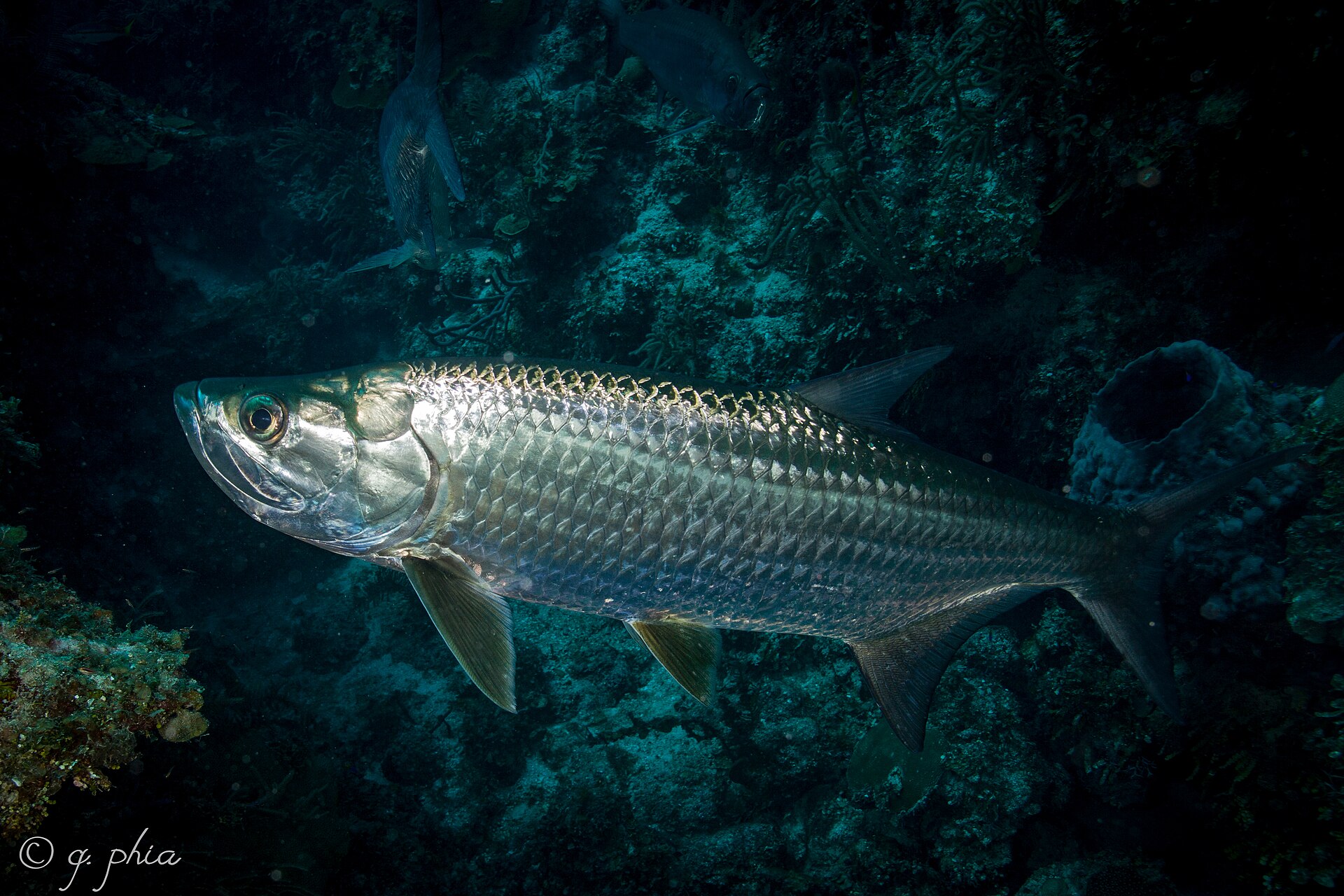
From the north · Wildlife
Tarpon
A hundred-pound prehistoric fish that jumps six feet out of the water — the most spectacular hookup available from a boat or a bridge in North America.
Megalops atlanticus
- Range
- Florida, Gulf Coast, Texas, Caribbean
- Prime season
- April–July migration
- Access
- State license plus a tarpon tag to possess
- Table quality
- Not eaten — release every fish
Regulations by region
Tarpon rules where you're headed
Seasons, tags, limits, and legal methods for tarpon are set jurisdiction by jurisdiction. Pick your state or province and we'll point you at the agency that writes the rules.
Jump to another species
About the tarpon
Tarpon are the reason a lot of anglers save for years for a single week in Florida. They are enormous, they are ancient, they can breathe air from a modified swim bladder, and when hooked they leave the water repeatedly and violently. They are also almost entirely a catch-and-release fishery. Florida requires a special tag to possess a tarpon at all, and virtually everyone releases fish boatside without lifting them. The core of the fishery is the spring migration. From April through July, schools of adult fish push north along the Gulf beaches and stage in the passes, and the same fish can be intercepted on fly, on live bait, or from a bridge at night.
Range, water, and where they live
Tarpon fishing concentrates around passes, beaches, bridges, and backcountry basins where fish stage predictably. Boca Grande Pass, Florida: The densest concentration of migrating adults anywhere. Florida Keys channels and bridges: Bridge fishing at night on outgoing tide. Homosassa, Florida: Legendary fly-rod flats fishery for very large fish. Texas coast beachfront: Late summer school fish along the surf. Louisiana marsh passes: Big August fish in the outer marsh.
Behavior and how they feed
You are intercepting a moving fish. The work is positioning, timing the tide, and making the first cast count. Fish the tide, not the clock. Moving water in a pass or under a bridge concentrates bait and puts fish in feeding lanes. For beach migration, run parallel to the shoreline in 8–15 feet and look for rolling fish and daisy-chaining schools. Position the boat ahead of the school's path and shut down early; a running motor turns a string of fish immediately. Lead a moving fish by ten feet with a fly or a live crab and let it come into the fish's line of travel. With live bait — crabs, mullet, pinfish — free-line it on a circle hook and let the fish eat before applying pressure. Bow to the jump. Drop the rod tip every time a tarpon comes out of the water or it will break the leader on landing. Fight the fish low and to the side, changing angles to keep it off balance, and expect 20–45 minutes on a big one. Release boatside: grab the leader, back the hook out with pliers, and revive the fish moving forward until it swims off.
Where they hold
Tarpon migrate along predictable routes and hold in specific places to rest and eat. Learn the route and the tide stage and you can meet them. Beach migration lanes — Strings of fish move along the beach just outside the bar; intercept ahead of them, never behind. Passes and inlets — Fish stack in deep passes on moving water, especially around the full and new moon crab flushes. Bridge channels — Tarpon lie in the shadow line of lit bridges and eat what the tide delivers. Backcountry basins and creeks — Mangrove creeks and canals hold 5–30 lb juvenile tarpon year-round — the best way to learn. Rolling fish in calm water — Tarpon gulp air and roll; a rolling fish is a locatable fish.
What they eat and what they hit
These are the presentations that consistently produce tarpon, with the conditions each one is actually for — not a tackle-shop wall. Live crab — A pass crab drifted on the outgoing tide during a crab flush is the highest-percentage bait there is. Live mullet, pinfish, or threadfin — Free-lined or fished under a float on a circle hook. Soft plastic swimbait / DOA — A 4–6" paddle tail on a jig head cast to rolling fish and swum slowly. Tarpon fly (toad/ toad-style) — 11–12 weight, a black or purple toad, and a cast that lands three feet ahead of a laid-up fish. Circle hook, 60–100 lb leader — Non-offset circle hooks are required in many Florida waters and dramatically reduce mortality.
In the field
The jump is the whole experience and also where most fish are lost — plan to lose a lot of them and enjoy the ones you touch. It is physically demanding fishing. A long fight in Florida summer heat will empty you out; bring water and take it seriously. Guides are worth it here more than almost anywhere. Reading rolling fish and positioning on a moving school is a learned skill.
Licenses, stamps, and limits
Tarpon are among the most protected gamefish in the country. Possession requires a specific tag, and handling rules are legally enforced. Buy the state saltwater fishing license, or fish with a charter operating under its own license. Understand that in Florida, tarpon may not be removed from the water except by a permitted tag holder pursuing an IGFA record. Learn the boatside handling rule: fish over 40 inches must stay in the water for release and photos. Check gear rules in Boca Grande Pass, which restrict certain weighted jig configurations. Use circle hooks with natural bait where required; they are mandatory in several tarpon fisheries.
Landing, release, and cleaning
What happens between the hookset and the cooler decides whether you land the fish and whether it is worth eating. Bow to the fish on every jump — push the rod tip toward it so the leader goes slack while the fish is in the air. Fight hard and fast with heavy tackle. A long fight exhausts the fish and makes it shark bait on release. Do not lift the fish out of the water at all if it is a big one. Take the photo boat-side, remove the hook with pliers or a de-hooker, and cut the leader if the hook is deep. Revive it by holding it upright, facing into current or by idling the boat forward slowly, until it clamps down and swims off under its own power. Use single, barbless or crushed-barb hooks and circle hooks with bait to cut deep hooking and mortality. Tarpon over 40 inches may not be removed from the water in Florida; keeping one requires a special harvest tag reserved for record attempts. Cleaning a tarpon the right way takes about four minutes once you know the sequence.
On the table
Tarpon are not a food fish. The flesh is bony and poor, and harvest is prohibited without a specialized tag in Florida. Treat every fish as a release. Keep it in the water, minimize fight time by using heavy tackle, and revive it fully before letting go. Shark predation on exhausted released tarpon is real. If sharks are working the area, move the fight and the release away from them.
Field notes
- 12-weight fly rod or 7' heavy spinning rod: Enough lifting power to end a fight before the fish is exhausted.
- Large-arbor reel with 250 yd backing: Tarpon run long and fast; capacity is not optional.
- 60–80 lb fluorocarbon bite tippet: Their jaw plates are sandpaper and will wear through light leader.
- 5/0–7/0 circle hooks: Corner hookups that release cleanly and legally.
- Live crabs or mullet: The most reliable natural bait on migrating fish.
- Long-handled dehooker and pliers: Release fish at the boat without lifting them out of the water.
Tarpon questions, answered
- When is tarpon season in Florida?
- The main migration runs April through July, peaking in May and June on the Gulf coast. Resident fish in the Keys and south Florida backcountry can be caught year-round, with a strong secondary window in early fall.
- Can you keep a tarpon?
- Effectively no. In Florida tarpon are catch-and-release only, and possession requires a special tag issued for pursuit of an IGFA record. Fish over 40 inches must remain in the water.
- What is the best bait for tarpon?
- A live pass crab on the outgoing tide is the classic and remains the most reliable. Live mullet, pinfish, and threadfin herring all work, and fly anglers use large baitfish and toad patterns on the flats.
- Why do I keep losing tarpon?
- Two reasons: not bowing to the jump, and not driving the hook home. Their mouths are bony, so you strip-set or sweep hard and repeatedly, and you drop the rod tip every time the fish leaves the water.
- Do I need a guide to catch a tarpon?
- Not strictly — bridge and beach anglers catch them from shore — but for the boat fishery a guide dramatically shortens the learning curve on tide timing, school positioning, and boat handling.
Official sources and further reading
- Florida FWC — Tarpon Regulations
Tag rules, handling law, and gear restrictions by area.
- Bonefish & Tarpon Trust
Migration research, tagging data, and best-practice release science.
- Texas Parks & Wildlife — Saltwater Fishing
Texas licensing and coastal tarpon regulations.