


What Happened
The season finale of Alone Season 7, titled "Over the Edge," brought an end to the most demanding challenge in the series' history. Season 7 altered the fundamental premise of the production: rather than simply outlasting the competition in an open-ended battle of attrition, participants faced a concrete benchmark. Anyone who lasted 100 days in the subarctic wilderness of the Northwest Territories around Great Slave Lake would walk away with a $1,000,000 prize.
By Day 100, only one individual remained on the landscape: Roland Welker. Having systematically worked his way through freeze-up, severe cold, and the relentless caloric deficit that defines high-latitude survival, Roland officially cleared the 100-day threshold. His victory was not a product of passive starvation in a sleeping bag. It was the culmination of aggressive hunting, disciplined processing of large and small game, and an uncompromising approach to infrastructure that insulated him from the environment. Roland became the sole surviving contestant, hitting the target date and securing the full million-dollar purse.
Reaching Day 100 in late autumn and early winter required an extraordinary operational rhythm. As water sources froze solid and ambient temperatures dropped well below zero, the margins for error evaporated entirely. Roland's routine during the final stretch was defined by fire management, hydration through ice-melting, and consuming preserved calories while guarding against acute cold injury. When the production team arrived under the guise of a routine medical check to inform him that he had reached the century mark, the survival run officially concluded.
Who Is Under Pressure
In a standard season finale, tension stems from comparing the deteriorating conditions of two or three surviving participants. In Episode 11, the pressure shifted entirely onto Roland Welker versus the clock and the subarctic climate. Even as the last person standing, Roland could not merely outlast a competitor; he had to survive until the calendar hit the mandated 100-day mark to secure the win.
The physical toll of 100 days without a modern supply chain creates compounding operational risks. Even with hunting success, long-term survivalists experience severe joint strain, muscle wasting, and systemic fatigue. Every task—from splitting frozen firewood to carrying water—carries elevated danger when physical reserves are depleted. In sub-zero weather, an accidental axe strike, a slip on river ice, or a sudden flare-up of hypothermia can force an extraction hours before the target date.
Psychologically, the closing stretch of an extended isolation stint presents a unique cognitive trap. As Day 100 approached, the mental demand required to maintain focus did not decrease. The temptation to cut corners on safety, skip firewood gathering, or neglect frostbite checks increases when the end is in sight. Roland had to manage his physical exertion precisely, expending enough energy to stay warm and functional without burning through his remaining body mass or risking a catastrophic tactical mistake.
Gear That Mattered
Roland’s achievement across 100 days serves as a definitive case study in gear utility and tool durability. Under extreme conditions, equipment failure is often fatal to a long-term camp. Several standard kit choices proved decisive in supporting Roland’s endurance through the final phase of the season.
Heavy-Duty Cutting Tools
Maintaining a heating fire in negative temperatures requires substantial cordage of firewood. Over 100 days, an axe and a folding or bow saw endure relentless mechanical stress against frozen birch, spruce, and deadfall. Roland’s tools had to hold their edges without chipping in deep-freeze conditions. The ability to buck and split large-diameter wood quickly allowed him to generate the British Thermal Units (BTUs) required to heat his stone-and-timber shelter, known as "Rock House," without burning excess calories on inefficient fuel gathering.
Archery Equipment and Big-Game Processing
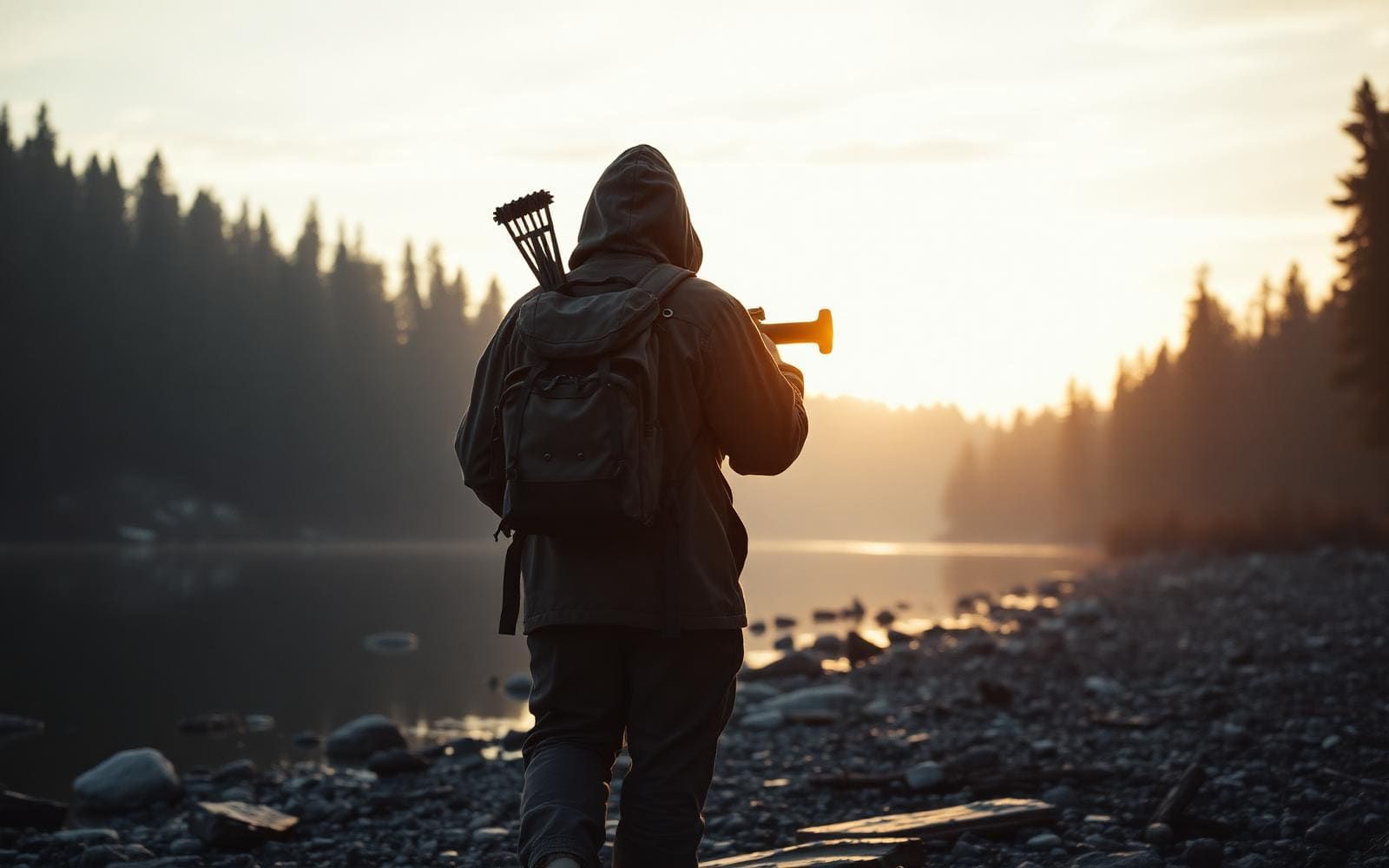
The defining variable of Roland’s campaign was his hunting success. A traditional hunting bow and matched arrows are difficult to deploy under extreme cold, where muscle stiffness and bulky layers interfere with anchor points and draw mechanics. Yet Roland leveraged his archery kit to take game that provided the caloric backbone of his 100-day stay. Just as critical as the weapon was the heavy fixed-blade knife used to dress, skin, and butcher meat before it froze solid. Without the tools to process animal protein and fat rapidly, a successful harvest can easily spoil or become inaccessible in subarctic conditions.
Cook Pot and Water Procurement
Once open water freezes into thick sheet ice, obtaining drinking water becomes one of the most calorie-intensive jobs in camp. Roland’s metal pot served as a continuous water-purification and ice-melting station. In extreme cold, dehydration accelerates hypothermia, thickens blood, and degrades mental acuity. A reliable vessel capable of handling direct campfire heat day after day is a baseline survival requirement that cannot be improvised effectively.
Cold-Weather Clothing and Sleep System
A rated sleeping bag paired with durable wool and heavy synthetic outer layers provided the passive thermal barrier necessary to survive nights where temperatures plummeted. Keeping that insulation dry from both exterior snow and interior perspiration was an everyday battle. Roland’s ability to manage sweat during high-output tasks and transition into dry base layers before resting kept cold-weather injuries at bay.
Current Standings
Episode 11 concludes Season 7 with an undisputed champion. Roland Welker is the sole participant remaining on Great Slave Lake, reaching the 100-day milestone and winning the competition.
- Roland Welker: Winner. Survived 100 days. Secured the $1,000,000 grand prize.
- All Other Contestants: Tapped out prior to or leading into the final stage of the competition.
Unlike seasons where the runner-up taps out on Day 60 or 70 and automatically hands the victory to the remaining contestant, Roland had to finish the full tour of duty. His survival clock stopped only when the calendar reached Day 100, making him the sole owner of the title and the seven-figure payout.
Bottom Line
Roland Welker’s victory in Season 7 of Alone establishes a benchmark that will be difficult for future seasons to match. By tying the million-dollar reward to a fixed 100-day duration, the show removed ambiguity: passive calorie preservation alone was insufficient. Roland’s outcome proved that taking large-scale calories out of the subarctic landscape, paired with aggressive shelter building and uncompromising field discipline, is the only repeatable formula for thriving past the three-month mark.
His success was not rooted in novel survival theories, but in old-school subsistence competence. Roland processed what he killed, engineered an exceptionally stable shelter, and maintained an unyielding, task-oriented mindset until the final helicopter touched down. Season 7 delivered the most punishing operational environment Alone has staged, and Roland Welker handled it with complete tactical dominance.
Build the kit you just watched
Every item below is ranked from field use — no filler, no budget picks.
- The 10 items, rankedWhat actually survives 100 days — our tested picks for every slot on the list.
- Best bushcraft axesThe axe is the highest-leverage pick in the game. Here are the ones worth the weight.
- Best bushcraft knivesEvery winner carried one. These are the fixed blades that hold up to a full season.
- What the winners carriedSeason-by-season loadout analysis of every Alone champion.